REVIEW · ROME
2-Hour Walking Tour in Rome’s Enchanting Jewish Ghetto
Book on Viator →Operated by CENTURION OF ROME - TOUR EXPERIENCE · Bookable on Viator
Rome’s layers hit fast on this walk.
This 2-hour Jewish Ghetto tour links ancient monuments near Trajan’s Column with the neighborhood’s Jewish story, then finishes at Isola Tiberina. I like that it stays compact: you get a real guided narrative without spending your whole day in transit, and the route is planned around memorable stops you can actually see and connect. I also like the small-group feel, which usually means fewer people and more chances to ask questions.
Two highlights I especially appreciate are the stop at Trajan’s Column (an excellent free anchor point for understanding Roman power) and the visit area around Tempio Maggiore / the Great Synagogue, which is still active today. One consideration: the walk includes challenging steps in parts, so if you’re sensitive to stairs or uneven ground, you’ll want to plan for that.
In This Review
- Key Takeaways
- A 2-Hour Jewish Ghetto Walk That Fits Real Rome Days
- Trajan’s Column: The Free Start That Sets the Tone
- Theatre of Marcellus: Ancient Entertainment Without the Ticket Stress
- Portico di Ottavia: Columns, Shelter, and a Place for People
- Tempio Maggiore (Great Synagogue): Living Jewish Rome, Not a Museum Set
- Fontana delle Tartarughe and the Walk to Tiber Island
- What You’re Really Paying For (and What’s Extra)
- Guide Quality Matters: Daniel’s Example of Good Leadership
- Who Should Book This Tour (and Who Might Hesitate)
- Should You Book This 2-Hour Enchanting Jewish Ghetto Walk?
- FAQ
- How long is the walking tour?
- Where does the tour start and end?
- What language is the tour offered in?
- Is this a private tour?
- Are tickets for Trajan’s Column included?
- Are tickets included for Teatro di Marcello and the Great Synagogue?
- Does the tour include gelato?
- What is included in the tour price?
- Do I need to bring my own transport?
- Is the walk easy?
Key Takeaways
- Small-group format (shared, capped) so your guide can keep a close eye on the group
- Ancient-to-modern storyline from Trajan’s era to the Great Synagogue still in use today
- Free stops sprinkled in to keep the cost realistic (Trajan’s Column, Portico d’Octavia, Turtle Fountain)
- Kosher gelato sample at the right moment, plus time to breathe between monuments
- Headsets when appropriate for clearer explanations in busier stretches
A 2-Hour Jewish Ghetto Walk That Fits Real Rome Days
Rome days can get messy fast: one wrong turn and you’re wandering for an hour. This tour avoids that by staying tight—about 2 hours—with a defined start near Via dei Fori Imperiali and an end at Tiber Island. That makes it a good choice when you want history and momentum.
The route is built around two big ideas. First, you see major ancient landmarks right where they’re still sitting in the city fabric. Second, you connect that setting to the Jewish community’s presence and continuity in Rome, culminating at the area of the Great Synagogue (Tempio Maggiore). The “small group” aspect matters here: it’s not a huge herd, so you’re more likely to get the kind of detail you actually need.
For comfort, you’ll appreciate the practical touches: mobile ticketing helps you show up smoothly, and headsets are provided when appropriate. And because it’s offered in English in both morning and afternoon slots, you can usually pick the time that matches your energy level.
You can also read our reviews of more walking tours in Rome



Trajan’s Column: The Free Start That Sets the Tone
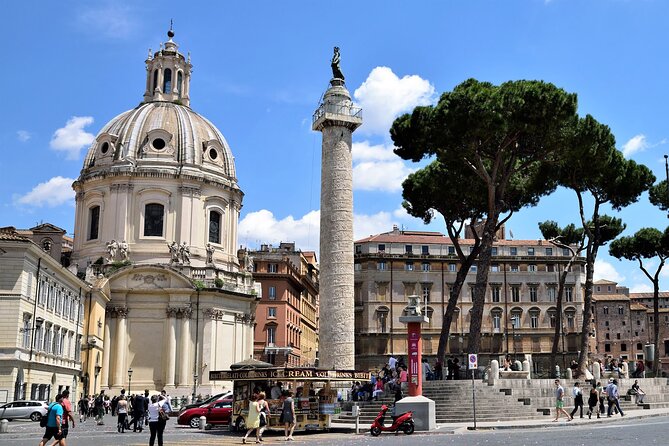
You begin at Trajan’s Column, and that choice is smart. This monument is covered in spiraling bas-reliefs that tell a story—official Roman victories, military scenes, and everyday details—woven together in one continuous climb-up narrative. The scale is the first eye-opener: the column reaches roughly 30 meters (98 feet) high, so you feel the ambition even before you start reading the guide’s explanation.
Why it works on a Jewish Ghetto tour: Trajan’s era is the foundation layer for the city you’re walking through. Even though your main focus is Jewish community history, understanding Roman imperial space helps you see why later communities developed where they did, and how different eras reused the same urban stage.
This stop is about 20 minutes and free admission. You likely won’t be going inside or climbing anything—this is about observation and story. Tip: if you care about photos, position yourself early so you’re not blocking anyone later while the group funnels forward.
Theatre of Marcellus: Ancient Entertainment Without the Ticket Stress
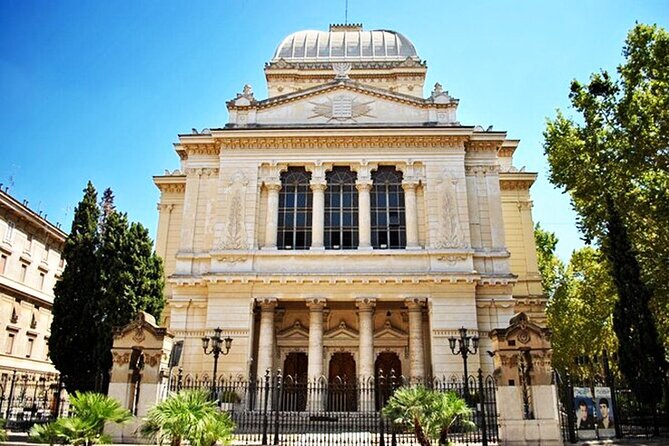
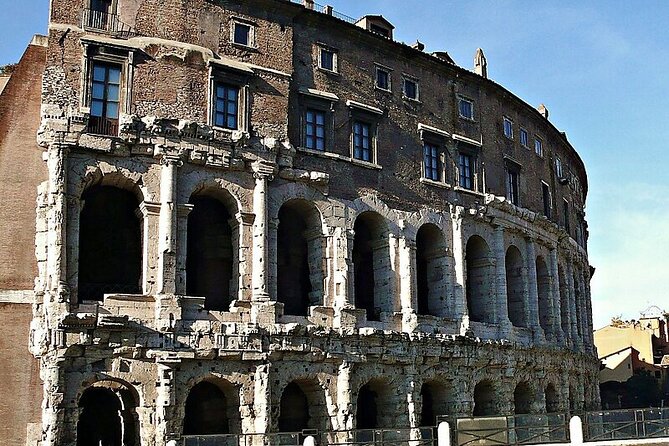
Next comes Teatro di Marcello, an enormous ancient theater commissioned in the 1st century BC and named after Marcus Marcellus. Even if you don’t buy the entrance, the exterior and surrounding views are still worth your time because the structure shows you how Rome built for mass audiences—an amphitheater designed for performances that could hold around 10,000 spectators.
The guide’s value here is the “how-to-read-it” aspect. This site blends Greek and Roman architectural influence, so you can spot the Roman flair while still seeing older ideas. If you’re an architecture fan, you’ll likely enjoy the fact that the theater today is a kind of time-capsule: parts changed over centuries, but the footprint and massing still tell the original tale.
This stop is about 20 minutes, and entrance is not included. So if your goal is just to walk past, look closely, and learn, you’ll be fine. If you’re the type who wants to go deeper inside ruins, check whether you’re willing to pay extra at the moment.
Portico di Ottavia: Columns, Shelter, and a Place for People
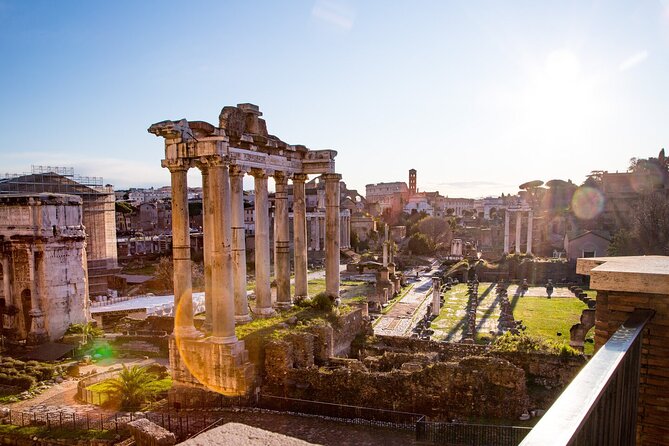
At Il Portico di Ottavia (Porticus Octaviae), you shift from performance space to public life. This is another free stop with about 20 minutes on the clock. It was built by Augustus in the 1st century BC and dedicated to his sister, Octavia Minor.
The portico’s practical purpose is what makes it memorable. It provided shelter for people during bad weather and also functioned as a space connected with cultural activity and social gatherings. In other words, it wasn’t just “pretty ruins.” It was a city room—covering, meeting, moving people through daily life.
Look for Corinthian columns and the sense of order the structure created. This part of the tour is also a smart pacing move: between the big monuments and the synagogue area, it gives you a calmer window to process what you’ve learned so far, and it often feels easier than the more traffic-heavy stretches.
Tempio Maggiore (Great Synagogue): Living Jewish Rome, Not a Museum Set
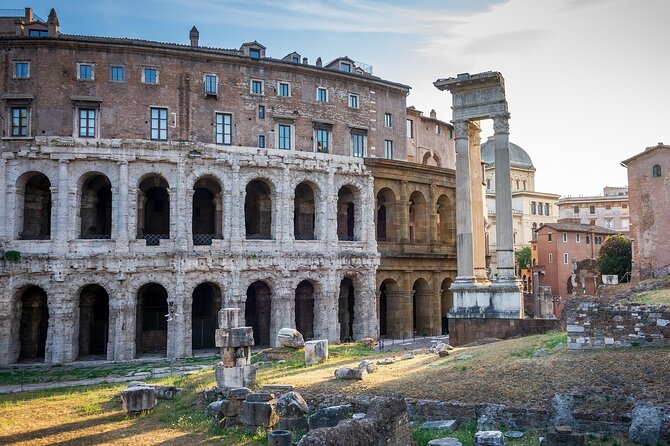
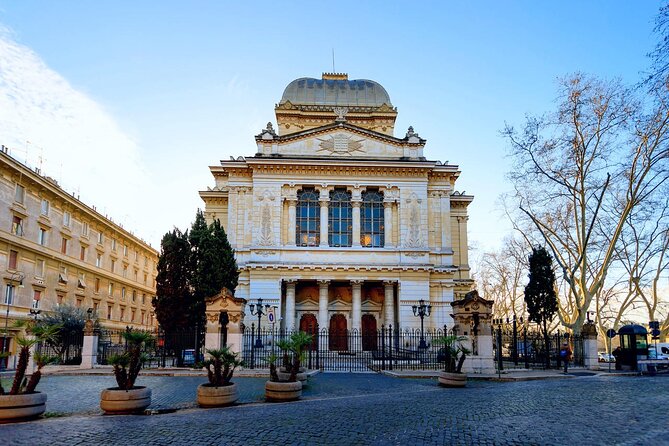
The tour’s emotional center is Tempio Maggiore, the Great Synagogue, which is still a functioning house of prayer and a key cultural reference point for Rome’s Jewish community. It’s also noted as the third largest synagogue in Europe—a fact you’ll feel in the way the building commands the area.
This is where the tour becomes more than architecture. The Great Synagogue was constructed in the early 20th century, and the design mixes Moorish and Roman styles. Expect to hear how the building reflects both cultural identity and the ongoing presence of Jewish life in Rome. The dome and tall windows are the visual giveaways; the story behind them is the reason this stop belongs in a “Ghetto” themed tour.
Timing-wise, you’ll spend about 30 minutes here, but entrance is not included. That means you’ll likely focus on the exterior and guided context. If stepping inside matters to you, you may want to budget separately.
Respect note: this is an active religious site, so keep your voice down and follow your guide’s cues about where to stand and when to move.
You can also read our reviews of more tours and experiences in Rome





Fontana delle Tartarughe and the Walk to Tiber Island
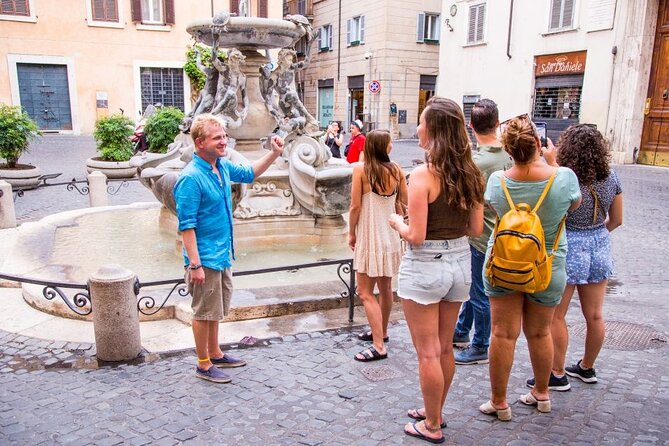
After the synagogue area, you shift into a more playful mode—without losing the history thread. You’ll move past Fontana delle Tartarughe, the Turtle Fountain in Piazza Mattei. This fountain is famous for its four bronze turtles perched on the basin edge. It was designed by Giacomo della Porta in the 16th century and later completed by Taddeo Landini in the early 17th century.
This stop is about 20 minutes and free. What I like about including it: it breaks the “serious monument” rhythm just enough to keep your brain from overheating. You also get a natural reset point where the guide can bring the story forward without the group getting restless.
There’s also a practical treat: you’ll sample kosher gelato. That’s not just a snack. It’s a small, local-feeling moment that makes the tour feel grounded in today, not only in dates and empires. One guide called out in feedback even helped with shade and kept things comfortable during the walk, which suggests the group experience can be attentive in real ways—not just rehearsed facts.
Then you cross to Isola Tiberina using the oldest active bridge in Rome. The crossing itself takes about 10 minutes and is free. Ending here is a strong choice because it gives you a scenic wrap-up and a clear finish line for your day. It’s also a handy end point if you want to keep exploring on your own afterward.
What You’re Really Paying For (and What’s Extra)
At $96.13 per person for about 2 hours, this tour sits in the “you’re buying guidance and structure” category. You’re not paying primarily for lots of paid attractions, because several highlights are free: Trajan’s Column, Portico d’Octavia, and Fontana delle Tartarughe are all marked free for admissions in the tour flow.
So what’s included that makes the price make sense?
- A professional guide who links sites into one story
- Headsets when appropriate, which helps with clarity on busy sidewalks
- A planned time block that keeps you from guessing logistics
- A kosher gelato sample at the right moment
- A compact route that typically works even if you’re not a long-walk person
What’s not included is also important:
- Teatro di Marcello entrance is not included
- Great Synagogue entrance is not included
That means you should treat this as a guided walk focused on seeing, learning, and connecting—rather than a ticket-heavy sightseeing day. If you’re the kind of visitor who always wants interiors, you’ll likely spend extra. If you mainly want the story and exterior context at these major sites, you’ll probably feel like the price is fair.
Also, it’s a shared tour (not private). Group size is capped—info mentions a maximum of 15 per group, and also lists a max of 12 travelers for this activity. Either way, you’re in the small-group zone where you can usually hear the guide, ask questions, and keep moving without the feeling of being herded.
Guide Quality Matters: Daniel’s Example of Good Leadership
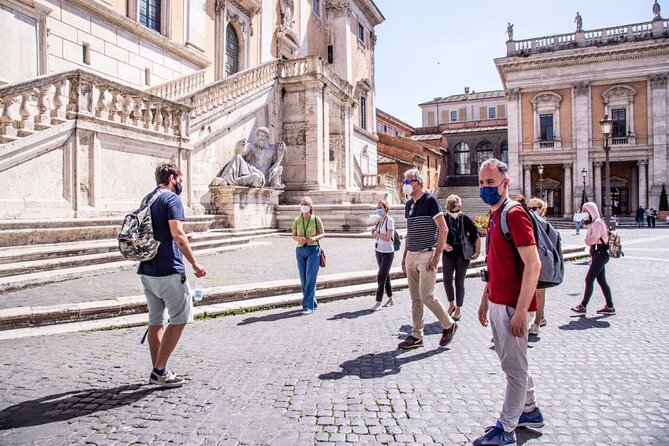
Even with a set route, the guide can make or break the experience. One guide name that shows up clearly is Daniel. The feedback highlights that he was very knowledgeable, took time with slower walkers, and even offered practical help like holding an umbrella for shade. That kind of attention matters on this specific route because you do have stairs and uneven sections.
The same feedback summary also includes one less enthusiastic score, mentioning that the tour had challenging steps and that the guide didn’t know certain important details about locations and rules. That’s a useful consideration: while the tour is designed well, you should expect that every guide may emphasize different points.
My advice: go in ready to learn, but also treat the tour as “guided context,” not a guarantee of total perfection on every micro-detail. If you’re picky about every rule at every monument, plan to do a little independent reading afterward.
Who Should Book This Tour (and Who Might Hesitate)
This is a good fit if you want:
- a short guided walk through major Rome landmarks
- a storyline that connects the setting around the Jewish community to the city’s ancient layers
- a mix of monuments and modern-day continuity, especially around the Great Synagogue area
- a tour with practical pacing and comfort touches like headsets and a gelato stop
It’s worth hesitating if:
- you’re very sensitive to steps and uneven ground (the walking includes challenging sections, and this is where you’ll feel it most)
- you require interior access at Teatro di Marcello or the Great Synagogue, since entrance tickets are not included
If you’re traveling with older legs, consider arriving early, wearing supportive shoes, and keeping a slower pace. If you’re curious about how Rome’s eras overlap in real places, this tour is built for exactly that.
Should You Book This 2-Hour Enchanting Jewish Ghetto Walk?
I’d book it if you like guided structure and you want a compact, meaningful route that doesn’t drown you in logistics. The best reason to choose it is the combination: Trajan’s Column for Roman context, Portico di Ottavia for daily-life architecture, and Tempio Maggiore as a living Jewish landmark—then a relaxing close at Isola Tiberina.
I wouldn’t book it if you’re mainly chasing interiors and ticketed sites, or if stairs will be a deal-breaker for you. And because it’s a shared format, bring the right mindset: you’ll get a group experience, not a private, tailor-made lecture.
If you pick the right time slot, wear good shoes, and come hungry for facts (and gelato), this tour is one of the more efficient ways to get a real sense of Rome’s Jewish story in a single focused afternoon or morning.
FAQ
How long is the walking tour?
The tour runs for about 2 hours.
Where does the tour start and end?
It starts at Trajan’s Column, Via dei Fori Imperiali, 00187 Roma and ends at Tiber Island (Isola Tiberina), 00186 Rome.
What language is the tour offered in?
The tour is offered in English.
Is this a private tour?
No. It’s a shared tour with a group size cap (not private).
Are tickets for Trajan’s Column included?
Trajan’s Column is listed as free for admission on the tour.
Are tickets included for Teatro di Marcello and the Great Synagogue?
No. Teatro di Marcello entrance is not included, and Great Synagogue entrance is not included.
Does the tour include gelato?
Yes. You’ll stop to sample kosher gelato.
What is included in the tour price?
Included items are a professional expert guide and headsets when appropriate.
Do I need to bring my own transport?
Transportation is not included, so you’ll need to get yourself to the meeting point near public transit.
Is the walk easy?
The walk includes challenging steps in parts, so wear supportive shoes and plan for uneven, stair-heavy sections.