REVIEW · ROME
Rome Palatine Hill, Roman Forum, Colosseum Panoramic Views Tour
Book on Viator →Operated by Rome Colosseum Tours | Official Guided Tours · Bookable on Viator
Rome feels different when you look down first. This tour pairs Forum-focused storytelling with Capitoline and Palatine photo stops, so you see the big picture quickly. You’ll start on Piazza del Campidoglio for wide views, then move through Trajan’s Forum, the Roman Forum, and Palatine Hill. The Colosseum comes in as an outside viewing and explanation moment, not a marathon inside the building.
Two things I like a lot: you get a licensed local Blue Badge guide plus radio and headsets, which makes it easy to follow along even in crowds. And the pacing is smart for first-timers: you get meaningful time in the Roman Forum (not just a drive-by), then a Palatine Hill stop that helps you understand where imperial Rome lived.
One consideration: the Colosseum admission ticket isn’t included. So plan on seeing it with guide context from the outside, not a fully ticketed deep visit into the interior.
In This Review
- Key things to know before you go
- Piazza del Campidoglio: Michelangelo’s big “get your bearings fast” start
- Trajan’s Forum and Trajan’s Column: military triumph turned architecture
- The Roman Forum: where laws, religion, and power overlapped
- Palatine Hill: the old center of imperial Rome
- Arch of Constantine: a triumphal arch built from other eras
- Colosseum panoramic views: learning without the full interior ticket
- Price and value: when $459.52 makes sense
- Practical tips that will save you stress
- Who should book this tour
- Should you book? A straightforward call
- FAQ
- Is the Colosseum admission ticket included?
- Which sites include entry or admission?
- Where does the tour start and end?
- Does this tour have an English option?
- Do I need an ID to enter the sites?
- What items are forbidden inside the Roman Forum?
- Will I be able to hear the guide?
- How big is the group?
- What happens if the Colosseum closes due to rain or events?
- What is the cancellation window for a full refund?
Key things to know before you go
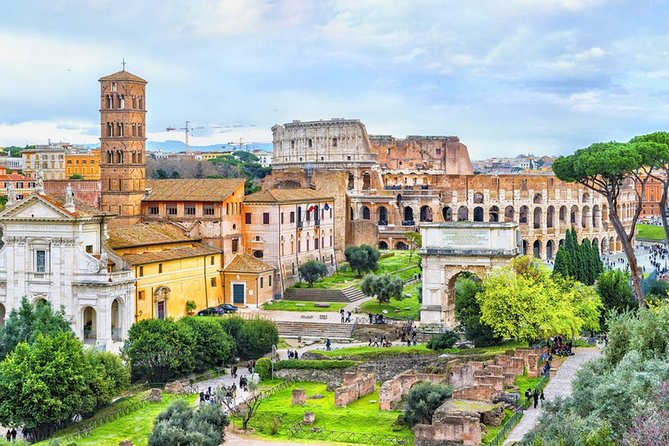
- Forum-first focus: you spend the bulk of your time where Rome’s public life actually played out.
- Top-to-ground viewpoints: Piazza del Campidoglio and the Palatine area are built for photos and orientation.
- Great hearing setup: radio and headsets mean you won’t miss details while walking.
- Multiple admissions included: Trajan Forum, Roman Forum, Imperial Forum, and Palatine Hill are covered.
- Colosseum is mostly exterior: admission isn’t included, so the tour stays efficient.
- Max group size of 24: small enough to ask questions, big enough to keep the tour moving.
Piazza del Campidoglio: Michelangelo’s big “get your bearings fast” start
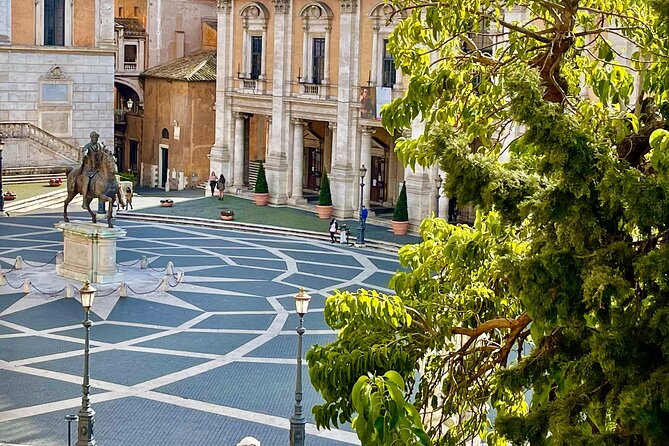
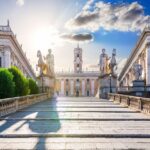
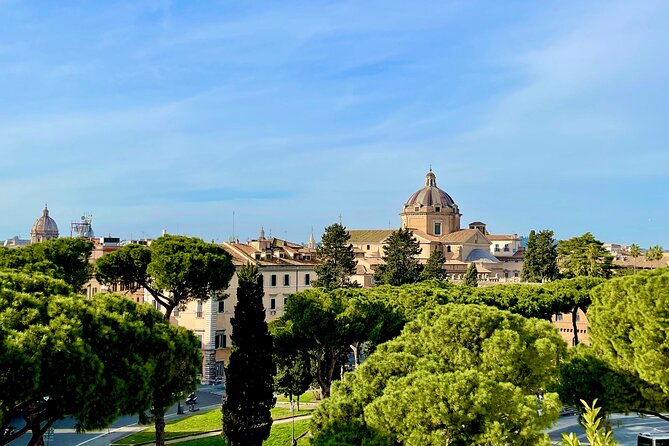
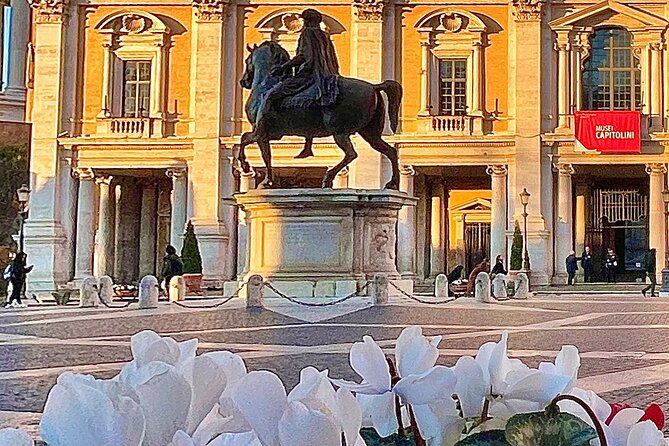
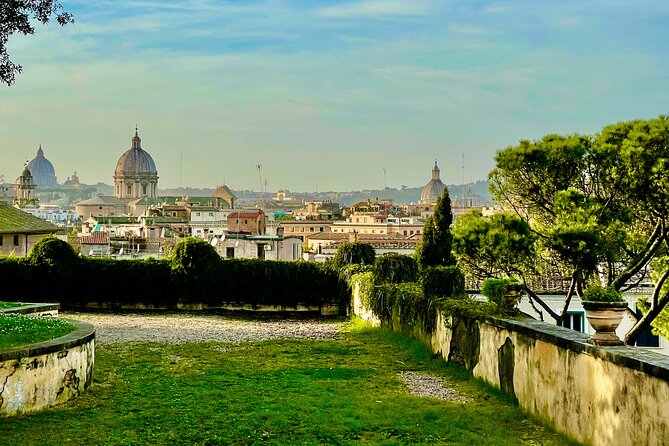
Your tour begins on Piazza del Campidoglio, on the Capitoline Hill. This square wasn’t just designed to look good. It follows a uniform plan created during a major Renaissance rebuild, commissioned when Pope Paul III asked Michelangelo to fix the hill’s long-neglected state around the visit of Charles V in 1536.
This is where you’ll get orientation fast. Michelangelo centered the project around the equestrian statue of Marcus Aurelius and added the grand staircase called the Cordonata, with those giant steps meant to lift you up toward the balustrade and classical marble groups. The practical payoff: standing here gives you the geography of ancient Rome in one glance—so later ruins feel less random.
What to watch for: use this time to spot where the Palatine sits relative to the Forum area. You’re not just sightseeing. You’re building a mental map.
You can also read our reviews of more tours and experiences in Rome.
Trajan’s Forum and Trajan’s Column: military triumph turned architecture
After the scenic start, the tour moves into Trajan’s Forum area. Trajan’s project was a serious feat of engineering. The forum was carved by cutting the slopes of Quirinale and Campidoglio and then connecting them with a saddle of land. Work likely started under Domitian and continued under Trajan after Domitian’s death.
The historical thread is clear: Trajan’s campaigns in Dacia (today’s Romania) in two rounds (101–102 and 105–106 AD) brought the wealth that funded this monument. Apollodorus of Damascus is credited as the architect—he was a military engineer who had accompanied the emperor in earlier victories.
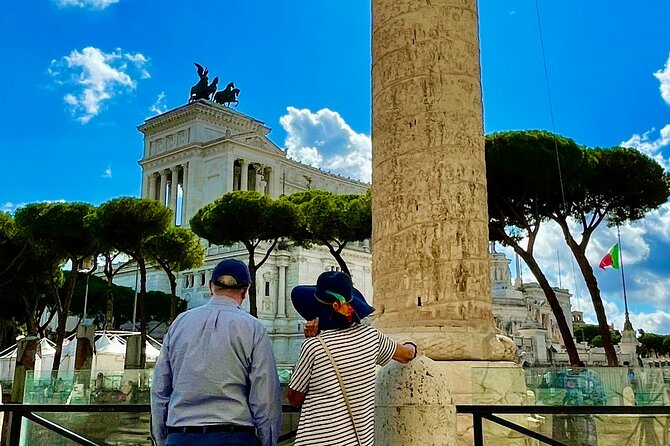
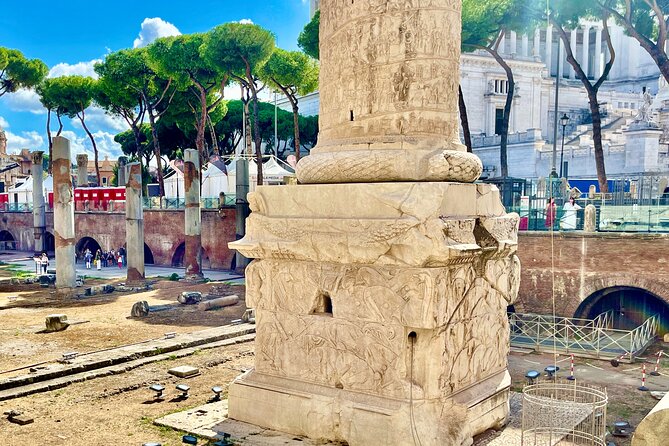
Then you move to Colonna Traiana (Trajan’s Column), where the war story is told in carved scenes that spiral around the shaft. This is one of the best “wait, that’s actually detailed” stops. The column is about 30 meters tall (100 Roman feet), built from 17 huge rocks of white Carrara marble. There’s also an internal spiral staircase of 185 steps.
Why this works on a 3-hour tour: it gives you a visual narrative. Even if you don’t read every carved figure, you come away knowing the column is basically a long illustrated record of the two Dacian campaigns, with thousands of small characters packed into a frieze that runs about 200 meters in total.
Time reality: this stop is short, so arrive ready to look with purpose. I’d treat it like a highlight walk: focus on the overall spiral and the base details rather than trying to memorize everything.
The Roman Forum: where laws, religion, and power overlapped
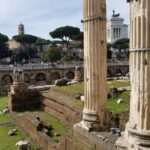
Next comes the Roman Forum, the heart of ancient Rome’s civic life. It sits low between the Palatine and Capitoline hills, and that position matters: you’ll feel how the city’s center shaped movement and attention.
In republican times, this was where you’d find public meetings and law courts, plus gladiatorial events and busy market activity with shops and open-air trade. Under the empire, it shifted toward religious and ceremonial spectacle, with major temples and monuments taking over the scene.
This stop isn’t vague. You’ll see key surviving structures (either in full or partial form), including:
- Temple of Castor and Pollux
- Temple of the Deified Caesar
- Mamertine Prison
- Curia (the senate house)
- Temple of Saturn and Temple of Vesta
- Temple of Romulus
- Arch of Titus
- Arch of Septimius Severus
- Cloaca Maxima
That list looks like a lot, and it is. The guide’s job here is to stitch it into one story, not just point at stones. That’s also why this is the tour’s “value pocket.” You’re given a focused block of time (about 45 minutes here), and the included entry helps you avoid the extra scheduling hassle.
A practical note: security rules apply in this area. Bottles and certain containers are forbidden inside the Roman Forum security zone, and backpacks and bulky bags are restricted. If you’re bringing a bag, keep it small and plan for inspection.
Palatine Hill: the old center of imperial Rome
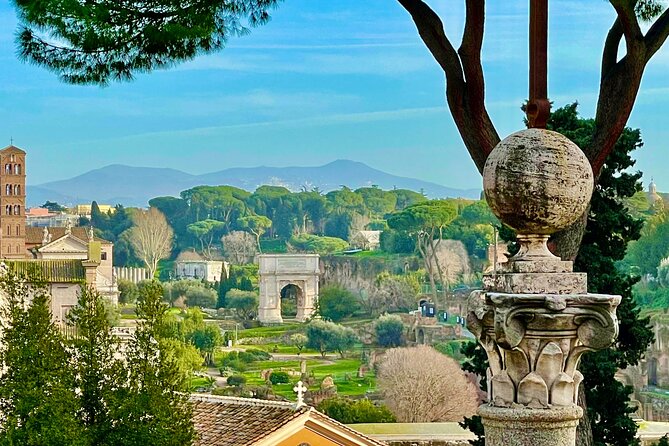
Palatine Hill is one of the most important places to understand where power actually lived. It’s considered the centremost of Rome’s Seven Hills and has been called the first nucleus of the Roman Empire. Today it feels like an open-air museum, with the Palatine Museum holding finds from these excavations and other Italian sites.
Imperial palaces began on this hill with Augustus. Before that shift, it was largely occupied by the homes of wealthy Romans. That’s why the Palatine stop works so well after the Forum: you see the public world of politics and ceremony below, then understand how the elite built a more private empire overhead.
The hill’s layout is also interesting. It originally had two summits separated by a depression: the higher Palatium and the other Germalus (also spelled Cermalus). The tour won’t teach you every measurement, but it helps you picture that the hill wasn’t just one flat viewpoint—it was a structured place where residences and palaces took advantage of elevation.
You’ll get about 30 minutes here, and that’s enough for orientation, photos, and a feel for why this hill became the symbol of imperial status.
What I’d do: slow down for photos, but don’t spend the whole time looking for the perfect shot. Use the time to connect lines: where you stood on Capitoline, where the Forum sits, and how the Palatine overlooks it.
Arch of Constantine: a triumphal arch built from other eras
On the way to the Colosseum area, you’ll pass by the Arch of Constantine. This is a triumphal arch commissioned by the Roman Senate to commemorate Constantine’s victory over Maxentius at the Battle of the Milvian Bridge in AD 312. It was dedicated in 315 and sits strategically between the Colosseum and Palatine Hill, spanning the Via Triumphalis—the route used for victorious processions.
The arch’s scale is part of its drama: it’s about 21 meters high and 25.9 meters wide. It has three bays, with the central opening taller and wider. Construction uses brick-faced concrete, but the details are marble.
Here’s the extra story detail that makes this stop better than just a photo-op: much of the sculptural decoration comes from earlier triumphal monuments dedicated to Trajan, Hadrian, and Marcus Aurelius. So you’re looking at Constantine’s victory message, but delivered using reused art from prior emperors—almost like Rome recycling its own image.
Time note: the stop is brief (around 10 minutes), so treat it like a landmark checkpoint and photo moment while your guide ties it back to the larger timeline.
Colosseum panoramic views: learning without the full interior ticket
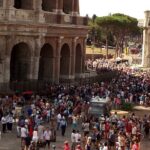
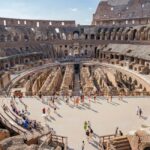
The tour ends with a Colosseum viewing and explanation segment. Importantly, the included service notes this as an exterior tour, and the Colosseum admission ticket is not included. That means you should expect viewpoint time and storytelling from where the tour is able to operate without your own Colosseum entry ticket.
Still, it’s not empty. The guide is set up to show you the best-preserved parts you can see and explain what the Colosseum was like in use—gladiator combats and animal fights, plus the drama of the crowds. Even without walking every corridor, you can understand what you’re looking at once someone connects the architecture to the spectacle.
If you want more than this: you’ll need to plan separate Colosseum ticket time. This tour is built for people who want the Forum and Palatine priority, then a panoramic Colosseum payoff at the end.
Price and value: when $459.52 makes sense
At $459.52 per person for about 3 hours, this isn’t a budget tour. But value here comes from a few concrete things you can feel on the ground.
First, you’re paying for a professional licensed local Blue Badge guide and for the radio/headset system. In a place like the Forum, audio clarity is not a luxury—it’s how you avoid turning the trip into silent walking.
Second, you’re getting entry included for Trajan Forum, Roman Forum, Imperial Forum, and Palatine Hill. That matters because these are the stops that typically eat time and patience. Your guide also bundles the story across multiple areas, so you’re not paying just for access—you’re paying for interpretation.
Third, the tour is designed to keep you out of Colosseum crowd chaos. The focus on the Forum means you’re spending your limited time where Rome’s daily public and ceremonial life was centered.
The bottom line: if you want an efficient “high signal” route through the Forum area with guiding and admissions included, the price can feel justified. If your main goal is the Colosseum interior in detail, this will likely feel like you’re paying for a partial experience unless you add your own Colosseum ticket plan.
Practical tips that will save you stress
Rome’s ancient sites reward planning. This tour has some specific rules you should take seriously.
- Bring the right ID: you’re asked to provide a valid ID card for Roman Forum and Trajan Forum entry. For Colosseum and Roman Forum, you must present a valid passport or ID that matches the name used at booking.
- Security screening is real: all visitors and luggage are screened. To make X-ray checks faster, you’ll be asked to place items (including a mobile phone) in the bag or tray for inspection.
- Pack small for the Forum: bottles and glasses containers, alcoholic beverages and aerosols, backpacks, bulky bags, camping gear, trolley luggage, knives, and selfie sticks are forbidden inside the Roman Forum area. Medium and small backpacks can be introduced but must be checked and visually inspected.
- Arrive early on meeting time: you have a mandatory meeting time 20 minutes before departure. The tour also notes that late arrivals who miss the tour may not receive tickets because there’s one group ticket for the whole group.
- Expect weather flexibility: if conditions are bad or the Colosseum closes due to events or strikes, the itinerary can change and you may receive a partial refund.
Who should book this tour
This one fits you best if:
- You want a Forum-and-Palatine priority day rather than a full day devoted only to the Colosseum.
- You like guided context so ruins feel connected instead of like scattered walls.
- You’re traveling with the kind of attention that wants dates, architecture, and the “why” behind each site.
It may not fit you as well if:
- Your top priority is an in-depth Colosseum interior visit, including time that depends on a separate Colosseum ticket.
- You’re the kind of traveler who prefers to wander without following a route at set stops and timings.
Should you book? A straightforward call
Book it if you want the best ROI of your time in Rome’s ancient core: Forum storytelling, Palatine context, and viewpoints that help everything click. The combination of licensed guiding, headsets, and included admissions for the Roman Forum/Trajan Forum/Imperial Forum/Palatine Hill is what makes this tour work.
Skip or supplement it if you’re specifically chasing the Colosseum interior experience. This tour is built to keep the Colosseum as a panoramic learning moment, not a full ticket-based dive into every level.
FAQ
Is the Colosseum admission ticket included?
No. The Colosseum stop is listed as Admission Ticket Not Included, and the service notes an exterior tour of Colosseum.
Which sites include entry or admission?
Entry/admission is included for the Trajan Forum, Roman Forum, Palatine Hill, and Imperial Forum.
Where does the tour start and end?
It starts at Piazza del Campidoglio (Campidoglio square) and ends at Piazza del Colosseo.
Does this tour have an English option?
Yes, the tour is offered in English.
Do I need an ID to enter the sites?
Yes. A valid ID card is requested for entry to the Trajan Forum and the Roman Forum. For Colosseum and Roman Forum entry, you must present a valid passport or ID document matching the name provided at booking.
What items are forbidden inside the Roman Forum?
Forbidden items include bottles and glasses containers, alcoholic beverages and aerosols, backpacks, camping items, bulky bags and luggage/trolley, knives, and selfie sticks. A bag policy also applies due to inspection and screening.
Will I be able to hear the guide?
Yes. The tour includes radio and headsets to help you hear clearly.
How big is the group?
The tour has a maximum of 24 travelers.
What happens if the Colosseum closes due to rain or events?
The administration can close the Colosseum or parts of it, with or without notice. If that happens, the tour offers an alternative itinerary and a partial refund.
What is the cancellation window for a full refund?
You can cancel up to 24 hours in advance for a full refund. If you cancel less than 24 hours before the start time, the amount paid is not refunded.