REVIEW · ROME
Rome Jubilee 2025 Tour: An Exploration of Early Christianity
Book on Viator →Operated by Through Eternity Tours · Bookable on Viator
A Jubilee-season walk through Rome’s big early-Christian landmarks is not just sightseeing. This 3-hour, small-group route uses an English-speaking guide to connect church art and relic tradition to what the sites meant for believers. And yes, there’s a pastry break that actually makes sense.
I especially like the focus on pilgrimage details, like the Holy Doors and the Scala Santa tradition, which turns the stops into a story you can follow. I also like the practical pacing: you get headset support for larger groups and enough time inside each place to see what matters without feeling rushed.
One possible drawback: it’s not recommended for travelers with mobility issues, since you’ll be walking between sites and dealing with the inside layouts of multiple major basilicas.
In This Review
- Key highlights you’ll care about
- Jubilee 2025: why the Holy Doors matter here
- San Giovanni in Laterano: Holy Doors, bronze portals, and Borromini inside
- The Holy Stairs: Scala Santa and the Sancta Santorum in 25 minutes
- Lateran Baptistery: octagons, Constantine, and recycled Egyptian stone
- Panella bakery on Via Merulana: your one real break
- Santa Maria Maggiore on the Esquiline: Mary’s basilica and gold from the New World
- Tour size, headsets, and walking reality
- Is $87.72 a fair deal for this Jubilee-focused plan?
- Who this tour fits (and who should skip)
- Should you book the Rome Jubilee 2025 Early Christianity tour?
- FAQ
- What language is the tour offered in?
- How long is the Rome Jubilee 2025 tour?
- Is there a mobile ticket?
- What size is the group?
- What does the tour include in terms of entrances?
- Is the bakery stop included?
- Do I need to arrange transportation?
- Is this tour suitable for people with mobility issues?
Key highlights you’ll care about
- Holy Doors at San Giovanni in Laterano with Jubilee context and what they mean historically
- Scala Santa (28 marble steps) tradition-focused visit to the Holy Steps and the Sancta Santorum
- Lateran Baptistery’s octagonal design and why early baptisms had their own architectural logic
- Lateran Obelisk—Egyptian stone recycled by Romans and later Christians
- Panella bakery stop for classic Roman maritozzi and coffee on your way down Via Merulana
- Santa Maria Maggiore on the Esquiline with mosaics, relic traditions, and an obelisk finish near Termini
Jubilee 2025: why the Holy Doors matter here
Jubilees in Rome aren’t a generic “seasonal theme.” They’re the reason certain doors open at all. In this tour, you’ll hear how the Holy Doors are tied to Catholic pilgrimage and why Rome treats them as more than decorative portals.
Because Jubilee events can mean crowding and maintenance, some monuments may be under restoration. You’ll want to pay attention to any messages you receive in advance, because the route may shift if access changes.
The bigger point for you: these stops are still active religious spaces. The Jubilee framing gives you a lens to interpret what you’re seeing—especially the iconography and the relic traditions—without turning the visit into a history lecture that forgets the faith side.
You can also read our reviews of more tours and experiences in Rome.



San Giovanni in Laterano: Holy Doors, bronze portals, and Borromini inside
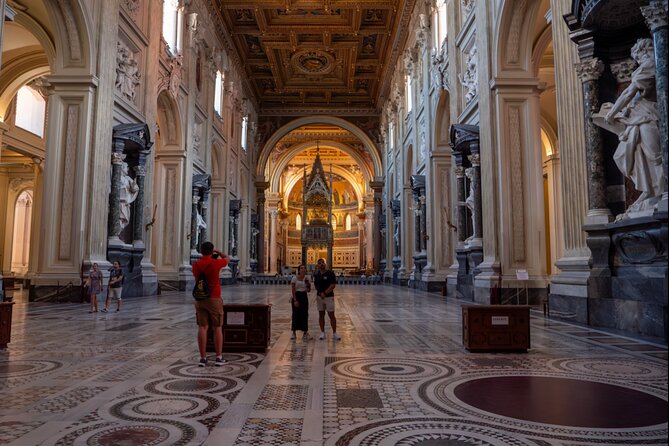
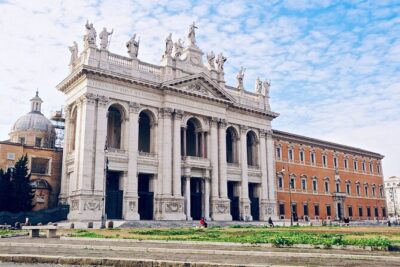
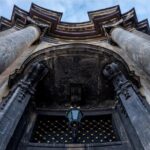
Your route begins at the Arcibasilica di San Giovanni in Laterano, and the scale hits fast. Even before you go far, stepping into the portico sets the tone: massive entryways, and a sense that you’ve arrived at one of Rome’s core early-Church centers.
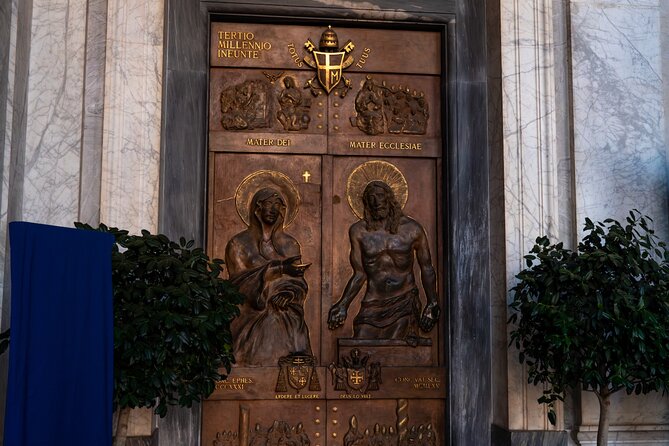
A standout detail is the bronze central doors. Your guide will connect them to their earlier life—bronze doors that once belonged to the Curia Iulia, the ancient senate house in the Roman Forum. It’s a reminder that Rome doesn’t replace its past; it reuses it, then reinterprets it.
You’ll also get the Jubilee angle: the basilica is part of the Holy Doors system, which only opens in a Jubilee or Holy Year (every 25 years). Instead of treating the doors as a photo opportunity, the guide explains the theological and historical meaning so you know what you’re looking at.
Inside, you’ll see Borromini’s Baroque redesign from the 17th century—high drama in architectural form. That said, the basilica is layered, not museum-clean. Traces of earlier structures remain, and you’ll have time to notice medieval frescos attributed to Giotto and to work through the apse mosaics’ meaning (including how iconography communicates doctrine and authority).
This stop also ties you directly to early Christianity in Rome through the tradition of Saints Peter and Paul’s relics resting here. Expect about an hour, and it’s included with free admission.
The Holy Stairs: Scala Santa and the Sancta Santorum in 25 minutes
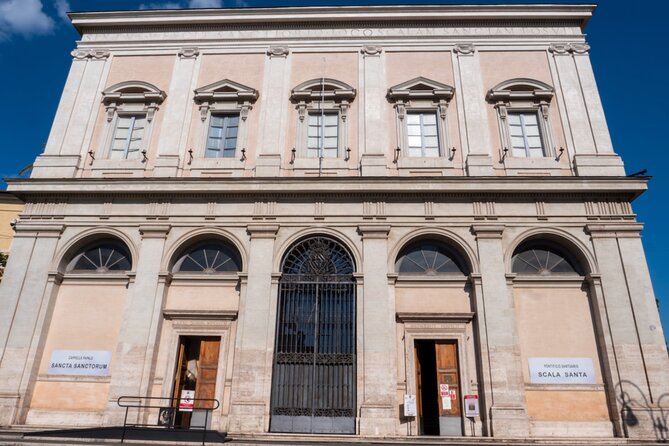
If San Giovanni gives you the institutional church story, the Pontifical Sanctuary of the Holy Stairs gives you pilgrimage emotion—fast. You start with the Scala Santa, a set of 28 marble steps brought to Rome by St. Helen, according to tradition. The tour frames these steps as the route associated with Christ’s passion story, specifically tied to Pontius Pilate’s palace.
Even if you’re not doing this as a devotional act, the experience lands because of how people move and how the space feels. Your guide will help you connect the tradition to why the steps still draw solemn pilgrims.
At the top is the Sancta Santorum (Holy of Holies). This wasn’t just a chapel; it was described as the pope’s private chapel long before the Sistine Chapel. The tour also notes that the place once held precious relics and that it remains associated with a mysterious image of Christ (described as the acheiropoieton). The good practical note is that it’s described as visitable on a private excursion—so don’t plan your expectations like a guaranteed sight unless you’re specifically arranged for that.
This stop runs about 25 minutes, and admission is included. The pacing is tight, so if you like quiet and slow looking, treat this as a “meaning first” stop, not a “hang out for photos” one.
Lateran Baptistery: octagons, Constantine, and recycled Egyptian stone
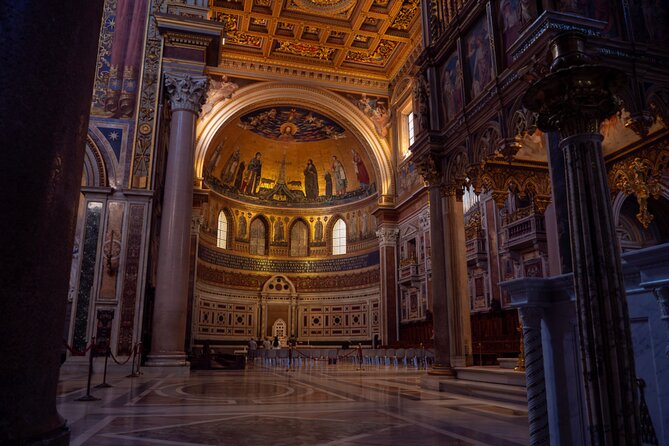
Next up is the Lateran Baptistery, tied to the legendary account of Constantine’s baptism. The tour spends real time on the “why” behind early Christian design, especially the octagonal shape that inspired other baptisteries across Italy and Europe (including Florence’s).
You’ll hear the practical reasoning too: why eight-sided baptisteries existed and why baptism spaces were set apart in separate buildings. Even if some details are partly tradition-based, the architectural logic is clear enough to make the shape feel meaningful instead of random.
Then you shift outside to the Lateran Obelisk, described as the tallest standing obelisk in the world today. It’s a big moment, because it connects Christian Rome back to earlier layers: Egyptian monuments were reused first by the Romans and later by the Christian Church. It’s the same stone story as at San Giovanni’s doors, but expressed in a skyline-sized way.
This stop is about 25 minutes and has free admission. The best way to enjoy it is to look for patterns: reused Roman materials, adapted Christian meanings, and architecture built to signal authority.
Panella bakery on Via Merulana: your one real break
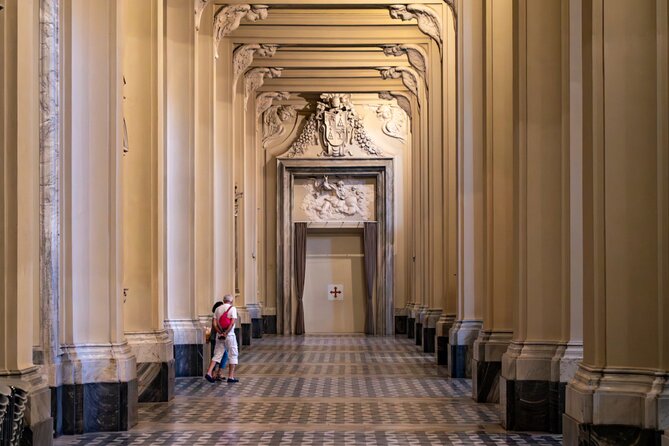
Not every church tour has a sensible food stop. This one does, because it uses the walk itself. You move down Via Merulana, a road laid out in the 16th century to help visitors on pilgrimage. The tour even points out the view toward the Auditorium of Mecenate area, a reminder you’re still walking through space with ancient weight.
Then comes Panella, a famous Roman bakery in business since 1929. This is your “fuel the brain” moment: you can sample classic Roman pastries like maritozzi (sweet yeast buns filled with freshly whipped cream) and enjoy coffee. It’s a short stop (about 10 minutes), but it’s exactly the kind of break that keeps a 3-hour tour from turning into a grind.
One small caution: consumption is listed separately from inclusions. The tour includes sampling traditional pastries at Panella, but if you want extras beyond that, you’ll likely pay on your own.
The value here is psychological as much as physical. You’re learning heavy themes—relics, relic traditions, doctrine in mosaics—so the sugary reset helps you keep absorbing.



Santa Maria Maggiore on the Esquiline: Mary’s basilica and gold from the New World
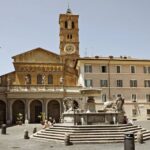
You end at Basilica di Santa Maria Maggiore, sitting on the Esquiline hill, described as the highest of Rome’s seven hills. If you’ve been expecting a strictly “early-Christian” finale, this basilica has a different feel. The tour frames it as ancient in spirit, and once you’re inside, the wow factor is mostly about layered sacred art rather than just scale.
This church also has a revered Holy Door, keeping the Jubilee theme consistent through to the end. That matters, because it turns the final stop into a completion of the pilgrimage arc rather than a last-minute wrap-up.
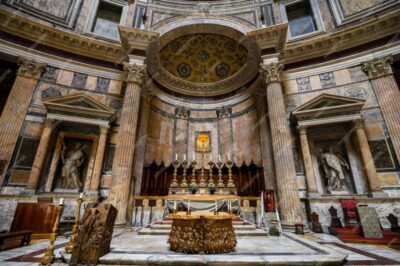
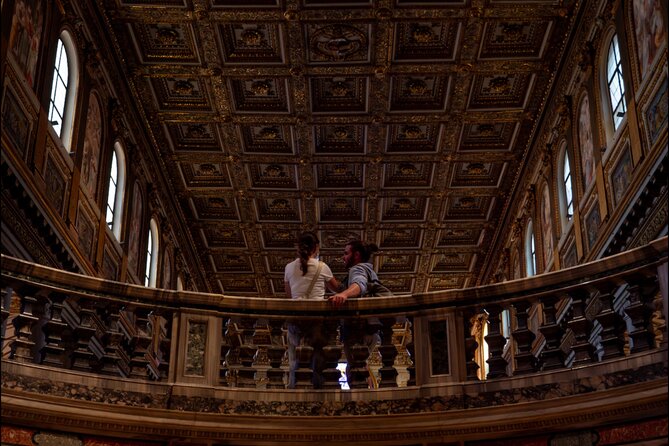
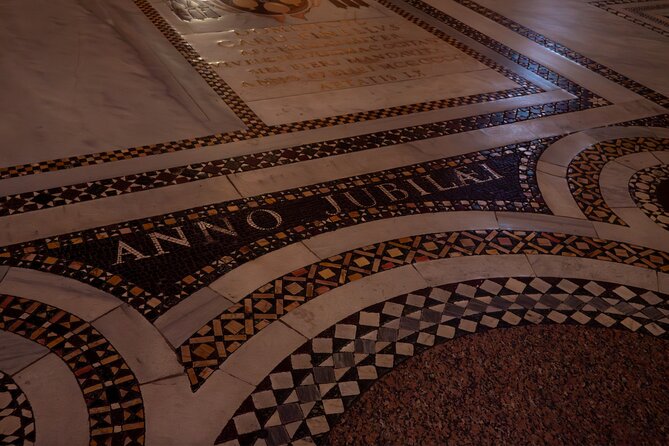
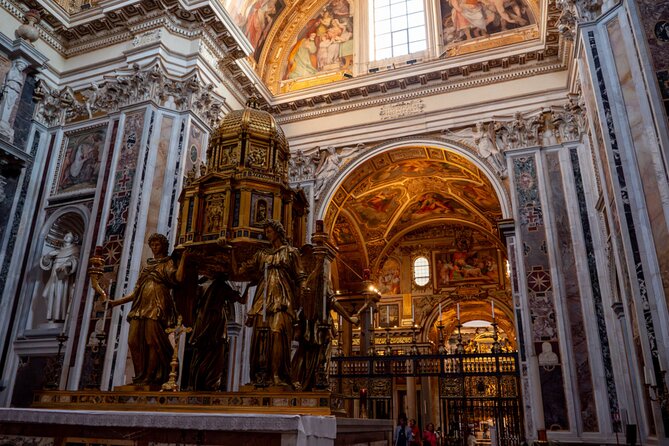
Inside, you’ll see Cosmatesque floors and a ceiling adorned with some of the first gold from the New World. That’s a detail that surprises people: Rome’s early Church isn’t the only chapter tied into these walls. The basilica holds centuries of faith politics and patronage in plain sight.
The tour also points out the relic and mosaic environment, plus a few high-recognition features that help you orient yourself. You’ll hear about another Sistine Chapel (the resting place of Sixtus V), the grave of Gian Lorenzo Bernini, and the sacred image Salus Populi Romani, an ancient Virgin said to have saved the people of Rome in the 6th century AD.
You finish at the obelisk of Santa Maria Maggiore, described as an ancient gem just steps from Rome’s main train station and near the fashionable Monti district. Translation for you: after the tour, you’re in a practical location for onward plans, not stuck in a dead-end neighborhood.
This stop is about an hour with free admission, and it’s a strong landing pad if you want to continue exploring without changing areas.
Tour size, headsets, and walking reality
This experience caps at 10 travelers, which is one of the reasons the guide can actually keep the group together and answer questions without the usual “tour herding” feeling. For groups of six or more, you’ll get headsets, so you’re not straining to hear the guide from across a noisy basilica entrance.
The tour lasts about 3 hours and starts at 9:00 am. It’s a compact route with five major “anchor” moments, so you don’t have long stretches of dead time. You’ll likely feel the walking though, since the itinerary connects multiple sites and you do move along Via Merulana.
Accessibility is the real constraint. It’s not recommended for travelers with mobility issues, likely because of the combination of walking and the way interiors and steps work in older Roman spaces. If that’s relevant for you, take the listing caution seriously and consider a different style of tour.
The meeting point is Piazzale Appio, 9, 00183 Roma, and you end at P.za di Santa Maria Maggiore, 00100 Roma at the Papal Basilica of Saint Mary Major. Since transportation isn’t included, you’ll want to rely on public transit or walking connections you set up yourself. The good news is the start point is near public transportation.
Is $87.72 a fair deal for this Jubilee-focused plan?
At $87.72 per person for about 3 hours, you’re paying for a very specific format: an English-language guide plus multiple high-importance religious sites in one concentrated walk. You’re also getting included admission at the Holy Stairs stop, and free entry at the major basilicas listed for the tour.
Here’s why the value makes sense. This isn’t just “see famous churches.” The guide is set up to explain the meaning of Jubilee Holy Doors, the iconography inside, the connection between architecture and early Christian practice, and why relic traditions matter in how Rome remembers its own beginnings. That kind of interpretation is what you’d normally pay extra for on a private tour.
The small group size (max 10) is also a value lever. You’re more likely to hear details and keep up, instead of listening to a distant guide while squeezed into the back of a crowd.
If you care about early Christianity plus Catholic pilgrimage traditions, this tour is priced like a focused, guided route rather than an all-day sightseeing buffet. If you only want quick photo stops, you might feel it’s more than you need. But if you like meaning, the structure is strong.
Who this tour fits (and who should skip)
You’ll probably love this if you’re a history buff who also likes religion as lived tradition, not just academic dates. Pilgrims will also feel at home here because the experience is built around pilgrimage elements: Holy Doors and the Scala Santa steps.
It’s also a great match if you want to use an English-speaking guide who can translate architecture, mosaics, and symbolism into something you can actually understand on-site. The guide names aren’t promised in the description, but feedback highlights guides such as Gracelyn as warm and deeply helpful with the church history and Christian context.
You might skip or look for an alternative if you:
- have mobility limitations and can’t do older-site walking and indoor movement
- want a very casual, no-context stroll (this tour is interpretation-forward)
- need transportation included (it isn’t)
Should you book the Rome Jubilee 2025 Early Christianity tour?
Book it if you want a single morning that connects early Christianity, Jubilee practice, and some of Rome’s most important sacred art—all in English with a small group. The Holy Door framing, the Scala Santa tradition focus, and the layered stops from San Giovanni to Santa Maria Maggiore create a clear pilgrimage arc.
Skip it if you’re mobility-limited or if you prefer purely self-guided browsing. The best Rome experiences are different for different people, and this one is strongly designed for guided meaning on foot.
If your timing works, I’d treat this as a top-choice morning plan—especially during the Jubilee season, when the Holy Doors and pilgrimage atmosphere are part of what you came for.
FAQ
What language is the tour offered in?
The tour is offered in English.
How long is the Rome Jubilee 2025 tour?
It runs for about 3 hours.
Is there a mobile ticket?
Yes, the tour includes a mobile ticket.
What size is the group?
The maximum group size is 10 travelers.
What does the tour include in terms of entrances?
Basilica stops listed are free admission, and the Holy Steps (Scala Santa) stop includes the admission ticket.
Is the bakery stop included?
Yes. You’ll stop at Panella and sample traditional Roman pastries.
Do I need to arrange transportation?
Transportation is not included. The tour notes it is near public transportation, so plan your transit to the start point.
Is this tour suitable for people with mobility issues?
It is not recommended for travelers with mobility issues.