REVIEW · ROME
Jewish Quarter and Trastevere District Private Walking Tour
Book on Viator →Operated by Crazy4Rome Private Tours · Bookable on Viator
Rome’s sides show you different stories.
This private walk strings together three places you often see separately: the Jewish Quarter (with the Portico di Ottavia and synagogue views), Tiber Island (Rome’s only river island), and Trastevere’s cobbled lanes and old churches. I like that it stays human-scale with short stops you can actually absorb, plus it’s private—so your guide can slow down for questions or speed up if your group is photo-happy. One thing to consider: the synagogue stop is described as outside, so if interior access is your must-do, confirm ahead of time with the provider.
You’ll start near Teatro di Marcello and end right back there. In the guide department, I like that names like Karin (specializing in Jewish history) and Yev/Yevgen (known for keeping groups engaged, even jetlagged students) show this tour can be led by people who really care. Still, as with any live guide-led experience, clarity and pacing can swing—so if you need a lot of factual detail or have accessibility needs for hearing/pace, it’s smart to communicate that early.
In This Review
- Key things I’d watch for on this tour
- Teatro di Marcello: where the walk starts (and why it’s a smart opener)
- Piazza Mattei and the Fountain of Turtles: the fun, weird pause you need
- Portico di Ottavia and the Jewish Quarter core: history you can walk through
- Ponte Rotto and Pont Fabricius: crossing Rome without leaving the story
- Isola Tiberina: Rome’s only river island (and why it’s tied to healing)
- Trastevere street time: cobblestones, piazzas, and two church stops
- Private guide value: what you’re really paying for
- Tickets, timing, and what to bring so the day goes smoothly
- Should you book the Jewish Quarter and Trastevere private walking tour?
- FAQ
- How long is the private walking tour?
- What does the tour cost?
- Is this a private tour or shared group?
- What language is the tour offered in?
- Where does the tour start?
- Where does the tour end?
- What are the main areas you’ll cover?
- Is bottled water included?
- Is there private transportation?
- Is the synagogue visit inside or outside?
Key things I’d watch for on this tour
- Private group pace: you’re not stuck in a cattle line, which helps on tight, historic streets.
- Jewish Quarter highlights in a tight loop: Portico di Ottavia and the synagogue area get your attention without wasting time.
- Tiber Island on foot: Ponte Rotto, Pont Fabricius, then the island itself—an efficient way to see “island Rome.”
- Trastevere with purpose: you’re not just wandering; you hit specific piazzas and churches.
- Tickets handled for you: the itinerary marks admission tickets included, delivered via mobile ticket.
Teatro di Marcello: where the walk starts (and why it’s a smart opener)
Your tour begins at Antico caffè del teatro di Marcello, on Via del Teatro di Marcello 42. It’s a practical starting spot because it puts you right where ancient Rome still feels close to the street—no long commute, no “first five minutes are transit” penalty.
Stop one is Teatro di Marcello, outside. This is one of those places where you get the vibe of an amphitheater without needing to stare at a museum label for an hour. You’ll hear the basic story: it’s an ancient open-air theater built in the late Republic era, advanced enough for major celebrations by 17 BC, and completed around 13 BC. It’s also tied to the Julius Caesar plotline—space cleared by Caesar, then the work continued later. Even if you only catch it from the perimeter, the setting helps you understand why Rome reused and repurposed older monuments so often.
I like starting here because it sets the rhythm. You’re walking in Rome, but you’re also reading the city like a timeline. And since the tour lasts about 3 hours 30 minutes, the opening matters. You want your brain switched on early—this does that.
You can also read our reviews of more walking tours in Rome

Piazza Mattei and the Fountain of Turtles: the fun, weird pause you need
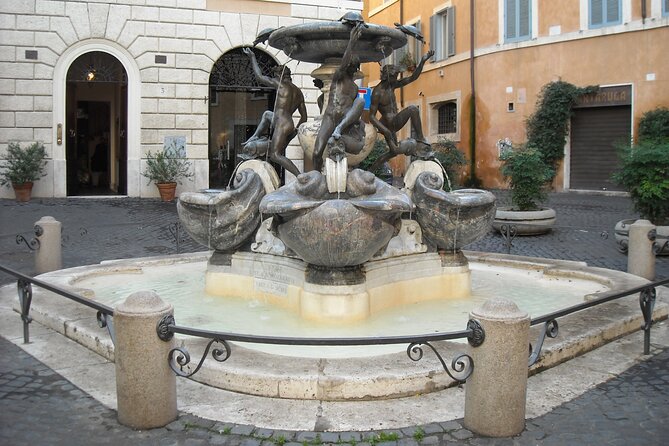
Next up is Piazza Mattei, where the Fountain of Turtles steals the scene. It’s famous, but what makes it worth your time is the detail: dolphins, marble shells, four African marble “shells” carrying water, and the turtles doing the job of being pushed toward the edge of the basin. The sculptural idea is whimsical, but the execution is serious.
A couple of useful context notes help you appreciate it instead of just snapping a selfie and moving on:
- The fountain design is associated with Giacomo Della Porta, with bronze sculptures credited to Taddeo Landini.
- The turtles you see today are linked to later restorations. Some original turtle sculptures were stolen at different points (the history is part of the story of why copies exist).
You’ll spend about 15 minutes here. That’s the right amount of time because it gives you room to look up at the setting, then look down at the waterwork. If you’re the kind of person who loves small quirks, this is your break from the heavier themes of the Jewish Quarter and gives you something lighter before the walk gets more “past meets present.”
Portico di Ottavia and the Jewish Quarter core: history you can walk through
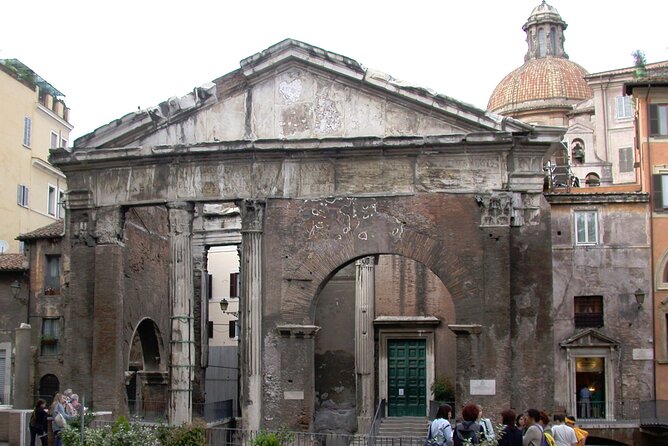
The heart of the Jewish Quarter portion starts with the Portico di Ottavia (Porticus Octaviae). This place isn’t just “old columns.” It’s a reminder that Rome used the same spaces for different purposes over centuries. The portico originally enclosed temples of Jupiter Stator and Juno Regina and even included a library. Then, much later, it became a fish market into the 19th century.
That layering matters. You’re not only learning Jewish history in this area—you’re also watching how Rome’s urban fabric changed around communities. In a private format, you can ask the kind of question most group tours don’t have time for, like how the physical layout of the neighborhood affected life and movement.
You’ll also get to the synagogue area next. The itinerary specifies the synagogue stop as outside, built in the early 1900s (1901 to 1904) on the banks of the Tiber, overlooking the former ghetto. Architecturally, the building mixes Assyrian-Babylonian, Egyptian, and Greco-Roman elements, and the interior is described as richly decorated in Art Nouveau style.
Here’s the practical caution I’d give you: because the plan lists the synagogue as an outside viewing stop, don’t assume you’ll be going inside unless you’ve confirmed. If the interior is a top priority, ask the provider ahead of time. I’d rather you verify early than end the day slightly disappointed.
Ponte Rotto and Pont Fabricius: crossing Rome without leaving the story
Then the tour shifts from neighborhood history to river geometry, and it’s a surprisingly good change of pace.
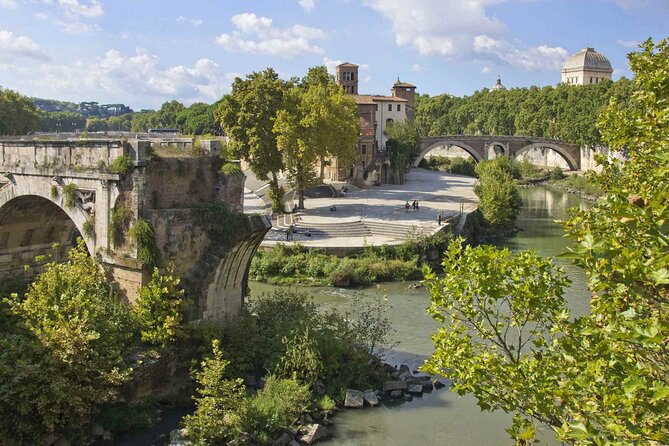
First, Ponte Rotto (Broken Bridge). Yes, it’s called broken, but that’s part of the charm. The remaining arch sits above the Tiber near Tiber Island. What’s important is that the visible piece isn’t some random ruin—it’s connected to the ancient Pons Aemilius, originally made of wood in the 2nd century BC and reconstructed in stone about a century later. It’s another “Rome reuse mode” story.
After that comes Pont Fabricius (Ponte Fabricio), the oldest Roman bridge still existing in its original state. Built in 62 BC, it spans half the Tiber and runs toward the Campus Martius side, with Tiber Island in the middle of the river. The “Quattro Capi” detail refers to two marble pillars with two-faced Janus herms—four heads in total—moved here in the 14th century.
What you’ll like here is the ability to see cause-and-effect. You’re walking near infrastructure that shaped daily life for centuries, then looking at what’s left today. Bridges are the ultimate time machines. They tell you where people wanted to go and how they kept doing it.
Isola Tiberina: Rome’s only river island (and why it’s tied to healing)
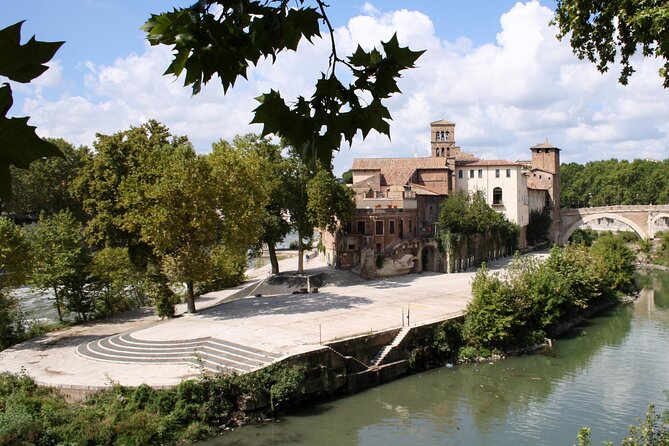
From the bridge crossings, you’ll reach Isola Tiberina, also known as Tiber Island. This is the only river island in the Rome stretch of the Tiber. It’s boat-shaped—about 270 meters long and 67 meters wide—and connected to both sides of the river since antiquity.
Even if you don’t go deep into every legend, the island’s theme is consistent: healing and medicine. It’s associated with the ancient temple of Asclepius and later a hospital. The island also includes the Fatebenefratelli Hospital (founded in the 16th century) and San Bartolomeo all’Isola dating from the 10th century.
The 15-minute stop is enough to orient yourself and get those “wait, this is an island in the middle of Rome” photos. But the real value is the contrast: you’ve just been in dense historic neighborhoods and ancient bridge lines, and suddenly you’re standing somewhere that feels like a pause in the city’s motion.
You can also read our reviews of more private tours in Rome





Trastevere street time: cobblestones, piazzas, and two church stops
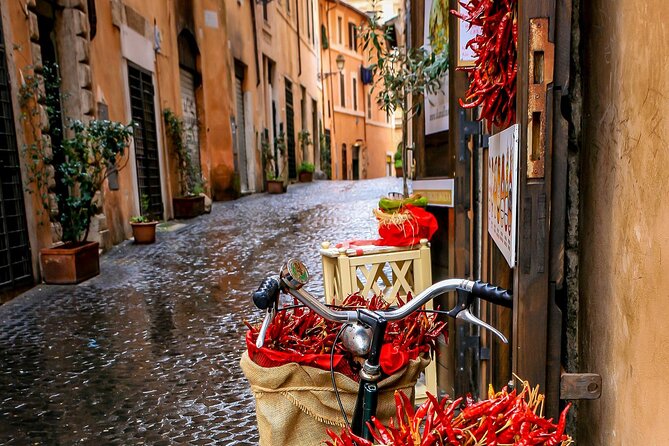
After Tiber Island, the tour shifts into Trastevere, which is the 13th rione of Rome (R. XIII), identified by the initials and known as being beyond the Tiber (trans Tiberim). The walk here feels like the payoff. You get cobbled streets, small squares, and a slower pace that still doesn’t feel like a tourist fake.
Your Trastevere portion includes a stop at Piazza in Piscinula, now known as a calm square area. This one’s small, but it’s exactly the kind of place that makes Trastevere worth wandering. Medieval structures called Case Mattei frame the square, and the church of San Benedetto in Piscinula is nearby—small enough that you can easily miss it if you’re just rushing.
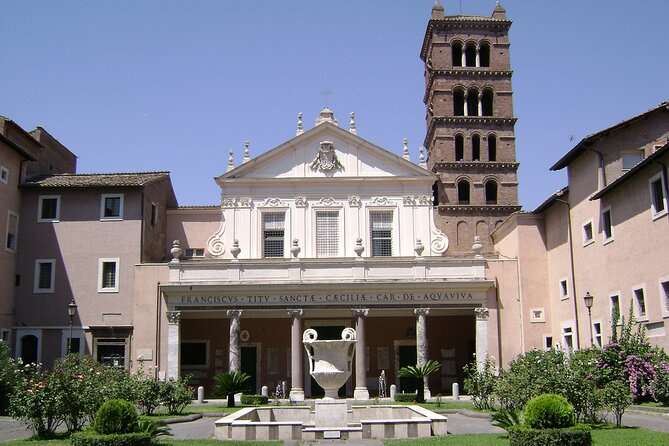
Then comes Santa Cecilia in Trastevere. This is a 5th-century church devoted to Saint Cecilia, a Roman martyr said to have lived in the early 3rd century. The key timeline point: the first church on the site is said to have been founded around the 3rd century by Pope Urban I. The saint’s martyr story is associated with Marcus Aurelius Severus Alexander (AD 222–235). Even if you’re not chasing religious detail, the dedication helps you understand why this neighborhood gathered around certain figures and rituals.
After Santa Cecilia, you’ll reach the Basilica di Santa Maria in Trastevere (Our Lady in Trastevere). This is one of the oldest churches of Rome. You’ll hear how the basic floor plan and wall structure go back to the 340s, with much of the structure dating to 1140–43. The church has mosaics from the late 13th century by Pietro Cavallini.
If you only ever see major basilicas from the outside, this stop is a good chance to pay attention to mosaics and building continuity. The tour gives you enough time to look without feeling rushed.
Private guide value: what you’re really paying for
The price is $437.68 per group, up to 10 people, for about 3 hours 30 minutes. That’s the big takeaway: you’re not paying per person in the typical way. It can be good value if you travel with friends or family and can fill out your group. For example, if you had 4 people, you’re roughly around $110 per person. If you had 6, it’s about $73 each. If you had 10, it’s around $44 each.
Even if your group is small, private format still matters here. You’re moving through areas where context makes the difference between seeing buildings and understanding why they matter. That’s where strong guides shine—Karin’s Jewish history focus is one example from past operations. Another example: Yev/Yevgen being able to keep jetlagged students engaged and adapting the route based on what the group already knew.
To get the best value out of your payment, do this: at the start, tell your guide two things—what you care about most (Jewish history, architecture, photo stops, churches) and whether you want more facts or more story. Private tours work best when you give the guide a little input.
Tickets, timing, and what to bring so the day goes smoothly
This tour uses a mobile ticket and runs about 3 hours 30 minutes total. The itinerary marks “admission ticket included” for each stop, so you shouldn’t need to juggle paperwork mid-walk. Bottled water is not included, so bring a small bottle or plan to refill.
Because it’s walking-heavy and includes cobblestones and church areas, comfortable shoes matter. Also, plan on a day in Rome where you might stop more often for photos than you think. The stops are roughly 15 minutes each, which is a good rhythm for keeping energy up while still learning something.
The meeting point is a café near Teatro di Marcello, and the tour ends back at the meeting point. That’s helpful because you don’t have to guess how to get home at the end.
Should you book the Jewish Quarter and Trastevere private walking tour?
Book it if:
- You want a private guide and care about getting context in the Jewish Quarter, not just sightseeing.
- You like a route that blends Roman classics (bridges, theaters) with neighborhood mood (Trastevere).
- Your group can split the cost, since pricing is per group up to 10.
Skip or double-check if:
- Your top priority is entering the synagogue building. The plan lists the synagogue stop as outside, so verify interior access before you go.
- You’re very sensitive to guide clarity and pace. There have been cases where a guide was reported as unclear or inaccurate, so it’s smart to communicate what you need early, then adjust if something doesn’t feel right.
FAQ
How long is the private walking tour?
It runs for about 3 hours 30 minutes.
What does the tour cost?
It costs $437.68 per group, up to 10 people.
Is this a private tour or shared group?
It’s a private tour. Only your group participates.
What language is the tour offered in?
The tour is offered in English.
Where does the tour start?
The meeting point is Antico caffè del teatro di Marcello, Via del Teatro di Marcello, 42, 00186 Roma RM, Italy.
Where does the tour end?
It ends back at the meeting point.
What are the main areas you’ll cover?
You’ll see Rome’s Jewish Quarter, Tiber Island, and Trastevere.
Is bottled water included?
No, bottled water is not included.
Is there private transportation?
No, private transportation is not included.
Is the synagogue visit inside or outside?
The synagogue stop is listed as outside. The interior is described, but the stop itself is outside viewing.