REVIEW · ROME
German port city of Ostia Antica
Book on Viator →Operated by Deutsche Römerin · Bookable on Viator
Rome’s port past feels shockingly real. This guided walk through Ostia Antica lets you picture how a thriving Roman port city worked, with daily-life ruins still laid out where you can see them. I like that the story is grounded in place—Ostia’s inland harbor role for Rome, and how the Tiber and sea coastline have shifted over thousands of years, helps everything click fast.
Two things I especially like: first, the tour includes headsets, so you can keep up without craning your neck or guessing what you missed. Second, the stops cover more than monuments. You’ll move from the theatre to multi-storey apartment buildings, the forum area, antique bakeries and inns, the Neptune thermal baths, and even latrines—so Roman life feels practical, not just decorative. One consideration: at about 2 hours, you’ll see the highlights, but you won’t have time to linger on every single corner if you’re the sort who reads every inscription.
In This Review
- Key things you’ll notice on the ground
- Ostia Antica: the port city that kept Rome humming
- Getting there from Rome at 10:00 and what “near public transport” means
- The two-hour route: theatre, apartments, forum, baths, and latrines
- Stop 1: Ostia Antica highlights you’ll see
- Why the guide experience matters more than you think
- What makes Ostia feel like a real day in ancient Rome
- Price and value: why this tour can be a steal
- Pace, comfort, and what to bring for an outdoor archaeological park
- Who should book this Ostia Antica tour
- Should you book this Ostia Antica tour?
- FAQ
- How long is the Ostia Antica tour?
- Where does the tour start and where does it end?
- What is included in the ticket?
- What is not included?
- Do I need a printed ticket?
- What language is the guide?
- How large are the groups?
- Can I get a refund if I cancel?
Key things you’ll notice on the ground
- A Roman port city built for trade into Rome: goods came from across the Mediterranean, because this place mattered.
- Life that kept going long after Pompeii: Ostia continued into late antiquity, so the ruins feel less like a frozen snapshot.
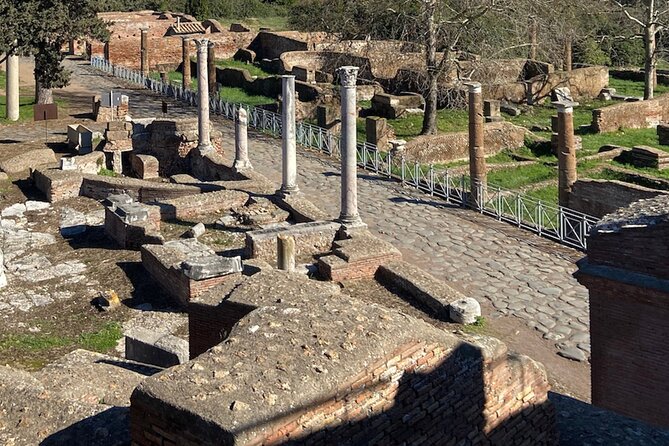
- Daily living, not only temples: shops, bakeries/inns, homes, baths, and latrines help you understand routine.
- Thermal baths that explain Roman hygiene and leisure: Neptune thermal baths put social life on the map.
- A theatre inside a working city: public events weren’t separate from commerce and neighborhoods.
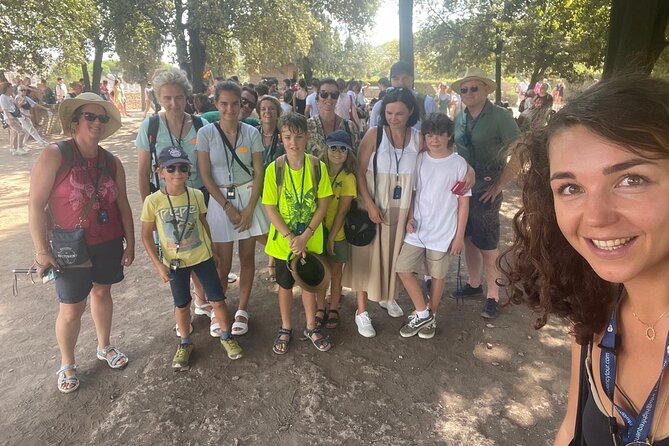
- Smaller group experience: a maximum of 20 travelers keeps the walk feeling manageable.
Ostia Antica: the port city that kept Rome humming
If you’ve done Rome’s big classics and want something that feels more like real city life, Ostia Antica is the right kind of detour. This was once the inland port for Rome, not a coastal vacation spot. Think logistics: ships bring goods, and then the city turns those arrivals into everyday supply.
What makes Ostia hit different is that you’re not looking at only one era. Unlike Pompeii, whose story ends in 79 AD, Ostia remained active into late antiquity. In other words, you can see more “layers of use” in the bones of the place, which helps you understand how Romans adapted over time rather than treating the city like a single moment.
And then there’s the sea-and-river reality check. The Tiber and the sea coast have changed dramatically over thousands of years. When you stand there now, you’re seeing a version of the coast that doesn’t match what people would have seen back then, which is exactly why a guide matters. The ruins are your anchor; the coastline change is the plot twist.
You can also read our reviews of more city tours in Rome



Getting there from Rome at 10:00 and what “near public transport” means
This tour starts at 10:00 am at Viale dei Romagnoli, 717, 00119 Roma RM. It ends in the archaeological park at 00119 Ostia Antica RM. From there, you can head back to Rome or go one stop further to the beach area of Ostia (Ostia Lido).
Practically, this is a good format if you want a half-day that’s not painful to fit into your Rome schedule. You’re not committing to a full-day excursion or a complicated checklist of transfers. Also, because the tour ends right in the park, you’re not forced to backtrack through the same ground before you get your bearings.
One more reason the timing works: because the duration is about 2 hours, you can plan a later meal in Rome without feeling rushed. If you’re staying near the center, you’ll still feel like you escaped the city buzz, but you won’t lose your entire day to transit.
The two-hour route: theatre, apartments, forum, baths, and latrines
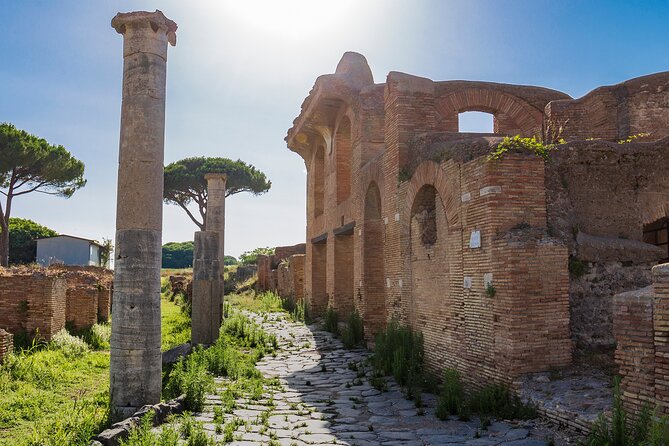
The heart of this experience is a guided walk through a working ancient city. The tour is designed around what you can actually spot on foot, so you’re not just hearing facts while standing in the same spot.
Stop 1: Ostia Antica highlights you’ll see
Here’s what to expect, in plain order-of-operations terms.
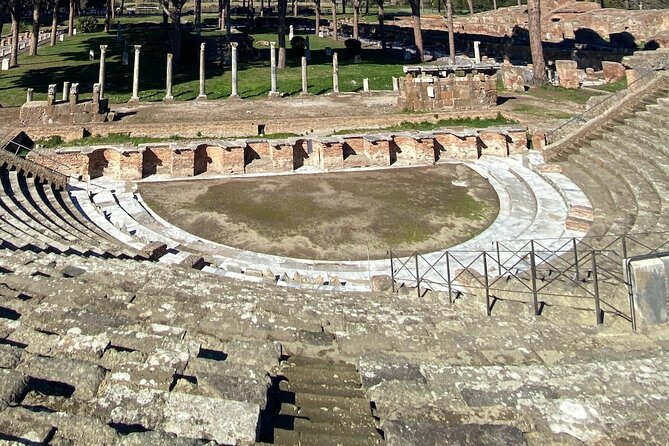
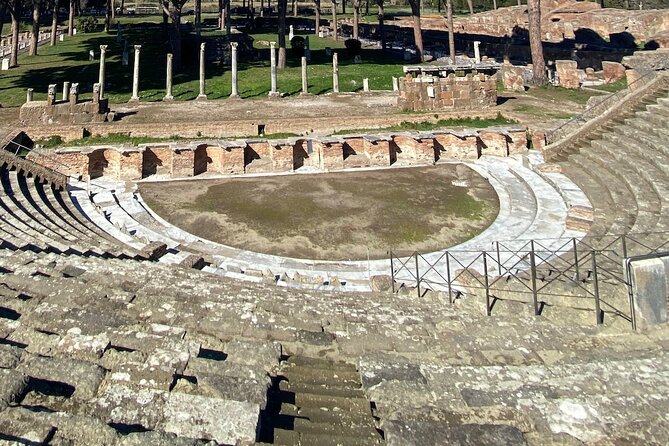
The theatre
This is your fast mental setup for how public life worked. A theatre in a port city tells you the community wasn’t only about hauling goods. People gathered, watched performances, and turned a city job into a social event.
Multi-storey apartment buildings
Next you’ll get a feel for density and daily movement. These buildings help you picture housing that wasn’t only for the elite. You can stand in front of structures and start imagining how families lived when the city had real momentum and incoming trade.
The forum area
In many Roman cities, the forum is where power, commerce, and announcements overlap. In Ostia, it ties the city’s economy to its civic life. It’s one of those places where a guide can help you interpret what looks like “ruins” until you know what to look for.
Antique bakeries and inns
This is where Ostia feels almost modern in spirit. Food, lodging, and service stops are part of how visitors and workers moved through the city. If you like ruins that connect to real habits—breakfast, snacks, and refueling—this stop is a big win.
Neptune thermal baths
The thermal baths are a standout because they reveal how Romans managed leisure and hygiene in the same complex system. You’ll get a sense of why people cared about bathing routines beyond cleanliness. Even if you’re not a baths person, the layout helps you “read” the daily rhythm of the city.
Latrines
Yes, latrines. And that’s a good thing. It grounds the tour in the reality of public infrastructure. You’ll come away with a sharper understanding of sanitation and shared space—an unglamorous topic that still tells you a lot about Roman urban life.
Why the guide experience matters more than you think
You’re not just buying access to an archaeological park. You’re buying help turning stone into story. That’s what makes this feel less like a self-guided wander and more like a guided pattern-recognition exercise.
The tour uses German-speaking city guides and includes headsets, so you can follow comfortably even when the group moves and the park gets spread out. This matters at Ostia, where the ruins can look similar until someone points out what’s functional, what’s civic, and what belonged to daily routines.
From the past experiences I’ve seen tied to this kind of tour, strong guides make a huge difference. One example is Philip, described as an archaeologist who knows the site in detail and can explain how the place worked. Another named guide on a city tour variation is Rob Miller, who paired transport from Rome with a guided walkthrough, making the transition from modern city to ancient port feel smooth.
In a practical sense, a good guide helps you do two things fast:
1) understand how to move your eyes across the site, and
2) stop treating everything as equally important.
That’s how you get the most meaning out of only two hours.





What makes Ostia feel like a real day in ancient Rome
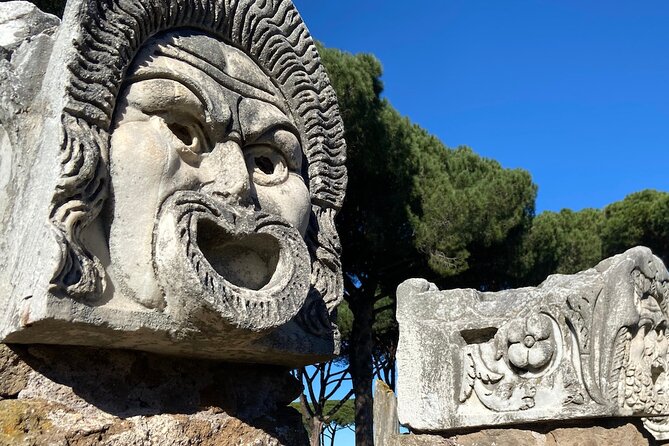
A lot of ruins get reduced to big sights. Ostia resists that. The set of stops in this tour is built around a city that had to function constantly.
You’ll feel that in the mix: theatre for public gatherings, apartments for housing, the forum for civic meaning, bakeries and inns for service life, Neptune thermal baths for leisure and hygiene, and latrines for public infrastructure. It’s a neat bundle because it covers different sides of living in the same place.
Also, the coastline-change context matters here. When you understand that the sea and river setting shifted over centuries, you stop asking one annoying question—where was the harbor exactly? Instead, you accept that the city’s relationship to water evolved, and you use the guide’s framing to make sense of what’s visible now.
That framing turns Ostia into more than a “Pompeii alternative.” It becomes a different kind of Roman lesson: how a city adapted and kept working.
Price and value: why this tour can be a steal
On the details you provided, the price is listed as $0.00 per person, and that’s unusually strong value on its own. Even when pricing changes by date, the structure here is still the key: you get entrance tickets to Ostia Antica plus headsets included.
So the real question isn’t the sticker price. It’s what you avoid. If you have to buy entrance separately and figure out audio help, that adds up fast. This format bundles two of the most annoying parts of visiting alone.
One more value point: group size is capped at 20 travelers. That keeps the guide from turning your experience into a rushed herd. In a place like Ostia, where “seeing” depends on knowing what to look for, smaller groups are a quiet quality upgrade.
Pace, comfort, and what to bring for an outdoor archaeological park
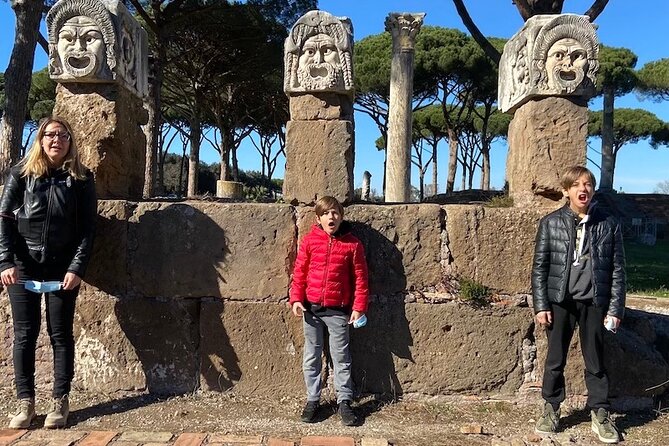
This is an outdoor visit in an archaeological site. That sounds obvious, but it changes what you should bring.
Wear comfortable shoes with solid grip. The ground in archaeological parks can be uneven, and you’ll want stable footing for a relaxed pace. Bring a light layer for shade and wind, even if Rome’s forecast looks friendly.
Also plan snacks and water yourself. Snacks aren’t included, and the tour is only about two hours. A simple plan helps you enjoy the walk instead of thinking about when you’ll eat.
If rain happens, don’t panic. One of the reasons people tend to rate Ostia highly is that even when conditions are messy, the ruins still work. A guided route helps keep your mind on the story rather than the weather.
Who should book this Ostia Antica tour
This tour fits best if you want:
- a Roman site that feels like daily city life, not only temples
- a guided walk in a manageable time window
- a German-speaking guide with headsets
- a visit that mixes big public space with practical details like baths and latrines
It’s also a good choice for you if you’ve already seen Rome’s core sights and want something that’s less crowded than the headline attractions. Ostia has that “quietly impressive” feel where you can read the city without constant interruption.
If you’re the type who wants to spend half a day studying every wall and corner, you might feel shortchanged by only two hours. But if you want a high-impact introduction and a sense of how the city worked, this is a smart length.
Should you book this Ostia Antica tour?
Yes, I’d book it if you want a fast, guided, and very practical way to understand Ostia Antica. The combination of entrance tickets, headsets, and a route built around theatre, apartments, the forum, bakeries/inns, thermal baths, and latrines is exactly how you get real value out of a two-hour window.
Book it especially if you care about how ancient Romans lived, not just what they built. The site is fascinating on its own, but the guide is what turns the stones into a coherent city.
If you’re expecting a long, slow museum-style experience, plan to extend your visit after the tour ends in the archaeological park. That way you get the best of both: guided clarity first, then your own pace.
FAQ
How long is the Ostia Antica tour?
The tour lasts about 2 hours.
Where does the tour start and where does it end?
It starts at Viale dei Romagnoli, 717, 00119 Roma RM, Italy and ends in the archaeological park at 00119 Ostia Antica RM, Italy. From there you can go back to Rome or continue one stop further to Ostia Lido.
What is included in the ticket?
The experience includes headsets so you can understand the guide well, and entrance tickets to Ostia Antica.
What is not included?
Snacks and transport are not included.
Do I need a printed ticket?
No. The tour uses a mobile ticket.
What language is the guide?
The tour features German-speaking city guides, and the included headsets help you follow along.
How large are the groups?
The tour has a maximum of 20 travelers.
Can I get a refund if I cancel?
No. The experience is non-refundable and cannot be changed for any reason.