REVIEW · ROME
Colosseum & Ancient Rome by Night Guided Walking Tour
Book on Viator →Operated by Tours of the Colosseum · Bookable on Viator
Night makes Rome tell a different story. This Colosseum & Ancient Rome by Night walk turns dark streets into a living timeline, with illuminated monuments that you can actually connect to the people who lived there. I also love how the tour is built for seeing the city in motion at night, not just standing still for photos.
The biggest trade-off is simple: it’s an outside-only tour. You won’t enter the Roman Forum or the Colosseum, so if you want inside access, you’ll need a different kind of ticketed tour.
The upside? It’s a private experience for your group in English, run by an official guide, and it keeps moving from one landmark to the next for about 2.5 hours. The route is straightforward from the first meeting point near Piazza di Campitelli and ends at Piazza del Colosseo, where you can grab the metro or a taxi.
In This Review
- Key Things That Make This Night Tour Work
- Ancient Rome at Night: What You Actually Get to See
- Why the Guide Makes the Difference (Thomas’ Approach)
- Teatro di Marcello: Rome’s Theatre You Can Spot and Understand
- Piazza del Campidoglio: Michelangelo’s Square and a Forum View
- Mercati di Traiano (Museo dei Fori Imperiali): The Forum Zone’s Big Scale
- Colonna Traiana: A War Chronicle That Reads Like a Comic
- Roman Forum from the Street: The Center of Power You Can Still Sense
- Colosseum from Outside: Gladiators and Shows Without Ticket Hassle
- Arch of Constantine: The Best-Preserved Arch and Its Legacy
- The Walk at a Glance: Timing, Comfort, and Night Photo Reality
- Starting and Ending Points: Easy Navigation for Your Evening
- Is It Worth $272.83? Value That’s About More Than the Price
- Who This Tour Suits Best
- Should You Book This Colosseum & Ancient Rome by Night Walk?
- FAQ
- How long is the Colosseum & Ancient Rome by Night guided walking tour?
- Is this tour inside monuments or outside only?
- What’s included in the tour price?
- Are admission tickets included for each stop?
- What language is the tour offered in?
- Is the tour private?
- Where do you meet and where does the tour end?
- What happens if the weather is poor?
Key Things That Make This Night Tour Work
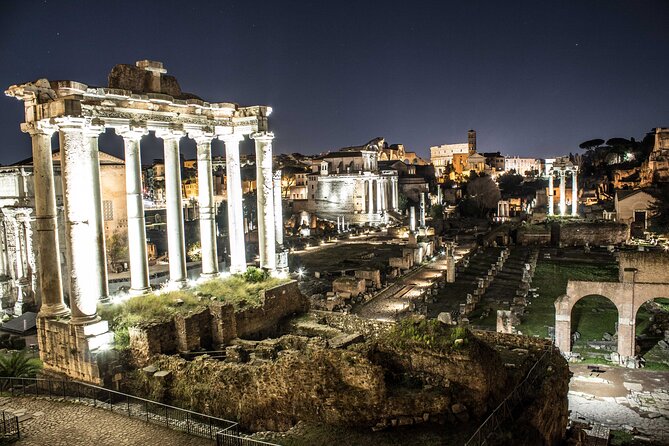
- Night-lit sights you can read: You’ll see major Roman landmarks illuminated and learn how they fit together.
- Professional archaeologist-style storytelling: Your guide makes the ruins feel like real places, not just stones.
- A tight 2.5-hour route: You cover several top sites without turning the evening into an all-night slog.
- Outside-only focus: You avoid inside lines and keep the experience moving on foot.
- Small-group attention: Reviews mention a smaller-group feel, which usually means better back-and-forth questions.
Ancient Rome at Night: What You Actually Get to See
This tour is all about the feeling of Rome after dark, when the monuments look less like textbook diagrams and more like settings. The highlights are the illuminated stops—Teatro di Marcello, the views from Piazza del Campidoglio, the monumental forum zone, and finally the Colosseum area—so you get that mix of atmosphere and context.
Because you’re walking, you also get a practical benefit: you’re not stuck studying a single spot for an hour. The route is designed like a sequence, so each location helps explain the next one. That matters with Roman ruins, where one arch or column can look random until someone points out what it was for.
You can also read our reviews of more walking tours in Rome
Why the Guide Makes the Difference (Thomas’ Approach)
In the reviews I saw a consistent theme: the guide’s command of Roman history and the way he explained what you were looking at mattered as much as the landmarks themselves. In one standout comment, the guide was named Thomas, and the praise was very specific—excellent English and an in-depth background that made it feel like you were watching a story unfold instead of just passing sights.
That teaching style is especially valuable on an outside-only tour. When you can’t step inside the Roman Forum or the Colosseum, you need the “read the scene” skills: what this structure was, what people did here, and how power and politics shaped what got built.
If you like asking questions—history, daily life, gladiators, politics—this is the kind of tour where your questions can land immediately because the guide can connect details on the spot.
Teatro di Marcello: Rome’s Theatre You Can Spot and Understand
Your first stop is Teatro di Marcello, a very well-preserved ancient theatre. It’s only about a 15-minute stop, but it’s a strong opener because it sets the “culture” layer of Rome. Before you hit the big imperial monuments, you get a sense of what Roman public life looked like—shows, spectacle, and how entertainment sat inside the city’s power system.
Since the tour is outside-only, your experience here is mainly visual plus explanation. You’ll want to focus on the structure itself: how theatres were designed to serve crowds, how audiences would have experienced the performances, and why these buildings mattered socially.
Practical tip: with a short first stop, arrive ready to look. If you chat with friends first, you’ll burn your best photo-window.
Piazza del Campidoglio: Michelangelo’s Square and a Forum View
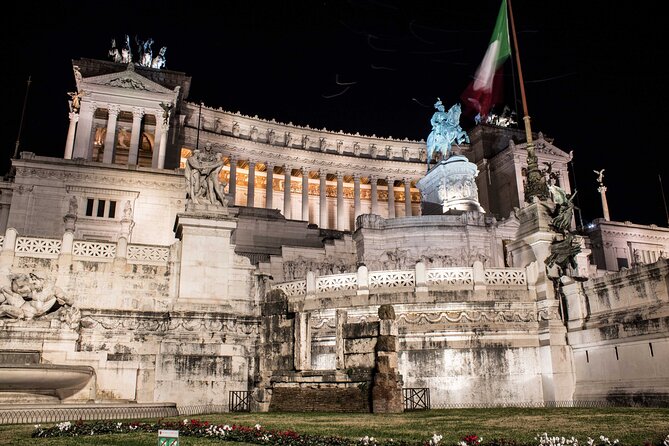
Next up: Piazza del Campidoglio, about 30 minutes. This stop is doing double duty. You get the square designed by Michelangelo, you see the town hall, and you’ll spot the statue of Marcus Aurelius. Then you also get a great view of the forums.
That viewpoint is the real gift. From here, the forum zone becomes more than “a pile of ruins.” It turns into a layout you can mentally map: civic spaces, imperial influence, and the heart-of-government feeling that Roman builders wanted to project.
Also, Campidoglio is a smart place to learn because Michelangelo’s redesign highlights how later leaders reinterpreted Roman greatness. You’re seeing layers of Rome at once: ancient civic intent underneath later artistic choices.
Mercati di Traiano (Museo dei Fori Imperiali): The Forum Zone’s Big Scale
After that, you’ll head to Mercati di Traiano – Museo dei Fori Imperiali. The stop is about 15 minutes, and it’s aimed at the grand scale of Trajan’s complex—one of the most important forum projects of Ancient Rome.
This is a moment where outside views can feel tricky. Trajan’s forums can look like “lots of structures” unless someone explains the purpose. The value of the tour here is that it’s framed as the grandest forum of Ancient Rome built by Trajan, which gives you an anchor to interpret what you’re seeing.
Why it’s worth your time: it’s a reminder that Roman public space wasn’t only temples and courts. It also included commerce and infrastructure—built into the architecture, not added later.
You can also read our reviews of more guided tours in Rome





Colonna Traiana: A War Chronicle That Reads Like a Comic
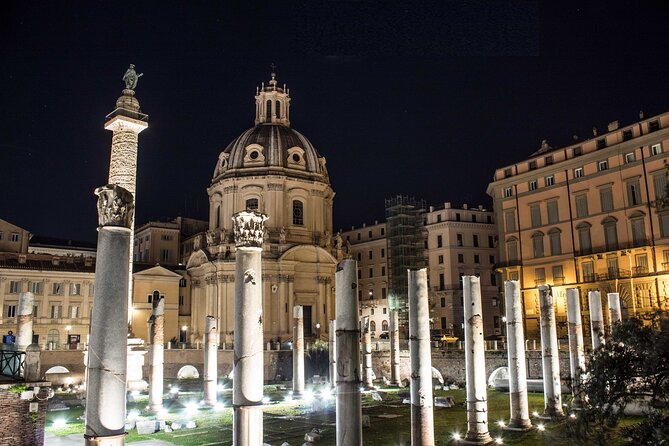
You then reach Colonna Traiana (about 10 minutes). This is where the tour’s explanation style really shines, because the column’s reliefs tell a campaign story through repeated scenes.
The description you’re given focuses on the campaign of Trajan’s war in the region of Romania, and the reliefs are described as spectacular, with an easy-to-follow “comic book” feel. That matters because columns like this can be visually overwhelming. With a guide explaining what you’re looking at, it stops being ornament and becomes narrative.
Even if your photos come out dark (night lighting can be tricky), you can still “read” the story by watching where the reliefs go and how the scenes progress.
Roman Forum from the Street: The Center of Power You Can Still Sense
The route then moves toward the Roman Forum, with about a 30-minute stop. Here, you’ll learn about the Forum as the center of Rome and the Roman Empire—home to important judicial courts, trade areas, and temples.
Important: the tour notes admission tickets are not included for the Roman Forum. That aligns with the overall outside-only approach. So you’re not walking through ticket-controlled entry points. Instead, the goal is to give you a mental map of what the Forum was and why it mattered.
This is one of those spots where a guide can prevent a common mistake: seeing the Forum as only “big ruins.” With context, you start connecting the architecture to Roman institutions—law, commerce, and religion as part of how power worked.
Practical note: because this is a key evening area, keep an eye on your footing. Night walks can be uneven, and the Forum zone can be crowded depending on the time.
Colosseum from Outside: Gladiators and Shows Without Ticket Hassle
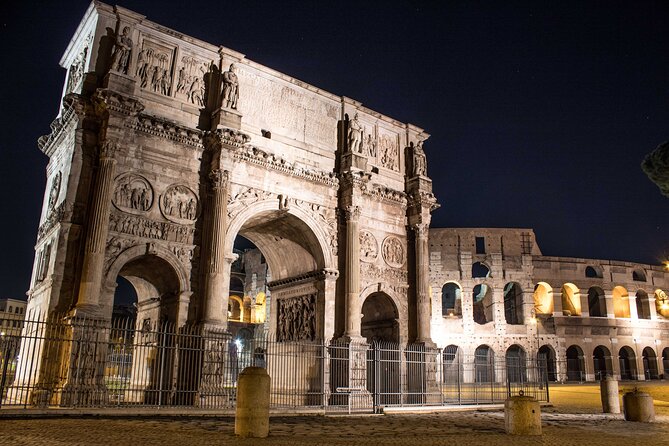
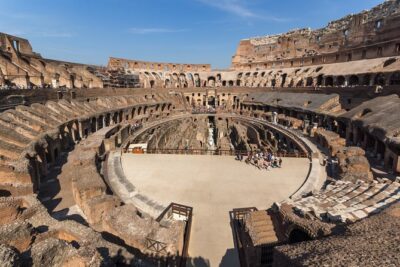
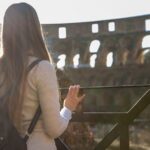
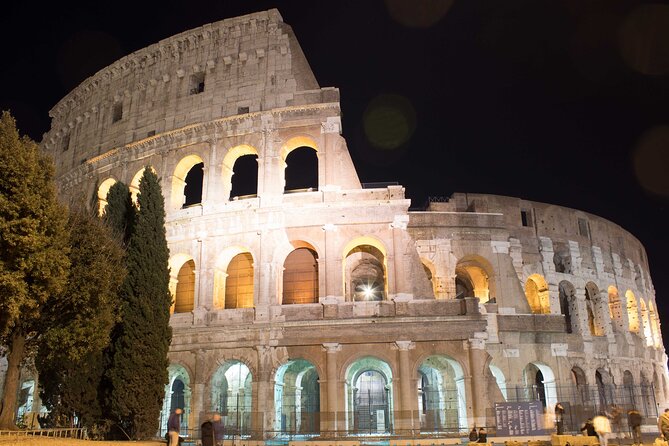
Then comes the Colosseum area—about 30 minutes. You’ll see it from outside and learn about gladiators and shows. The practical advantage is that you don’t spend your time in queues for entry. You get a guided evening experience that ends at a place you can continue exploring after the tour.
Still, you should calibrate expectations: you won’t go inside the Colosseum on this tour, and admission tickets aren’t included. That means your learning is built around what you can see from the street—its scale, its role in Roman entertainment, and the way crowds would have experienced spectacle.
If your ideal night in Rome is “see the big icons, understand the story, keep moving,” this format fits well. If your ideal is “I must stand inside the arena,” you’ll need a different tour that includes entry.
Arch of Constantine: The Best-Preserved Arch and Its Legacy
Before the tour ends, you’ll stop at the Arch of Constantine for about 20 minutes. This is one of the best-preserved ancient arches in Rome, and the explanation you get connects it to later influences—its role as a model for famous arches elsewhere.
Why I like this stop: arches are deceptively easy to miss because they’re not the biggest structures on the route. But they’re political billboards. When you understand the “why” behind the arch, it becomes a moment you can feel.
At night, an arch also frames views. Even if you’re focused on learning, you’ll likely find yourself pausing longer than planned just because the shape pulls your eyes.
The Walk at a Glance: Timing, Comfort, and Night Photo Reality
This tour runs about 2 hours 30 minutes, and it’s designed as a steady sequence. The stop times are short enough that you won’t freeze in the cold for hours, but long enough that you should be able to absorb the main ideas at each stop.
A few practical considerations you should take seriously:
- Good weather matters. The experience requires good weather. If it’s canceled due to poor weather, you’ll be offered another date or a full refund.
- It’s near public transportation. That helps when you’re planning your pre- or post-dinner timing.
- Mobile ticket. You’ll receive confirmation at booking and use a mobile ticket format.
For photos: night illumination looks great in theory, but camera settings matter. Keep your expectations realistic. The real win is understanding what you’re seeing, not just capturing a perfect shot.
Starting and Ending Points: Easy Navigation for Your Evening
You meet at Chiesa di Santa Maria in Portico in Campitelli, Piazza di Campitelli 9, 00186 Roma RM. The tour ends at Piazza del Colosseo, 00184 Roma RM.
That end point is useful. Once you finish, you can keep exploring around the Colosseum area, or you can head out via metro or taxi. If your plan includes dinner nearby, this matters because you’re not stuck coordinating a long return across the city after dark.
If you’re using transit, give yourself a little buffer. Night crowds can slow everything down, even when your tour itself stays efficient.
Is It Worth $272.83? Value That’s About More Than the Price
At $272.83 per person, this is not a “budget walk.” But it can be good value depending on your priorities.
Here’s where the price makes sense:
- You’re paying for a guide who explains Roman culture and history from a professional archaeologist perspective.
- The route covers multiple major stops in a single evening without entry ticket costs (since it’s outside-only).
- You get a private format for your group, which can feel more personal than big-group city tours.
Where you should think twice:
- Because it’s outside-only, you won’t get the inside experience of the Roman Forum or the Colosseum.
- If you’re the type who needs access to the full interior to feel like you “really did” a sight, then you may feel this tour is more about context than about access.
For couples, friends, or small groups who want a structured night walk with interpretation, the value can be strong. For people who want to hit ten landmarks on their own and only spend money on entry tickets, it may feel expensive.
Who This Tour Suits Best
This tour fits you if:
- You enjoy history explanations that connect buildings to real Roman life.
- You want a night outing that feels guided but doesn’t require entry tickets.
- You’d rather learn than wander cluelessly around ruins.
It might be less ideal if:
- You strongly prefer inside access at major sites.
- You’re sensitive to cold and want a more flexible schedule with fewer outdoor minutes.
- You’re expecting a full Colosseum interior visit.
Should You Book This Colosseum & Ancient Rome by Night Walk?
I’d book it if your goal is a guided, outside-only night narrative—Campitelli to the forum zone to the Colosseum area—with a guide who can explain what you’re looking at, especially at stops like Colonna Traiana where the details matter.
Skip it if you specifically want to enter the Roman Forum or the Colosseum, or if you’re mostly chasing ticketed viewpoints. This tour sells something different: understanding the city’s power and culture through what you can see after dark.
If you do book, come prepared to walk, bring good footwear, and stay present. The ruins change at night—and with the right explanation, they stop being vague shapes.
FAQ
How long is the Colosseum & Ancient Rome by Night guided walking tour?
It’s approximately 2 hours 30 minutes.
Is this tour inside monuments or outside only?
This is an outside-only tour. You won’t enter any monument.
What’s included in the tour price?
You get an official tour guide. Admission tickets are not included.
Are admission tickets included for each stop?
Admission tickets are not included in general, and the tour is designed as outside viewing. Some stops are described as free, while the Roman Forum and Colosseum admissions are noted as not included.
What language is the tour offered in?
The tour is offered in English.
Is the tour private?
Yes. It’s a private tour/activity, with only your group participating.
Where do you meet and where does the tour end?
You meet at Chiesa di Santa Maria in Portico in Campitelli, Piazza di Campitelli 9, 00186 Roma RM, and the tour ends at Piazza del Colosseo, 00184 Roma RM.
What happens if the weather is poor?
The experience requires good weather. If it’s canceled due to poor weather, you’ll be offered a different date or a full refund.