REVIEW · ROME
Walking and Guided Tour of Rome at Dusk
Book on Viator →Operated by Gray Line I Love Rome by Carrani Tours · Bookable on Viator
Rome looks its best when the sun starts to drop. This small-group guided evening walk threads through Rome’s center as landmarks glow at night. You’ll cover the Jewish Ghetto area vibe, hit iconic sights like the Pantheon and Trevi Fountain, then finish in Piazza di Spagna with gelato.
Two things I really like: the tour keeps things simple and scenic with a tight route, and the guide storytelling turns big monuments into understandable moments. The included gelato is also a smart payoff, not just a random extra.
One possible drawback is that it’s a walking tour. If you’re not comfortable doing an evening stroll (and standing around for views), you may find it a bit much.
In This Review
- Quick hits
- Dusk Rome in 90 minutes: why this route feels made for evenings
- Price and value: what $20 buys you (and what it doesn’t)
- Getting there and starting on time at Via del Teatro di Marcello
- Stop-by-stop highlights, from the Small Colosseum vibe to Piazza di Spagna
- Teatro di Marcello: the Small Colosseum you can spot fast
- Portico d’Ottavia: preserved entrances and Ghetto-area perspectives
- Fontana delle Tartarughe in Piazza Mattei: turtles and a fast Bernini connection
- The Pantheon at night: Hadrian, earlier temples, and Christian transformation
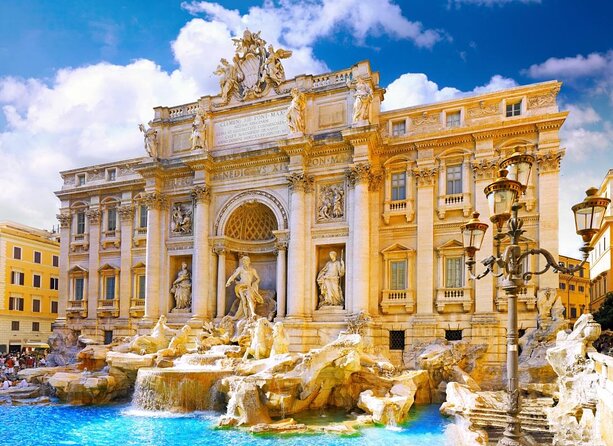
- Trevi Fountain: Acqua Vergine, plus the right-shoulder coin tradition
- Piazza di Spagna: the Bernini Barcaccia fountain and the gelato payoff
- The guide experience: the biggest variable, and how to make it work
- Who this tour is best for (and who should pick another plan)
- Should you book this Rome at Dusk walking tour?
- FAQ
- How long is the Walking and Guided Tour of Rome at Dusk?
- Where does the tour start and where does it end?
- What time does the tour begin?
- How much does the tour cost?
- What’s included in the tour?
- Can I cancel for a full refund?
Quick hits
- Small group, max 20 people for a more personal pace at night
- Dusk timing for Rome’s softer lighting and a romantic feel
- Stop list hits the essentials: Teatro di Marcello, Pantheon, Trevi, Piazza di Spagna
- Gelato is on us and you get it right after the walking portion
- Coin-toss moment at Trevi with a fun, traditional right-shoulder tip
- Most admissions are listed as free at the featured stops
Dusk Rome in 90 minutes: why this route feels made for evenings
This is the kind of Rome tour that works on your first night, when you want your bearings fast. The start time is 8:15 pm, and the whole point is to see the Eternal City when the sky turns dramatic and the streets feel calmer.
You’re led by a guide in a group of up to 20 people, so the experience stays human-sized. Expect a pleasant stroll through the characteristic streets of the Jewish Ghetto area, then a smooth sweep toward Rome’s most famous monuments.
It’s also paced like a real evening out: you look, you listen, and you move on. That matters because Rome’s top sights can feel endless if you try to do them all alone.
You can also read our reviews of more walking tours in Rome
Price and value: what $20 buys you (and what it doesn’t)
At $20 for about 1 hour 30 minutes, you’re paying mainly for two things: a professional guide and the included gelato. The stops are listed with free admission at each featured point, which helps keep the cost predictable.
This isn’t a ticket-heavy day. Instead, you get a guided walking route that layers context over what you’re seeing, so the buildings don’t just look impressive, they make sense.
If you’re traveling on a budget, this can be one of the cleanest values in central Rome: you’re not paying for museum entries, and you’re ending with something enjoyable that you won’t have to hunt for.
If you prefer self-guided travel, you might feel the price is less worth it. You’d still see the same sights, but you’d likely miss the quick explanations that make each stop click.
Getting there and starting on time at Via del Teatro di Marcello
The meeting point is Via del Teatro di Marcello, 00186 Roma RM, and the tour starts at 8:15 pm. You reach the meeting point on your own, and the tour ends at Piazza di Spagna, 00187 Roma RM.
This end point is handy because Piazza di Spagna is a natural hub for evening plans afterward. It also means you won’t spend your last 20 minutes backtracking just to get to where you want to be.
Bring your mobile ticket. Confirmation is received at booking time, so you’re not scrambling for paperwork at the last minute.
Because the tour is near public transportation, it’s easy to connect it with the rest of your Rome schedule. You just want to arrive a little early so the group can start smoothly.
Stop-by-stop highlights, from the Small Colosseum vibe to Piazza di Spagna
Teatro di Marcello: the Small Colosseum you can spot fast
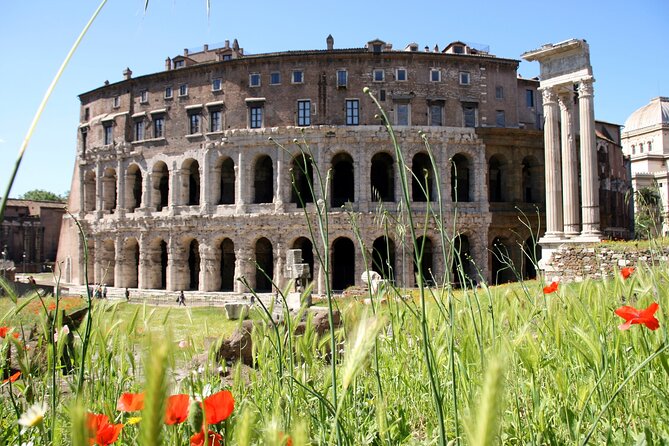
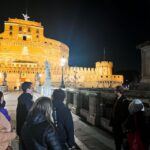
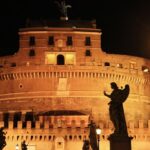
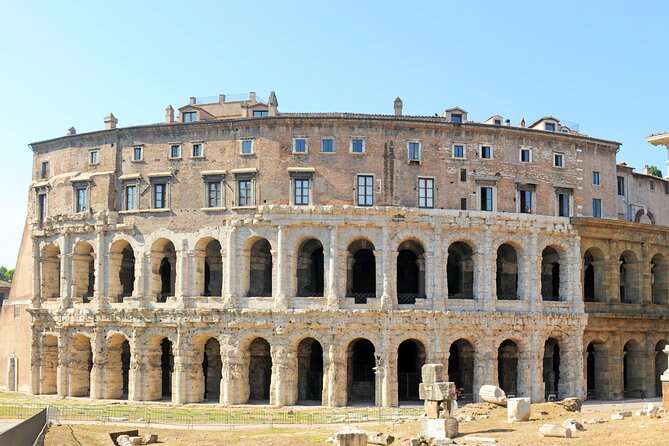
Your first stop is Teatro di Marcello, commissioned by Emperor Augustus. It’s often described as the Small Colosseum because of its similarity in style, but it’s smaller and semicircular.
This is a great first anchor for the walk. You get a strong sense of Roman scale right away, and you start the evening with something unmistakably Roman rather than jumping straight to the postcard fountains.
The time here is about 10 minutes, with admission listed as free. That short stop length is intentional: it gets you oriented without eating up the evening.
You can also read our reviews of more guided tours in Rome





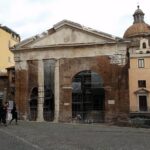
Portico d’Ottavia: preserved entrances and Ghetto-area perspectives
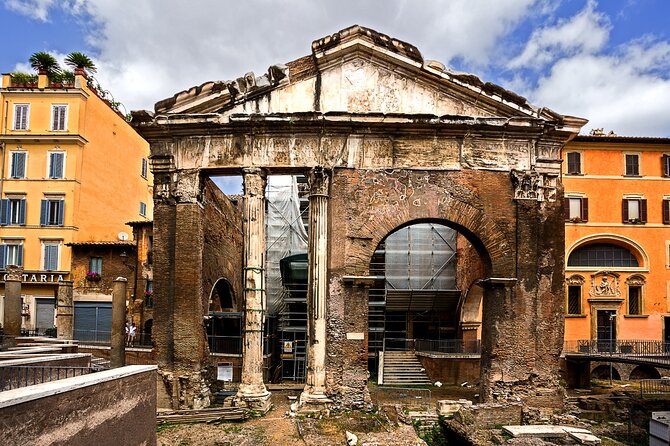
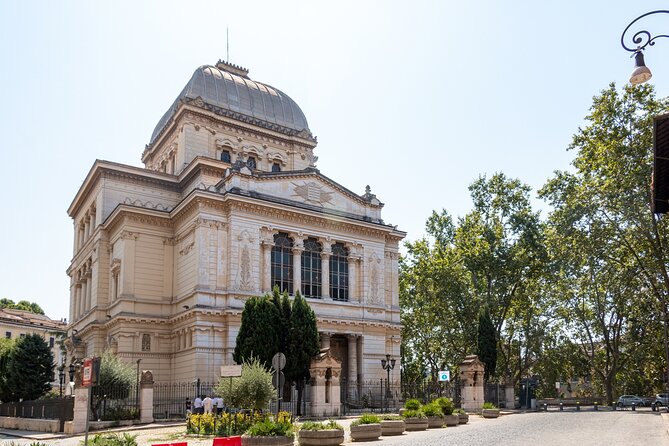
Next comes the Portico d’Ottavia, where only the monumental entrances are preserved. Even with what’s missing, this structure helps shape one of the more evocative views of the area.
This stop matters because it connects architecture to atmosphere. It’s not just another facade photo; it’s a perspective point that helps you understand the streets around you.
Plan on about 8 minutes here, with admission listed as free. Use the time to look for sightlines through the preserved parts, since that’s where the structure really tells its story.
Fontana delle Tartarughe in Piazza Mattei: turtles and a fast Bernini connection
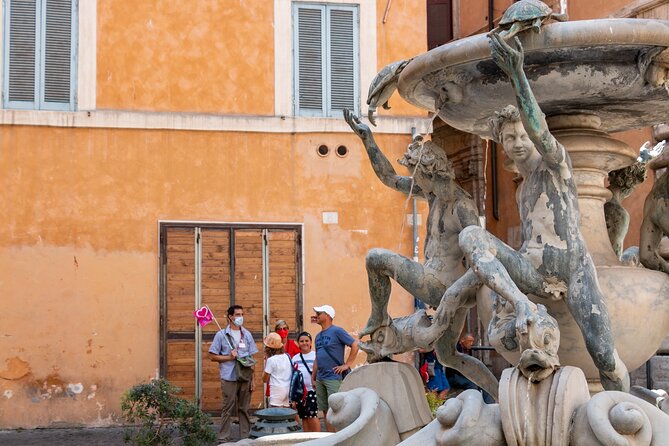
Then you’ll reach the Fontana delle Tartarughe in Piazza Mattei, the turtle fountain everyone notices. It was built toward the end of the 16th century after a challenge, commissioned by Duke Mattei, and the turtles were designed and placed by Bernini in 1658.
Even if you’ve only seen it from occasional photos, seeing it live at dusk gives it a different feel. The fountain becomes a little stage: a compact burst of movement and detail right in the middle of the streets.
The stop runs about 10 minutes with free admission listed. That’s enough time to spot the key details and still keep the walk flowing.
The Pantheon at night: Hadrian, earlier temples, and Christian transformation
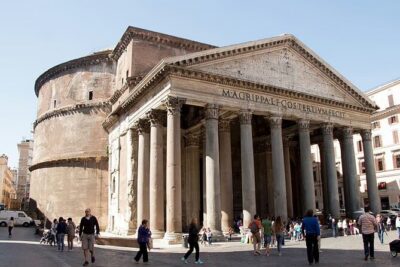
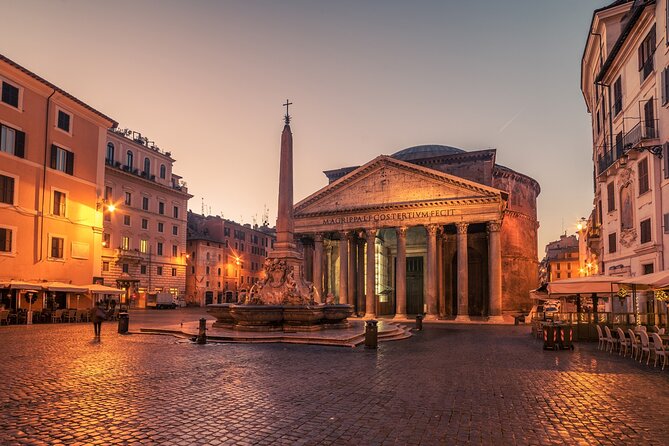
One of the biggest moments is the Pantheon. The site is dedicated to the worship of all the gods, built by Emperor Hadrian between 118 and 125 AD on the remains of an earlier temple from 27 BC, with an inscription from that earlier era.
Later, it became a Christian church in 609 under the name Santa Maria ad Martyres. In 1870, it became the shrine of Italian kings, and it welcomes the remains of Vittorio Emanuele II, Umberto I, and Margherita di Savoia.
You’ll spend about 10 minutes here, and admission is listed as free. This is a quick stop, so the guide’s job is key: you want the main ideas explained in a way that sticks after you walk away.
The best way to enjoy this part is to slow down for a few seconds when you arrive. Let the building settle in your mind, then use the guide’s context to connect the layers you’re seeing.
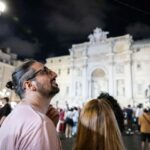
Trevi Fountain: Acqua Vergine, plus the right-shoulder coin tradition
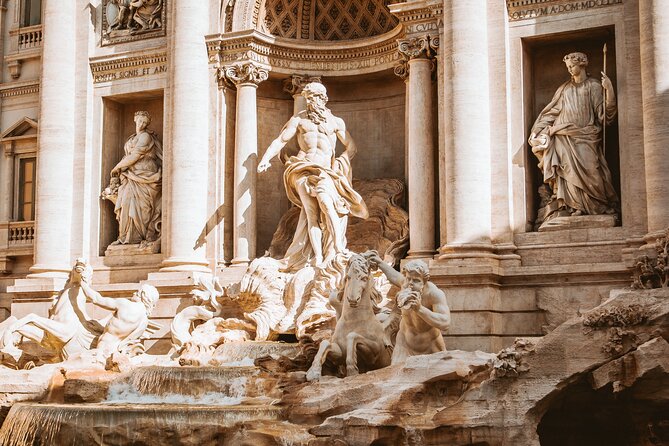
Next is Fontana di Trevi, which is described as Rome’s most scenic and famous fountain. It’s tied to the Acqua Vergine aqueduct, led to Rome in 19 BC under Marco Vipsanio Agrippa to feed the thermal baths.
This is also where the tour adds a classic ritual. You’ll hear the tradition to close your eyes and throw a coin over your right shoulder straight into the Trevi Fountain.
The Trevi stop is about 20 minutes, and admission is listed as free. That extra time is smart because Trevi is the kind of place where people want a moment for photos, a moment for the architecture, and a moment to just look up.
If you don’t like feeling rushed, this is the stop that lets you breathe. Stand where you can see the whole composition, then step aside for your coin moment and your best view.
Piazza di Spagna: the Bernini Barcaccia fountain and the gelato payoff
The walk continues to Piazza di Spagna, one of Rome’s most visited squares. In the center is the Fontana della Barcaccia, a Baroque fountain designed and sculpted by Pietro and Gian Lorenzo Bernini.
Piazza di Spagna is described as having a distinctive butterfly-like shape formed by two triangles that cross at the top. As a final touch, the tour ends in this area, right where it’s easy to keep exploring after you finish.
You’ll spend about 20 minutes here, and this is also where the tour adds the best kind of reward: an authentic Italian gelato, included for everyone. The gelato is a practical ending because it gives you a clear finish line after a good chunk of walking.
The guide experience: the biggest variable, and how to make it work
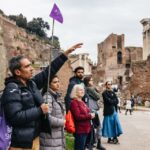
A walking tour lives or dies on the guide. This one is led by a professional guide, and the group size stays small enough that questions actually get answers.
In past experiences tied to this tour, guides such as Francesca, Fabio, Laura, and Davide have been specifically mentioned for bringing history to life and making the walk fun. That’s the level you want: clear storytelling, good pacing, and answers that connect landmarks to what you’re looking at right now.
That said, one note of caution shows up in the overall rating: there’s at least one outlier complaint about an inexperienced or unprofessional guide. You can’t control who you get, but you can control how you handle it.
My advice: stay close at the start, listen for the guide’s main themes, and ask one or two direct questions early. If the energy feels off, you’ll at least have a chance to steer your own experience.
Who this tour is best for (and who should pick another plan)
This tour is ideal if you want a first-night orientation. You cover major sights like the Pantheon and Trevi, plus smaller historical anchors along the way, without committing to long museum blocks.
It also suits you if you like walking at an easy pace with built-in stops for real photos. The small group limit (20 people) helps keep it from feeling like a stampede.
You might want a different plan if you don’t do well with steady walking in the evening. The tour states most travelers can participate, but if your mobility is limited or you tire quickly, the pace may not feel comfortable.
Should you book this Rome at Dusk walking tour?
I’d book it if your goal is simple: see Rome’s big icons in an enjoyable evening format, with a guide who helps the sites make sense, and finish with gelato. For $20 with a professional guide and included treat, it’s strong value, especially since the featured stops are listed as free admission.
I’d skip it if you want a long, slow wander where you control every minute, or if you dislike walking tours in general. And if you’re the kind of traveler who needs deep time in one place, this route may feel too focused and time-boxed.
If you want a practical evening that starts at Teatro di Marcello and ends at Piazza di Spagna, this one is a smart fit. It’s built for getting your bearings, then enjoying Rome while the city is at its most atmospheric.
FAQ
How long is the Walking and Guided Tour of Rome at Dusk?
The tour lasts about 1 hour 30 minutes.
Where does the tour start and where does it end?
It starts at Via del Teatro di Marcello, 00186 Roma RM and ends at Piazza di Spagna, 00187 Roma RM.
What time does the tour begin?
The start time is 8:15 pm.
How much does the tour cost?
The price is $20.
What’s included in the tour?
You get a professional guide and an authentic Italian gelato.
Can I cancel for a full refund?
Yes, you can cancel up to 24 hours in advance for a full refund. If you cancel less than 24 hours before the start time, the amount paid is not refunded.