REVIEW · ROME
Rome Art Walking Tour Who Killed Caravaggio
Book on Viator →Operated by What About Tours · Bookable on Viator
Caravaggio’s clues walk right through Rome. In about two hours, you follow a Baroque “who did it” storyline through major churches and city corners tied to his art, from Piazza della Minerva to Palazzo Borghese. I especially like the energy of guides such as Simone, Ivan, and Jacopo, who bring the paintings to life with dramatic, clear storytelling and help you connect the dots between works and people.
I also like that the tour is built for short stops you can actually handle—no marathon lectures, just focused art moments at each site. One thing to consider: it’s a tip-based tour, so you’ll want to plan for tips, and because many stops are brief, you’ll get more by staying close to the guide instead of lingering a few steps back.
In This Review
- Key takeaways before you go
- Why a Caravaggio mystery tour feels different in Rome
- Price and what your money is really buying (including that $4.83 figure)
- Starting at Piazza della Minerva: Bernini, a temple site, and the right mindset
- Piazza della Minerva to the Pantheon and Palazzo Madama: where art meets power
- San Luigi dei Francesi and Sant’Agostino: the Caravaggio moments you’ll remember
- San Luigi dei Francesi (St. Louis of the French) and the Contarelli Chapel
- Sant’Agostino: Madonna di Loreto plus Raphael’s Isaiah
- Via di Pallacorda and Vicolo del Divino Amore: street “clues” and the Lena storyline
- Via di Pallacorda and the Tomassoni murder scene
- Vicolo del Divino Amore: the model Lena and Caravaggio’s house
- Palazzo Borghese and the secretive Hunting Club thread
- Group size, 5:00 pm timing, and how to get the most from short stops
- Should you book Who Killed Caravaggio in Rome?
- FAQ
- How long is the Who Killed Caravaggio walking tour?
- Where does the tour start and end?
- What time does it start?
- Is the tour offered in English?
- Do I need to buy tickets for the sights?
- What’s included in the price?
- Are tips included?
- How big is the group?
- Can I cancel for a refund?
Key takeaways before you go
- A murder-mystery format that ties Caravaggio’s paintings to places you can see in daylight (and at 5:00 pm light shifts fast)
- Licensed local guide storytelling with named guides like Simone, Ivan, and Jacopo showing up in people’s experiences
- Baroque churches you can’t easily self-navigate, especially San Luigi dei Francesi and Sant’Agostino
- Street-level “clues” at Via di Pallacorda and Vicolo del Divino Amore, where the tour frames Caravaggio’s world
- Small group size (max 25) keeps the experience social but not chaotic
Why a Caravaggio mystery tour feels different in Rome
Rome has a thousand art tours. This one works because it gives you a reason to care, beyond just spotting famous paintings. You’re solving a centuries-old mystery while you walk through a Baroque art circuit, so each stop feels like it has a job.
Caravaggio is perfect for this kind of approach. His paintings don’t feel quiet. The tour leans into the drama—how the works were received, who was involved, and why the stories still stick to the streets today. If you like art history that moves, not art history that recites dates, this tour fits your style.
Also, you get to see the city layered. You’re not only looking at “art in churches.” You’re watching how Roman power, politics, and religion swirl together around the same neighborhoods.
You can also read our reviews of more walking tours in Rome
Price and what your money is really buying (including that $4.83 figure)
The posted price is $4.83 per person, and that makes the math interesting. The tour includes a walking tour, a licensed local guide, and a mobile ticket. There’s also storytelling built to interpret what you’re seeing, not just name-drop artists.
Another value signal: the itinerary notes admission ticket free at several key stops, including Piazza della Minerva and both San Luigi dei Francesi and Sant’Agostino. That matters, because it means you’re not paying your day away on entrance fees while someone explains the art.
One more practical thing: tips are not included, and the tour is tip-based. So yes, the sticker price looks tiny. But your real total cost will depend on what you feel is fair for the guide who keeps you engaged.
Starting at Piazza della Minerva: Bernini, a temple site, and the right mindset
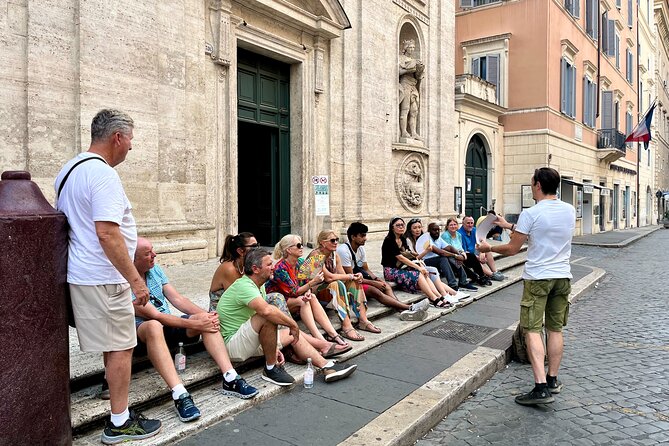
Your tour begins in Piazza della Minerva, near the Pantheon area. This is a smart start because the square itself mixes eras in a small space, and it sets the tone: Rome rarely gives you a clean straight line. The big visual note here is Bernini’s Elephant and Obelisk, plus the nearby Basilica of Santa Maria sopra Minerva, built over an ancient temple connected to Minerva.
When a tour starts with a mix like this, it trains you to look in two directions at once. You’ll be ready for the rest of the walk, where the story keeps jumping between ancient Rome, Baroque art, and the “who’s who” around Caravaggio.
Time-wise, the first stop is around 15 minutes. That’s usually just enough to get your bearings: see the main elements, listen to how the guide links the site to the broader Caravaggio thread, then move on before the group loses focus.
Piazza della Minerva to the Pantheon and Palazzo Madama: where art meets power
From the start zone, you move toward the Pantheon, one of Rome’s big engineering flexes. The building dates back around 126 AD, and the centerpiece is the huge domed roof with the oculus that lights the interior. You’ll also hear that the Pantheon is the resting place of Raphael.
This stop isn’t only about architecture. It helps you understand why Roman religious and cultural life could support—and amplify—the dramatic style Caravaggio became famous for. It’s the kind of setting where art isn’t decorative. It’s part of how people show belief, status, and meaning.
Then the tour brings you to Palazzo Madama, a historic Baroque palace now home to the Italian Senate. Even without going inside, just seeing the kind of building it is helps you grasp that “art Rome” and “political Rome” were never separate. The palace’s aristocratic architecture connects nicely to the way art patronage and power worked in Caravaggio’s world.
San Luigi dei Francesi and Sant’Agostino: the Caravaggio moments you’ll remember
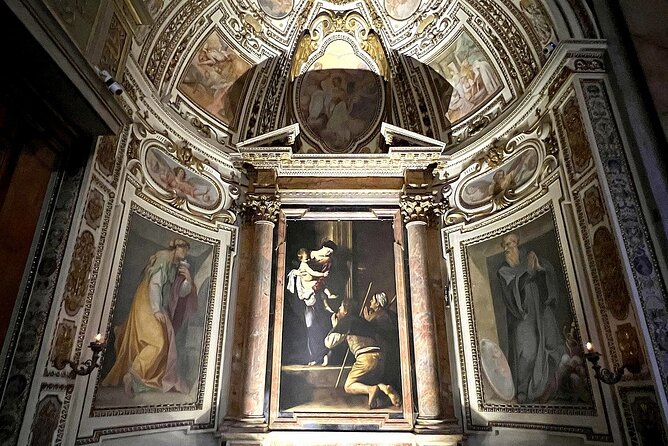
If you care about Caravaggio, these are the stops that tend to do the most emotional work.






San Luigi dei Francesi (St. Louis of the French) and the Contarelli Chapel
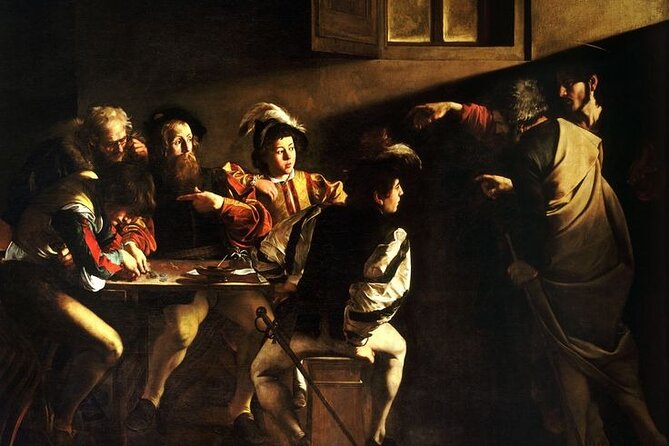
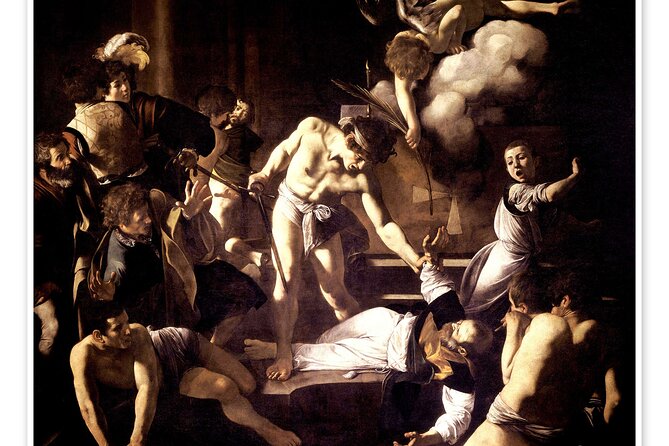
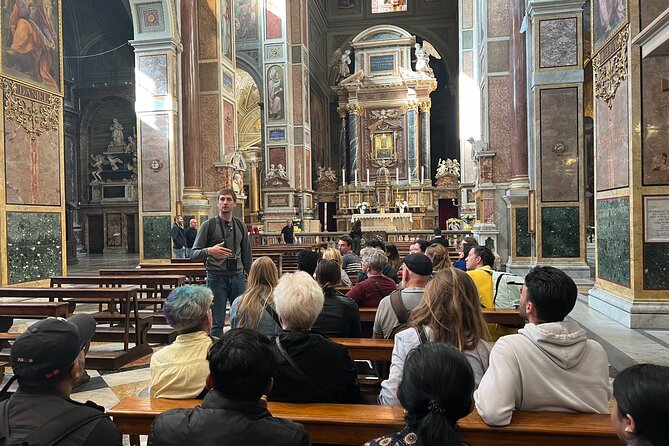
Near Piazza Navona, San Luigi dei Francesi is where Caravaggio’s Contarelli Chapel takes center stage. You’ll focus on three paintings about the life of St. Matthew. The guide’s job here is crucial: Caravaggio’s dramatic style can be easy to admire at a glance. The tour helps you read the scenes—so you understand what makes them feel intense and human rather than staged.
The stop is marked at about 15 minutes with admission noted as free. That short length is actually a plus. You’ll get the essentials and then move before you start tuning out.
Sant’Agostino: Madonna di Loreto plus Raphael’s Isaiah
Next up is Sant’Agostino, near Piazza Navona again. This is one of those Roman churches where your brain has to switch gears because the art mix is so good. You’ll see Caravaggio’s Madonna di Loreto and also Raphael’s fresco of Isaiah.
That pairing matters for what you’re doing on this tour. Caravaggio’s approach feels different from the smoother Renaissance style you associate with Raphael. Seeing both in one place helps you understand why Caravaggio felt controversial, and why his influence kept spreading.
Another 15-minute stop, with admission noted as free, means you’re learning fast without getting stuck too long.
Via di Pallacorda and Vicolo del Divino Amore: street “clues” and the Lena storyline
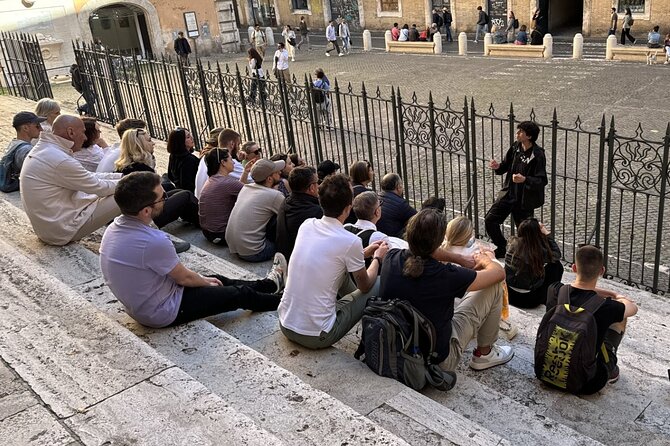
After the churches, the tour shifts from paintings on walls to the narrative of the city itself.
Via di Pallacorda and the Tomassoni murder scene
At Via di Pallacorda, the tour frames the story as a murder scene connected to Tomassoni, identified as Caravaggio’s victim. This isn’t the kind of place where you’ll see a dramatic plaque and instant “gotcha.” Instead, it’s more about context—how the guide ties an artwork’s backstory to a real address you can stand on.
This is one of those moments where staying close to the guide helps. If you wander, you’ll miss the linking story that makes the street stop meaningful.
Vicolo del Divino Amore: the model Lena and Caravaggio’s house
Then you hit Vicolo del Divino Amore, where the tour points out two linked locations. One is described as the house of Caravaggio’s most scandalous model, Lena. The other is described as the house of the controversial painter himself.
Both are listed as short stops (around 5 minutes each). That brevity is fine because the value is listening to how the guide connects these places to the character of Caravaggio’s life and the rumors that followed him. Even if you don’t think of yourself as a “mystery person,” the format turns Rome streets into a story map.
If you’re sensitive to sketchy history or sensational art gossip, keep your expectations realistic. The tour is telling a narrative, using these points in the city to interpret a larger mystery. You’re there to understand how the story has been passed along through art and time, not to treat every detail like a courtroom transcript.
Palazzo Borghese and the secretive Hunting Club thread
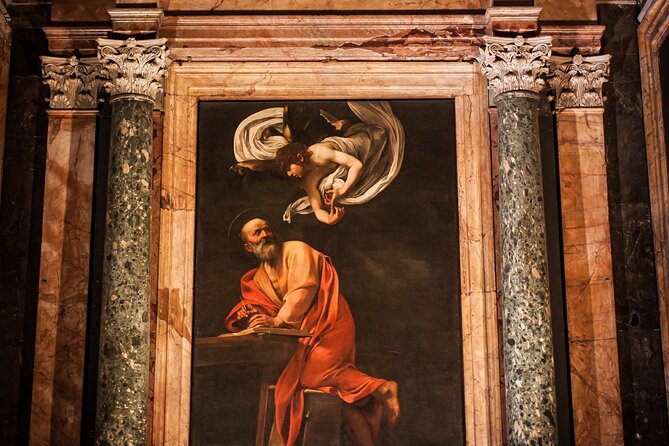
The walk ends at Palazzo Borghese, near the Spanish Steps area. It’s a fitting final stop because the Borghese family represents the kind of elite patronage that could shape an artist’s career.
The tour connects Palazzo Borghese to Il Circolo della Caccia (The Hunting Club), described as an exclusive club founded in the 17th century by the Borghese family. The club is presented as a gathering place for noblemen and intellectuals, with private discussions and art exhibitions, plus hunting activities.
This ending does two things well:
- It broadens your understanding of Caravaggio’s world beyond one artist.
- It reminds you that art stories are also social stories—who had influence, who had access, and who got to decide what mattered.
The final palace stop is listed at about 15 minutes, and it’s where you usually get a last chance to ask questions and tie the “who killed Caravaggio” storyline back to the art you saw.
Group size, 5:00 pm timing, and how to get the most from short stops
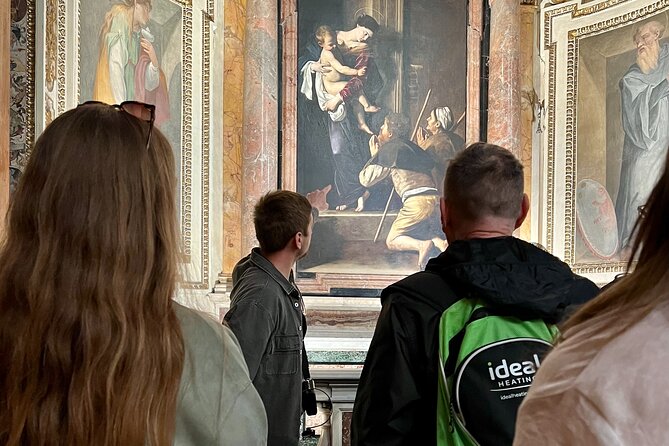
This tour runs in English and has a maximum group size of 25, which is a sweet spot for an art walk. Big enough that you feel the social energy, small enough that you can follow along without losing your place.
It starts at 5:00 pm, so you’ll likely be walking through Rome during that late-afternoon shift when light changes quickly and some places feel calmer than mid-day. That timing is helpful for churches too, because the art doesn’t compete with a crowd so much.
Because the stops are short—many are 10 to 15 minutes, and some are even shorter—you’ll do best if you:
- stay close to the guide during transitions
- treat the story as the “main course,” then look at the artwork right after the guide points you to what to notice
- pause for a moment on the key spots, so you actually connect image + explanation
Also note: the tour uses a mobile ticket. That keeps things easy, and it matters when you’re hopping between nearby sites.
Should you book Who Killed Caravaggio in Rome?
If you like art history with momentum, this is a very strong pick. The format is built around a mystery storyline, and the stops are chosen to show you Caravaggio’s world through church art, street “clues,” and the elite patronage orbit connected to the Borghese name.
I’d especially recommend it if:
- you want to see Baroque Rome but don’t want a slow, lecture-heavy tour
- you care about Caravaggio specifically, and you want context that makes his paintings feel personal
- you enjoy guides who answer questions and keep things engaging (names like Simone, Ivan, and Jacopo show up in past experiences)
One caution: it’s tip-based, and the itinerary is made of brief stops. If you prefer long museum time and unhurried wandering, you might find the pacing a little brisk. But if you want a smart, story-driven walk where every stop has a reason, this one is hard to beat.
FAQ
How long is the Who Killed Caravaggio walking tour?
It lasts about 2 hours (approx.).
Where does the tour start and end?
It starts at Piazza della Minerva, 00186 Roma RM, Italy and ends at Palazzo Borghese, Piazza Borghese, 00186 Roma RM, Italy.
What time does it start?
The start time is 5:00 pm.
Is the tour offered in English?
Yes, it’s offered in English.
Do I need to buy tickets for the sights?
The itinerary notes admission ticket free for multiple stops, including Piazza della Minerva, San Luigi dei Francesi, and Sant’Agostino.
What’s included in the price?
The tour includes a walking tour, a licensed local guide, rare paintings as part of the focus, and a mobile ticket, along with the storytelling approach.
Are tips included?
No. Tips are not included, and it’s a tip-based tour.
How big is the group?
The tour has a maximum of 25 travelers.
Can I cancel for a refund?
Yes, there’s free cancellation. You can cancel up to 24 hours in advance for a full refund.