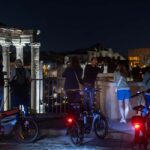
Rome at night is a different city.
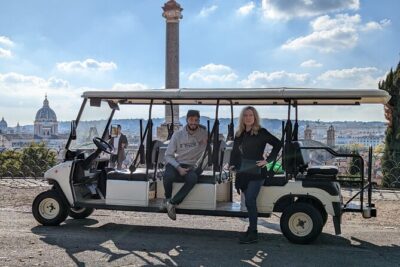
This E-Tuk Tour Rome by Night is a fun, comfortable way to cover a lot of lit landmarks without the stress of stitching together buses and crowds. I like that you get personal attention on a small-group route, and I also like the practical rhythm: you’re moving, stopping for photos, and hearing stories while the city glows. One thing to keep in mind is that time is tight—most stops are around 20 minutes—so if you want long museum-style visits, this is not that kind of tour.
The route is a greatest-hits walk-through of central Rome: elegant streets, famous fountains, big viewpoints, and big-name squares. I especially like the pairing of street-level sights (Via dei Condotti, Piazza di Spagna) with the higher perspective (Terrazza del Pincio), which helps the night feel varied instead of repetitive. As a drawback, entrance planning matters: Colosseum entry is not included, while many other stops have free admission tickets.
In This Review
- Key Things To Know Before You Go
- Why an E-Tuk Tour at Night Works So Well in Rome
- Price and Value: What $90.35 Buys You in 3 Hours
- Getting Onboard: Meeting Point, Pickup, and Mobile Tickets
- The Night Route in Real Time: What Each Stop Feels Like
- Stop 1: Via dei Condotti — Rome’s Elegant Main Street After Dark
- Stop 2: Spanish Steps and Trinità dei Monti — The Square That Always Has a Story
- Stop 3: Trevi Fountain — Coin Toss, Then Look Past the Icon
- Stop 4: Terrazza del Pincio — A View That Changes the Pace
- Stop 5: Piazza del Popolo — Three Streets Meet, Plus Twin Church Details
- Stop 6: Castel Sant’Angelo — From Emperor Tomb to Night Monument
- Stop 7: Il Buco della Serratura (Keyhole of the Knights of Malta) — Point, Look, Smile
- Stop 8: Piazza del Campidoglio — Michelangelo’s Remodel in the City’s Admin Heart
- Stop 9: Piazza Navona — The Famous Square You’ll Recognize Instantly
- Stop 10: Colosseum — The Main Event, With Entry Planning
- Stop 11: Via dei Condotti Again — A Useful Finish Back in the Flow
- What I’d Pack and Plan for This Type of Tour
- Guide Energy: The Difference Between a Sight List and a Story Night
- Who Should Book E-Tuk Tour Rome by Night?
- Should You Book This Tour or Skip It?
- FAQ
- How long is the E-Tuk Tour Rome by Night?
- Is hotel pickup available?
- Where does the tour meet?
- Is this a large tour or a small group?
- What’s included in the price?
- Are monument entrance tickets included?
- Can I cancel for a full refund?
Key Things To Know Before You Go
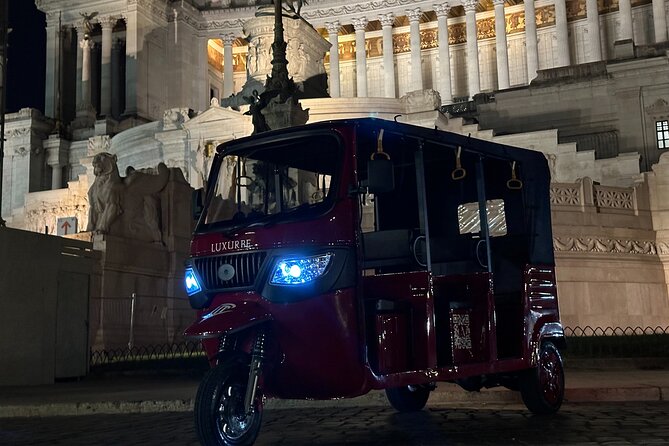
- Small group size (max 15): easier questions, less waiting around, smoother photo stops.
- English-speaking driver/guide: you’re not just sightseeing—you’re getting a running explanation as you go.
- Most stops are short (about 20 minutes): great for an overview, less ideal for lingering.
- Pickup is optional, with a 10-minute waiting window: show up outside your hotel entrance at street level.
- Colosseum isn’t included: you may need to plan for entry separately if you want inside.
Why an E-Tuk Tour at Night Works So Well in Rome
Rome at night has a calm you don’t get at noon. The streets look softer under lights, and the big monuments stop feeling like traffic backdrops and start feeling like scenes. This e-tuk format is made for that mood. You get to glide between sights without spending your whole evening hiking across uneven sidewalks and crossing busy roads—especially helpful when you’re trying to see a lot in a limited time.
The vehicle also changes how you experience the city. Instead of standing in place and scanning, you get a moving view. That makes the illuminated architecture feel more “connected.” And because it’s a small group, you don’t get the feeling of being rushed by a giant crowd.
The real win here is the stories tied to what you’re seeing. The tour is guided by an English-speaking driver/guide, and the stops are designed to cover both famous landmarks and the details that make them make sense. If you’ve only seen photos of Rome, this kind of route helps you build the mental map fast.
You can also read our reviews of more evening experiences in Rome

Price and Value: What $90.35 Buys You in 3 Hours
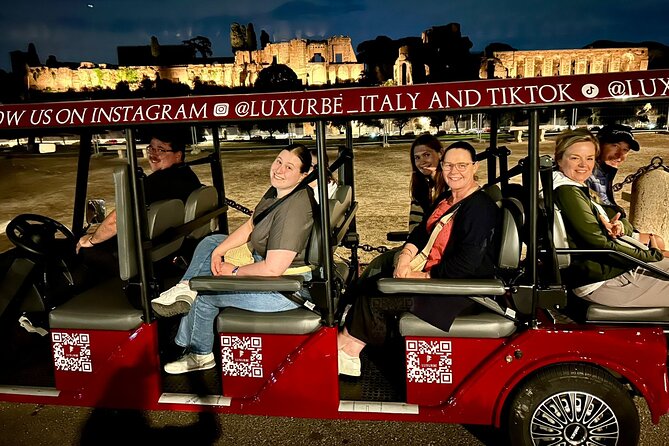
At $90.35 per person for about 3 hours, you’re paying for convenience plus guidance. You’re not paying for a long museum day, and you’re not paying for entrance tickets across the board. The included value is the ride, the guiding, and the fact that you’re stopping at multiple top sights with a set schedule.
Here’s what’s included:
- Guided sightseeing tour by electric E-Tuk
- English-speaking driver/guide
- Audio guides on request (if available)
- Hotel pickup and drop-off if you select it
- Photo stops at main landmarks
What that means in real life: you’ll spend your energy on seeing and listening instead of figuring out routes, parking, or how to get from one lighted square to the next.
You do need to factor one cost issue into the value math: Colosseum entrance isn’t included. Everything else is listed as admission ticket free at each stop, with the Colosseum marked as not included. So the tour is a smart way to see Rome’s highlights and get a strong overview—but if the Colosseum is your “must-see inside” priority, budget for that separately.
Getting Onboard: Meeting Point, Pickup, and Mobile Tickets
The tour starts and ends at the same place: Piazza del Popolo, 11, 00187 Roma RM. If you choose pickup, you wait outside your hotel or accommodation at street level, at the main entrance.
The pickup detail that matters most: the driver arrives at the scheduled pickup time or within a 10-minute waiting window. That’s enough time to make a plan work, but it’s not enough time to wander around looking for the right corner. Be outside, be visible, and be ready a few minutes early.
You’ll also have a mobile ticket, so keep your phone accessible and charged. If you’re traveling with a friend, set a simple meeting rule for the pickup moment—same door, same spot—so you’re not splitting up right before boarding.
One last practical note: e-tuk tours depend on clear pickup points. In the past, pickup confusion has been reported when people arrived early but couldn’t be found quickly. You can’t control everything, but you can control your visibility—stand where the guide expects you.
The Night Route in Real Time: What Each Stop Feels Like
This route is built like a tour of Rome’s “center stage.” You start with elegant central streets, move into famous squares, and then shift toward major monuments and viewpoints. Most stops are about 20 minutes, which gives you time to look, snap photos, and absorb the story—without turning your night into a waiting game.
Stop 1: Via dei Condotti — Rome’s Elegant Main Street After Dark
You begin on Via dei Condotti, one of the central, high-end streets that defines that postcard Rome feeling. At night, the streetlights make the façades look more three-dimensional, and you can actually appreciate the scale of the buildings instead of just rushing past them.
This stop is especially good if you’re arriving in Rome that evening and want an instant sense of the city’s style. It’s also a nice warm-up: you’re not instantly thrown into a crowd of one monument; you’re easing into the look and rhythm of the center.






Stop 2: Spanish Steps and Trinità dei Monti — The Square That Always Has a Story
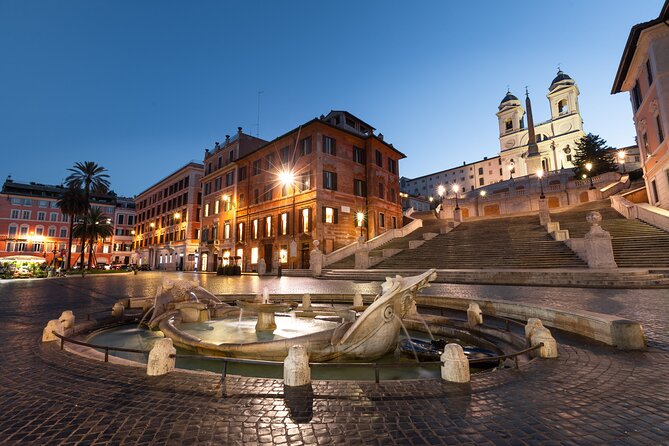
Next is the Spanish Steps at Piazza di Spagna, plus views tied to Trinità dei Monti. This is the kind of location where the architecture and the people both feel part of the scene. Even with a short stop, you’ll have enough time to orient yourself: where the steps rise, where the square opens, and how the church area frames the background.
If you want value, treat this as your “orientation” stop. Take a photo, but also pay attention to sightlines—this helps for the next fountains and squares.
Stop 3: Trevi Fountain — Coin Toss, Then Look Past the Icon
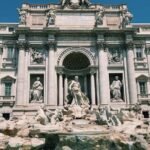
Then comes the big one: Trevi Fountain (Fontana di Trevi). The tour gives you time to appreciate it properly, not just as a selfie backdrop. Don’t forget the traditional coin toss for luck—yes, it’s touristy. But it’s also one of those Rome rituals that you’ll feel better doing as part of an organized plan rather than chasing time later.
In 20 minutes, you won’t memorize every statue detail. But you will understand why this fountain is such a magnet: the scale is the point, and the lighting at night turns the stone into something you can actually study from different angles.
Stop 4: Terrazza del Pincio — A View That Changes the Pace
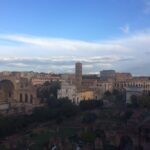
From fountains to a viewpoint: Terrazza del Pincio on the Salita del Pincio. This is where the tour becomes more than walking. You’re taking a step back from street-level crowd energy and getting a broader picture of Rome.
A viewpoint like this is valuable because it connects landmarks in your mind. Even if you can’t identify every domed building instantly, you start to see how Rome’s city center layers upward. For many people, that’s the difference between seeing Rome and understanding Rome’s layout.
Stop 5: Piazza del Popolo — Three Streets Meet, Plus Twin Church Details
Next is Piazza del Popolo. The key idea here is the geometry: it’s where major streets in central Rome meet—Via del Corso, Via di Ripetta, and Via del Babuino. When you stand here at night, you feel how Rome pulls you in multiple directions.
The tour also highlights a detail people often miss: the twin churches on the back of the piazza. That kind of small architectural cue is exactly what makes a guided night tour worth it. You’ll notice things you might otherwise walk past.
Stop 6: Castel Sant’Angelo — From Emperor Tomb to Night Monument
You’ll then reach Castel Sant’Angelo, a site known for its museum reputation. The tour adds a fascinating historical anchor: it was initially designed as Augustus Emperor’s tomb.
Even if you don’t go inside, this is one of those monuments that feels like a story you can see. At night, Castel Sant’Angelo has a dramatic silhouette. And with a short guided stop, you’ll at least come away with a clear “what am I looking at and why does it matter” explanation.
Stop 7: Il Buco della Serratura (Keyhole of the Knights of Malta) — Point, Look, Smile
Then the tour shifts to a clever, very Roman sight: Il Buco della Serratura dell’Ordine di Malta, the famous Keyhole view of Saint Peter’s Basilica. This is one of those “small moment” stops that can still be unforgettable.
It’s not about a long visit. It’s about perspective. You’ll get the chance to frame the view through the keyhole and understand why this tiny opening became such an icon. If you like quirky, high-impact sights, this is one of the best uses of the tour’s limited time.
Stop 8: Piazza del Campidoglio — Michelangelo’s Remodel in the City’s Admin Heart
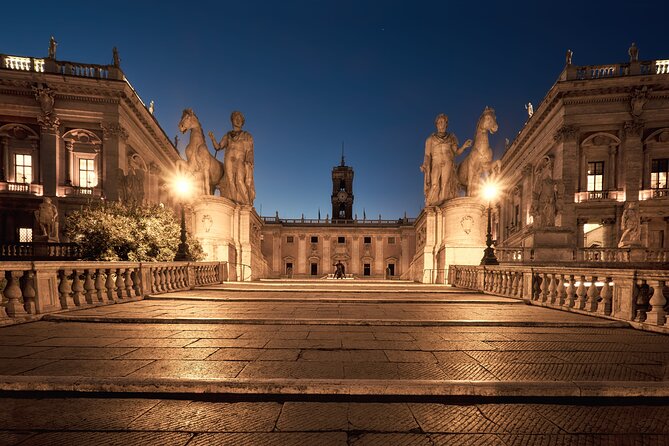
Next is Piazza del Campidoglio. This place isn’t just scenic; it’s tied to the city’s administration, with the headquarters of public administration located there today. The tour also notes that the square was redesigned by Michelangelo Buonarroti.
That makes the stop more interesting than a random piazza photo. You’re seeing how art, politics, and architecture overlap. It’s a strong stop if you want at least one moment where Rome’s layers feel obvious.
Stop 9: Piazza Navona — The Famous Square You’ll Recognize Instantly
Now you’re in Piazza Navona, one of the best-known squares in Rome. The tour frames it around the Four Rivers’ fountain and Sant’Agnese, which helps you look in the right direction.
This is also a good “wrap-around” point before the biggest monument. By now, you’ve seen a street, steps, a fountain, a viewpoint, and multiple historic squares. Piazza Navona pulls it together as a public stage—one where the buildings act like walls around a living artwork.
Stop 10: Colosseum — The Main Event, With Entry Planning
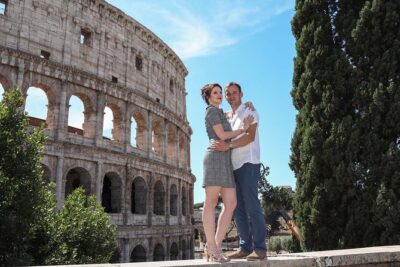
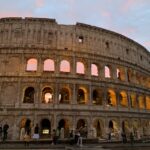
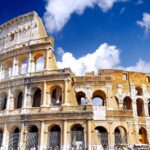
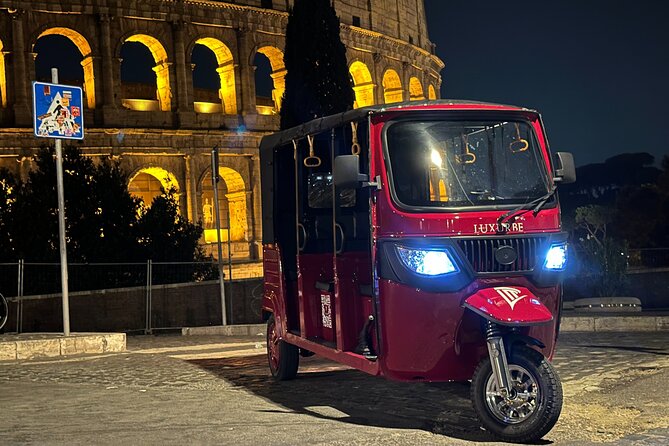
Finally, you’ll reach the Colosseum (Colosseo). The tour gives you context: it’s the biggest Roman amphitheater, designed to host more than 50,000 people, built under the Flavian Dynasty, with construction starting in 72 AD and completed in 80 AD.
The important detail: Colosseum entrance tickets are not included. So you have to decide what you want from this stop:
- If you want outside viewing plus stories, this still works well in the time you’re given.
- If you want to go inside, you’ll need to handle entrance separately.
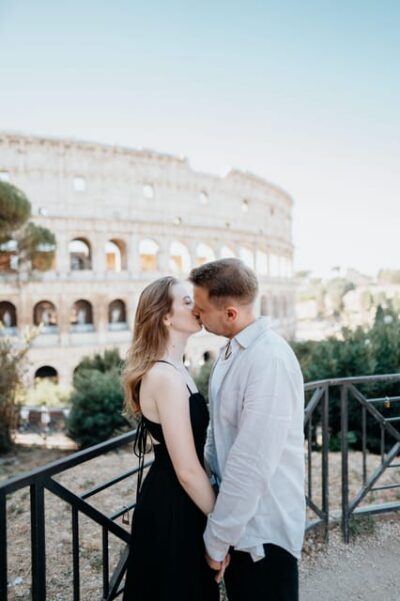
Either way, seeing the Colosseum at night is a different feeling than seeing it in daylight. It’s larger, darker, and more cinematic. Just be sure you’re not assuming entry is part of the ticket price.
Stop 11: Via dei Condotti Again — A Useful Finish Back in the Flow
The last stop returns to Via dei Condotti. Think of it as a closing reset: you’re back on a familiar central street, and it helps bring your night to a clean, repeatable ending rather than a complicated final detour.
What I’d Pack and Plan for This Type of Tour
Even though the tour is set up for you, Rome still rewards a little prep. Here’s what helps you get the most out of a short night schedule:
- Keep your phone ready for the mobile ticket.
- Stay at the pickup spot until the driver is confirmed, since the waiting window is limited.
- Use your 20 minutes at each stop for “look first, then photo.” It’s the easiest way to avoid just snapping and missing the story.
Also, the tour is listed as Most travelers can participate, but always use common sense for how you handle short stops and time in a vehicle. This isn’t a long hike; it’s a ride-through overview.
Guide Energy: The Difference Between a Sight List and a Story Night
This tour’s reputation is built on guide style. Names that have come up include Matt (Mateo), Andrea, and Giacomo—and what stands out across those experiences is a mix of warm personality plus strong command of what you’re seeing. That matters because Rome’s landmarks can feel like trivia if nobody connects them.
If you get a guide with a great delivery, you’ll understand details like why the Keyhole view exists, why Castel Sant’Angelo is tied to early imperial history, and how Michelangelo’s Campidoglio fits into the square’s modern function. That’s the difference between taking a bunch of photos and coming home with an actual sense of place.
Who Should Book E-Tuk Tour Rome by Night?
I’d point you here if:
- You’re short on time and want a fast overview of central Rome in a single evening.
- You want comfort and movement more than walking for hours.
- You like guided storytelling and don’t want to plan each stop on your own.
You might choose a different option if:
- Colosseum inside access is your main goal. Since entrance isn’t included, you’ll need extra planning time and ticket handling.
- You dislike short stop windows. With about 20 minutes per stop, you’ll have to accept a “see it, absorb it, move on” style evening.
Should You Book This Tour or Skip It?
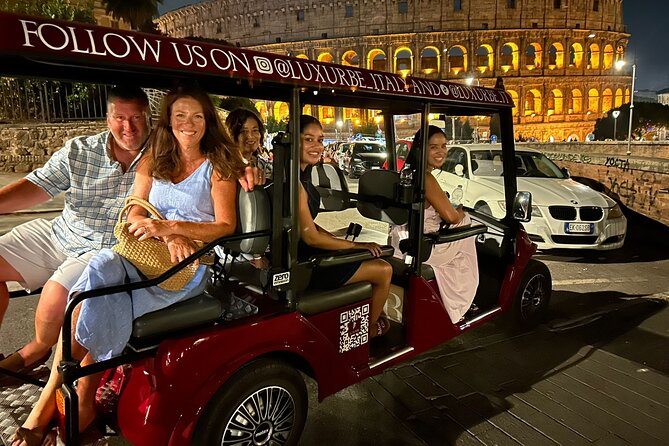
Book it if you want a smart, low-effort way to see Rome’s biggest illuminated highlights without turning your night into logistics. The small group size (max 15) plus hotel pickup options makes it feel smoother than a random hopping-on-and-off plan. And because entrance is listed as free for most stops (with the one big exception of the Colosseum), the tour structure keeps your evening focused.
Skip it if you’re expecting a deep-dive Colosseum visit or long museum time. This is about an overview with stories, not a ticketed, all-access monument crawl.
If you can handle that trade-off, this is a strong pick for your first or second night in Rome—especially when you want to get your bearings fast and leave with a night-time memory of the city’s classic sights.
FAQ
How long is the E-Tuk Tour Rome by Night?
It lasts about 3 hours.
Is hotel pickup available?
Yes, hotel pickup and drop-off are offered if you select that option. You wait outside your hotel at street level at the main entrance.
Where does the tour meet?
The tour meets at Piazza del Popolo, 11, 00187 Roma RM, Italy.
Is this a large tour or a small group?
It’s limited to a maximum of 15 travelers.
What’s included in the price?
The tour includes an English-speaking driver/guide, guided sightseeing by electric E-Tuk, photo stops, and audio guides provided upon request if available. Mobile tickets are used, and hotel pickup/drop-off is included if selected.
Are monument entrance tickets included?
Admission tickets are listed as free for most stops. Colosseum entrance is not included.
Can I cancel for a full refund?
Yes. You can cancel up to 24 hours in advance for a full refund.