REVIEW · ROME
Private Golf Cart Tour of the Eternal City
Book on Viator →Operated by Rome Tours · Bookable on Viator
Rome on a golf cart keeps your day moving. This private tour is all about comfort and backstreet access, so you spend less time stuck in traffic and more time actually seeing Rome. I especially like that your guide can shape the pace and choices around what you want most.
My second favorite part is the guide-led storytelling style, the kind you see in guides like Andrea, Vino, Elaine, and Alex: direct facts, on-the-spot adjustments, and a focus on what you can use to understand what you’re looking at. One consideration: this runs about 2 to 3 hours with short stops, and entry tickets aren’t included, so plan on a few extra costs if you want to go inside certain sites.
In This Review
- Key things to know before you ride
- Private Golf Cart Rome: Why This Format Works
- Price and Group Value: What $930.85 Really Means
- Where You Meet and How the Tour Flows
- Arco di Costantino: Constantine’s Victory in Stone
- Bocca della Verità at Santa Maria in Cosmedin: Legend Meets Detail
- Temple of Ercole Vincitore (Portunus/Or Fortuna Virilis): The Power of Small Stops
- Teatro di Marcello: The Theater That Showcases Rome’s Layers
- Piazza Venezia and Altare della Patria: Rome’s Political Center in One View
- Largo di Torre Argentina: Roman Power Stripped to Foundations
- Piazza di Spagna and the Spanish Steps: Time Your Photos
- Trevi Fountain in Your Own Pace: Big Icon, Big Feel
- Pantheon: Roman Engineering You Can Feel
- Piazza Navona: Fountains, Obelisk, and a Church Designed as Theater
- What It Costs You in Time (and How to Plan Around It)
- Who Should Book This Private Golf Cart Tour?
- Should You Book This Private Golf Cart Tour of the Eternal City?
- FAQ
- How long is the private golf cart tour?
- How much does the tour cost?
- How many people can ride in the group?
- Is there a mobile ticket?
- Is food and drinks included?
- Are entry tickets to Rome attractions included?
- Where do I start the tour?
- Where does the tour end?
- Is this tour suitable for babies or children?
- What is the cancellation policy?
Key things to know before you ride
- Private, up to 6 people: pay one group price and keep the experience focused on your crew
- Golf cart comfort: less walking, more sights, and easier routes through smaller streets
- Guide customization: your guide can tweak what you see to match what you already covered
- Big landmarks, tight timing: expect quick stops at major Rome anchors
- Entry not included: you may need extra tickets for some of the stops
- Mobile ticket: confirmation and access are designed to be straightforward
Private Golf Cart Rome: Why This Format Works
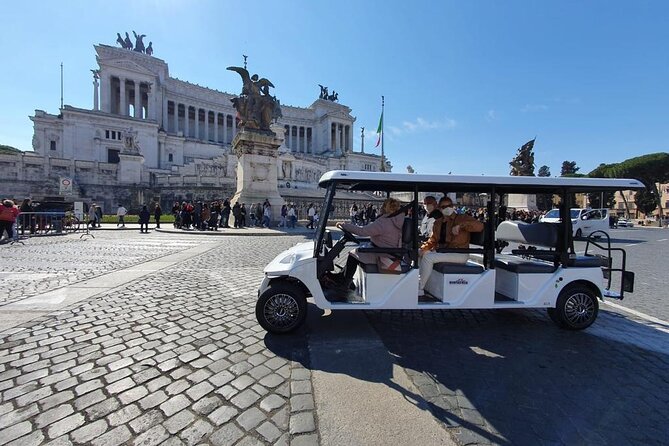
Rome looks best when you can keep momentum. A car gets stuck; a bus is slow; and walking everywhere can turn a great day into sore feet and stress. This private golf cart style is built for the middle ground: you cover a lot of ground without draining your energy.
You also get the benefit of where the cart can go. The value isn’t just that it is a novelty ride. It is that it helps you reach alleyways and backstreets that feel like real Rome, not just a slow-moving queue outside the biggest monuments.
And since it is private, you’re not fighting for time. If your group is more into architecture, you’ll usually get a different emphasis than a group that wants more legend and lively anecdotes. The guide names coming up in feedback—Andrea, Vino, Elaine, and Alex—point to the same thing I look for: people who can explain what you’re seeing clearly, then shift gears when your group’s interests change.
You can also read our reviews of more city tours in Rome


Price and Group Value: What $930.85 Really Means
The price is $930.85 per group, up to 6 passengers, for a 2 to 3 hour tour. On paper that number can feel steep, until you do the math per person. If you fill the cart with 6 people, it works out to about $155 each—often in the same ballpark as a single attraction ticket or a shared guided experience, but with far more time and transport included.
Also consider what you’re buying besides transportation: a professional guide and a route designed to save effort. You’re not just paying for driving; you’re paying for interpretation—what to notice at each stop and how the pieces of Rome connect.
The other value factor is speed-with-understanding. Most people don’t want 90% travel time and 10% looking. This tour aims for more sight time, and the guide’s job is to help you make sense of it quickly.
Where You Meet and How the Tour Flows
You start at Via del Cardello, 31, 00184 Roma RM, and you finish at Trevi Fountain, Piazza di Trevi, 00187 Roma RM. That end point matters. Trevi is a natural bridge to your next plans—dinner nearby, a nighttime walk, or just one more look at Rome’s most famous fountain after your guided timing window.
You’ll be in a private vehicle experience with a guide, so the rhythm is different from a standard group tour. It tends to feel lighter: pause, look, listen, move on. The total time window is short enough to keep energy up, but long enough for the guide to explain why each place matters.
One practical note: admission tickets are not included for Rome entries. That means you should be ready for quick outside views at some stops, and extra ticket costs only if you choose to go in where tickets apply.
Arco di Costantino: Constantine’s Victory in Stone
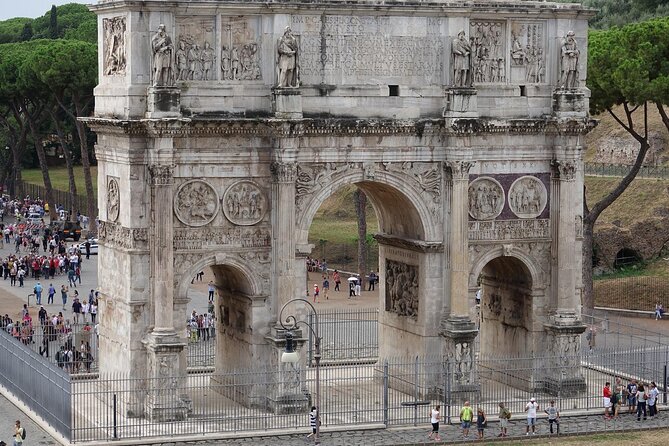
You begin with the Arch of Constantine (Arco di Costantino), near the Colosseum area. It is a triumphal arch, but what makes it interesting is how it tells multiple stories at once. Commissioned by the Roman Senate, it celebrates Constantine the Great’s victory over Maxentius after the Battle of the Milvian Bridge in AD 312.
Look closely and you’ll notice something that makes the arch feel like a snapshot of Rome changing: reliefs and inscriptions incorporate elements from earlier monuments. It is a physical reminder that empires don’t wipe the slate clean—they build, reuse, and reframe.
As a first stop, it sets your lens for the whole day. Instead of treating Rome as a collection of old buildings, you start noticing the political and religious shifts that are literally carved into stone.
Bocca della Verità at Santa Maria in Cosmedin: Legend Meets Detail
Next you head to Piazza della Bocca della Verità, where the Mouth of Truth sits at the Basilica di Santa Maria in Cosmedin. The object itself is a large stone disc with a carved humanoid face, hollow eyes, and an open mouth.
What makes this stop fun is the mix of uncertainty and myth. Its original function is debated: some theories treat it like a ceremonial well cover or a decorative fountain element, while others suggest a manhole cover. And yes, the famous legend says it bites the hand of those who lie—part theatre, part people-watching.
There’s also a real benefit to stopping here even if you already know the legend. The best time to appreciate it is when you can take a few minutes to look at the stonework and understand what you’re standing next to, not just pose for the photo.
You can also read our reviews of more private tours in Rome





Temple of Ercole Vincitore (Portunus/Or Fortuna Virilis): The Power of Small Stops
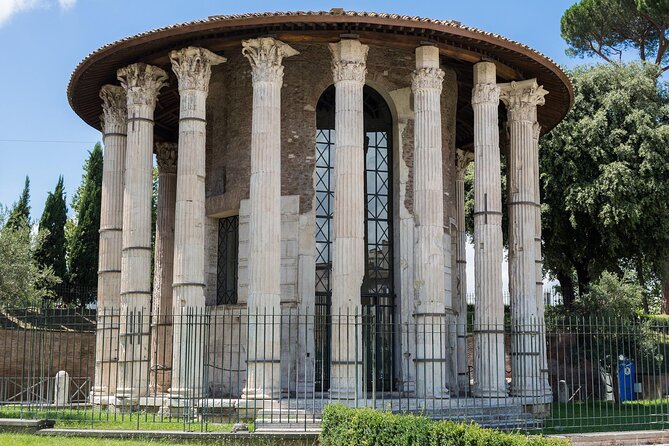
Right by Bocca della Verità is a smaller, easier-to-miss monument: the Temple of Portunus, also known as the Temple of Fortuna Virilis. It dates to the 4th century BCE and it is dedicated to the god of river ports.
This is one of those stops that can quietly become a highlight. The structure is well preserved, and you’ll see architectural mixing—plus Corinthian columns—showing how Roman religious buildings weren’t always purely one style or one era.
The value here is pacing. After big headline sights, this kind of monument helps your brain reset and start noticing proportions, construction choices, and placement.
Teatro di Marcello: The Theater That Showcases Rome’s Layers
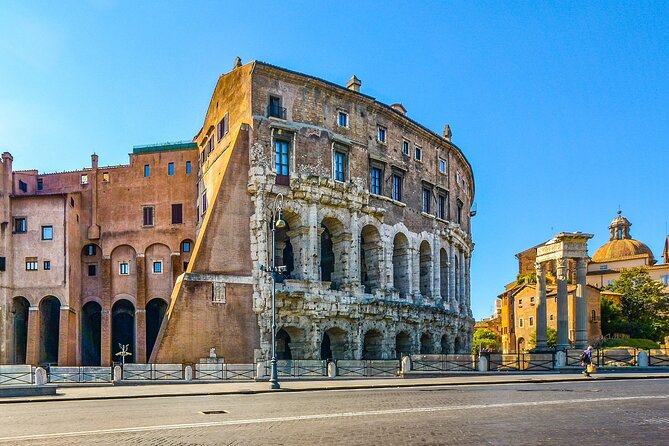
Then you ride (and pause) at the Teatro di Marcello, originally inaugurated in 13 BCE. Julius Caesar commissioned it, and Augustus completed it in honor of his nephew Marcellus. It could hold around 20,000 spectators and was used primarily for drama.
Even when you can’t take in the full theater structure like you would with a major restored site, you can still see why it matters. The semi-circular form and the way later buildings integrate with older construction is a concrete example of Rome’s habit of layering over time rather than starting from scratch.
If you’re the kind of visitor who likes architecture and urban history, this is a stop that pays off because the guide can point out what’s original versus what’s adapted.
Piazza Venezia and Altare della Patria: Rome’s Political Center in One View
You’ll also spend time around Piazza Venezia, at the foot of Capitoline Hill. The square is named after Palazzo Venezia, a 15th-century residence for Venetian ambassadors.
This area is a traffic hub, but it is also a visual hub. The monumental Altare della Patria (Altar of the Fatherland), dedicated to Victor Emmanuel II, anchors the square with modern Italian unification-era symbolism.
It is useful to hit this stop in your tour because it reminds you that Rome is not just ancient ruins. You’re standing in the city’s political and civic imagination too—past and present sharing the same stage.
Largo di Torre Argentina: Roman Power Stripped to Foundations
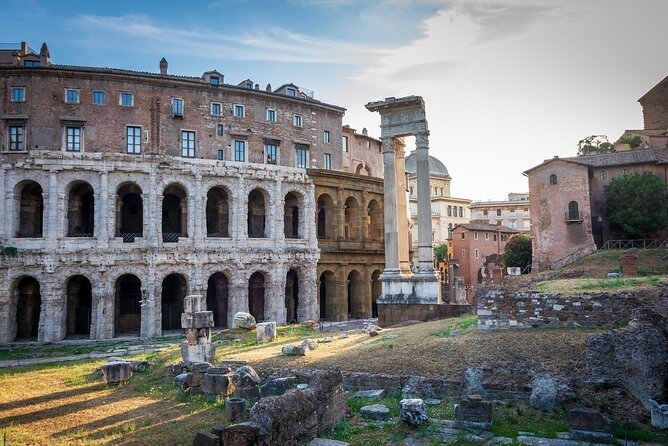
At Largo di Torre Argentina, you’re looking at a famous archaeology pocket that holds multiple eras close together. The site includes four Republican Roman temples dating to the 3rd and 2nd centuries BCE, plus remnants of Pompey’s Theatre, built by Gnaeus Pompeius Magnus in 55 BCE.
It is especially linked to a dramatic moment in Roman legend and recorded history: the assassination of Julius Caesar is believed to have happened here. Whether you focus more on the politics or the physical evidence, it’s a striking place because you can see how foundations create meaning.
There’s also a very contemporary detail you’ll notice immediately: it’s known for a cat sanctuary where stray cats are cared for. It adds a human, everyday layer to the scene without changing the historical weight of the stones.
Piazza di Spagna and the Spanish Steps: Time Your Photos
Next up is Piazza di Spagna, known for the Spanish Steps that connect to the church of Trinità dei Monti above. This square has a constant flow of people, locals and visitors, but the stop still works because it’s visual and easy to understand in minutes.
The area’s name comes from Palazzo di Spagna, which has served as the seat of the Spanish Embassy to the Vatican since the 17th century. That detail helps you see why this is not just a tourist square—it has diplomatic and cultural importance.
A practical approach: if you want iconic steps photos, ask your guide when the light and movement are best during your pause. With a timed tour, you have to work the clock a bit.
Trevi Fountain in Your Own Pace: Big Icon, Big Feel
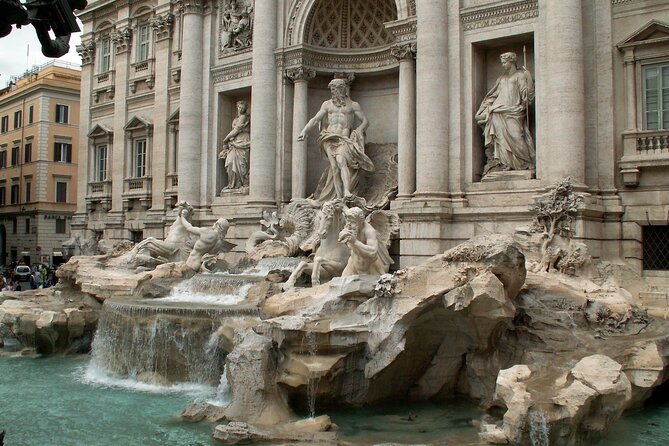
You finish the guided portion at Fontana di Trevi, with time to take it in. It is one of Rome’s most elaborate Baroque fountains, completed in 1762 and designed by Nicola Salvi. The fountain’s central figure is Neptune, flanked by allegorical statues such as Abundance and Health.
The legend is the familiar coin ritual: toss one coin to return to Rome. Even if you’re skeptical, the ritual matters because it becomes part of the way the monument lives in the city.
The biggest value of seeing Trevi on a guided cart tour is control. You’re not trying to squeeze your way through the densest crowd moments while also deciphering the symbolism. You can focus on the composition—how the statues and water form one visual story—and then decide whether you want to stay for longer after the tour ends.
Pantheon: Roman Engineering You Can Feel
The Pantheon is where Rome stops being about seeing and starts being about understanding how builders thought. It is largely made from brick and concrete, with a grand portico supported by 16 granite columns.
Inside, the dome and the oculus create a simple but mind-bending effect. The opening at the top is the oculus, letting in light that moves with the sky. The scale of the dome was once the largest in the world, and the symmetry of the design is one reason the building became a model for later architecture.
This is a stop where your guide really earns their fee. A short time is enough if you know what to look for—columns, portico-to-rotunda alignment, and the lighting effect. Admission is not included for this stop, so you’ll want to decide on the spot whether you’re paying extra to go in deeper.
Piazza Navona: Fountains, Obelisk, and a Church Designed as Theater
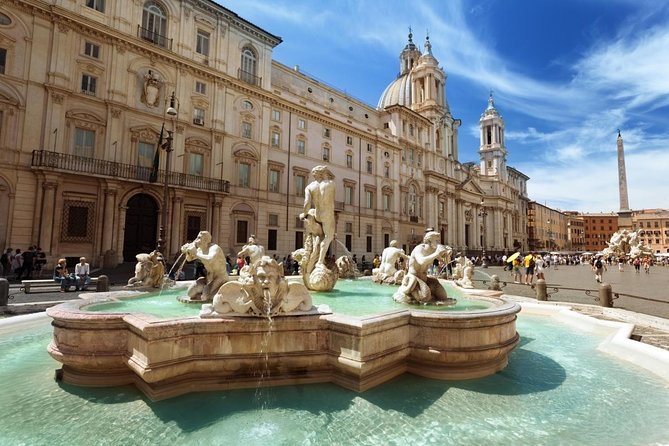
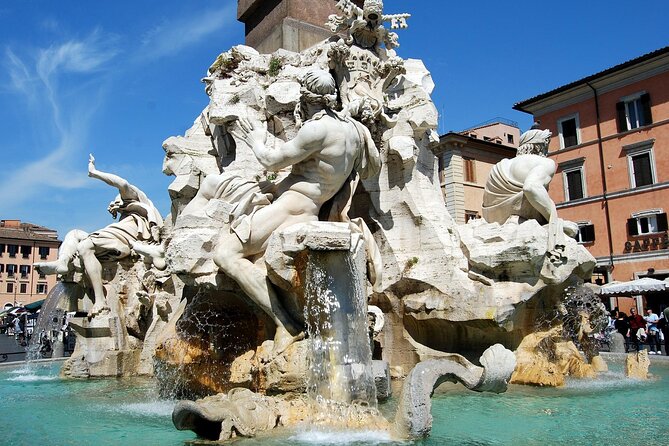
You’ll also make time for Piazza Navona, known for Baroque architecture and its fountain-centered layout. The square features three major fountains, with the centerpiece being the Fontana dei Quattro Fiumi. That fountain includes an obelisk and allegorical figures representing four major rivers of the world.
Look up and you’ll also spot the Church of Sant’Agnese in Agone, designed by Francesco Borromini. The church acts like a backdrop, giving the square a built-in sense of drama.
If you have limited time in Rome, Piazza Navona is a smart choice because it condenses several artistic ideas into one place: sculpture, water engineering, and dramatic architecture. Even from a short pause, you can walk away with a stronger sense of how Baroque design works on the street.
What It Costs You in Time (and How to Plan Around It)
This tour is designed for 2 to 3 hours. That’s great for first-timers, but it does mean every stop is a visit, not a long session.
So I recommend you keep your expectations like this:
- Treat major sights like snapshots that you understand.
- If one place calls to you, save more time for it after the tour.
- For places with extra ticket options, decide quickly so you don’t lose your flow.
Also, you should plan for some walking at each stop, even with the cart. Short distances add up over time, and Rome sidewalks are not always forgiving.
Who Should Book This Private Golf Cart Tour?
This is a strong match for:
- Small groups up to 6 who want more efficiency than a walking tour
- People who hate traffic and want the route kept moving
- Visitors who want context fast—history and symbolism explained at each stop
- Families of adults, couples, and friends who want a relaxed pace rather than a sprint
It is not suitable for babies/children, so if that affects your group, you’ll want a different type of tour.
If you’re someone who already knows a bit about Rome and wants a quick, guided refresher across multiple icons, this hits the sweet spot.
Should You Book This Private Golf Cart Tour of the Eternal City?
Yes, I’d book it if your top priority is saving energy while still getting a guided, high-signal day. The private cart format is especially good for covering the arc from major monuments in the central core to Trevi, with stops that mix big names and smaller architectural moments.
If your priority is deep museum time or long inside visits at several sites, you might find the pacing tight. And because entry tickets aren’t included, you should be ready for a few extra costs depending on what you choose to go into.
If you want an efficient Rome day that feels personal and teaches you what you’re looking at, this private golf cart tour is a very practical way to do it.
FAQ
How long is the private golf cart tour?
It runs about 2 to 3 hours.
How much does the tour cost?
The price is $930.85 per group (up to 6 people).
How many people can ride in the group?
It’s a private tour for your group, with capacity up to 6 passengers.
Is there a mobile ticket?
Yes, it includes a mobile ticket.
Is food and drinks included?
No, food and drinks are not included.
Are entry tickets to Rome attractions included?
No, admission/entry tickets are not included.
Where do I start the tour?
The start point is Via del Cardello, 31, 00184 Roma RM, Italy.
Where does the tour end?
The tour ends at Trevi Fountain, Piazza di Trevi, 00187 Roma RM, Italy.
Is this tour suitable for babies or children?
It is not suitable for babies/children.
What is the cancellation policy?
You can cancel for free up to 24 hours in advance for a full refund. If you cancel less than 24 hours before the experience starts, the amount paid won’t be refunded.