REVIEW · ROME
Pompeii and Naples Day Trip from Rome
Book on GetYourGuide →Operated by Romaetravel · Bookable on GetYourGuide
Few places beat Pompeii for sheer wow-factor.
This Rome day trip strings together Pompeii with an official on-site guide and then feeds you the Naples highlights (from Piazza del Gesù to Piazza Plebiscito) without forcing you to plan the whole day. I also like the practical mix: you get skip-the-line entry at Pompeii, and you’ll stop for an authentic sfogliatella instead of just passing through. One thing to keep in mind: it’s a long 10-hour day with limited time in Naples, so you’ll want to be flexible and realistic about what you can fit in.
You’ll start with pickup from your Rome hotel (only if it’s within the Aurelian Walls area), then ride along the Mediterranean coast for big Amalfi Coast views en route to Pompeii. At Pompeii, the guided visit focuses on the places that make the city feel lived-in—an old food market area, thermal baths, and homes of wealthier residents—so the ruins don’t stay as random ruins. The day is built for people who want a strong overview fast, not for anyone who’s hoping to slow down and wander Naples all afternoon.
In This Review
- Key Things to Know Before You Go
- A Long Day From Rome With Coastline Views
- Getting Pompeii Right: Skip the Line and Follow the Guide
- The Pompeii Stops That Make Ancient Daily Life Click
- The food market area
- Thermal baths
- Wealthy residences
- Naples in a Hurry: Church Squares and Historic Streets
- Via San Gregorio Armeno
- Piazza San Domenico and Piazza del Gesù
- Piazza Plebiscito, Royal Neighbors, and Castel Nuovo
- Sfogliatella Break: The Smart Way to Handle No Lunch
- Price and Value: What $292.28 Buys You in a 10-Hour Day
- Logistics That Matter: Comfortable Shoes and Realistic Time
- Who This Tour Fits (and Who Might Want Another Option)
- Should You Book the Pompeii and Naples Day Trip?
- FAQ
- How long is the Pompeii and Naples day trip from Rome?
- What is included in the price?
- Is there a guide in Naples?
- Do I need to buy Pompeii tickets?
- Is lunch included?
- Can you pick me up from any hotel in Rome?
- Is the tour wheelchair accessible?
Key Things to Know Before You Go

- Official guide at Pompeii: you’ll learn what you’re actually looking at, not just read plaques.
- Amalfi Coast roadside views: you get scenery on the drive, not only city stops.
- Naples highlights in a tight window: Via San Gregorio Armeno, Piazza del Gesù, Piazza Plebiscito, and more get priority.
- Pompeii entry and guide time included: entrance fee at Pompeii is covered, which helps the value feel real.
- Sfogliatella stop: you get an authentic local pastry break before heading back to Rome.
A Long Day From Rome With Coastline Views
This is the kind of trip that makes Rome feel like a launchpad. You get hotel pickup (within the Aurelian Walls), then you head south by road. On this route, you should expect Mediterranean scenery and those classic Amalfi Coast lookouts—good for quick photos and for that moment where you remember you’re not only doing ruins.
The total time is 10 hours, which sounds manageable until you remember it includes riding time plus guided walking. Plan your pace like you’re doing a workout: comfortable shoes, a refillable water bottle, and snacks in case you get hungry before the pastry stop. Since lunch isn’t included, your best strategy is to arrive ready to snack lightly during the gaps.
You can also read our reviews of more tours and experiences in Rome



Getting Pompeii Right: Skip the Line and Follow the Guide

Pompeii is popular for a reason, but it can also overwhelm you fast. That’s why I like the structure here. You’ll use skip-the-ticket-line access, and then you’ll have an official guide at the archaeological site.
This matters because Pompeii isn’t one “main attraction.” It’s a whole city, frozen in time. With a guide, you can connect the dots: what daily life probably looked like, how different neighborhoods functioned, and why certain structures are worth your attention. Without that, it’s easy to walk through and miss the story.
Also, this visit is led in English or Italian, so you’re not stuck relying on translations you have to interpret yourself. You’ll hear context as you move, which is the best way to make the place stick.
The Pompeii Stops That Make Ancient Daily Life Click
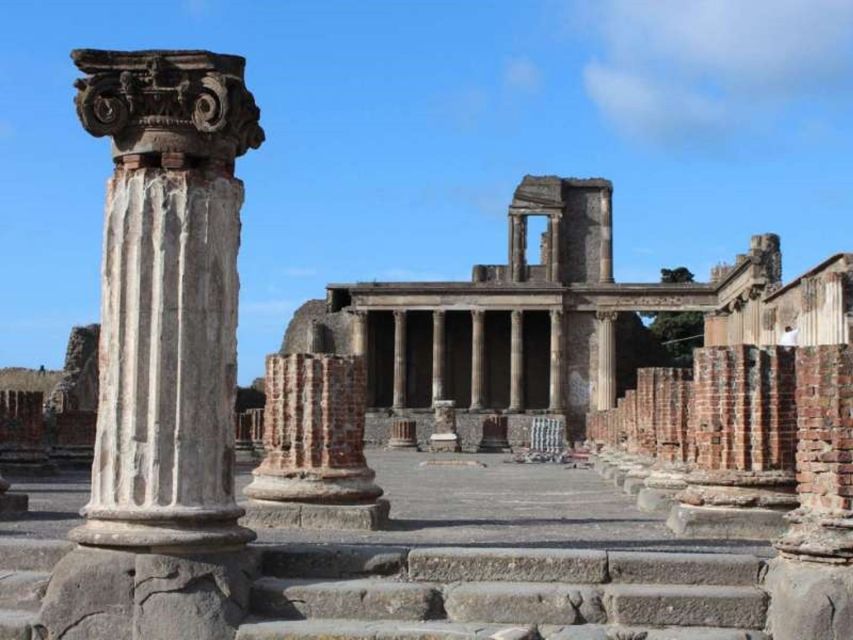
The guided portion focuses on areas that represent real routines, not just fancy architecture. You’ll see remnants of the food market, thermal baths, and residences from wealthier citizens. That trio is smart because it covers three big parts of Roman life: where people shopped and ate, how they relaxed and socialized, and how the wealthy lived.
The food market area
A market stop is where Pompeii starts to feel immediate. You can imagine vendors selling goods, people running errands, and everyday conversations happening in the open. Even as ruins, the layout helps you understand movement—where people likely gathered and how activity was organized.
If you’re the type who likes to look closely, take an extra minute here to notice how the spaces connect. Markets aren’t just about food; they show the city’s rhythms.
Thermal baths
Thermal baths are one of the best “Roman reality checks.” The baths were social spaces, not only places to get clean. When you see the remains, you get a sense of different zones and how the day might have been planned around bathing and hanging out.
If you’ve never been inside a historic bath complex before, this is a great primer. It helps you understand why bath culture was a huge deal in Roman cities.






Wealthy residences
Then you shift to homes of the wealthy, which is where Pompeii can turn from educational to emotional. These residences show what money bought—more comfort, more decoration, and more controlled living spaces. The guide helps you interpret what you’re seeing so it doesn’t become “pretty wall fragments.”
This is also where you should slow down a little. Even if you’re thinking about photos, spend time absorbing layout and scale.
Naples in a Hurry: Church Squares and Historic Streets
After Pompeii, you continue to Naples for the main sights. The tour doesn’t pretend Naples is a 10-hour blur—but it is a high-priority highlights kind of stop. That means you’ll see famous squares and key lanes, while the deeper neighborhoods are for another trip.
Via San Gregorio Armeno
This street is known for shops and craft traditions, and it’s the kind of place where you can get your bearings fast. It’s a good warm-up after Pompeii: more street-level life, less ancient stone.
Piazza San Domenico and Piazza del Gesù
From there, you hit major public spaces. Piazza del Gesù is especially important because it’s tied to monumental church architecture. You’ll visit the Church of Gesù Nuovo and the Basilica di Santa Chiara.
Why these stops matter: Naples isn’t only about individual buildings. It’s about the way squares and churches anchor daily life. These areas are packed with visual cues—facades, steps, and street flow—so you feel like you’re in a living city, not a museum.
And yes, you’ll want to pause for photos, but keep moving. With limited time, it’s easy to get “stuck standing still” and miss the next square.
Piazza Plebiscito, Royal Neighbors, and Castel Nuovo
Naples’ big-canvas moments keep coming. You’ll spend time around Piazza Plebiscito, which is one of the city’s showpieces. Here, you’ll admire the Royal Palace and the Church of San Francesco di Paola.
This part of the day is good if you like contrasts. Pompeii is about daily routines frozen. Piazza Plebiscito is about grandeur and power, staged in open space. Put together, you get a quick lesson in how different eras shaped Naples.
Then you’ll move toward Via Toledo to see the Galleria Umberto I, a stunning glass-and-iron shopping arcade that feels more modern than it looks (in the best way). Finally, you’ll end at Piazza Municipio to appreciate Castel Nuovo, a medieval stronghold that adds another layer to Naples’ timeline.
Sfogliatella Break: The Smart Way to Handle No Lunch
Lunch isn’t included, but you do get a pastry stop for an authentic sfogliatella. I like this choice because it’s local, quick, and filling enough to tide you over while the schedule stays tight.
Here’s the practical tip: treat the sfogliatella like your anchor meal. If you need something earlier, bring snacks. The tour allows you to bring your own drinks and snacks, which is a big deal on a day that’s mostly walking and driving with no lunch.
If you’re sensitive to crowds or long lines, the pastry stop is also a good chance to reset. You’ll likely have a short moment to sit, eat, and regroup before the return ride.
Price and Value: What $292.28 Buys You in a 10-Hour Day
At $292.28 per person for a 10-hour program, the real question is whether the value matches the day. In your favor, several costs that can add up are included:
- Hotel pickup and drop-off
- Transportation
- Entrance fee to Pompeii
- Official guide at Pompeii
What isn’t included is also clear: lunch isn’t part of the price, and there’s not an expert guide in Naples.
So where does that leave the “value math”? You’re paying for guided Pompeii plus a coordinated Naples highlights loop. If you tried to replicate this yourself, you’d still spend time on transport and you’d likely want a Pompeii guide for the context. The small group size (limited to 7) also helps keep Pompeii manageable and the experience less chaotic than a large bus day.
If you’re someone who wants a leisurely Naples day with in-depth commentary everywhere, this price may feel heavy—because the Naples portion is mainly highlights. But if you want the highlights with Pompeii done the right way, the package makes sense.
Logistics That Matter: Comfortable Shoes and Realistic Time
This is a non-stop day, and that affects everything. You’re doing guided walking at Pompeii, then switching to Naples sightseeing, then heading back to Rome. Comfortable shoes aren’t a suggestion here; they’re the difference between enjoying the day and feeling grumpy at every curb.
Also, the tour is not wheelchair accessible. If accessibility is a concern, you’ll need to look for a different format designed for mobility needs.
One more real-world thing: pickup is tied to the Aurelian Walls area. If your hotel is near the edge of that boundary, it’s worth confirming the exact pickup point. And because the Naples time window is tight, don’t plan on detouring to big-ticket extras like museums unless you’re okay skipping something on the main list.
Who This Tour Fits (and Who Might Want Another Option)
This day trip is a strong match for:
- People who want Pompeii with an official guide rather than wandering.
- Travelers who like big-picture pacing: ruins plus major Naples landmarks in one go.
- Anyone who’s short on time in Rome but wants to see more than just Roman ruins.
It may be less ideal for:
- People who want a deep, slow Naples experience with an expert guide for every stop.
- Visitors who hate tight schedules and need lots of “free time.”
- Anyone who struggles with long days of walking and changing neighborhoods.
Should You Book the Pompeii and Naples Day Trip?
I’d book this if your goal is simple: see Pompeii with strong guidance, then get the best-known Naples landmarks without building your own transportation plan. The Pompeii guide and entrance inclusion do the heavy lifting, and the Amalfi Coast views add a nice extra layer you don’t get from a strictly inland trip.
Hold off or ask extra questions first if you’re the type who needs lots of downtime in Naples. Because it’s a 10-hour day, you’ll want your expectations tuned to highlights, not a full second day in Naples.
If you do book, I’d plan like this: comfortable shoes, snacks for between-meals, and a short list of what you most want in Naples (Piazza del Gesù, Piazza Plebiscito, Galleria Umberto I, Castel Nuovo). Then the day feels focused instead of rushed.
FAQ
How long is the Pompeii and Naples day trip from Rome?
The duration is 10 hours.
What is included in the price?
Included are hotel pickup and drop-off, transportation, the entrance fee to Pompeii, and an official guide at Pompeii.
Is there a guide in Naples?
An expert guide in Naples is not included, so you’ll be exploring Naples highlights without a specialist guide.
Do I need to buy Pompeii tickets?
No. The entrance fee to Pompeii is included, and you get skip-the-ticket-line access.
Is lunch included?
No, lunch is not included.
Can you pick me up from any hotel in Rome?
Pickup is possible from your hotel if it is located within the Aurelian Walls area.
Is the tour wheelchair accessible?
No, the tour is not wheelchair accessible.