REVIEW · ROME
Ostia Antica Archaeological Park with Italian Gelato
Book on Viator →Operated by Ideas for Travelers · Bookable on Viator
Rome has a second face: Ostia Antica. This small-group outing takes you beyond central Rome to a once-busy river port city, with a guide who helps you read the ruins like a real place. You’ll walk through major areas of the archaeological park, then head to the medieval Borghetto for a short, scenic stroll.
I especially like the focus on how the city worked—from gates and squares to baths, theatres, markets, and guild spaces. I also like that you get a real break at the end with Italian gelato just outside the medieval walls.
One thing to plan for: the archaeological park entrance fee is not included, so you’ll want to budget extra on top of the tour price. Also, expect a good chunk of walking and a few short stair climbs that you can skip if you’d rather not.
In This Review
- Key highlights to know before you go
- Why Ostia Antica feels different from Rome
- Getting there and meeting at Viale della Stazione di Ostia Antica
- The 2-hour park walk: what you actually see
- Necropolis to Romana Gate: the city begins outside
- Neptune Baths: mosaics plus a view
- Roman Theatre and civic squares: entertainment with a purpose
- Forums, temples, and Castrum: where power shows up in stone
- Painted houses, Diana’s house, and the Thermopolium
- Mills, bakers, and firemen: job titles carved into daily life
- Cisiari’s Baths and the harbor’s sidewalk: finishing with the port feeling
- The Borghetto citadel: medieval Rome next to Roman Rome
- Gelato outside the medieval walls: included and well-timed
- Price and value: what you’re paying for (and what you’re not)
- Practical tips to make the day easier
- Should you book Ostia Antica with Italian gelato?
- FAQ
- Is the archaeological park entrance included in the price?
- How long is the Ostia Antica tour?
- What language is the tour offered in?
- What is included besides the guided tour?
- Where do we meet, and when does the tour start?
- How many people are in the group?
- Do I need a printed ticket?
- Is this tour dependent on weather?
- Can I cancel for free?
Key highlights to know before you go
- A working Roman port, not just ruins: You’ll connect buildings to daily trade and city life.
- Small group size (max 6): More time for questions and a steadier pace.
- A mapped route through the park: Necropolis, gates, baths, theatre, forums, houses, mills, and harbor-side areas.
- Borghetto citadel time: A medieval village stop with the castle courtyard.
- Gelato included: An easy, crowd-free reward right after the medieval section.
- English mobile ticket: Simple check-in and clear guide communication.
Why Ostia Antica feels different from Rome
If you love Roman ruins, you’ve probably already seen the big-ticket sites in Rome. Ostia Antica gives you a different angle. This was a commercial city tied to the river—so the story isn’t only emperors and monuments. It’s warehouses, streets, baths, workplaces, and the rhythms of an operating port.
That difference matters because the park can feel more readable. When a guide walks you through named areas—like Neptune Baths, the Roman Theatre, the Forum zones, and the harbor-side sidewalk—it’s easier to picture what people did here. You’re not just looking at stones; you’re following a lived-in city plan.
Plus, the small group size keeps things calm. With a maximum of 6 people, you’re less likely to get shuffled through the way you sometimes do on larger tours.
You can also read our reviews of more tours and experiences in Rome.



Getting there and meeting at Viale della Stazione di Ostia Antica
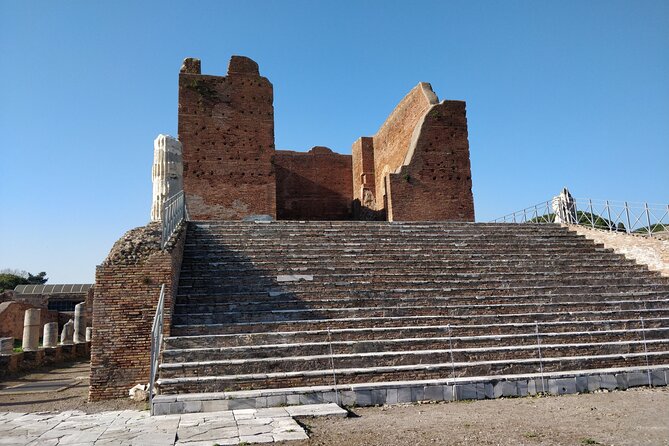
This tour starts at 9:30 am at Viale della Stazione di Ostia Antica, 00119 Roma RM, Italy, and it ends back at the same meeting point. That “start and finish nearby” setup is helpful. You avoid the stress of finding a new location later.
You’ll also find it’s near public transportation, which is great if you want a low-cost day trip. A practical route (if you’re coming from Rome by train) is: take the metro to Piramide station, then connect to the train at Porta San Paolo, and continue on the Ostia-Lido commuter train. The meeting point is right by the station area in Ostia Antica, so it fits this transit strategy well.
If you’re traveling with a stroller or using a mobility aid, note that the day is built around walking through an outdoor archaeological site. The tour’s pace and terrain are part of the experience.
The 2-hour park walk: what you actually see
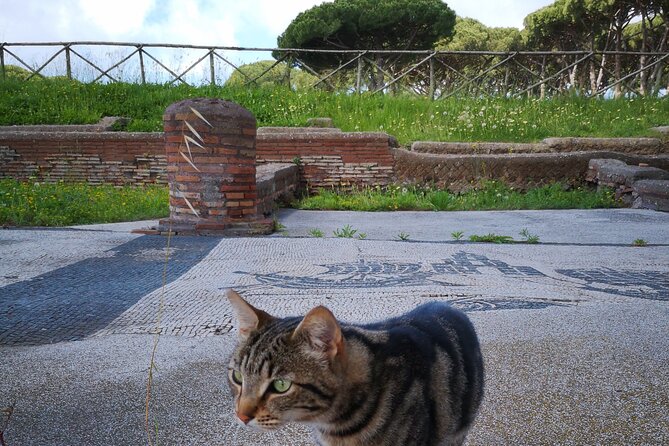
The tour’s main block is about two hours walking through Parco Archeologico di Ostia Antica. Admission tickets for the park are not included, so you’ll want to secure those separately if you haven’t already.
Here’s the real value: the walk follows a route that hits major “life zones” across the city. You’re not randomly bouncing between scattered ruins. You’re moving through a sequence that lets the city feel coherent—like you’re walking inside a map of a real port community.
And this is where Ostia Antica becomes more than a Roman highlight. The site reflects the scale of the Roman Republic’s and Empire’s river trade. It includes monumental public spaces, but also areas linked to everyday routines—baths for daily cleansing and socializing, shops and food culture, and guild-related buildings that show what jobs people did.
Necropolis to Romana Gate: the city begins outside
The walk kicks off with the Necropolis of Ostia Antica, filled with monumental tombs and mausoleums. This start point isn’t just “something to look at first.” It frames the city’s position and importance. Even before you hit the urban core, you get a sense that this place mattered to people and families.
From there, you move toward the Romana Gate and Victory Square along the Decumanus Maximus. The big idea here is orientation. A guide helps you understand where you are in the ancient grid and why the main street mattered for movement and civic life.
If you like history that’s practical rather than abstract, this section is a strong start. You see how roads connected major areas and how public spaces aligned along main routes.
Neptune Baths: mosaics plus a view
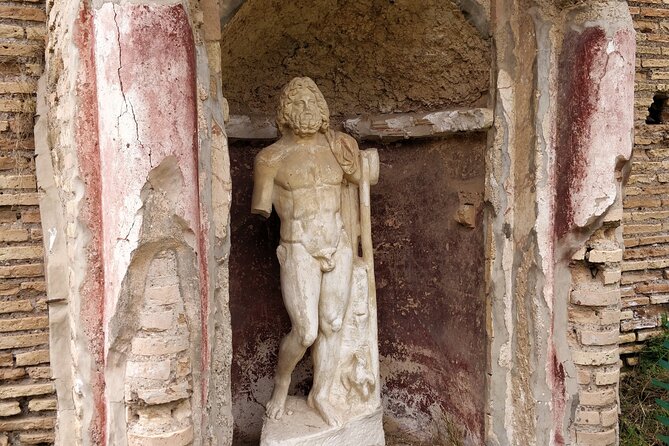
The Neptune Baths are one of the park’s most visually satisfying stops. You’ll get to see their majestic mosaics, and you also get time for the perspective that comes from looking down from higher ground in the area.
That “look from above” moment is worth your attention. It’s one of the easiest ways to understand how large the city was and how different building types relate to one another. Even if you only remember a few details later, this helps your brain form a spatial map.
If you’re photographing, go slow here. Mosaics are detail-heavy, and you’ll appreciate the time to notice patterns instead of blasting through.






Roman Theatre and civic squares: entertainment with a purpose
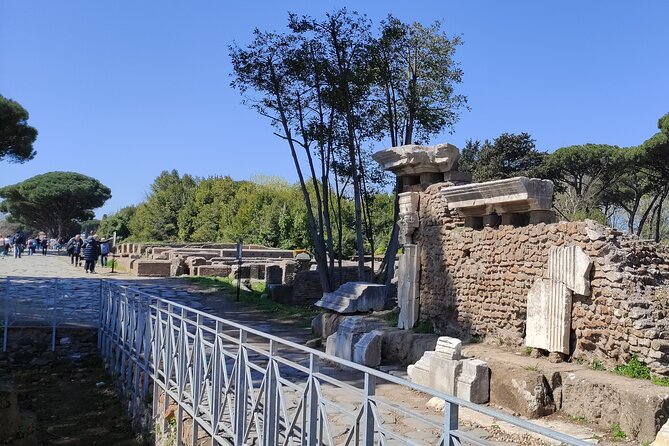
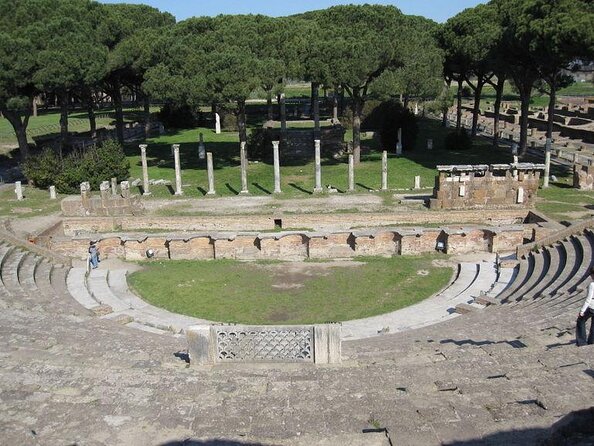
Next up is the Roman Theatre, followed by areas tied to public and commercial life—like Corporation square and the ARA of Romulus and Remus.
What I like about this sequence is that it doesn’t treat theatre as separate from daily life. In a port city, public events and civic rituals mattered because they pulled the community together. A guide’s explanations help you connect these spaces to a working urban rhythm.
It’s also a good “energy shift” in the walk. After mosaics and street orientation, you’re now seeing social gathering space. The ruins feel more alive because you can imagine the crowds and activity.
Forums, temples, and Castrum: where power shows up in stone
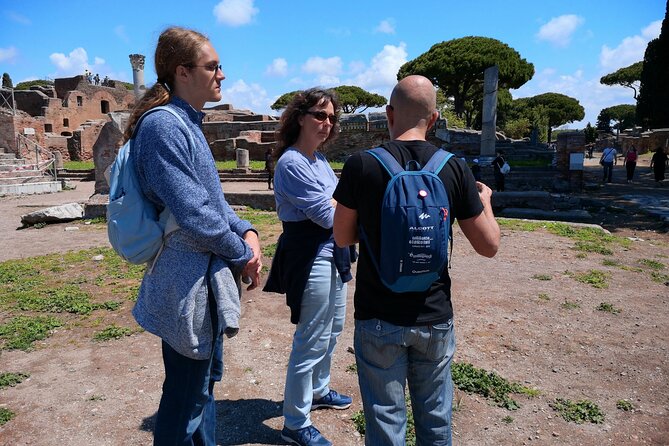
As you continue, the route moves through several central anchors: Forum baths, the Forum, the Capitoline Triad temple, and the Castrum.
This section is the city’s backbone. Even if you’re not a “temple person,” the forum area gives you the clearest sense of civic organization—where people gathered, where important buildings sat, and how authority was expressed in architecture.
The Castrum stop is a useful reminder that cities changed over time. You’re seeing evidence of shifts in priorities and urban structure across different periods of Ostia’s life.
Painted houses, Diana’s house, and the Thermopolium
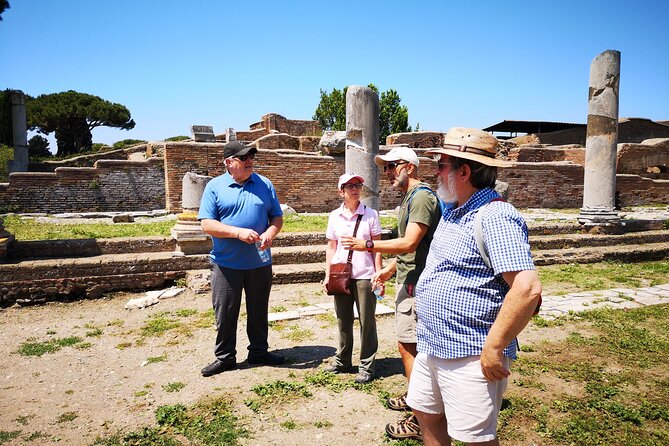
Then the tour gets more human. You’ll walk past painted houses, including Diana’s house, and you’ll also see the Thermopolium.
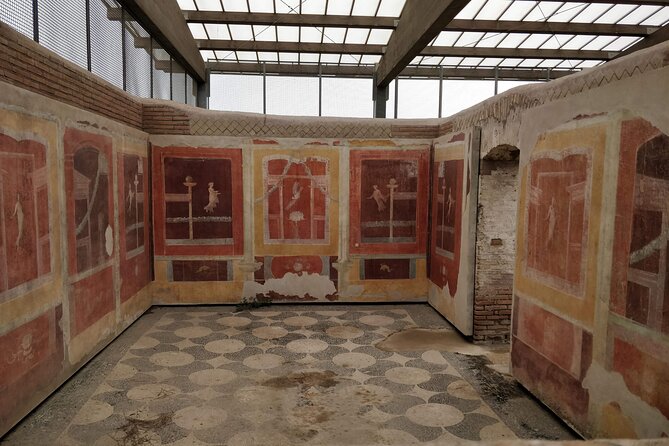
This is where Ostia Antica feels less like a museum and more like a record of regular life. House decoration and commercial spaces show how people lived and ate, not just how they worshipped or governed. It’s a different kind of Roman storytelling.
If you’ve only seen ruins where everything is grand and monumental, this part helps balance the picture. You start noticing how the city supported everyday meals, service work, and neighborhood routines.
Mills, bakers, and firemen: job titles carved into daily life
One of the most memorable parts of this outing is the stop set around Silvano’s Mills, the Guild of Pistores (bakers), and the Firemen headquarters.
These names are gold because they turn the site into something you can picture. Mills mean production. Bakers mean food culture and supply chains. Firemen hint at real urban risk and services in a dense settlement.
This is also a good reminder that Roman cities weren’t only about elite residences and ceremonial spaces. They were made of occupations, logistics, and specialized functions. Ostia Antica makes that clear in a way that’s easy to carry with you after the tour ends.
Cisiari’s Baths and the harbor’s sidewalk: finishing with the port feeling
The route closes in areas tied closely to daily hygiene and the city’s waterfront life, including Cisiari’s Baths and the Harbor’s sidewalk.
Baths are one of the best “feel-good” windows into Roman life because they were social and practical at the same time. Even when the structure is broken, you can still grasp the purpose.
Then the harbor-side focus brings you back to the theme of the day: Ostia Antica as a river port that supported huge commercial movement. When you finish here, you’re better able to understand why this city grew and why it was so important across the Republic and into later imperial times.
The Borghetto citadel: medieval Rome next to Roman Rome
After the park walk, you shift to Centro Storico di Ostia Antica, known as the Borghetto. This is a small medieval pocket with a dating story that reaches back to the 9th century.
The highlight is the Giulio II castle (a citadel with its courtyard area). It was built as part of papal-era strategy tied to controlling river trade along the Tevere and defending farmers from raids by the Saracens. It’s a striking pivot from Roman commercial life to medieval border-and-defense logic, all within the same area of town.
This isn’t a long segment—about 30 minutes—so treat it as a palate cleanser. You’re switching from large open-air ruins to a compact, atmospheric medieval setting.
Gelato outside the medieval walls: included and well-timed
You’ll get Italian gelato just outside the medieval walls, which is a smart placement. It gives you a clear break after a concentrated walking route, and it also keeps the finish feel light instead of rushed.
It’s included as a snack, so you don’t need to budget separately for dessert. If you plan lunch later, this gelato can also help you pace your appetite instead of going from breakfast to a late meal.
Price and value: what you’re paying for (and what you’re not)
This experience costs $119.27 per person for about 2 hours 30 minutes. With a maximum of 6 people, you’re paying for guide-led route planning and interpretation—plus the included gelato snack.
The part you should not miss is that the archaeological park entrance fee is not included. That can change your true total price depending on how much you need to add. If you’re comparing options, make sure you factor that in first.
Booking seems to sell fairly well, too—on average it’s booked about 71 days in advance. If you’re traveling during peak months, earlier booking is the safer move.
Overall, I see the value in two things: the route makes the ruins more understandable, and the small group size keeps your time effective rather than stretched.
Practical tips to make the day easier
Wear shoes you trust. The park is outdoors, and you’ll be walking a lot over uneven ground. Good grip matters.
Bring water. The walk is long enough that you’ll appreciate it, especially on warmer mornings.
Use the view stops, not the stairs. There can be short steep stair climbs in the park area for better overhead views. If you’d rather not do them, you can skip those climbs and still get plenty from the route.
Plan your Rome-to-Ostia transit early. Starting at 9:30 am means you’ll want a calm commute. Once you’re near the station meeting point, everything becomes straightforward.
Expect good weather. The tour requires weather that works for an outdoor walk. If conditions aren’t right, you should expect your operator to offer a different date or a refund.
Should you book Ostia Antica with Italian gelato?
If you want Rome’s ancient world but with less crowd energy, I’d book this. The best reason is the way the walk connects a working river port city to the specific places you’re standing in—necropolis, gates, baths, theatre, forums, house zones, guild spaces, mills, and the harbor-side finish.
I’d also pick it if you like guided explanations that help you understand what you’re seeing. The small-group setup means you can ask questions without waiting your turn in a long line.
Skip it only if you know you don’t want to add a park entrance fee on top of the tour price, or if long outdoor walking is a deal-breaker for you. Otherwise, this is a solid day trip: Roman, but not the same Roman.
FAQ
Is the archaeological park entrance included in the price?
No. The tour price includes the guided walking tour and snacks, but the entrance fee to the archaeological park is not included.
How long is the Ostia Antica tour?
The duration is about 2 hours 30 minutes (approx.).
What language is the tour offered in?
The tour is offered in English.
What is included besides the guided tour?
You’ll receive snacks: Italian gelato during the experience.
Where do we meet, and when does the tour start?
The tour starts at Viale della Stazione di Ostia Antica, 00119 Roma RM, Italy and begins at 9:30 am. It ends back at the meeting point.
How many people are in the group?
The experience has a maximum group size of 6 travelers.
Do I need a printed ticket?
No. The tour uses a mobile ticket.
Is this tour dependent on weather?
Yes. It requires good weather, and if it’s canceled due to poor weather, you’ll be offered a different date or a full refund.
Can I cancel for free?
Yes. Free cancellation is available up to 24 hours in advance for a full refund.