REVIEW · ROME
Moonlight Walking Tour in the Heart of the Imperial & Baroque Rome
Book on Viator →Bookable on Viator
Rome looks different after dark. This 2.5-hour moonlit walk threads together Imperial Rome and Baroque Rome at a time when streets feel calmer and the monuments glow. I like how the route keeps you moving through hidden alleys away from daytime crush, and I love that the focus is on what you see plus the stories behind it—so the architecture doesn’t feel like just another photo stop.
My second favorite thing: each main stop is timed to let you actually take it in, with a local guide explaining the details as you pass landmark by landmark. You’ll also get the best kind of Rome bonus: a night atmosphere that makes places like Trevi and the Roman Forum feel cinematic. One thing to consider is simple: this is a walking tour that runs at 8:00 pm, and the experience depends on good weather.
In This Review
- Key highlights I’d prioritize before you go
- Why a moonlit start time makes sense for Imperial and Baroque Rome
- Where you meet at Fontana del Moro and why the ending at the Colosseum helps
- Piazza Navona after dark: Four Rivers and Sant’ Agnese details
- The Pantheon exterior stop: why it’s so oddly resilient
- Trevi Fountain under moonlight: sound, symbolism, and film magic
- Piazza Venezia and the Vittoriano: modern landmarks in a very old setting
- Trajan Column: a tall monument with big backstory
- Roman Forum after dark: illuminated stones and legend-driven storytelling
- How the guide can make or break the experience (and who shines here)
- Price and value: what $82.80 gets you at night
- Who this moonlight tour is best for
- Quick practical tips for a smooth night walk
- Should you book this moonlight walking tour?
- FAQ
- What time does the tour start?
- How long is the moonlight walking tour?
- Is the tour offered in English?
- Where do I meet, and where does the tour end?
- Is a local guide included?
- Are tickets included for the stops?
- What happens if the weather is poor?
Key highlights I’d prioritize before you go
- Night-first route that aims to keep you away from daytime crowds and traffic
- Baroque focus at Piazza Navona, with art-style clues tied to the period
- Trevi Fountain in its best mood: sound of water, strong lighting, and film-famous vibes
- Imperial Rome after dark with an illuminated Roman Forum and legend-filled stories
- Small group size (max 15) that helps you ask questions and get personal attention
Why a moonlit start time makes sense for Imperial and Baroque Rome

This tour starts at 8:00 pm, which is a sweet spot in Rome. Daytime brings buses, tour groups, and the kind of pedestrian traffic that turns sightseeing into stop-and-go. At night, the streets still have energy, but the pacing is more human. You can look up. You can hear the guide. You can breathe.
The total time is about 2 hours 30 minutes, and the schedule keeps each stop around 10–20 minutes. That matters because you’re not stuck staring at a spot with nothing left to learn. Instead, each location gives you a clear moment to see something specific, then you move on.
Also, the group is limited to 15 travelers. In Rome, that’s the difference between feeling like a herd and feeling like a small group that can actually discuss details.
You can also read our reviews of more walking tours in Rome
Where you meet at Fontana del Moro and why the ending at the Colosseum helps
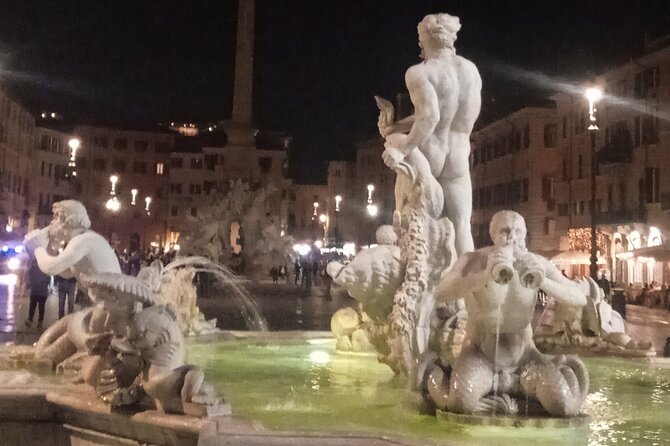
You’ll meet at Fontana del Moro in Piazza Navona. That’s convenient because you’re starting in the heart of one of Rome’s most central, easy-to-navigate neighborhoods. The tour ends at the Colosseum area (Piazza del Colosseo), which is a smart way to finish your night. Even if the tour ends and you’re not visiting anything else immediately, you’ll be set up right where many people want to go next.
Private transportation is not included. That’s normal for Rome walking tours, but it’s still worth noting: you’re expected to handle the walking yourself. Good shoes are a bigger deal than people think when you’re covering multiple historic zones after dark.
The tour also uses a mobile ticket, and it’s in English. If you like clear communication and minimal paperwork stress, that’s a plus.
Piazza Navona after dark: Four Rivers and Sant’ Agnese details
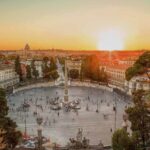
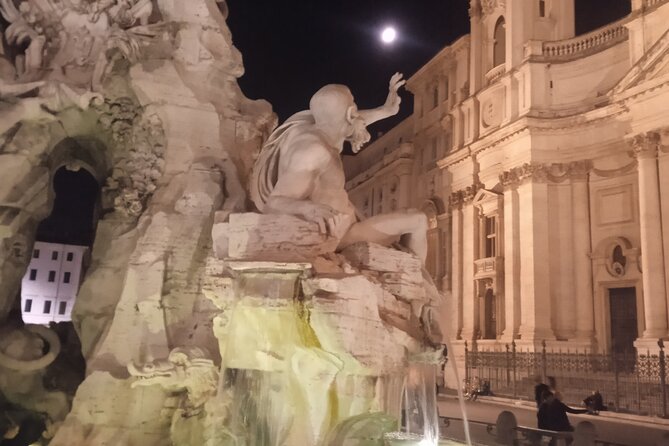
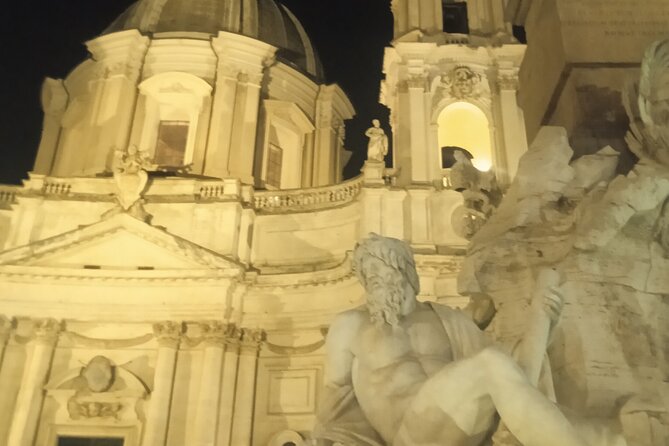
Piazza Navona is famous in daylight, but at night it becomes something else. You start here with time to take in the centerpiece: the Baroque Fountain of the Four Rivers. The key is the Baroque style itself—Rome’s love of movement, dramatic forms, and symbolism. A good guide doesn’t just point. They explain what you’re seeing and why it was built that way.
You’ll also have a close-by look at Sant’ Agnese in Agone, and the tour includes stories that connect the churches and fountains to two major Baroque artists of the period. That sort of detail is exactly what turns Piazza Navona from a pretty square into a lesson you’ll remember.
Timing is about 20 minutes for this start stop. That’s enough time to look, listen, and orient yourself without feeling rushed.
Practical note: this is a big, open piazza. If you’re sensitive to crowds, you may still see plenty of people around it. The tour’s goal is to keep the rest of the experience calmer by the time you move into the next areas.
The Pantheon exterior stop: why it’s so oddly resilient
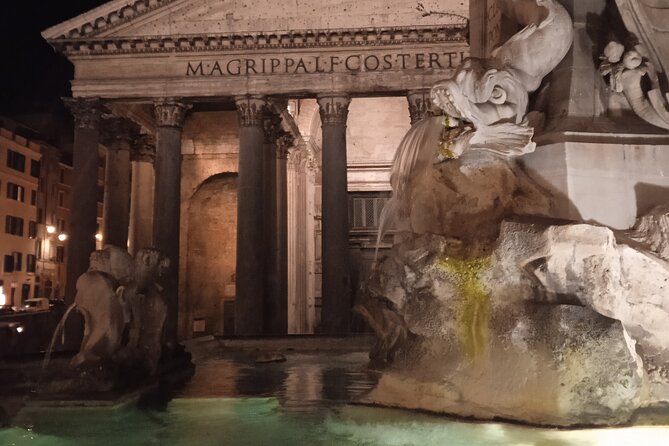
Next up is the Pantheon, viewed from the exterior. You’ll admire it as one of the best-preserved ancient monuments still in use today. The tour also calls out a detail that really helps you understand why the Pantheon has such a hold on people: it was built 3 times and destroyed twice.
That’s not just trivia. It’s a reminder that Rome’s monuments weren’t frozen in time. They changed, were damaged, rebuilt, and survived political and physical chaos. A night walk makes these lessons click, because the stones look less like museum objects and more like real architecture holding up real city life.
This stop also runs about 20 minutes, with admission ticket free as part of what’s included for the stop experience.
If you’re hoping to go inside the Pantheon during this tour: you might find the plan is more exterior-focused than entry-focused. The value here is what you can see and the story you can get without queues.
Trevi Fountain under moonlight: sound, symbolism, and film magic
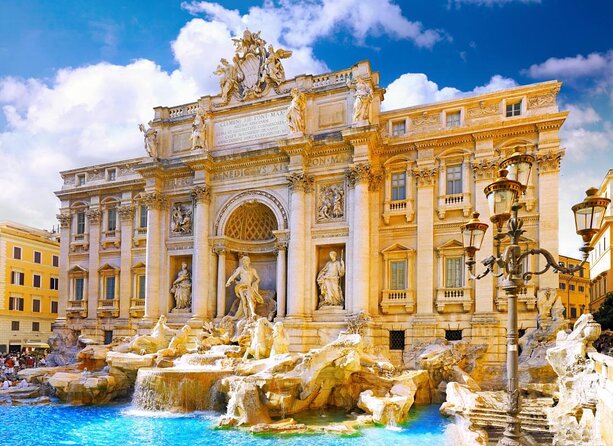
Trevi Fountain is the kind of place that’s hard to appreciate if you only see it from ten feet away in daylight crowds. Here, you get 20 minutes focused on the fountain itself, and the timing helps: the water sound carries, the lighting is dramatic, and you can actually stand close enough to take in the scene.
The tour frames Trevi as a symbol of Baroque style and Roman beauty, and it connects the fountain to popular culture—specifically the legendary film Dolce Vita. Even if you’re not a film buff, the point is useful: Trevi didn’t just become famous because it’s pretty. It became iconic because it’s theatrical, and Rome loves a little theater.
Practical advice: plan to take photos, but don’t camp. Give yourself a few minutes from different angles so you capture the right perspective without blocking the flow.
Trevi is also listed with free admission for this tour’s experience, so you’re not paying extra to see the key sight of the evening.






Piazza Venezia and the Vittoriano: modern landmarks in a very old setting
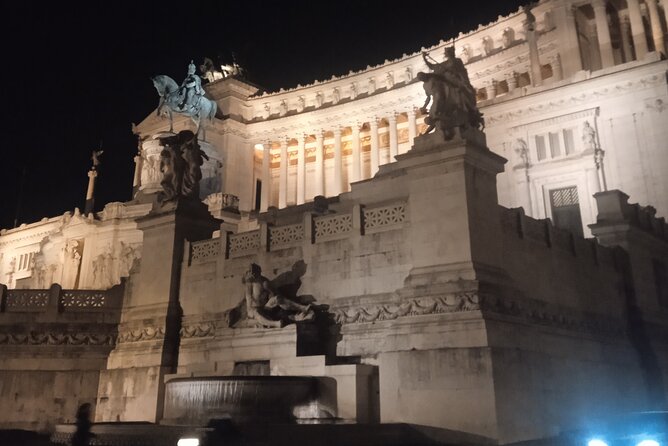
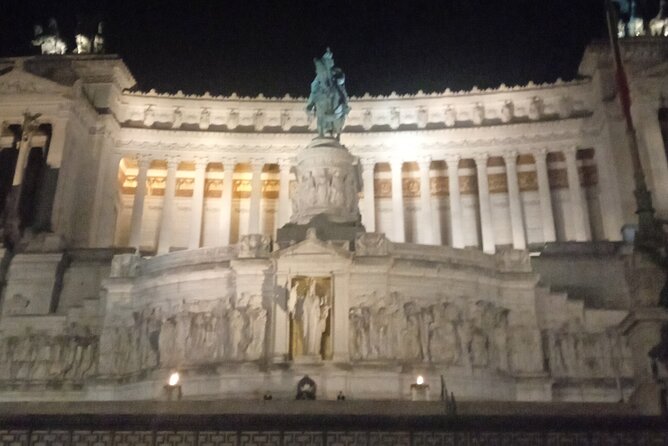
After Trevi, you’ll move to Piazza Venezia for about 10 minutes. This is a shorter stop, but it has a clever purpose: it’s a bridge between the Roman worlds in the tour title—Baroque and Imperial—while also showing modern Rome.
Here you’ll notice the illuminated Altar of the Fatherland, also known as the Vittoriano. It was built to honor the unification of Italy, designed by Giuseppe Sacconi. For many first-time visitors, this is the moment when Rome stops being only ancient. You see how the city keeps layering eras on top of each other.
The vibe at night helps too. The Vittoriano can feel imposing even in photographs, but in person, the scale hits harder when it’s lit.
If you prefer only ancient sights and nothing modern, this might feel like a quick detour. I treat it as a useful palate cleanser before you step deeper into Imperial Rome.
Trajan Column: a tall monument with big backstory
As you enter Imperial Rome, you’ll see the Trajan Column. This stop is timed for about 20 minutes, and it’s built around the feeling of majesty plus the legends tied to Rome’s foundation stories.
Trajan Column isn’t just a tall object. It’s a visual tool. If your guide is good at explaining what you’re looking at, you’ll leave with a better sense of how Romans used monumental art to narrate power—without needing a textbook.
This stop is also marked as admission ticket free, so the cost doesn’t jump due to extra entry fees here.
One thing I like about this tour’s structure is that you don’t linger too long in any one place. You see enough detail to understand why it matters, then you move on while your eyes are still fresh.
Roman Forum after dark: illuminated stones and legend-driven storytelling
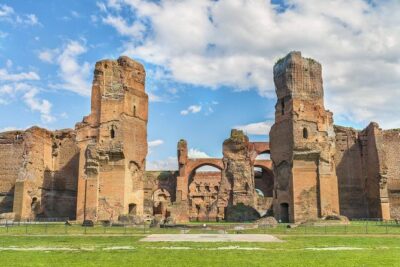
The final major stop is the Roman Forum—about 20 minutes—visited late at night, away from crowds. The Forum is illuminated, and that lighting changes everything. Without daylight glare, the ruins feel more like a stage set. It’s easier to imagine the place as it once functioned, and the guide’s stories land better.
The tour’s focus here is legends and secrets, with history laid out across three crucial Roman periods. It also brings in the human side: scandals and personalities, the kind of stories that make ancient politics feel less abstract and more personal. That’s where the night format helps. At dusk, ruins feel quieter, and you can listen without shouting over crowds.
This is where you’ll likely understand the tour’s overall promise: you’re not just walking past famous sites. You’re getting a narrative thread tying Baroque aesthetics to Imperial power.
Practical note: ruins and old stones can be uneven. If you’re traveling with ankle trouble, take it slow on the footing.
How the guide can make or break the experience (and who shines here)
The biggest consistent theme from the tour’s praised experience is the guide’s ability to connect art and architecture to real stories—especially the Baroque style. Names that came up with strong feedback include Rina, Rena, and Lascarina.
What I’d pay attention to in a guide like these (based on the feedback) is interaction: they answer questions, take pictures with you, and don’t act like you’re just a pair of legs in a line. People also noted one-on-one attention, which matters a lot for a smaller group tour. And there’s a practical benefit too: the guide can give suggestions for what to do next after the walk, so the tour doesn’t end and leave you staring at your map.
If you care about details—fountain symbolism, artistic links, and why each building looks the way it does—this kind of guide is the reason the experience feels special.
Price and value: what $82.80 gets you at night
At $82.80 per person for about 2 hours 30 minutes, this is not a budget-only street walk. But it’s also not priced like a private guide experience. You’re paying for two things: a trained local guide and a curated night route that bundles multiple major sights into one evening.
The value improves because the experience lists admission ticket free at each stop. That means you’re not layering entrance costs on top while you’re already paying for the guided time. You’re also not paying for private transportation, since it’s a walking plan, which keeps the price more reasonable.
The max 15 travelers size is part of the value. In Rome, that usually means more questions answered and less time waiting for the group to catch up.
If you’re comparing against doing the sights alone: you could save money. But you’d lose the explanation layer that ties Baroque artistry to Roman identity, and ties Imperial remains to legends and scandal-driven human stories.
Who this moonlight tour is best for
This tour fits best if you:
- want a guided night narrative instead of solo wandering
- love Baroque art and symbolism, not just the headlines
- are doing Rome for the first time and want a well-paced sampler of both Baroque and Imperial anchors
- prefer smaller groups and good Q&A, not a fast-moving crowd
It might not fit if you:
- don’t want any walking at night
- get uncomfortable on uneven historic surfaces
- prefer a strictly ticketed, inside-entry itinerary (this is mostly focused on exteriors and the illuminated Forum experience)
Quick practical tips for a smooth night walk
- Wear comfortable, grippy shoes. Rome at night is still Rome—stone is stone.
- Bring a charged phone for the mobile ticket, and keep it accessible.
- Expect you’ll want photos at Trevi and the Forum. Plan for short stops and quick angles.
- Since good weather is required, check the forecast before you commit. If weather turns poor, the tour may be rescheduled or refunded.
- The tour is English-only, so plan your language comfort level accordingly.
Should you book this moonlight walking tour?
I’d book it if you want Rome to feel like a story, not a checklist. The combination of Baroque landmarks (Piazza Navona and Trevi) plus Imperial anchors (Trajan Column and the Roman Forum) is a smart evening arc. And the small group setup plus the guide praise for detail and interaction suggests you’ll actually understand what you’re seeing.
Skip it only if you strongly dislike walking at night, want lots of indoor museum time, or you know your weather tolerance is low. Otherwise, it’s a solid way to see some of Rome’s biggest names with meaning—and to do it while the city feels calmer and more cinematic.
FAQ
What time does the tour start?
It starts at 8:00 pm.
How long is the moonlight walking tour?
It lasts about 2 hours 30 minutes.
Is the tour offered in English?
Yes, the tour is offered in English.
Where do I meet, and where does the tour end?
You meet at Fontana del Moro, Piazza Navona, and the tour ends at the Colosseum area, Piazza del Colosseo.
Is a local guide included?
Yes. A local guide is included.
Are tickets included for the stops?
The tour notes admission ticket free for the stops listed.
What happens if the weather is poor?
The experience requires good weather. If it’s canceled due to poor weather, you’ll be offered a different date or a full refund.