REVIEW · ROME
Half-Day Private Tour of Rome by Eco Golf Cart
Book on Viator →Operated by Addicted to Rome · Bookable on Viator
Rome looks better from a cart.
This private Half-Day Rome tour is a fast, comfortable way to see the big landmarks without turning your day into a stamina test. I like the flexibility it offers, so you can steer the experience toward what you actually want to photograph and learn, not just what fits a fixed bus route. I also like how the route pairs headline sights with a couple of Rome detours that most first-timers skip. The one thing to consider is the pacing: with only about 3 hours, each stop is brief, so you’ll want to decide in advance what matters most.
What makes this tour feel special is the guide. In the best examples, guides like Mattea ask what you’re most interested in and adjust the flow for your group, then share clear, site-specific stories as you move between neighborhoods. And when you get a guide like Pietro P, the vibe can turn into something your whole group talks about for days, including families with kids. If you’re hoping for a slow, long wander through museums or churches, this format won’t be that tour.
In This Review
- Key things that make this golf cart tour worth your time
- Why a private eco golf cart is a smart Rome intro
- The meeting point and how the 3-hour format feels
- Piazza del Popolo and Santa Maria del Popolo’s Caravaggio link
- Terrazza del Pincio: the panoramic balcony moment
- Spanish Steps and La Barcaccia: what to look for in 20 minutes
- Trevi Fountain: a short stop with real historical context
- Piazza Navona: stadium shape on ancient Domitian ruins
- St. Peter’s Square from the Vatican edge
- Through the Jewish Ghetto and Circo Massimo by road
- Price and value: $906.97 per group up to 6
- What you get from the guide matters more than you think
- Who should book this Rome golf cart tour
- Should you book it?
- FAQ
- How long is the Half-Day Private Tour of Rome by Eco Golf Cart?
- What’s the price for this private tour?
- Is this tour private?
- Does the tour offer pickup?
- What language is the tour in?
- What are the main stops on the itinerary?
- Is lunch included?
- What’s included in the price?
- Where does the tour start and end?
- Is it cancellable if plans change?
Key things that make this golf cart tour worth your time
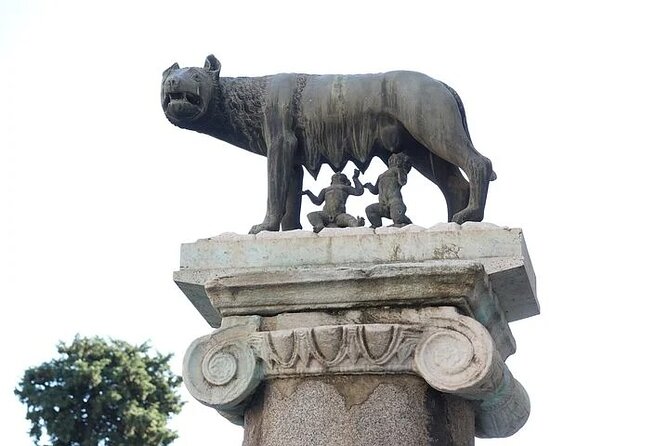
- Private group comfort (up to 6): you’re not squeezed into the loud middle of a bigger crowd.
- A viewpoint-heavy route: you get to reach the scenic spots without banking on steep Rome walks.
- Short, focused stops: enough time to see, react, and grab photos, then move on.
- History plus practical context: Caravaggio, Bernini connections, and fountain backstories get explained along the way.
- A drive through Rome’s layers: Jewish Ghetto lanes and Circo Massimo show the city beyond the postcard core.
Why a private eco golf cart is a smart Rome intro
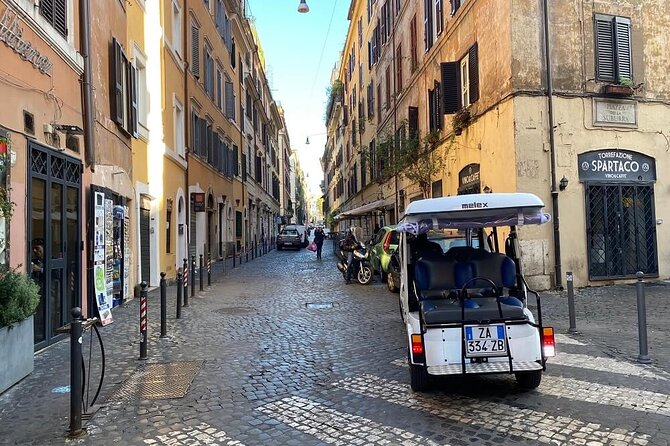
Rome has two speeds: fast crowds at the sights, and slow time when you’re digging into details. This tour gives you the fast speed where it helps you—getting from landmark to landmark—then slows down just enough at each stop to make those moments count. It’s ideal if you’re arriving for the first time and want a strong map in your head before you start picking neighborhoods.
The “eco golf cart” part matters too, because it changes how you experience the city. You’re not constantly hunting for parking, or rationing your energy for walking. Instead, you sit back between stops and watch Rome unfold around you, which is a big deal if your group includes people who don’t want to spend hours on uneven sidewalks.
The tour is also private, meaning only your group rides. That reduces the feeling of being shuffled through photo stops on a timer. It’s much easier to ask questions, and guides can respond to what your group cares about.
You can also read our reviews of more private tours in Rome


The meeting point and how the 3-hour format feels
This tour starts and ends back at Piazzale delle Canestre, 00197 Roma RM, Italy. That matters because you’re not spending your half-day figuring out transit logistics across town. It’s also offered in English, and a mobile ticket is provided, which is handy if you like keeping everything on your phone.
In practice, about 3 hours is just enough time to touch a lot of Rome’s most famous scenes. Each stop runs roughly 10 to 30 minutes, and the route is built around that. You’ll get the “wow” moments—like Trevi Fountain and Piazza Navona—but you won’t get the kind of lingering that turns into half a day at a single location.
If you want the best experience, think like this: use the cart time to arrive at the right place, then use your minutes on the ground to do three things—look up, take the main photo, and ask one good question. When you do that, the short schedule feels efficient instead of rushed.
Piazza del Popolo and Santa Maria del Popolo’s Caravaggio link
Your first stop is Piazza del Popolo, one of Rome’s most dramatic squares. It’s framed like a stage, so even a quick visit gives you instant “this is Rome” energy. You also get Santa Maria del Popolo nearby, and the church is known for paintings by Caravaggio—a detail that gives you more to notice than just the facade.
The 20-minute window is short, but Piazza del Popolo is perfect for a quick orientation. It helps you understand how Rome’s big urban planning works—wide open space, then art and architecture rising around you. If you’re the type who likes to know what you’re looking at, this is a good first stop because the guide can set the tone for the route.
One practical consideration: even though the stop is brief, squares in Rome can attract crowds. If you’re sensitive to noise or crowded sidewalks, aim to step into calmer spots while your cart is staged and let the busiest edges pass.
Terrazza del Pincio: the panoramic balcony moment
Next up is Terrazza del Pincio, a scenic terrace with a panoramic view of the city. The best part is that you get a big-picture view quickly, including the view back toward Piazza del Popolo from the balcony area. This is the kind of stop that helps your photos look more “Rome-wide,” not just close-up landmarks.
This is also where the golf cart structure shines. You get the viewpoint benefit without turning your half-day into a long climb-and-descend routine. With about 30 minutes here, it’s enough time to pick a viewpoint angle, catch the light, and settle your bearings for the day ahead.
If you’re traveling with kids or anyone who dislikes long walking days, this stop is usually a win. It’s memorable, it’s scenic, and it doesn’t require museum stamina.
Spanish Steps and La Barcaccia: what to look for in 20 minutes
Then you hit the Spanish Steps and Piazza di Spagna. The staircase is famous for a reason: it pulls you in with symmetry, texture, and that classic Rome photo angle. There’s also the fountain La Barcaccia, connected to the Bernini family, which adds another layer beyond the obvious staircase.
With about 20 minutes, your goal should be to see the steps from more than one perspective. Walk a little around the piazza edge if you can, and look for where the fountain sits relative to the stair lines. That’s how you turn a quick stop into something more satisfying than a single snapshot.
A tip for best results: decide where your group wants to stand for the “hero photo,” then use the remaining time to explore the details—stone edges, fountain basins, and the geometry of the square. It’s the geometry that makes these spots work so well in photos.
You can also read our reviews of more tours and experiences in Rome


Trevi Fountain: a short stop with real historical context
Fontana di Trevi is next, and yes, it’s crowded. Still, it’s one of those places where even a short visit can feel complete—especially when you know the story behind what you’re seeing. The fountain you recognize was built on the facade of Palazzo Poli. Work began in 1732 with Nicola Salvi, and after later changes, it was entrusted in 1759 to Pietro Bracci, helped by his son Virginio, with completion leading to an inauguration in 1762.
That timeline isn’t just trivia. It changes how you look. You start noticing the ambition of the design—this wasn’t a small roadside fountain. It was a major project, and the scale feels intentional because it took decades to finish.
With about 20 minutes, you won’t do a deep artistic study. But you can still get the essence: the facade, the flow of water, and the famous central composition. If you want your best shots, treat your first minute there as a scouting run, then commit to one main spot for photos.
Piazza Navona: stadium shape on ancient Domitian ruins
After Trevi, the route moves to Piazza Navona, one of Rome’s most celebrated squares. It has the layout feel of an ancient stadium, which is exactly what it was built to echo. The square was commissioned by the Pamphili family under Pope Innocent X (Giovanni Battista Pamphili), and it sits on the ruins of the ancient stadium of Domitian.
This is a good stop to slow down mentally, even if time is short. You’ll see how the square’s curve and long proportions work, and you’ll understand why it feels like a place designed for crowds and spectacle. The fountain and street life keep the square lively, but the geometry is what makes it historic rather than just scenic.
Drawback to note: Navona is a magnet for street activity and noise. If you need quiet for photos, go for a position a bit away from the most concentrated center. Your guide can also help you time your steps so you’re not stuck waiting for a clear shot.
St. Peter’s Square from the Vatican edge
Next comes St. Peter’s Square, in front of St. Peter’s Basilica. You’re in the zone where Vatican City meets the Italian state, and the border context is part of the atmosphere—one city, but two different realities right next to each other. The stop focuses on the grand view of the square and the surrounding structures, including what you can see of the Papal Palace area from where you’re positioned.
With about 20 minutes, you won’t do an extended basilica visit during this tour. But you can still take in the scale: the way the square opens out, and how it funnels your eye toward the basilica itself. This is one of those “you get it fast” places.
If you’re the kind of visitor who likes knowing what’s where, ask your guide about what defines the square’s design and why it feels so ceremonial. A good guide can make the space feel less like a postcard and more like a place with a function.
Through the Jewish Ghetto and Circo Massimo by road
Two of the most interesting route moments happen as drive-by stops.
First is Antico Quartiere Ebraico, a drive through the lanes of the Jewish Ghetto in Rome. With about 10 minutes, it’s not a historical walking tour, but the experience of passing through the alleys gives you a sense of how the city layers itself over time. It’s a reminder that Rome isn’t only marble squares and major churches.
Then you get Circo Massimo, the ancient Roman circus in the valley between the Palatine and the Aventine. It’s remembered for games from very early on, plus the chariot-race tradition. There’s also a famous myth tied to the area: the episode of the rape of the Sabine women is said to have taken place in the valley.
These two shorter stops give balance. If your day starts with big monuments, you end with places that explain Rome’s everyday historic depth. You’ll likely come away with better questions for your later walks, because you’ll know where to look and what you’re seeing.
Price and value: $906.97 per group up to 6
Here’s the math that makes this tour make sense. The price is $906.97 per group for up to 6 people. That can sound high if you’re thinking solo. But if you’re traveling as a small group—family, friends, or a mix of ages—the value shifts fast.
This isn’t just transport. You’re paying for a private route, a guide who can shape the experience to your interests, and the ability to hit multiple distant landmarks in a short window without turning your day into constant walking. The stops themselves include free admission tickets for each listed stop, so you’re not stacking extra entry costs on top.
If you’re only two people, the per-person cost still may feel steep compared with shared group tours. But the private format can be worth it if your group includes kids, slow walkers, or anyone who wants fewer crowds and more direct explanations while you’re moving.
My practical advice: treat this as a “time buy.” In Rome, time is expensive. A three-hour private cart tour can be a smart move when you want orientation and iconic sights without losing your whole day to logistics.
What you get from the guide matters more than you think
The standouts from the experience are often about the guide interaction. In the best examples, Mattea was praised for being very interesting and extremely knowledgeable, with a knack for sharing details that make each stop feel connected. The most useful part, though, is how Mattea asked what the group was most interested in and then personalized the trip accordingly.
Another highlight: Pietro P was noted as funny and considerate, even when traveling with five sons. That’s a telling detail. A guide who can handle mixed ages and keep the mood light is usually doing more than reciting facts. They’re translating the city so it clicks.
Because the tour is private, you can take advantage of that. When you book, think about what you want: more art focus, more ancient Rome, or more neighborhood flavor. Then ask questions at the start and let your guide steer the emphasis.
Who should book this Rome golf cart tour
This is a strong match if you want a quick Rome hit that covers multiple landmarks in one half-day. It’s also great if you’re traveling with a family and want to avoid a long walking day while still seeing iconic spots like Trevi, Spanish Steps, and Piazza Navona.
It also works well if you like guidance. The route is packed, but the guide context helps you notice details you’d likely miss if you were just hopping between sights on your own. And if you’re the type who enjoys history but hates getting lost in it, this balance can feel just right.
If your ideal day is slow, solitary, and heavy on museum time, you may prefer a different type of tour. This one is built to move, see, and then leave you energized for your next walk.
Should you book it?
I’d book this if you’re visiting Rome for the first time and you want a fast, comfortable route that hits the big names plus a couple of less obvious drives. The private format for up to 6 is the key value driver, and the guide personalization can make the experience feel tailored instead of generic.
I would not book it if you want long stops, hands-on museum time, or a relaxed wandering day with minimal schedule pressure. In that case, you’ll probably feel the time limits.
But if your goal is to get your bearings fast—while still learning why each place matters—this eco golf cart tour is a solid splurge with practical payoff.
FAQ
How long is the Half-Day Private Tour of Rome by Eco Golf Cart?
It lasts about 3 hours.
What’s the price for this private tour?
The price is $906.97 per group for up to 6 people.
Is this tour private?
Yes. It’s a private tour/activity, so only your group participates.
Does the tour offer pickup?
Pickup is offered.
What language is the tour in?
It’s offered in English.
What are the main stops on the itinerary?
You’ll visit Piazza del Popolo, Terrazza del Pincio, Spanish Steps, Fontana di Trevi, Piazza Navona, St. Peter’s Square, Antico Quartiere Ebraico, and Circo Massimo.
Is lunch included?
No. Lunch is not included.
What’s included in the price?
Included is private transportation.
Where does the tour start and end?
It starts at Piazzale delle Canestre, 00197 Roma RM, Italy and ends back at the same meeting point.
Is it cancellable if plans change?
The policy allows free cancellation, with a full refund if you cancel at least 24 hours before the experience’s start time.