REVIEW · ROME
eBiking along the Appian Way
Book on Viator →Operated by Rome in tours · Bookable on Viator
Basalt roads and electric assist: Rome, but faster. On this e-bike Appian Way tour, I love how the motor lets you cover up to 19 miles (30 km) without sightseeing turning into a grind, and I love the archaeologist-led way you learn what you’re seeing. The one catch: you really do need to feel comfortable riding over uneven paths, since this is ancient ground, not a smooth track.
This is also a small-group experience with a maximum of 10 people, which keeps the ride relaxed and lets questions actually get answered. I especially liked that the route includes the Park of the Aqueducts—an area many itineraries skip—and ends up feeling like a Rome detour you’ll want to brag about later. If you’re booking with Ferdinando as the guide, you can expect friendly energy, fast communication, and clear English that makes the stops click.
For $324.63 per person (about 3 hours 30 minutes), it’s priced like a premium small-group activity—but the value comes from the mix of guided learning plus long riding time. Most stops are marked as free, and the only notable exception listed is Terme di Caracalla, where admission is not included.
In This Review
- Key things that make this Appian Way e-bike tour worth your time
- Why the Appian Way works so well on an e-bike
- Start at Circus Maximus: the ancient starting gate to the road
- Caracalla’s baths and the Roman world of crowds
- Arco di Druso, Porta San Sebastiano, and the Domine Quo Vadis story
- Arco Di Druso (aqueduct arcade, not a triumphal arch)
- Porta San Sebastiano (Aurelian’s defensive gate)
- Chiesa del Domine Quo Vadis (Saint Peter’s meeting)
- Catacombs and Vatican extraterritorial land: a quieter, heavier stop
- The Appian Way itself (Via Appia Antica): 2 hours on the famous road
- Maxentius sites, Cecilia Metella’s tomb, and mosaic baths
- Circus of Maxentius
- Villa di Massenzio (imperial complex)
- Mausoleo di Cecilia Metella e Castrum Caetani
- Complesso di Capo di Bove (mosaic baths)
- Park of the Aqueducts: the stop that feels like a secret bonus
- Guide style, small-group pace, and the e-bike comfort checklist
- Price and value: what you get for $324.63
- Who should book this Appian Way e-bike tour
- Should you book it?
- FAQ
- How long is the e-bike tour of the Appian Way?
- How far will I ride on the e-bike?
- What’s the group size?
- Do I need prior e-bike experience?
- Is riding mainly on uneven paths part of the experience?
- What are the age limits?
- Are admission tickets included for all stops?
- Where does the tour start?
- Where does the tour end?
- Can I cancel and get a full refund?
Key things that make this Appian Way e-bike tour worth your time
- Up to 19 miles (30 km) on an easy-to-pedal e-bike so you see more with less fatigue
- Small group (max 10) and private tour format, so the pace stays human
- A mandatory e-bike training session before you start, focused on safety on uneven ground
- Park of the Aqueducts gets real attention (30 minutes), not a quick photo stop
- Catacombs + Vatican City border area with 50 martyrs and 16 popes mentioned for this stop
- Ferdinando is highlighted as having excellent English and a warm, responsive style
Why the Appian Way works so well on an e-bike
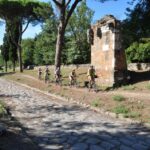
The Appian Way (Via Appia Antica) is one of those Roman places where you want time, not just speed. Even though it’s famous, it can also be tiring if you’re doing it the hard way on foot or hopping between stops without a real flow.
That’s why the e-bike part matters. You’re not “cheating” your way through history—you’re just choosing the smarter transport for a long, mixed surface route. The tour is built around cycling out into Rome’s historic outskirts and then coming back, with enough riding distance to feel like you actually left the center.
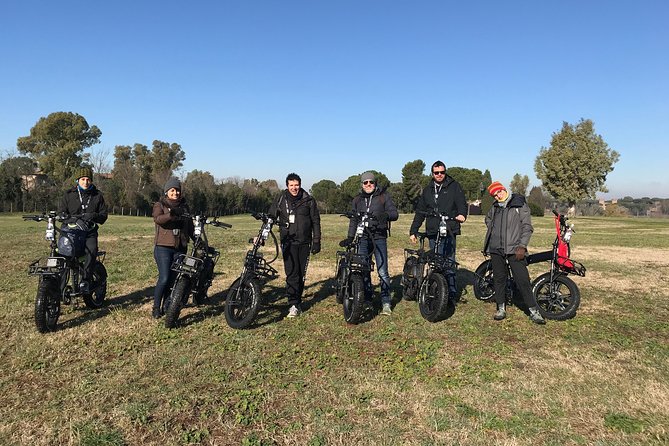
Practically, this means you’ll spend much of the 3 hours 30 minutes moving between major sites and a few deeper stops where you can really look. And because the bikes are described as easy-to-pedal with a short training session beforehand, you’re not expected to master complicated tech mid-tour. You just need to be willing to ride on mostly uneven paths.
One more small detail that affects your enjoyment: the whole experience is designed for a maximum of 10 people. On a site-heavy day, that keeps the group from turning into a line you’re always trying to catch.
You can also read our reviews of more tours and experiences in Rome
Start at Circus Maximus: the ancient starting gate to the road
You begin at Circo Massimo, the Circus Maximus. This isn’t a random roadside stop—it’s the biggest chariot race track in Ancient Rome and the starting point for the Appian Way.
Here’s what makes it memorable:
- It’s described as capable of 250,000 people, about a quarter of Rome’s population in its heyday.
- The track length is given as 600 meters.
- The stop is short, about 5 minutes, and the admission is marked as free.
What you’ll feel in this first moment is scale. Circus Maximus is one of those places where your brain takes a second to catch up with how massive Roman entertainment could be. Even if you’ve seen photos, standing near the space where races and crowds would have been makes the whole rest of the tour make more sense.
Also, it’s a good “warming up” stop. You’re not instantly thrown into the longest riding segment; you get context first, then you roll.
Caracalla’s baths and the Roman world of crowds
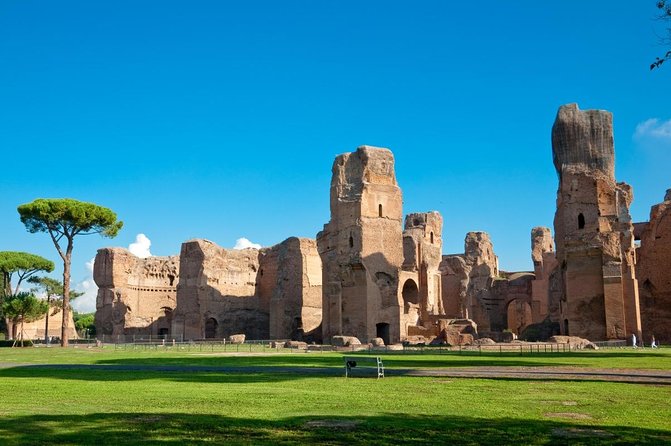
Next you go to Terme di Caracalla (Baths of Caracalla). This is among the biggest and most well-preserved Roman bath complexes.
This stop has two big numbers that set the mood:
- Up to about 15,000 people could bathe at the same time.
- The time you have is about 5 minutes.
- Admission is not included (so if you’re planning your day around cost, this is the one place to remember).
The baths are a useful counterpoint to Circus Maximus. Both are Roman “infrastructure for people,” just in different flavors. A circus brings crowds for spectacle; baths brought crowds for daily life, socializing, and ritual.
Because the stop is quick and admission isn’t included, plan to focus on the parts you can actually absorb fast: the architectural layout and the sense of how large the complex was.
Arco di Druso, Porta San Sebastiano, and the Domine Quo Vadis story
This tour moves from sport and daily life into defense and faith—still along the road corridors that made Rome’s power feel permanent.
Arco Di Druso (aqueduct arcade, not a triumphal arch)
Stop 3 is Arco Di Druso. It’s often wrongly treated as a triumphal arch. The tour framing here is different: it’s described as an arcade of an aqueduct made by Caracalla meant to feed his thermal baths.
It’s a short 2-minute stop, and admission is free. The practical value of a stop like this is that you learn not just what something is, but how people misread it.

Porta San Sebastiano (Aurelian’s defensive gate)
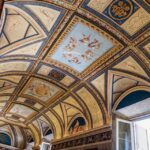
Stop 4 is Porta San Sebastiano, described as the largest and among the best preserved gates in Aurelian’s defensive walls around Rome.
You get about 5 minutes, and admission is free. This stop helps you shift from “ancient leisure” into “ancient survival.” It’s a good reminder that Rome wasn’t just monuments—it was also military engineering.
Chiesa del Domine Quo Vadis (Saint Peter’s meeting)
Stop 5 is Chiesa del Domine Quo Vadis, tied to the story of Saint Peter during Nero’s persecution. The key moment is Peter fleeing Rome, meeting Jesus, asking where he’s going, and hearing that Jesus goes back to Rome to be crucified again.
The tour notes this as a 2-minute stop with free admission.
Is this a short stop? Yes. But it’s also one of those “how you tell the story of Rome” moments, where faith legends and physical locations overlap in a very Roman way.
Catacombs and Vatican extraterritorial land: a quieter, heavier stop
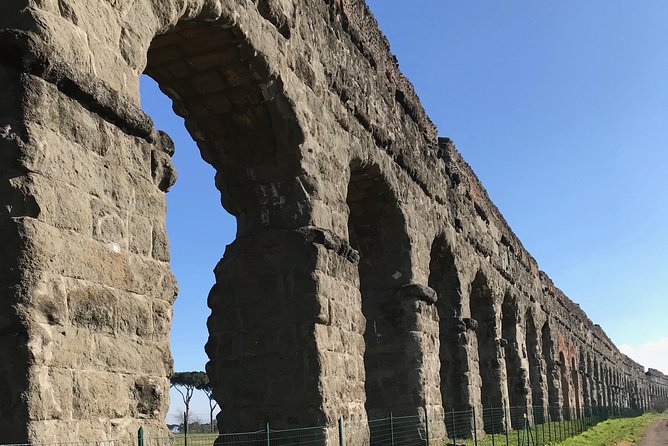
Then the tour turns more reflective. You’ll reach one of Rome’s biggest catacombs area, described with:
- 50 martyrs
- 16 popes buried here
- The note that you’ll ride inside the Vatican City state as this area is among the Vatican’s extraterritorial belongings
The time for this stop isn’t stated, but you should expect the tone to change. Catacombs aren’t about speed. Even with a bike-based tour, this kind of stop usually asks you to slow down, look, and absorb what it means to have a sacred underground space tied to early Christianity.
After that, there’s another stop tied to relics of the apostles Peter and Paul. The tour describes that these relics were moved during the invasion of the barbarians to prevent them from being vandalized.
Taken together, these two stops add weight to the day. The Appian Way often gets talked about as engineering and tombs, but this section reminds you it’s also a corridor of survival, memory, and protection.
The Appian Way itself (Via Appia Antica): 2 hours on the famous road
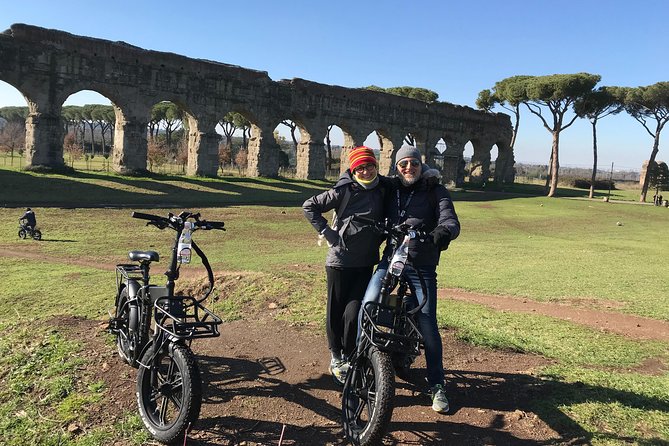
Stop 6 is the heart of the experience: the Appian Way. You’ll get about 2 hours here, and admission is free.
The tour description gives some standout details:
- Built in 312 BC by Appius Claudius Caecus
- Stretching 360 Roman miles (with much of the original basalt-block paving still in place)
- A road tied to major events across centuries, including:
- the crucifixion of Spartacus’ 6,000 soldiers
- capture of Rome during World War II
- part of the men’s marathon course for the 1960 Summer Olympics
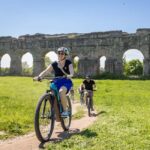
This is where the e-bike pays off. Riding along preserved basalt gives you a physical sense of age that you won’t get from a viewpoint. It’s bumpy in a very specific way—old stone under your wheels, not modern paving designed for comfort.
And because it’s long and scenic, you’ll also get countryside-style views as you move along. This is exactly the kind of Rome you can’t really replicate with a typical “center-only” itinerary.
Maxentius sites, Cecilia Metella’s tomb, and mosaic baths
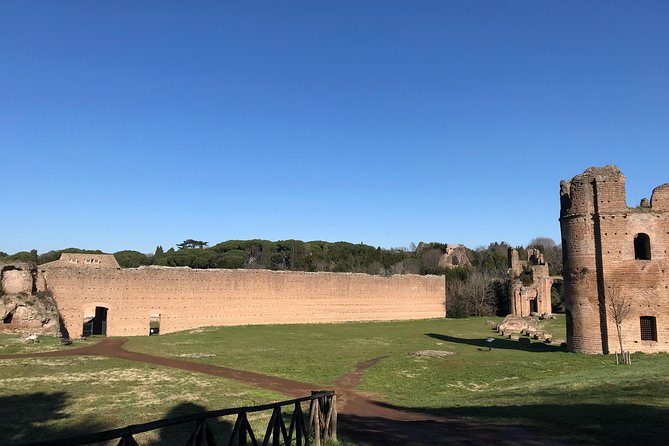
After the main Appian Way segment, the tour continues with a string of major monuments. These are shorter stops, but they’re chosen like chapters.
Circus of Maxentius
Stop 7 is the Circus of Maxentius, described as one of the best preserved ancient chariot race tracks with capacity around 10,000.
It also ties to popular culture: it’s mentioned as a filming location for the movie Ben-Hur (1959). Admission is free, and you get about 10 minutes.
Villa di Massenzio (imperial complex)
Stop 8 is Villa di Massenzio, an imperial villa built by Emperor Maxentius. The complex is described as having three main buildings:
- the palace
- the circus of Maxentius
- the dynastic mausoleum
Admission is free, about 10 minutes.
Mausoleo di Cecilia Metella e Castrum Caetani
Stop 9 is the monumental tomb of Cecilia Metella and Castrum Caetani within the Appia Antica archaeological park. It’s described as tied to an illustrious family connected to the 1st century BC and named through members of the Triumvirate of Julius Caesar and the one who ended Spartacus’ revolt.
You get about 2 minutes, and admission is free.
Complesso di Capo di Bove (mosaic baths)
Stop 10 is Capo di Bove, described as baths from a vast land property in the 2nd century AD, with mosaics still preserved.
Admission is free, about 5 minutes.
The pattern here is useful. You’re seeing different types of Roman spaces—entertainment (circus), power (villa), commemoration (tomb), and daily luxury (baths). Even in quick stops, the variety helps you understand how the Appian Way functioned as a live corridor, not just a place for one kind of monument.
Park of the Aqueducts: the stop that feels like a secret bonus
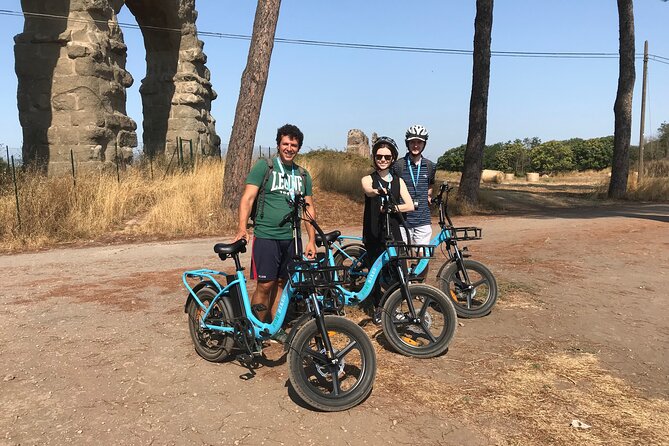
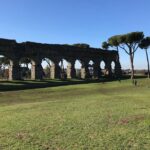
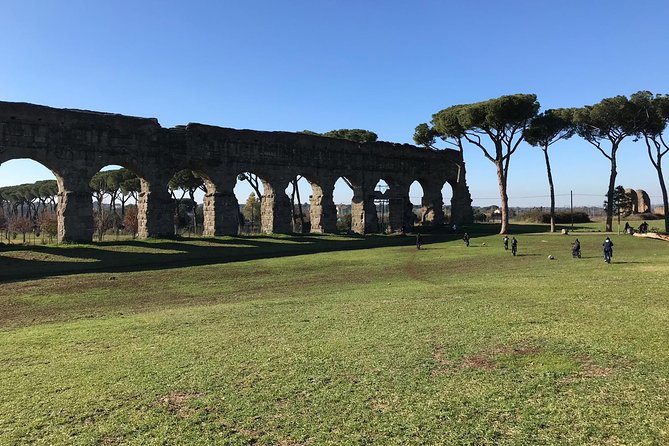
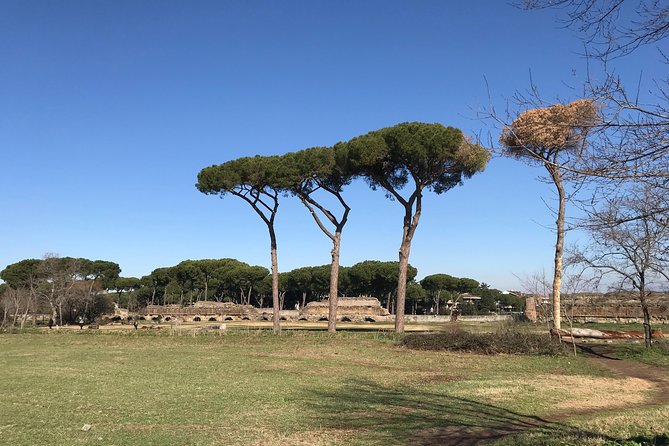
Then comes the highlight for many people on this tour: Parco degli Acquedotti in the Appia Antica archaeological park. The tour notes:
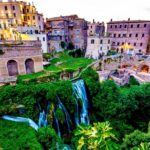
- The name comes from seven Roman and papal aqueducts that supplied ancient Rome
- The aqueducts run under and overground
You have about 30 minutes here, and admission is free.
Why this matters for your day: aqueducts are one of the most important Roman technologies, yet they’re often treated like an extra. Here they become the main event. You get time to see and understand how water infrastructure built the city’s everyday life.
If you like technical history—things that explain how a place worked—you’ll appreciate this stop a lot. It also makes your final stretch feel less like a checklist and more like a themed walk through Roman systems.
Guide style, small-group pace, and the e-bike comfort checklist
A big part of this experience is the people. The tour emphasizes learning with an archaeologist guide, and the hosting guide is known for excellent English and a friendly, accommodating manner. Ferdinando specifically comes up for being approachable, quick to respond, and clearly enjoying the work. That kind of energy helps when the itinerary moves between very different sites.
Group size also matters. Maximum of 10 means:
- you don’t spend the ride waiting for a large group
- you can ask real questions
- the pacing stays gentle enough for a three-and-a-half-hour experience
Now, about the e-bike training. The tour includes a short training session to get confident before you start, with a clear safety focus. Even so, the operator asks you to feel comfortable riding mainly on uneven paths. So I’d treat this as an active tour, not a casual Sunday spin.
Age limits are part of the planning picture:
- Minimum age is 18
- Maximum age is 70
- It’s noted that most travelers can participate, but comfort on uneven ground is the true deciding factor.
Price and value: what you get for $324.63
$324.63 per person for roughly 3 hours 30 minutes sounds high at first glance—until you look at how the experience is built.
You’re paying for a combination of:
- an e-bike experience designed to cover up to 19 miles (30 km)
- a guide team that includes archaeologist-led learning
- small-group touring with a maximum of 10
- a route that strings together major monuments plus less-common stops like the Park of the Aqueducts and catacombs area
Most stops are marked as free entry in the description, with Terme di Caracalla called out as the one admission not included. In other words, you’re not spending your time worrying about buying tickets at every turn.
There’s also the practical value of the mobile ticket and the group-discount angle. And since the tour is commonly booked about 28 days in advance on average, it’s worth grabbing your spot rather than waiting for last-minute plans.
If you want value, the best move is to show up ready to ride confidently. This tour is built to reward that.
Who should book this Appian Way e-bike tour
Book it if:
- you want to see more than the central Rome highlights without exhausting yourself
- you like ancient engineering and infrastructure (aqueducts, road paving, baths)
- you want off-the-usual-route stops like the aqueduct park and catacombs area
- you prefer a small-group feel over a big bus tour
Skip it if:
- uneven, ancient surfaces make you nervous
- you want a fully flat, easy ride with minimal dismounting or stops
- you’re mainly after one monument and don’t care about the broader corridor of sites
Should you book it?
If your ideal Rome day includes the Appian Way as the main character, an e-bike is the smart way to do it. The combination of long riding time, archaeologist-led context, small-group logistics, and the Aqueduct Park stop makes it more than just transportation between ruins.
I’d book this one if you’re comfortable on uneven ground and you want a day that feels like you’re actually moving through Roman space—from Circus Maximus out to the surviving basalt road, then into the quieter depth of catacombs and waterworks.
FAQ
How long is the e-bike tour of the Appian Way?
The tour lasts about 3 hours 30 minutes.
How far will I ride on the e-bike?
You can cover up to 19 miles (30 kilometers) on the e-bike.
What’s the group size?
It’s a small-group experience with a maximum of 10 people, and it’s a private tour/activity for your group.
Do I need prior e-bike experience?
No prior experience is required, but a short training session is mandatory before the tour starts.
Is riding mainly on uneven paths part of the experience?
Yes. The tour notes that you should make sure you feel comfortable riding mainly on uneven paths.
What are the age limits?
Minimum age is 18. Maximum age is 70.
Are admission tickets included for all stops?
Most stops are listed as free admission, but Terme di Caracalla admission is not included.
Where does the tour start?
The meeting point is Via dei Cerchi, 59, 00186 Rome, Italy.
Where does the tour end?
The activity ends back at the meeting point.
Can I cancel and get a full refund?
Yes. Free cancellation is allowed if you cancel up to 24 hours in advance for a full refund.