REVIEW · ROME
Unique E-Bike Experience in the Appian Way and the Catacombs
Book on Viator →Operated by Easy Bike Rent Rome · Bookable on Viator
If you want Rome with legs and a view, try this route. You’ll pedal a power-assisted e-bike along the ancient Appian Way and then go underground into the Catacombs of Callixtus with a local guide.
I like the way this tour balances big landmarks with quick looks at what you’d miss on foot, like Circo Massimo and Porta San Sebastiano. I also love that the Catacombs visit is guided and included, not something you have to plan separately.
One thing to consider: the ride can be a little bumpy and at times you’ll share the road with cars, so you’ll want to feel comfortable on two wheels for about four hours.
In This Review
- Key highlights at a glance
- E-bike Rome on the Appian Way: why this route works
- What you get for the $100.55 price (and what may cost extra)
- Meeting point and timing: a 4-hour loop with multiple quick stops
- The ride itself: fitness level, comfort, and road reality
- Guides and group vibe: learning fast, riding easy
- Stop 1: Circo Massimo in 20 minutes
- Stops 2 and 3: Baths of Caracalla and Porta San Sebastiano
- Stop 4: Catacombs of Saint Callixtus for about an hour underground
- Stops 5 to 7: Circus of Maxentius, Cecilia Metella, and the true Appian Way ride
- Stop 8 and 9: Ninfeo di Egeria and Parco della Caffarella
- How to decide if this fits you
- Should you book the Appian Way e-bike and Catacombs tour?
- FAQ
- How long is the tour?
- What’s included with the e-bike tour?
- Are tickets for all sites included?
- Is the tour offered in English?
- Is there a minimum age or fitness requirement?
- Can I cancel and get a refund?
Key highlights at a glance
- E-bike power for a countryside feel without the punishment of a traditional bike
- Guided Catacombs of Saint Callixtus with about an hour underground
- Appian Way plus aqueduct viewpoints as you move out of the city
- Small group size (max 10) for a more personal pace
- Helmet and phone holder included so you can focus on riding and photos
E-bike Rome on the Appian Way: why this route works
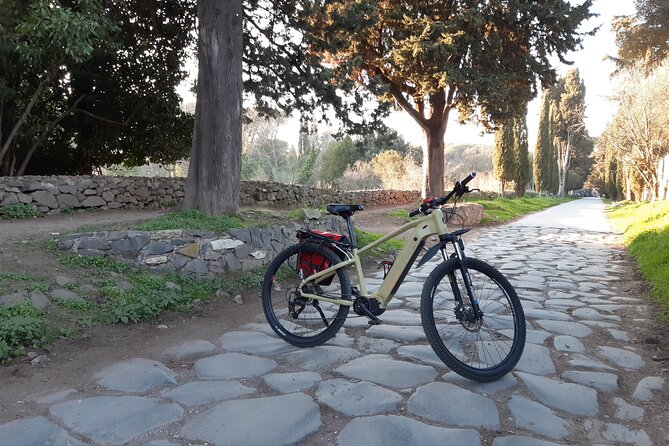
This is one of those Rome tours that changes the pace for you. Instead of standing in line or doing a slow crawl through crowded blocks, you ride out into the old spine of the city. The Appian Way is the star, but the tour also gives you a set of Roman ruins and landmarks that make sense as you travel away from the urban core.
The other big win is the combination: surface sights, then a guided trip underground. You’re not just biking past history signs. You get a real context shift, from wide Roman spaces like circus arenas to the quiet, tight passages of the Catacombs of Saint Callixtus.
You can also read our reviews of more cycling tours in Rome
What you get for the $100.55 price (and what may cost extra)
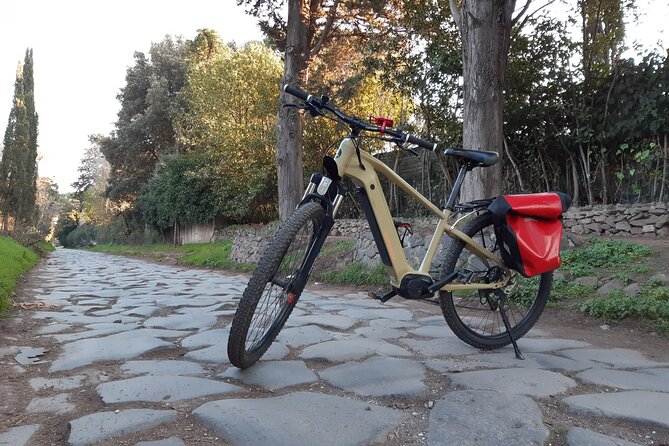
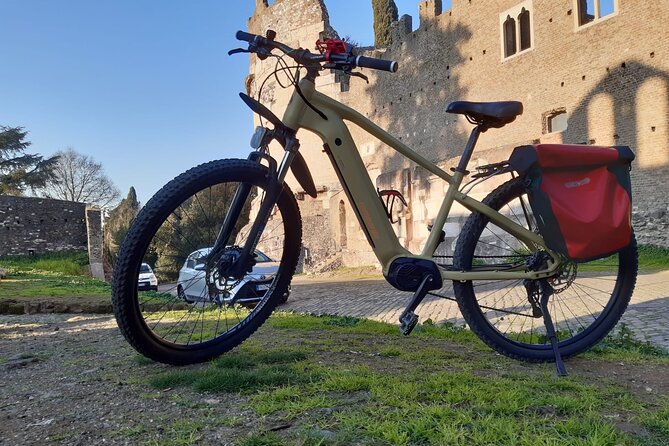
At $100.55 per person, you’re paying for more than a rental bike. The tour includes the e-bike (multiple sizes), a helmet, and a phone holder. That matters because it turns the Appian Way part into an organized experience, not a scavenger hunt.
It also includes admission for Catacombs of Saint Callixtus. Several other stops are listed as free admission, while a few are listed as not included. Specifically, the Baths of Caracalla, the Mausoleo di Cecilia Metella and Castrum Caetani area, and the Appian Way segment are marked as not included tickets. So you should expect the tour price to cover the guided core, with possible extra site costs depending on what you’re able to enter.
Food and drink are not included. Plan on eating before or after, and keep the tour focused on moving, riding, and learning.
Meeting point and timing: a 4-hour loop with multiple quick stops
The tour starts at Via dei Cerchi 59, 00186 Roma RM, Italy. It ends back at the same place, which keeps things simple when you’re planning dinner afterward. Duration is listed as about four hours, and the stop lengths are mostly short: many are around 20 minutes, with a longer 1-hour segment for the Catacombs and about 40 minutes for Parco della Caffarella.
That timing pattern is part of the value. You get variety without burning your day. If you like efficient sightseeing where each stop has a reason, this format fits well.
The ride itself: fitness level, comfort, and road reality
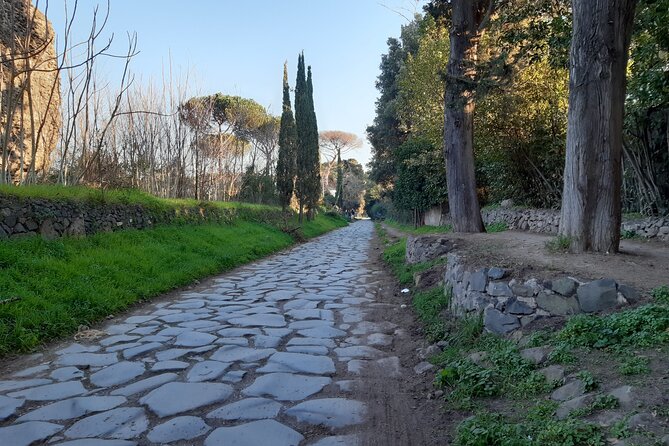
You’ll need moderate physical fitness and you should be able to ride a bike already. The tour also is not recommended for kids under 12. If you haven’t ridden in years, the e-bike can still make it doable, and guides handle the pace and safety during the group ride. I like that this is small-group (up to 10), because you aren’t constantly waiting for the slowest rider.
From real ride feedback, the route can be slightly bumpy, and sometimes you ride on street segments near cars. The good news: people doing this are typically not feeling unsafe, but it’s still a fair consideration. If you’re anxious around traffic or uneven pavement, this is the one element you should think through before booking.
Guides and group vibe: learning fast, riding easy
This tour runs with local guides, and the history details are part of what people rave about. I’m especially impressed by how guides like Frederick, Philippo, and Adriana are described as knowledgeable and attentive. You’re not getting a rushed lecture while someone else takes the lead on the biking; instead you get stop-by-stop context that matches where you are.
Because the group max is 10, you should expect a more human pace. It also makes it easier for your guide to help if you’re still finding your comfort on the e-bike.
You can also read our reviews of more tours and experiences in Rome




Stop 1: Circo Massimo in 20 minutes
You start with Circo Massimo, the ancient Roman chariot-racing stadium. It’s set in the valley between the Aventine and Palatine hills. This isn’t a small ruin you have to work to see. The scale is the point: it measured about 621 meters long, 118 meters wide, and could hold over 150,000 spectators.
Why this stop matters on an e-bike tour: it gives you the big “Roman arena” feeling early, so later when you’re on the Appian Way you can connect how these grand public spaces shaped daily life. Admission is listed as free, which is a nice way to start with zero extra cost.
Stops 2 and 3: Baths of Caracalla and Porta San Sebastiano
Next up is Terme di Caracalla (Baths of Caracalla). It was the second largest Roman public baths complex after Diocletian’s baths. The dates given are early 2000s era—built around AD 212 (or 211) and used until the 530s, when it fell into ruin.
This stop is only about 20 minutes, and you should treat it as a focused look at how Roman leisure worked and how large-scale buildings faded fast once the era changed. Admission is listed as not included, so keep an eye on whether you’re entering any areas or paying at the site.
Then you reach Porta San Sebastiano, the largest and one of the best-preserved gates in the Aurelian Walls. The key value here is the transition. You’re moving toward the parts of Rome that feel less compressed, where walls and roads define the boundaries of the old city.
Admission here is free, so you can spend your mental energy on the architecture instead of budgeting for tickets.
Stop 4: Catacombs of Saint Callixtus for about an hour underground
This is the emotional contrast stop. The Catacombs of Saint Callixtus are part of the underground Rome system on the Appian Way. The time slot is about 1 hour, and admission is included. You’ll go with a local guide leading the way, which is exactly how you want to do this.
You’re dealing with narrow corridors and a setting where context matters. A guide helps you make sense of what you’re seeing, instead of treating it like a maze. And because the meeting point area is described as nice and almost pedestrian, you’re less likely to feel swallowed by chaotic traffic before you even go underground.
If you only have time for one “underground” experience in Rome, this is the one here. It’s not just a photo stop; it’s a full guided segment.
Stops 5 to 7: Circus of Maxentius, Cecilia Metella, and the true Appian Way ride
After the underground portion, you climb back into daylight and back onto the e-bike. This is where the tour identity locks in.
First, you pass the Circus of Maxentius, part of a complex built by Emperor Maxentius on the Via Appia between AD 306 and 312. Admission is free. Even in short time, it helps to know what you’re looking at: another Roman arena world, connected to the main road network.
Then you see the Mausoleo di Cecilia Metella and Castrum Caetani at Parco Archeologico dell’Appia Antica. Cecilia Metella’s tomb is described as one of the best known and well preserved monuments along the Via Appia. It was built in the 1st century BC in her honor, and she’s identified as the daughter of Quintus Caecilius Metellus Creticus. Admission is listed as not included.
This stop is a “scale and survival” moment. The Appian Way route isn’t only about what’s gone. It’s also about monuments that still hold shape and tell you how much effort Romans put into long-lasting statements.
Finally, the Appian Way itself. You’ll ride along Via Appia Antica, described as the first highway ever built, starting in 312 BC by Appius Claudius Caecus. The tour notes that you’ll see just a few of the 365 parts, which is a gentle way of saying this is a highlight ride, not a full Roman road marathon.
Practical value: this e-bike segment is what lets you actually enjoy the countryside feeling and not just sprint between ruins. From real ride feedback, the best part for many people is getting away from the crowds while seeing aqueducts up close and moving through greener stretches that don’t feel like central Rome.
Stop 8 and 9: Ninfeo di Egeria and Parco della Caffarella
Two stops finish the ride with a different flavor: myth and open space.
Ninfeo di Egeria is tied to Egeria, a nymph associated with early Roman legendary tradition. She’s described as a counselor to Numa Pompilius, the second king of Rome, and the name is used as a sort of eponym for female advisors. This is another short stop, about 20 minutes, with free admission.
Then you ride into Parco della Caffarella. This is a large park in the heart of Rome, part of the Parco Regionale Appia Antica. The description places it within the Caffarella Valley, bordered by the Via Latina and the Appian Way. You get about 40 minutes here with free admission.
Why this pair is a smart ending: you end with breathing room after being in ruins and underground spaces. It also gives your legs a reset before heading back to the meeting point.
How to decide if this fits you
Book this if you want Rome that mixes movement and meaning. It’s ideal if you like ruins with context, and you’re excited by the idea of pedaling out to the Appian Way instead of doing another bus-and-walk day. The Catacombs are included and guided, which makes the underground portion easy to commit to without extra planning. People also highlight the guide care, and that’s a big deal when your day includes both biking and a longer underground section.
Skip it (or at least think hard) if you don’t ride bikes comfortably or you don’t handle uneven pavement well. The ride can be bumpy, and some parts share road space with cars. You’ll also be better off if you can manage about four hours total with several short stops, rather than needing long rests between sights.
Should you book the Appian Way e-bike and Catacombs tour?
Yes, if your top priorities are the Appian Way experience plus a guided Catacombs visit in the same half-day. The price feels fair because the essentials are included: a quality e-bike with helmet and phone holder, and Catacombs admission. The route also gives you multiple Roman landmarks without turning the day into one long wait.
No, if you’re not confident on a bike or you’re uncomfortable around cars on road segments. In that case, the e-bike won’t cancel the reality of the surface and traffic mix.
FAQ
How long is the tour?
The tour runs for about 4 hours.
What’s included with the e-bike tour?
You get a quality e-bike (several sizes), a helmet, and a mobile phone holder.
Are tickets for all sites included?
Catacombs of Saint Callixtus admission is included. Other listed sites such as Terme di Caracalla, Mausoleo di Cecilia Metella and Castrum Caetani (Parco Archeologico dell’Appia Antica), and the Appian Way segment are listed as not included.
Is the tour offered in English?
Yes. The tour is offered in English.
Is there a minimum age or fitness requirement?
You should have moderate physical fitness. It is not recommended for kids under 12 years old, and it is not recommended for people who don’t know how to ride a bike.
Can I cancel and get a refund?
Yes. You can cancel up to 24 hours in advance for a full refund.
If you want, tell me your comfort level on bikes and whether you want more focus on history or more on riding, and I’ll help you decide if this is the right fit for your Rome day.