REVIEW · ROME
Rome: Ostia Antica Archaeological Park Ticket & Audio App
Book on GetYourGuide →Operated by GetYourGuide Tours & Tickets GmbH · Bookable on GetYourGuide
Ancient streets feel surprisingly readable. I love the mosaics and frescoes that still look crisp, and I like having 8-day access to multiple sites beyond Ostia; the big consideration is that the park is spread out with uneven paths, and the route can feel confusing without a plan.
You get a digital audioguide plus a simple way to turn your own photos into a postcard, which makes the visit feel personal instead of just sightseeing. One drawback: the audio/app experience can be a bit tricky when you’re trying to pinpoint exactly where you are among all the ruins.
If you want a Roman day trip that feels like walking inside a preserved city, Ostia Antica is hard to beat. Just wear real walking shoes, bring a charged smartphone, and plan to spend a full chunk of the day.
In This Review
- Key things to know before you go
- Why Ostia Antica is a standout Roman ruins experience (even if you’ve seen the big names)
- The integrated ticket: what $27 buys beyond a single archaeological park
- How the audio app and photo-to-postcard feature changes the experience
- Ostia Antica Archaeological Park: what to see, and how to pace it
- The “feel” of the streets
- Apartment blocks: a picture of urban Rome
- Procoio villas and the bath complex
- Uneven ground and route confusion: plan for it
- Castle of Julius II and the ports: why your ticket makes the trip more complete
- Castle of Julius II
- Museum of Ships in Fiumicino and the Imperial Ports
- Necropolis of Porto on Isola Sacra
- Best way to use the 8-day window without overplanning
- Practical value check: is $27 worth it?
- Who this ticket suits best (and who should rethink it)
- Should you book this Ostia Antica Archaeological Park ticket with audio?
- FAQ
- How long is the ticket valid?
- What is included with the ticket?
- Where do I exchange my voucher?
- Do I need to bring an ID?
- Is transportation included?
- Can I use the audio guide on my phone?
- Can I really make a postcard from my photos?
- Is free cancellation available?
- What should I wear or bring for the walk?
- Is there a set itinerary I must follow?
Key things to know before you go
- Exceptionally preserved Roman art: mosaics and frescoes throughout the streets and rooms
- A real city layout: apartments and villas help you picture daily life, not just isolated ruins
- Audio app support: digital audioguide keeps you moving at your pace
- Procoio villa area: a seaside complex with a bath setup and an amphitheater with stone masks
- Integrated admission: your ticket covers multiple sites around Ostia/Fiumicino
- Photo-to-postcard feature: you can send a custom postcard from your own images
Why Ostia Antica is a standout Roman ruins experience (even if you’ve seen the big names)
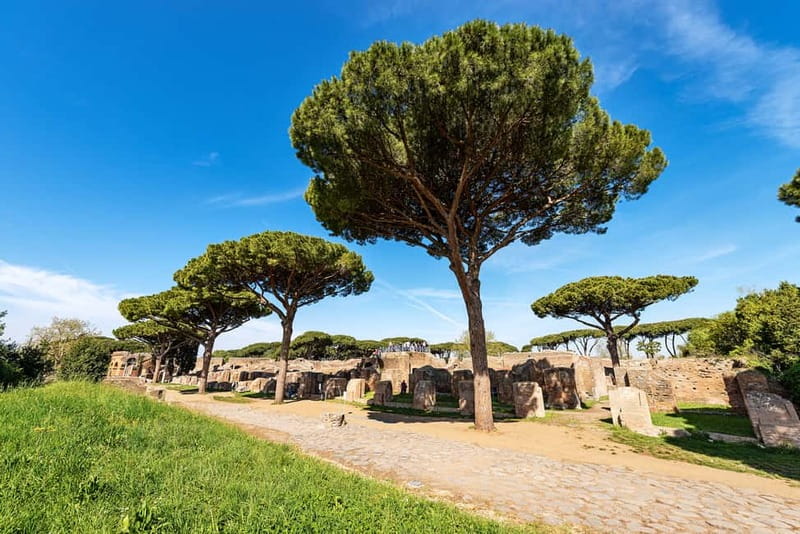
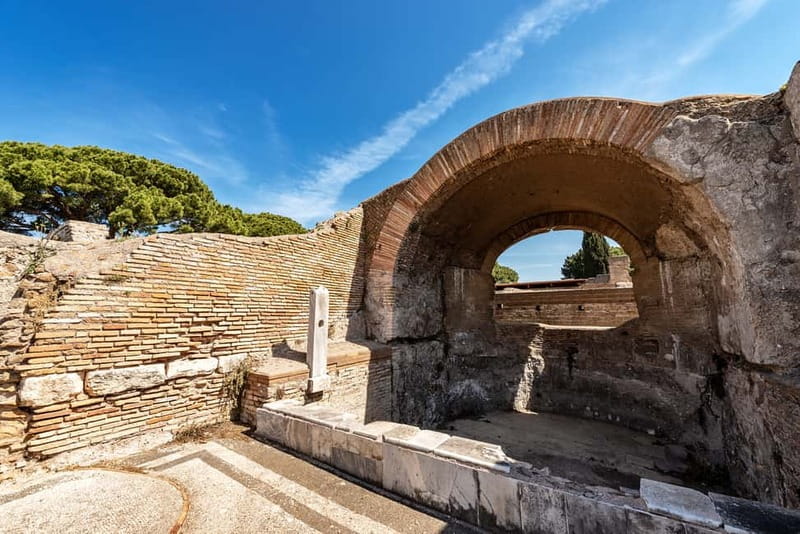
Ostia Antica sits just outside Rome on the coast, and it works as a counterpoint to the iconic hits you’ll hear about nonstop back in the Eternal City. Instead of a single monument dominating the view, you get something closer to an entire neighborhood: streets, rooms, building corners, and decorative floors. The effect is practical and visual. You can almost “read” the town by how people built it.
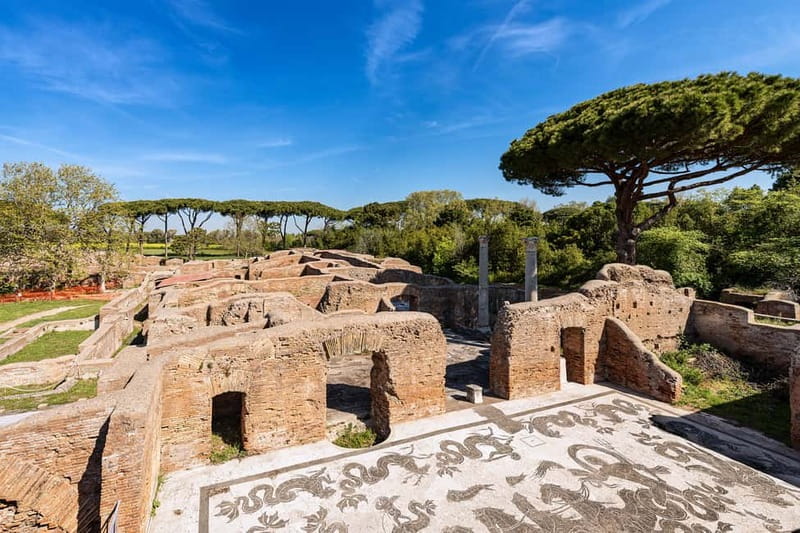
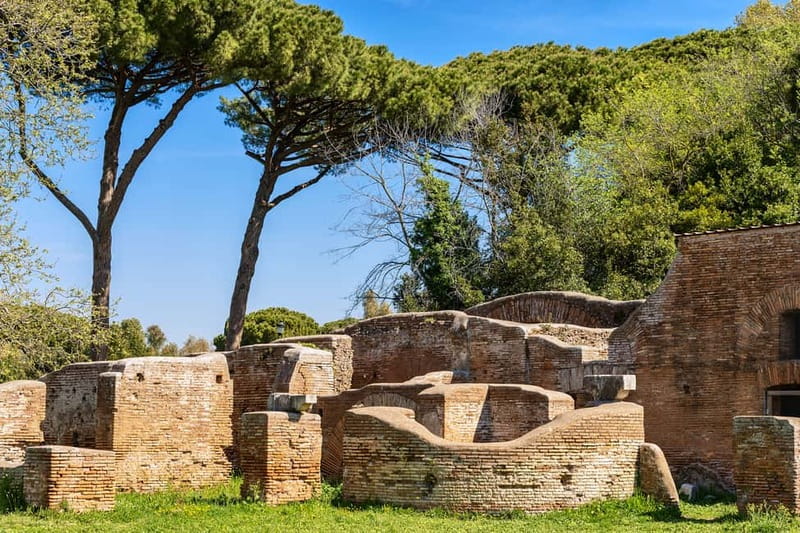
What makes the site especially compelling is how much is still here. The ruins stayed remarkably intact because the river silt that once covered the city helped protect walls, frescoes, and mosaics. There’s a legend it was founded in 620 BC as a Roman colony at the mouth of the Tiber (connected to Ancus Marcius). Whether you treat that as history or story, the result is the same for your visit: you’re seeing a Roman town that’s unusually well preserved.
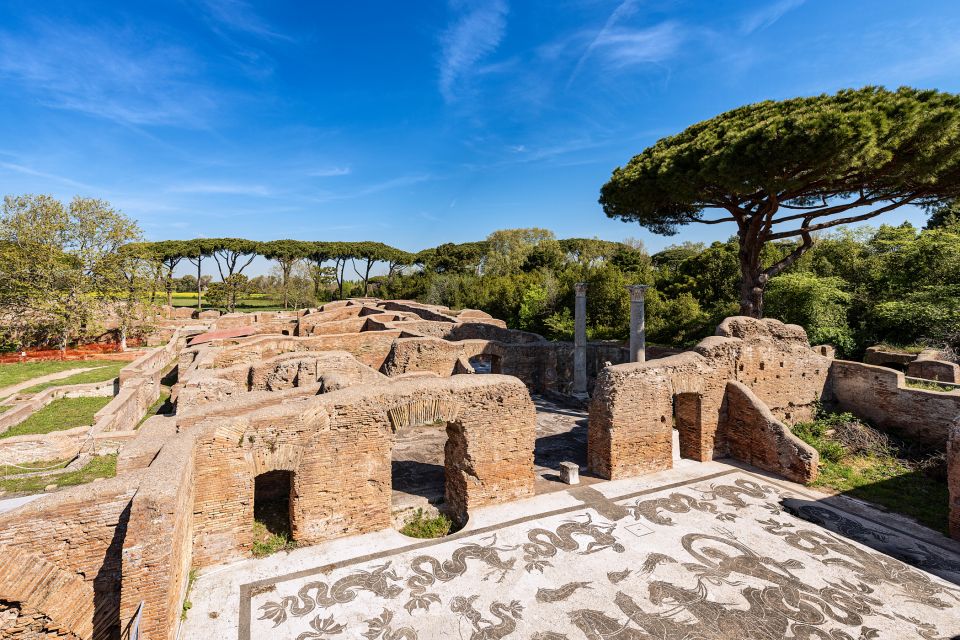
Two things I’d call out right away: the floor-level detail and the sense of everyday space. Mosaics aren’t just decorative surprises; they’re tied to rooms you can imagine being used for cooking, work, and relaxing. And the apartment blocks and villas help you picture how Romans lived when Ostia functioned as a port city.
The main consideration is simple: this is not a short stroll. Paths can be uneven, and the route isn’t always intuitive. If you show up without a plan, you can waste time backtracking or miss important areas while you’re figuring out where you are.
You can also read our reviews of more tours and experiences in Rome


The integrated ticket: what $27 buys beyond a single archaeological park
The price listed is $27 per person, and the real value is that this is an integrated admission ticket. You’re not only paying for Ostia Antica Archaeological Park. Your ticket also includes admission to:
- Castle of Julius II
- Museum of Ships in Fiumicino
- Imperial Ports of Claudius and Trajan
- Necropolis of Porto on Isola Sacra
That matters because Ostia’s story doesn’t end at the excavated streets. The port context is built into the experience through those extra sites. Even if you only have time for Ostia itself one day, the ticket gives you flexibility to add more later without paying separate admissions.
You also get a digital audioguide. That helps you keep the visit from becoming a “walk and hope” situation, especially on days when you don’t have the energy for a live guide.
One small caution: the info you have shows 8 days valid from first activation, but the fine print also states 7 days. Check your voucher or confirmation for the exact validity window so you don’t cut it close.
How the audio app and photo-to-postcard feature changes the experience
This ticket includes a digital audioguide, which is a big deal at a large archaeological park. Ostia is spread out, and some features can be easy to overlook if you’re just scanning for the most dramatic walls. The audioguide helps you link what you’re seeing to what it likely was in daily life—apartments, public areas, and decorative rooms.
That said, don’t assume it’s perfect for navigation. The ruins are extensive, and at times it can be harder to track the exact location of individual stops, especially if you’re paused to look at mosaics and then start walking again without checking where you are relative to the next segment.
Now for the fun part: you can turn one of your own photos into a unique postcard. This is not a gimmick you’ll use once and forget. It’s a small way to create a take-home memory tied to your own photos, and it gives you a meaningful reason to stop for a shot instead of treating photography as an afterthought.
To make this work smoothly, bring a charged smartphone and keep it handy while you walk. If your battery dies halfway through your visit, you’ll feel the loss.
Ostia Antica Archaeological Park: what to see, and how to pace it
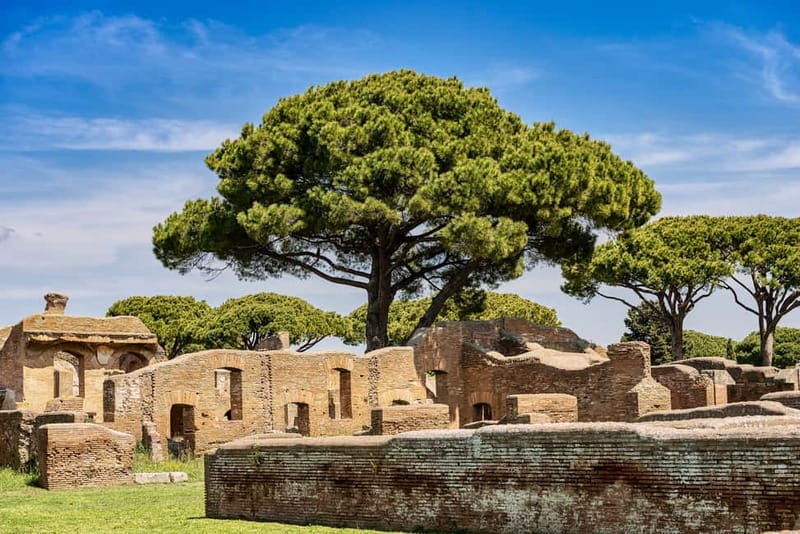
Your visit starts with an exchange of your voucher at the Ostia Antica ticket office. From there, you’re essentially set up to explore at your own pace across the park.
The “feel” of the streets
One of the best parts of Ostia Antica is how the town scale helps you understand the port city’s rhythm. You’re not just looking at walls; you’re moving through a layout that makes sense: rooms connect, floors imply activity, and building fronts hint at how people approached work and home.
If you like to walk through a place slowly, Ostia rewards that style. The site has enough variety that you won’t feel bored after the first hour, but you also shouldn’t expect a single nonstop highlight. You’ll likely enjoy it most when you alternate between longer stops for mosaics/frescoes and shorter “walk-through” segments where you just absorb the layout.
You can also read our reviews of more tours and experiences in Rome




Apartment blocks: a picture of urban Rome
The park includes two-story Roman apartment blocks. This is one of the most helpful areas for understanding city life because it anchors the ruins to something modern travelers recognize: dense living, shared building space, and a layered urban environment.
Take your time here and look for the sense of repeated rooms and levels. Even without a guide, the structure tells a story about how Romans managed daily routines inside tight spaces.
Procoio villas and the bath complex
Another standout section is the seaside villas of Procoio. This is where the ruins shift from “streets and apartments” to a more leisure-and-luxury rhythm.
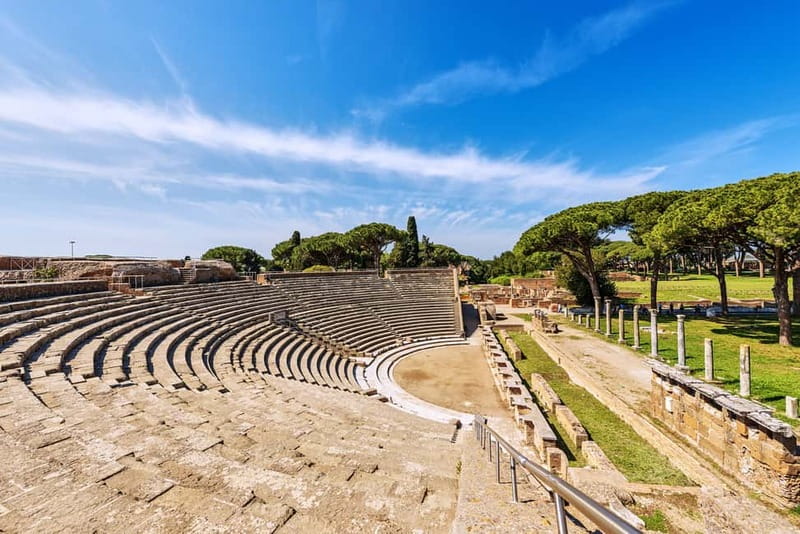
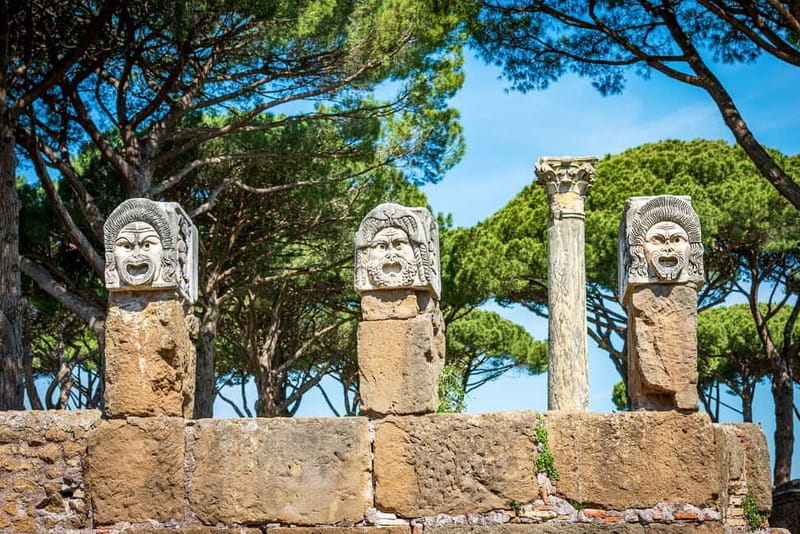
Expect a large bath complex and a seaside villa setting. There’s also an amphitheater lined with striking theatrical masks made from stone. This is the kind of detail that makes the visit feel more human. You’re looking at entertainment culture embedded into a building footprint.
Uneven ground and route confusion: plan for it
Ostia Antica is extensive, and the access paths can be uneven. It’s not the place for fragile footwear. Real walking shoes matter.
The route also isn’t always obvious. You might find it easy to get turned around even with a guidebook style approach. If you can, arrive with a basic sense of the main zones you want to hit. And during warmer months, carry water because you’ll be walking longer than you expect.
There’s also a café, but it can be hard to locate. It’s not a dealbreaker, just something to factor in: don’t rely on finding food instantly if you’re hungry.
Castle of Julius II and the ports: why your ticket makes the trip more complete
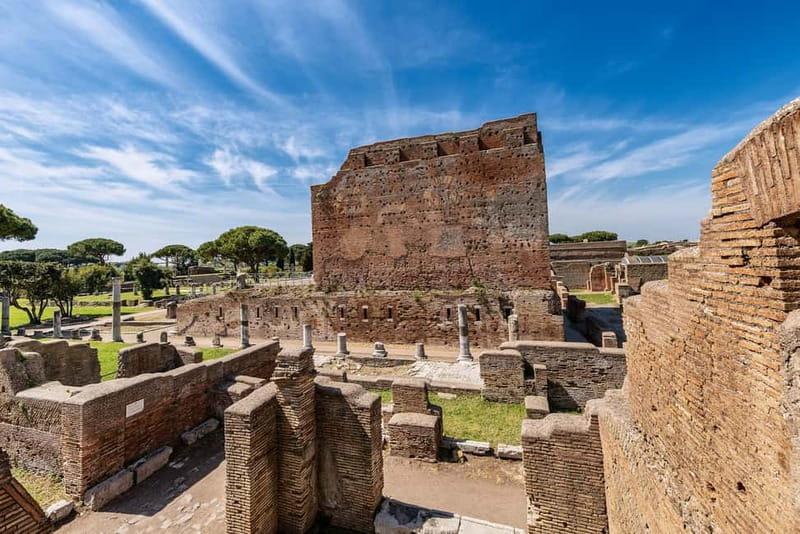
The big advantage of this ticket is that it doesn’t lock you into just the park.
Castle of Julius II
You’ll also have access to the Castle of Julius II. This gives your day (or multi-day visit) a different flavor than the Roman street-level ruins. It’s a way to connect the layers of history around the site: ancient Roman remains are one chapter, and later structures are another.
Museum of Ships in Fiumicino and the Imperial Ports
If you care about why Ostia mattered, the ports are where that clicks. Your ticket includes the Museum of Ships in Fiumicino and the Imperial Ports of Claudius and Trajan.
This is valuable because a port isn’t just a location on a map. It’s the engine behind everything: trade, supplies, movement of goods, and jobs. Even if you only skim these areas, they help you connect the dots between the streets you walk and the wider maritime economy that fed Rome.
Necropolis of Porto on Isola Sacra
Finally, the ticket includes the Necropolis of Porto on Isola Sacra. A necropolis shifts the emotional register. You’re moving from day-to-day building life into remembrance and burial spaces. It’s a reminder that the city had endings too, and you’re seeing the site from another angle of Roman culture.
If you have only one day, you might prioritize Ostia Antica first, then choose one additional stop based on your interests—ships/ports if you’re into trade and logistics, or the necropolis if you want a quieter, more reflective visit.
Best way to use the 8-day window without overplanning
The validity window is from first activation (listed as 8 days, with fine print noting 7). The smart move is to treat it like flexibility, not a stopwatch.
If you want the most satisfying visit:
- Do Ostia Antica early or mid-morning to give yourself the best light for mosaics and frescoes.
- Plan at least one additional site the same week if you can, since the port theme ties the locations together.
- If you’re short on time, you can still cover Ostia first and treat the other sites as bonus value later.
This is one of those tickets that pays off when your schedule has breathing room. You’re not forced into a tight itinerary, and you can return to things you want to see again.
Practical value check: is $27 worth it?
For a single archaeological park ticket, $27 might look straightforward. The real question is whether that price includes enough to justify your time and money.
Here’s the practical value:
- You get access to multiple major sites tied to Ostia and its maritime world.
- You get a digital audioguide, which supports a large, spread-out place.
- You can create and send a photo postcard, which adds a small but memorable souvenir angle.
Your cost per site is much lower than paying separately, and the ticket structure fits the way most people actually travel: one day is for the main park, and the rest is for optional add-ons when energy and time allow.
If you’re traveling with limited time and will only ever see the main park, you might feel the extra sites are wasted. But if you can spare even another half-day nearby, the integrated format makes the price feel fair.
Who this ticket suits best (and who should rethink it)
This experience fits you if:
- You want self-paced walking through a well-preserved Roman city.
- You care about mosaics, frescoes, and apartment/villa life, not just big standalone ruins.
- You’d rather use an audioguide than commit to a group tour.
You might want to rethink it if:
- You’re looking for an itinerary where everything is handled start-to-finish. Here, you’re responsible for navigating the park and spacing out your stops.
- You rely on precise, on-the-spot wayfinding. The audio support can be harder to match to exact locations, and the route can feel unclear.
Should you book this Ostia Antica Archaeological Park ticket with audio?
I’d book it if you want a strong Roman ruins experience that doesn’t require finding a guide, and you like the idea of extending your day into the port and necropolis context. The combination of well-preserved decorative art, a real sense of the city layout, and a multi-site ticket makes it a good value for a Rome-area trip.
Pass on it only if you’re certain you won’t go beyond Ostia itself. In that case, you may be paying for access you won’t use.
If you do book, go in with sturdy shoes, a charged smartphone, and a plan for pacing. Ostia rewards patience, and once you slow down, the ruins start to feel less like a collection of stones and more like a place where people actually lived.
FAQ
How long is the ticket valid?
It’s listed as valid for 8 days from the first activation. The fine print also mentions 7 days, so check your voucher for the exact window.
What is included with the ticket?
It includes admission to Ostia Antica Archaeological Park and also the Castle of Julius II, Museum of Ships in Fiumicino, Imperial Ports of Claudius and Trajan, and Necropolis of Porto on Isola Sacra, plus a digital audioguide.
Where do I exchange my voucher?
Exchange your voucher at the Ostia Antica ticket office.
Do I need to bring an ID?
Yes. You’ll need to present a valid ID, and the activity lists bringing a passport or ID card.
Is transportation included?
No. Transportation is not included.
Can I use the audio guide on my phone?
Yes. You’ll need a charged smartphone to use the digital audioguide.
Can I really make a postcard from my photos?
Yes. One of your own digital photos can be turned into a unique postcard to send to friends or family.
Is free cancellation available?
Yes, you can cancel up to 24 hours in advance for a full refund.
What should I wear or bring for the walk?
Bring comfortable shoes since the paths at the site are uneven, and bring water if you’re visiting in warm weather (the site involves a lot of walking).
Is there a set itinerary I must follow?
No. The experience is designed so you can explore at your own pace across the included areas.