REVIEW · ROME
Appian Way, Catacombs and Aqueducts Park Tour with Top E-Bike
Book on Viator →Operated by Topbike Rental & Tours Di Ciro Muratori Societ Societa' Inaccomandita Semplice · Bookable on Viator
The Appian Way is too big for just walking.
This small-group e-bike tour lets you cover serious ground on the Ancient Appian Way landscape without turning it into an endurance test. You ride through the Aurelian Walls area, then out into the parks where the vibe shifts from city noise to Roman countryside.
I especially love two things: the catacombs option (included only on the 6-hour route) and the way the route mixes off-road paths with carefully chosen city connectors. In my book, that combo is what makes this feel like a real day out, not just another checklist of stops.
One thing to consider: this isn’t for brand-new bike riders. Even with e-assist, you’ll handle bumpy tracks and you may need to concentrate during the traffic links and tighter paths, so bike confidence matters.
Quick highlights you’ll care about
- Two route lengths: 4 hours or 6 hours, with catacombs guided only on the longer tour
- 27 km covered, with about 60% off-road and the rest through planned city streets
- Small group size (max 10), so you get more attention from the guide
- Helmet provided and mandatory, plus an e-bike setup designed for comfort and stability
- Wednesdays change catacombs (San Sebastiano instead of San Callisto on the 6-hour tour)
- Aqueducts Park views from prime vantage points, with guided context about how Roman water worked
In This Review
- Why an e-bike fits the Appian Way better than your legs
- Price and value: what $102.79 buys you
- Meeting point and start: where your day begins
- The e-bike setup: what’s included (and what that means for comfort)
- The common itinerary backbone: Porta San Sebastiano to key ruins
- Catacombs stop: San Callisto on most days, San Sebastiano on Wednesdays
- Aqueducts Park: where the scenery and the story connect
- The 6-hour add-ons: Villa dei Quintili and Caracalla’s baths
- What the ride feels like: traffic links, bumpy paths, and photo reality
- Small groups and the guide effect (examples from real departures)
- Who should book this, and who should skip it
- Tips to make your day smoother (without overplanning)
- Should you book the Appian Way, Catacombs, and Aqueducts Park e-bike tour?
- FAQ
- How long is the Appian Way, Catacombs and Aqueducts Park tour?
- What’s the difference between the 4-hour and 6-hour tours?
- Which catacombs are visited?
- Is there traffic on the route?
- How far do you ride?
- What about helmets and bike equipment?
- Can kids join the tour?
- Can I cancel for free?
Why an e-bike fits the Appian Way better than your legs
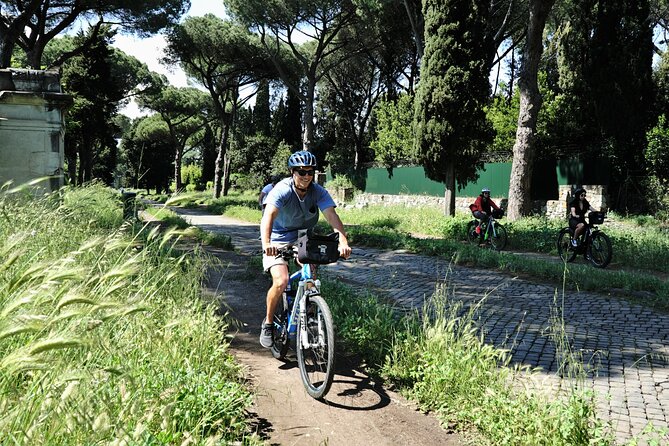
The Appian Way isn’t just a single street you stroll past. It’s an enormous swath of ancient infrastructure—roads, ruins, and landscapes—that can eat up your energy if you try to do it all on foot.
On an e-bike, you still get the feeling of leaving Rome and moving through real countryside, but you can save your legs for the parts that actually need walking and looking. You also get a smoother way to cover distance, which matters because the total route is about 17 miles (27 km).
And the e-assist is there for a reason. You can turn it on to make the ride easier, and you won’t feel forced into a marathon pace just to keep up with the schedule.
Price and value: what $102.79 buys you
At around $102.79 per person, this tour is priced like a guided experience with actual logistics handled for you. You’re paying for more than bike rental—you’re buying a route plan, a local expert guide, and structured time at major stops.
Here’s the value logic that makes sense: the tour includes helmet gear, a bike designed for stability (including anti-puncture tires), and guided interpretation at key points. If you choose the 6-hour version, the guided catacombs visit is included too, which is a big deal because catacomb entry is a separate kind of experience and not just another photo stop.
If you’re doing Rome sightseeing on limited days, this is the kind of half-day tour that can prevent wasted time. It gets you out to areas that are harder to string together without a lot of walking or extra transport.
You can also read our reviews of more cycling tours in Rome
Meeting point and start: where your day begins
The tour starts at Via Labicana, 49, 00184 Roma RM, Italy, and it ends back there. That back-to-base format is convenient because it removes the stress of figuring out how to get yourself from the parks back into the city later.
You’ll be near public transportation at the meeting point, which helps if you want to line this up with other plans. Since the tour lasts about 4 to 6 hours, you can usually treat it like a main event day rather than a short add-on.
You’ll also be required to wear a helmet, and the helmet is provided for free. You don’t need to bring one from home.
The e-bike setup: what’s included (and what that means for comfort)
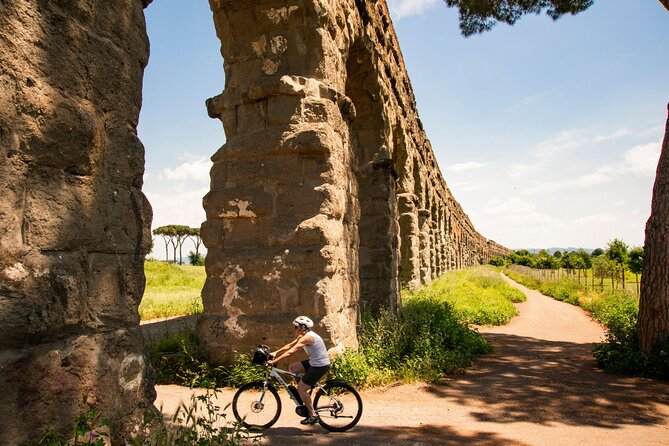
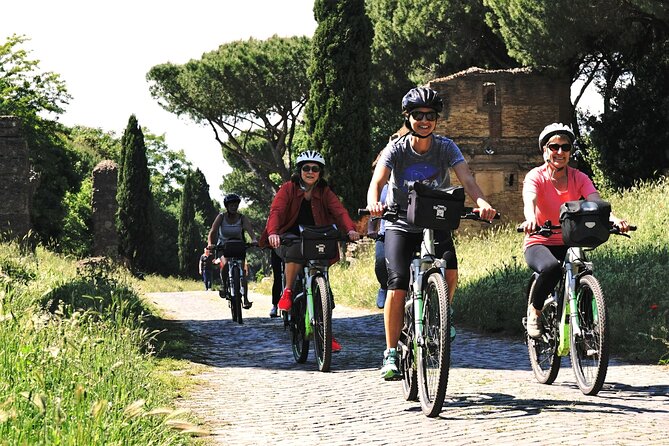
Included with the tour is a top-quality e-bike with anti-puncture tires, plus a helmet (mandatory). You also get a front bag and a water bottle, and the bottle is described as biodegradable.
That package matters because Appian Way riding isn’t always smooth pavement. Anti-puncture tires are especially helpful when you’re spending time off-road and on older surfaces where the ground can be unpredictable.
It’s also a practical choice for your back and hands. One review specifically warns that the roads and trails can be bumpy, and people with back or neck issues should think carefully before booking. The e-bike reduces leg strain, but it doesn’t erase vibration if the surface is rough.
The common itinerary backbone: Porta San Sebastiano to key ruins
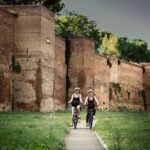
Both durations follow a shared arc early on, starting at Porta San Sebastiano near the Aurelian Walls. This is a strong first move because it sets the tone—this is Rome’s ancient defensive architecture, right where the city transitions into older routes.
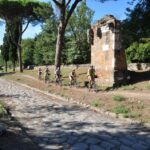
Next you head out onto the Appian Way (Via Appia Antica) itself. Early on, it can feel like the street is changing identity as you move into the protected park environment. You get that slow shift from more urban surroundings into the preserved ancient thoroughfare with pastoral countryside vibes around you.
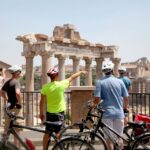
Then you reach the Circus of Maxentius, an Imperial complex from the 4th century with a villa, a mausoleum, and a chariot racetrack area. It’s short on time, but it helps you understand how the Appian Way wasn’t just a road for travel—it was connected to major power structures and entertainment spaces.
You’ll also pause at Mausoleo di Cecilia Metella e Castrum Caetani, one of the largest and best-preserved funerary monuments along the route. This stop is quick, but it’s visually impressive in a way that’s hard to replicate if you’re rushing between other top sites.
At this point, the day starts feeling like a system: roads tied to water, burial tied to politics, and monuments tied to the long timeline of Rome.
Catacombs stop: San Callisto on most days, San Sebastiano on Wednesdays
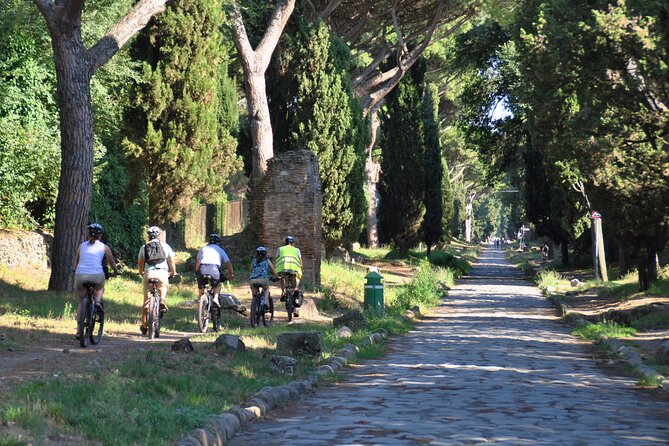
The biggest decision between the two tour lengths is how you handle the catacombs.
On the 4-hour tour, you get a short pause for contemplation at Catacombe di San Callisto, described as the resting place of half a million souls. It’s not a guided catacomb tour in the 4-hour format.
On the 6-hour tour, you get a 45-minute guided visit of the catacombs, with the guide explaining the complexity and the mystery of the underground spaces. That guided time is the difference between seeing an entrance and actually understanding what you’re looking at.
One scheduling detail matters: on Wednesdays, the 4-hour tour does not include that catacombs stop. And on Wednesdays, the 6-hour tour visits the Catacombs of San Sebastiano instead of San Callixtus.
Also, catacombs are inherently tight spaces. Even with a guided plan, you can feel crowded in the entry/queue moments, so if you dislike enclosed areas, this is something to weigh before you book.
You can also read our reviews of more tours and experiences in Rome





Aqueducts Park: where the scenery and the story connect
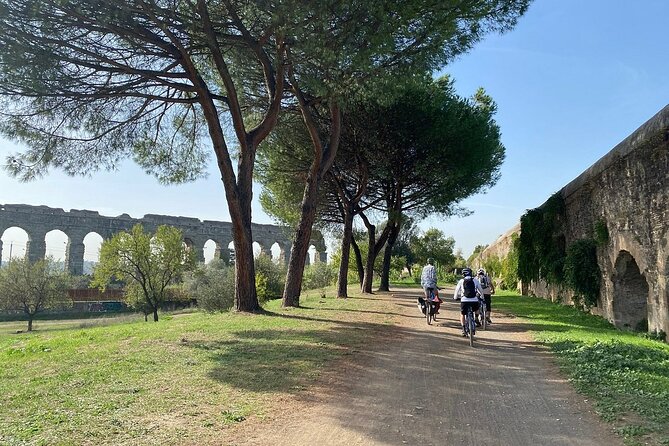
The Parco degli Acquedotti stop is one of the big reasons to choose this tour. You’ll see colossal aqueduct structures and get an explanation of the Roman water-supply system—both underground and above-ground—designed to serve a massive city.
Even if you’ve read about aqueducts before, this is the setting where the scale hits you. You’re looking at engineering that was built to last, then hearing how it functioned as infrastructure, not just as stone decoration.
The tour also gives you time to actually take it in. You’re not sprinting through a museum; you’re stopping in the park environment with room to breathe and look up.
One practical note: it’s a park setting, and that means surfaces can vary. Wear shoes that are comfortable if you end up walking a little beyond the bike route, and keep your camera ready early since some of the best views are tied to where you pause rather than where you ride at full speed.
The 6-hour add-ons: Villa dei Quintili and Caracalla’s baths
If you pick the 6-hour option, you gain two additional major stops.
First is Villa dei Quintili e Santa Maria Nova, a sprawling 2nd-century private villa complex connected to two of the richest brothers in Roman Imperial history. This is a shift in tone from monumental public spaces toward private wealth and power.
Then you get Terme di Caracalla from a strong vantage point, with context about how baths were central to ancient social life. This is a great pairing with aqueducts because it ties water supply to daily culture—Rome didn’t treat water as a technical detail; it made it part of social routines.
If your priority is understanding how Romans lived day to day, the 6-hour route adds depth in a way the shorter tour can’t. If your priority is maximizing outdoor riding and avoiding added time, the 4-hour tour can still be satisfying because you already hit the biggest road-and-ruins rhythm plus the catacombs pause.
What the ride feels like: traffic links, bumpy paths, and photo reality
This tour is described as intermediate, and that’s accurate. Even though 60% of the route is off-road, you still have about 40% in city streets to connect the ancient parks. Traffic is limited on the planned connectors, but it’s not zero.
You should also expect that some paths can feel tight or uneven. One review points out that the route includes narrow bike paths and some rough areas, and it’s not ideal for novice riders or small kids who aren’t steady.
Photo stops are also real-life tricky on a bike. Some riders want to pause more often for photos, but you’re riding in motion with a group pace. If you’re serious about getting perfect shots, consider taking fewer photos while moving and then focusing on the established pause points where you can step off safely.
Battery levels are usually not something you need to obsess over, but your experience can depend on group pacing. One review complained about going extremely slow, which reduced the sense of using the e-bike power. That might happen if the guide is prioritizing spacing and safety in busier segments.
Small groups and the guide effect (examples from real departures)
The tour caps at 10 travelers, which is a practical difference. In a smaller group, you can hear explanations better, and the guide can manage the ride more smoothly when paths get narrow.
The guides described in past departures are consistently friendly and enthusiastic, with strong command of history. Names that have shown up include Arina, Stefan, Zac, Lorenzo, Fabio, Claudia, Bita, Ali, David, and Christian.
That matters because this area is layered. The guide isn’t just pointing at ruins; they’re connecting why Porta San Sebastiano, the Appian Way road line, and the water infrastructure belong to the same Roman story.
Who should book this, and who should skip it
This is a smart fit if you want an outdoor, culture-heavy Rome day and you don’t want to sacrifice comfort. The ride is designed for moderate physical fitness, and the e-bike helps make it doable even if you’re not a daily cyclist.
It’s also a good choice for families with older kids. For kids aged 5–8, a child extension is provided. For kids aged 9 and above, children can ride on a correctly sized e-bike.
I’d think twice if:
- you’re not self-confident on a bike, even with e-assist
- you have back or neck sensitivity and bumpy surfaces could be a problem
- you strongly dislike enclosed spaces, given the catacombs environment
For most people who can handle a controlled ride with some concentration, this tour hits a sweet spot: you get big ancient sights without losing your energy to walking.
Tips to make your day smoother (without overplanning)
Since the tour doesn’t include food or drinks, plan on finding something during a break if you need it. You can buy food or drinks along the route and consume them during a suitable pause.
Bring water you can sip, even though a bottle is provided on the bike. If you run cold easily, consider a light layer because parks can feel different from the city even in decent weather.
Finally, pick the right duration for your style:
- If you want a shorter day and don’t need the full guided catacombs program, choose 4 hours.
- If you want the guided catacombs plus the extra culture stops at Villa dei Quintili and Terme di Caracalla, choose 6 hours.
And if you’re visiting on a Wednesday, double-check which catacombs you’ll see so the plan matches what you want most.
Should you book the Appian Way, Catacombs, and Aqueducts Park e-bike tour?
I’d book it if you want Rome in a different mode: less crowding, more movement, and a guided route that takes you out to the Appian Way and Aqueducts Park without turning the day into a transport puzzle.
This tour is especially worth it if you have only a couple days in Rome and you want more than the usual highlights. The combination of a safe-feeling route plan, a small group, and the option for a guided catacombs visit makes it a strong value for the time you spend.
Skip it if you’re truly new to biking or if bumpy terrain and tight spaces would stress you out. Otherwise, this is one of those rare Rome experiences that feels both practical and memorable: you travel through history fast enough to see a lot, but you slow down enough to actually understand what you’re looking at.
FAQ
How long is the Appian Way, Catacombs and Aqueducts Park tour?
The tour runs for about 4 to 6 hours, depending on which version you choose.
What’s the difference between the 4-hour and 6-hour tours?
The 4-hour option includes a short pause at the catacombs. The 6-hour option includes a 45-minute guided catacombs visit, plus additional stops.
Which catacombs are visited?
The catacombs stop is Catacombe di San Callisto for the standard route. On Wednesdays, the 6-hour tour visits the Catacombs of San Sebastiano instead.
Is there traffic on the route?
Approximately 40% of the route takes place in the city, with carefully chosen streets and some unavoidable traffic. About 60% of the route is in the parks with no traffic encountered.
How far do you ride?
You’ll cover about 17 miles (27 km), with around 60% off-road.
What about helmets and bike equipment?
Helmets are mandatory and provided for free. The tour also includes a top-quality e-bike with anti-puncture tires, plus a front bag and a water bottle.
Can kids join the tour?
For ages 5–8, a child extension is provided. Ages 9 and above can ride an appropriately sized e-bike on their own.
Can I cancel for free?
Yes. You can cancel up to 24 hours in advance for a full refund. If you cancel less than 24 hours before the start time, the amount paid is not refunded.