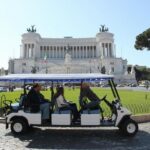
Rome can be a church marathon. This tour cuts the walking and strings together six big stops in one smooth loop, with pickup and a private golf cart pacing that lets you stop for questions, photos, and quick looks without the pressure of keeping up.
I really like two things about this format: first, the way the cart helps you cover serious ground fast; second, how the stops are chosen for visual impact and story, from Michelangelo to Caravaggio. The one thing to watch is that each church stop is short, so if you like to linger for 45 minutes per site, you may feel a little rushed.
- Pickup that keeps you out of transit stress: the meeting can be at your central hotel area if it’s within the golf-cart range.
- Six churches/basilicas in about three hours: efficient routing beats a random on-foot shuffle.
- Most entrances are free: several stops list admission ticket free, leaving your paid time focused on the art.
- Stop design includes the fun surprises: trick perspectives, echoes, and the stories behind famous sculptures.
- You can get a great guide mix: names like Luisa, Antonio, Carlos, Marco, Yashar, and Gianluca show up for strong service and narration.
Rome’s church scene is huge, and trying to see the major ones on foot can turn into constant negotiating: hills, crowds, and cobblestones. A golf-cart tour gives you a practical advantage—faster repositioning and fewer bottlenecks—so you spend more of your energy inside the buildings, not in transit.
You also get a calmer rhythm. Instead of sprinting from one doorway to the next, you can follow the route, then slow down when something catches your eye—ceilings, chapels, tomb monuments, or the moments where a familiar name shows up in an unexpected place.
At about $204.70 per person for an experience lasting around three hours, you’re paying for more than just transportation. You’re buying time, comfort, and interpretation—someone handling the routing and turning each stop into a quick, meaningful visit.
Also, several stops are listed with admission tickets as free (so you’re not stacking entry fees on top of the tour cost). One stop—the Pantheon—explicitly says admission ticket not included, so you’ll want to plan on that separately.
This tour is built like a sightseeing loop: it starts in a major square, then works through a cluster of churches and artistic landmarks, and ends at another iconic public space. The logic is simple: you’ll get big Rome views from the carts and then hit major interiors without crossing the city in a zigzag mess.
Expect short stops—around 20 minutes each at the listed sites. That’s enough for a focused look at the standout pieces, but it does mean you should go in with a small game plan: decide what you most want to see at each place so you don’t spend the whole time hunting.
Piazza del Popolo is one of those Rome squares you recognize even if you’re not sure you can name the details. Here, the tour leans into the small “how is that possible?” moments: the story of the twin churches, how the square’s layout plays with echoes, and why this famous setting feels a little theatrical if you know what to look for.
You’ll get an early mental map. This is a good first stop because you can orient yourself in Rome while the narration sets the tone—part architecture, part storytelling, part quick curiosity.
San Pietro in Vincoli is where the tour earns its reputation for church variety. On the surface, you’re seeing a place tied to Saint Peter’s chains, linked to captivity both in Jerusalem and Rome. But the main visual draw is the Michelangelo statue of Moses, which gets you close enough to really appreciate how famous pieces can feel human when you’re standing in the same room.
The tour description also hints at a “little peculiarity” connected with the Moses statue. You’ll want to let your guide point out what’s different once you’re there, because it’s the kind of detail that can be missed if you treat the visit like a quick photo stop.
This is one of the most art-forward stops on the route. The church sits near the Pantheon area, and you’ll start by looking at the breathtaking façade before moving into chapels with major paintings. The highlight set here includes the Chapel of St. Louis, noted as the first chapel entirely designed by a woman, plus the Contarelli Chapel with three extraordinary Caravaggio paintings.
Two practical notes. First, the church lists free entrance during the day, which helps make this stop feel like extra value. Second, the schedule says the stop may be modified due to religious holidays, national/bank holidays, or road closures—so keep a flexible mindset that the plan can adjust on the day.
Now you shift from paintings to optical trickery. The ceiling at Chiesa di Sant’Ignazio di Loyola is famous for a false perspective effect tied to Saint Ignatius, and it can feel like the church is bending reality in your favor.
Here’s why this stop works in a guided cart tour: the pacing is designed so you don’t just stop at the first interesting part. The tour description suggests the guide may keep you going past where most people stop, so you see the more subtle angle that makes the illusion click.
The Pantheon is the stop where Rome’s “layers” become unavoidable. You’ll see an ancient Roman temple that functions as a Catholic church, and the tour framing also mentions earlier Egyptian sacred complex activity in the area.
Admission here is marked not included, so treat this as the one stop where you’ll likely need to handle your entry ticket on your own. The upside: because it’s a predictable major site, you can spend your limited time wisely—focus on the scale, the geometry, and one or two key details your guide points out instead of trying to scan the whole place at once.
The tour finishes at Piazza Navona, and the big idea is that the square’s shape has an origin story. From above, it’s said to look surprising, because the site was built as the Stadium of Domitian, with parts of the ruins still showing.
This final stop gives you a comfortable landing. You’re done with interiors, and you get a public-space payoff—wide open views, easy conversation, and a chance to wrap your brain around how Roman planning still echoes in the modern city.
The standout praise across guide names is consistent: people often talk about the driver-guide doing more than transportation. Guides like Luisa and Antonio come up with service that feels attentive and energetic, with narration that makes church art easier to “read” once you’re inside. Others like Marco, Carlos, Yashar, and Gianluca are described as especially good at matching the pace to the group and making the rides and stops feel smooth.
One practical advantage you’ll feel is the cart’s ability to handle narrow cobblestones. That matters in Rome. It’s not just comfort—it’s keeping the tour on the route you came for. And since several comments emphasize that the cart helps people avoid heavy walking, you’ll likely find this option works well when your knees, feet, or energy level are not up for a long day.
Because each church stop is timed at about 20 minutes, the biggest factor in enjoyment is your mindset. Before you go, pick your “must-see” for each location.
Quick prep ideas:
- Dress for church interiors: shoulders and knees may be needed, and you’ll want something you can sit/stand in comfortably.
- Bring a small plan for Pantheon day: since admission isn’t included, you’ll want that sorted ahead of time so your time inside isn’t eaten up.
- Wear shoes you can trust on uneven stone, even if the cart reduces walking.
This tour is a strong match if you want major Roman churches without spending your whole day walking. It’s also a good fit for groups that value private attention—since it’s private, only your group is involved, and the guide can adjust the flow if you want one extra look at something.
It may be less ideal if you want deep, slow study at each site. With only about 20 minutes per stop, this is structured for highlights, not for reading every plaque and lingering for hours in one chapel.
I’d book it if your priority is a smart, efficient route through Rome’s most famous church-and-art stops, with pickup convenience and a guide who can turn what you see into something you actually understand. The value case is strongest when you want to maximize sites in a half-day without sacrificing comfort, and when you appreciate that many entrances are listed as free for most stops.
I’d skip it or pair it with extra time on your own if you’re planning a slow, museum-style visit where you’d rather spend 45–90 minutes in one church than 20 minutes across six.
If your travel style is “see the highlights, get the stories, keep moving,” this is built for you.
In This Review
- FAQ
- How long is the private golf-cart church tour?
- How much does the tour cost?
- Is pickup available, and where do we meet if there’s no pickup?
- Is this tour private?
- What language is the tour offered in?
- Are admission tickets included for all the churches?
- What churches and sights are visited?
- Can the itinerary change on the day?
- How do I get the tickets?
- Are service animals allowed?
- What’s the cancellation policy?
FAQ
How long is the private golf-cart church tour?
It’s listed at about 3 hours (approx.), with around 20 minutes at each of the six featured stops.
You can also read our reviews of more private tours in Rome

How much does the tour cost?
The price is $204.70 per person.
Is pickup available, and where do we meet if there’s no pickup?
Pickup is offered if your hotel is within the golf cart range. If not, the meeting point is Piazzale delle Canestre, 00197 Roma RM, Italy.
Is this tour private?
Yes. It’s a private tour/activity, so only your group participates.
What language is the tour offered in?
The tour is offered in English.





Are admission tickets included for all the churches?
Most listed stops show admission ticket free. The Pantheon stop explicitly lists admission ticket not included.
What churches and sights are visited?
The tour includes Piazza del Popolo, San Pietro in Vincoli, Church of St. Louis of the French, Chiesa di Sant’Ignazio di Loyola, the Pantheon, and Piazza Navona.
Can the itinerary change on the day?
Yes. One stop notes it may be modified due to religious holidays, national/bank holidays, and/or road closures.
How do I get the tickets?
A mobile ticket is provided.
Are service animals allowed?
Yes, service animals are allowed.
What’s the cancellation policy?
Free cancellation is available up to 24 hours in advance for a full refund, based on local time. If you cancel less than 24 hours before the start time, the amount paid is not refunded.