REVIEW · ROME
Rome: Pantheon Visit and Hop-On Hop-Off Open Bus Ticket
Book on GetYourGuide →Operated by Tour in the City - Travel Agency Rome - · Bookable on GetYourGuide
Rome is better with a plan.
This combo pairs the Pantheon with an easy hop-on hop-off bus so you can do the must-see first, then stitch together the rest of the city at your pace. I love that the Pantheon part comes with an audio guide and admission, and I also love the bus perks like onboard Wi‑Fi, a map, and recorded commentary in multiple languages. One drawback to think about: the Pantheon experience is the clear star, while the bus ride can feel like less of a wow if you want lots of walking-free sightseeing.
You start by picking up your ticket at OhMyGuide – Roma Museum Store, Via dei Bergamaschi 49, and you go straight to the Pantheon using the online reservation line. After that, you’re free to hop on and off at major stops across the center, with the bus running daily from 9:00 a.m. to 6:30 p.m.
If you’re visiting with limited energy or you want less stress than trying to connect multiple buses, this works. The 24-hour to 72-hour options also help you spread things out without feeling trapped by a strict group schedule.
In This Review
- Key points before you go
- Pantheon Audio Guide Pickup: where your day really starts
- What you’re actually seeing inside the Pantheon
- The dome and recorded listening points: how to use the audio guide well
- Hop-on Hop-off Bus: your Rome pace, your stops
- The stops that map the center fast (and what to watch for)
- Small extras that make this feel smoother (Wi‑Fi, assistant, earphones)
- Price and value: is $71 per person a good deal?
- Who should book this, and who should skip it
- Tips to make the day feel effortless
- Should you book this Pantheon and open bus ticket?
- FAQ
- Where do I collect the Pantheon ticket and audio guide?
- What are the Pantheon opening hours for this experience?
- How long is the hop-on hop-off bus ticket valid?
- When can I use the hop-on hop-off bus each day?
- Where are the main bus stops?
- Is Pantheon admission included?
- What languages are available for the Pantheon audio guide?
- Is the tour suitable for wheelchair users?
Key points before you go
- Pantheon admission plus audio guide: You get entry to Rome’s best-preserved ancient temple and a set of 15 listening points.
- Audio guide pickup is separate: You collect your materials at Via dei Bergamaschi 49, then head to the Pantheon right away.
- Bus runs all day: Valid use starts from your first boarding each day, with service from 9:00 a.m. to 6:30 p.m.
- Stops cover major icons: Piazza dei Cinquecento, Santa Maria Maggiore, Colosseum, Circus Maximus, Piazza Venezia area, Vatican City, Villa Borghese, Barberini Square.
- Onboard comfort adds up: Wi‑Fi, a multilingual assistant, single-use earphones, and recorded commentary on board.
- The bus is a tool, not a tour: It helps you reach sights fast, but it’s still a ride between neighborhoods, not a replacement for walking.
Pantheon Audio Guide Pickup: where your day really starts

Your booked time is for the Pantheon portion, not for the bus. The bus ticket is valid from the first time you use it, and it’s only usable during the daily operating window (9:00 a.m. to 6:30 p.m.).
Before you enter, you’ll pick up your ticket at OhMyGuide – Roma Museum Store, Via dei Bergamaschi 49. After you get your ticket, you can go directly to the Pantheon, enter through the online reservation line, and collect the audio guide there.
Timing matters because the Pantheon has set opening hours for this experience: Monday to Friday 09:00–18:00, Saturday 09:00–15:00, Sunday 12:00–18:00. If your Pantheon time slot is later in the day, you’ll likely want to use the first bus window efficiently right after.
If you plan to do a little of everything in one day, this is the smart sequence: Pantheon first, then hop bus once you’ve learned the basics and want to see the city through a looser lens.
You can also read our reviews of more tours and experiences in Rome


What you’re actually seeing inside the Pantheon
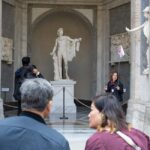
The Pantheon is described as the best-preserved temple of ancient Rome, and it’s built between 25 and 27 BC. It’s largely intact compared with other ancient Roman structures, which is why it can feel almost unreal once you’re standing there.
You’ll also get context for the building’s purpose and changes over time. It was dedicated to all the deities of pagan Rome, and it was erected by Emperor Hadrian on the site of an older temple commissioned by Marcus Agrippa during Augustus’s reign.
Here’s the part that makes the audio guide useful: the Pantheon is classified as a temple, but its original use and worship style aren’t fully known. The structure also differs from other traditional Roman temples, including those in the Roman Forum, which is exactly the kind of nuance that’s hard to pick up just by looking.
In practice, the Pantheon today is used as both a church and a mausoleum. The audio guide’s 15 listening points are designed to help you notice the big architectural ideas while you’re there, not just admire the surface.
If you like monuments where the details have stories attached, you’ll appreciate having the guided listening rather than wandering with your phone and guessing. It keeps your attention on the right things.
The dome and recorded listening points: how to use the audio guide well
The dome is called out as spectacular in the experience, and the audio guide is meant to help you connect that wow with why it exists. The guide covers the building’s history and how the Pantheon fits into Roman religious life (and later life).
Because the audio guide has 15 listening points, you don’t need to listen from start to finish like a lecture. I like using audio guides with a light plan: pick a section, press play, and let the story steer your eyes.
This is especially helpful with a place like the Pantheon where you’re surrounded by visitors and you might otherwise miss the key contrasts. The guide also helps you understand why the building’s layout doesn’t match the usual expectation of what a Roman temple is supposed to look like.
Language options include Italian, English, French, German, Spanish, Portuguese, Polish, Dutch, Arabic, Chinese, and Korean. If you choose one of the major European languages, you’ll probably feel the narration pacing more naturally, but even with a less common language you’ll still get the structure of the story and the listening points.
One practical tip: single-use earphones are included, so you don’t need to bring your own. Just keep an eye on the device or earbud situation so you don’t burn time switching gear when you get inside.
Hop-on Hop-off Bus: your Rome pace, your stops
After the Pantheon, your ticket turns into mobility. The open bus is described as an alternative to public buses that lets you reach Rome’s most important attractions and monuments without constantly navigating schedules.
You can choose a validity option (24, 48, or 72 hours). The exact option affects your planning, but the core idea stays the same: you hop on where you want, hop off when you see something you want to walk into, then reboard later at another stop.
The bus operates daily from 9:00 a.m. to 6:30 p.m. Your ticket is valid every day from the moment you first use it, which matters because it avoids the common headache of timed tickets that start at booking rather than boarding.
On board, you get recorded commentary in multiple languages, and the experience also includes multilingual audio guides selectable once on board. The materials mention 8 languages for recorded commentary, and they also list up to 16 languages via onboard audio selection, so either way you should have a language choice you can use comfortably.
Also note that there’s a multilingual assistant onboard and Wi‑Fi onboard. That’s not just nice; it can save you when you want to check directions, translate signage, or confirm which stop makes the most sense next.
The stops that map the center fast (and what to watch for)
The bus route covers 8 major stops in the city center. That’s not the whole city, but it’s enough to connect several iconic areas without turning your day into constant cross-town travel.
1) Piazza dei Cinquecento (corner Via Cavour)
This is your main starting terminal. It’s a useful place to reboot your route, especially if you want an early loop before spreading out.
2) Santa Maria Maggiore (Piazza dell’Esquilino, 12)
This stop is positioned for the Esquilino area. If you like to wander and then reconnect to the bus, this can be an easy anchor.
3) Colosseum (Via di San Gregorio)
This is one of the biggest names on the list. The value here is practical: it’s a quick way to get to the Colosseum area so you’re not guessing which bus gets you closest.
4) Circus Maximus (Via del Circo Massimo, Belvedere di Romolo e Remo)
This gives you access to the Circus Maximus area. Again, the benefit is access and convenience rather than replacing walking routes.
5) Piazza Venezia area (Via del Teatro Marcello, in front of civic numbers 32–34)
This pairing is interesting because the stop references Teatro Marcello while pointing you toward the Piazza Venezia zone. If you like Rome’s central monuments but don’t want to overplan, this kind of “drop you near multiple walkable sights” stop can be handy.
6) Vatican City (Lungotevere Tor di Nona, n. 7)
This stop connects you to the Vatican side of central Rome. If you’re trying to balance religious sites and classic ruins without burning time, the bus is a time-saver.
7) Villa Borghese (Via Ludovisi, n. 48)
This is a calmer-feeling area compared with the densest central streets, and it’s a good choice when you want a break from heavy foot traffic. Use it as a reorientation point before another hop.
8) Barberini Square (Via Barberini, n. 14)
This is a strong closing stop because it’s easy to pair with walking in central Rome. It’s also a good place to aim if you want to stay near cafes and shopping areas.
A key consideration: the itinerary may vary due to unpredictable events. That’s common in Rome, and it’s a reminder to stay flexible and check where the next hop will be rather than expecting everything to run exactly as printed.






Small extras that make this feel smoother (Wi‑Fi, assistant, earphones)
This ticket includes more than just transport and entry. You get a map of the city, onboard Wi‑Fi, and a multilingual assistant.
There’s also an app (Free App GLT) and a timetable of bus rides. The timetable can be useful if you want to avoid waiting forever at a stop, especially if you’re stacking multiple hops in one hour.
Single-use earphones are included with the audio guide side. Even if you’re a pack-light traveler, it’s one less thing to worry about.
Also, you receive an electronic voucher. That makes the process simple once you’re on the ground: show the voucher to board the hop-on hop-off bus.
These details matter because Rome punishes small friction. When your day goes smoothly, you can spend more time actually looking up at architecture instead of checking your phone every ten minutes.
Price and value: is $71 per person a good deal?
At $71 per person, you’re paying for two things: Pantheon entry with audio guide plus a hop-on hop-off open bus ticket valid for 24, 48, or 72 hours depending on your selected option.
If you’re only going to do the Pantheon and nothing else, value can feel thin. But if you plan to use the bus to connect multiple areas across the center, it starts to make sense because it turns travel time into a sightseeing buffer with commentary and easy access to major stops.
Think of the bus as a way to reduce decision fatigue. Instead of “Which bus should I take to get to the next area?” you’re choosing among a handful of main drop points. That’s especially helpful if your feet are tired, the city feels too spread out, or you just want your day to run on rails.
The experience rate also supports the idea that the Pantheon side is strong. One account described the Pantheon as excellent, while also implying the bus part wasn’t as impressive. So if you’re evaluating purely on spectacle, keep your expectations centered on the Pantheon.
For best value, choose the bus length that matches how many hours you’ll actually spend outside. A 72-hour option pays off if you’ll ride more than once or twice and if you’re planning multi-day pacing.
Who should book this, and who should skip it
This works well for:
- First-time visitors who want one major ancient site handled properly, then freedom afterward.
- Travelers who like audio context more than reading museum-style panels.
- People who want easy connections between central monuments without treating the day like a logistics puzzle.
It might not be ideal if:
- You don’t plan to use the bus much. If you’ll mostly walk, you may not get your money’s worth from the open ticket.
- You’re expecting a bus that replaces guided exploration. The bus helps you reach places and gives commentary, but it’s not the same as a deep local walking tour.
Also, note the restrictions: weapons or sharp objects aren’t allowed, and there are limits on oversize luggage, baby strollers, luggage or large bags, backpacks, alcohol and drugs, and electric wheelchairs. And it’s not suitable for wheelchair users.
If you’re traveling with a small daypack, you’ll likely be fine, but if your load is bulky, plan to travel lighter or leave extra items behind.
Tips to make the day feel effortless
- Start with the Pantheon and use the bus after. You’ll get more out of Rome when you’ve already learned what you’re looking at.
- Use the audio guide in short chunks. 15 listening points are easier to manage than a single long audio track.
- Pick two or three stops as your “must use” for the day. Then fill the rest based on energy, not ambition.
- Keep an eye on the time window. The bus is only available until 6:30 p.m., so don’t schedule your final hop like it’s a midnight train.
One more practical thought: Rome can be crowded around the biggest names. The bus drops you near major areas, but your walk from the stop can still feel busy. Build in a buffer and don’t treat every minute like a checklist.
Should you book this Pantheon and open bus ticket?
Book it if you want the easiest possible way to combine Rome’s top ancient icon with flexible exploring. The Pantheon portion is the real anchor here: admission plus an audio guide that helps you understand what you’re seeing, including the building’s Hadrian-era story and its differences from other Roman temples.
Consider skipping or adjusting your expectations if you mainly want the bus to be the attraction. The hop-on hop-off is a practical transport tool, and it makes sense most when you’ll actually hop on multiple times or use several stops across your days.
If you’re aiming for value, choose the bus duration that matches your schedule. A longer validity period is worth it only if you’ll ride enough to connect several areas, not just one quick loop.
FAQ
Where do I collect the Pantheon ticket and audio guide?
You collect your ticket at OhMyGuide – Roma Museum Store, Via dei Bergamaschi 49, Rome. After that, you can go directly to the Pantheon and collect your audio guide there.
What are the Pantheon opening hours for this experience?
Monday to Friday: 09:00 to 18:00. Saturday: 09:00 to 15:00. Sunday: 12:00 to 18:00.
How long is the hop-on hop-off bus ticket valid?
It’s available as 24, 48, or 72 hours, depending on the option you choose.
When can I use the hop-on hop-off bus each day?
The bus is valid every day from 9:00 a.m. to 6:30 p.m. It’s also valid from the moment you first board the bus each day.
Where are the main bus stops?
Stops include Piazza dei Cinquecento, Santa Maria Maggiore (Piazza dell’Esquilino 12), Colosseum (Via di San Gregorio), Circus Maximus (Via del Circo Massimo), Piazza Venezia area (Via del Teatro Marcello 32–34), Vatican City (Lungotevere Tor di Nona 7), Villa Borghese (Via Ludovisi 48), and Barberini Square (Via Barberini 14).
Is Pantheon admission included?
Yes. Pantheon admission is included, along with the audio guide.
What languages are available for the Pantheon audio guide?
The audio guide is available in Arabic, Chinese, Dutch, English, French, Japanese, Korean, Polish, Portuguese, Spanish, Italian, and German.
Is the tour suitable for wheelchair users?
No. It’s listed as not suitable for wheelchair users.