REVIEW · ROME
Rome Key Sights Golf Cart Tour | Private & Groups
Book on Viator →Operated by Golf Cart Italy · Bookable on Viator
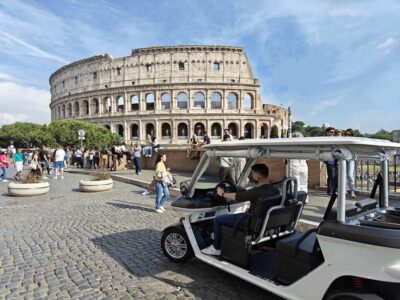
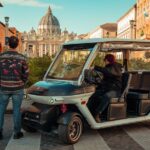
Rome looks best when you’re not wiped out. This electric golf cart tour stitches together Rome’s top sights in a way that’s fast, comfortable, and actually fun. You ride between landmarks, hop out for photos and key moments, then roll on—so you get more Rome with less back-and-forth.
I especially like the time balance: short stops that still let you take in places like the Spanish Steps and the Trevi Fountain without losing your whole afternoon. I also like the human factor—multiple guides in this experience (like Francisco and Dennis) are friendly, calm on tight streets, and ready with practical guidance like where to stand for better photos.
One thing to consider: Rome’s energy can interrupt plans. Even on a normal day, you’re moving in real traffic, and the experience requires good weather, so build some flexibility into your schedule.
In This Review
- Key Things to Know Before You Ride
- Why This Golf Cart Format Works for Rome
- Meeting Point Near the Colosseum (And Why Ending There Helps)
- Electric Cart Highlights: What You’ll Actually Do During the Ride
- Stop 1: Piazza di Spagna (Spanish Steps) + The Fashion Street Run
- Stop 2: Trevi Fountain (1732 Baroque Drama in Stone)
- Stop 3: The Pantheon (Architecture Time, With Admission Extra)
- Stop 4: Piazza Navona (Baroque Masterpieces + an Ancient Stadium Shape)
- Stop 5: Via Giulia + The Tiber Side Streets
- Stop 6: Tempio Maggiore di Roma (Jewish Life in the City Center)
- Stop 7: Tiber Island (Two Roman Bridges + a Thousand-Year Church Vibe)
- Stop 8: Trastevere Area + Historical Layers Along the River
- Stop 9: Bocca della Verità (The Mouth Myth You Can See in Person)
- Stop 10: Piazza dei Cavalieri di Malta (Keyhole View of St. Peter’s)
- Stop 11: Giardino degli Aranci (Parco Savello on Aventine Hill)
- Stop 12: Circo Massimo (Ancient Spectacle, Still Shaped Like an Arena)
- Final Stop at the Colosseum (Plus Optional Pasta Tasting)
- Price and Value: Is $449.49 Worth It?
- Who This Tour Fits Best (And Who Might Prefer Something Else)
- Should You Book This Rome Key Sights Golf Cart Tour?
- FAQ
- How long is the Rome Key Sights Golf Cart Tour?
- Is this tour private or do you join a group?
- What language is the tour offered in, and do I get a ticket on my phone?
- Is the Pantheon admission included?
- What is included in the pasta tasting upgrade?
- What happens if the weather is bad?
Key Things to Know Before You Ride
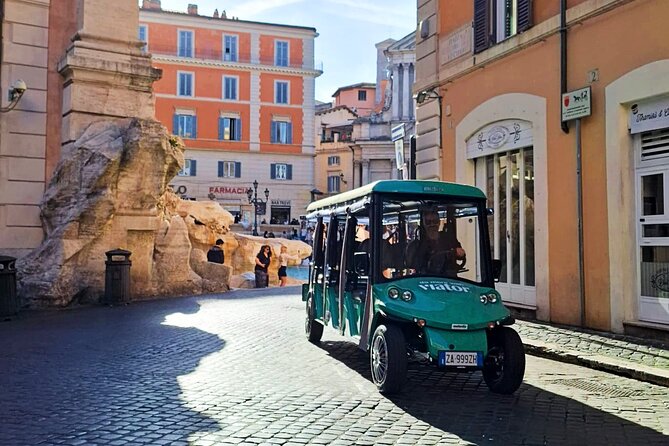
- Electric golf cart comfort: you see major monuments while staying off your feet for most of the day
- Short, purposeful stops: you usually get minutes to look and snap photos before moving to the next highlight
- Small groups or private: up to 12 max, with options for a tighter group of seven or a private schedule
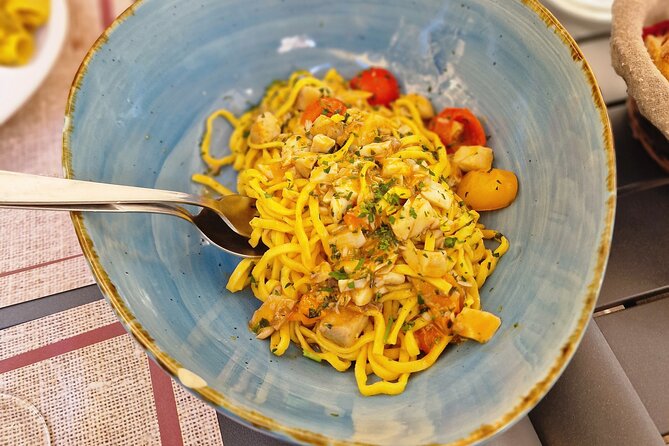
- Extra value with pasta tasting: you can upgrade to a tasting of three traditional Roman dishes
- Pantheon isn’t included: the stop is built in, but entry admission is not part of the tour cost
- Guide-driven flexibility: guides like Francesco, Fabio, and Dennis are praised for handling street disruptions smoothly
Why This Golf Cart Format Works for Rome
Rome rewards people who pace themselves. If you’ve ever tried to walk a “highlights” day—Colosseum, then Trevi, then Pantheon, then piazzas—you know the math gets ugly fast. This tour keeps you moving while you sit comfortably in an electric cart, so your energy stays for the moments that matter.
I also like that it’s not just a sightseeing loop. The best guides in this experience don’t merely list dates. They point out angles for photos, explain what you’re seeing in plain terms, and keep you from feeling like you’re constantly chasing the next corner. In the feedback, I kept seeing the same theme: guides staying right where they should be during each stop, so you don’t waste time finding your group.
Still, you’re doing this in Rome, not a theme park. If there’s a protest or street disruption, the driver’s route planning matters. You’ll want to be ready for detours and crowd behavior, and you’ll feel that more on a cart than on a bus. The upside: when the route is handled well, you don’t miss the core highlights.
You can also read our reviews of more private tours in Rome


Meeting Point Near the Colosseum (And Why Ending There Helps)
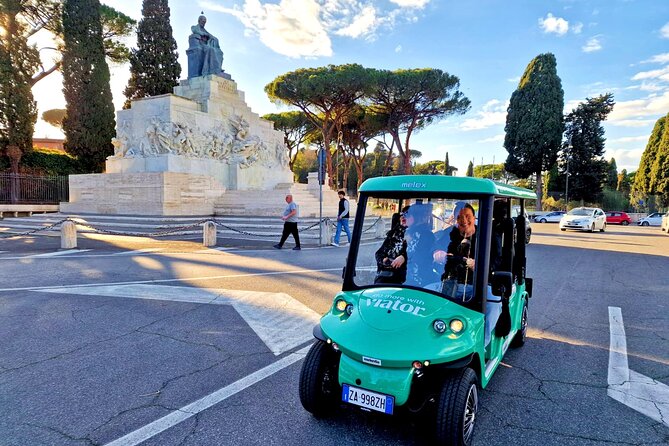
You start and end at Piazza del Colosseo, 3. That’s a smart anchor point because it puts you close to major transit options and makes it easy to keep going afterward—walk a bit, grab a taxi, or connect onward.
Finishing near the Colosseum also helps emotionally. After hours of moving through squares, fountains, and church landmarks, you can end with Rome’s big “wow” factor and then decide what to do next. If you add the pasta tasting upgrade, the tour positions it at that finish area too—so you’re not trying to fit food into the middle of heavy monument hopping.
Electric Cart Highlights: What You’ll Actually Do During the Ride
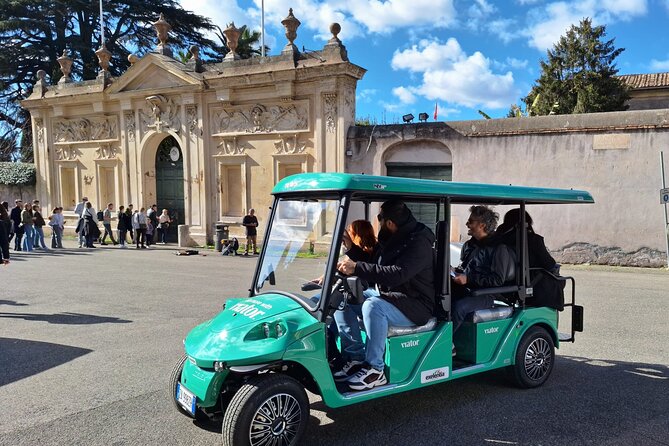
Most of your “time on tour” is spent seated, moving between areas. You’ll park the cart at each main stop and step out for a focused look—then you climb back in and continue.
Expect a rhythm like this:
- brief photo time and quick orientation at the big icons
- guided context from your driver while you’re on the move
- a clear pickup point so you don’t linger and fall behind
This pacing is especially good if it’s your first visit to Rome or your time is short. One reason the feedback is so strong is that you still get that feeling of seeing everything, even when you’re not doing long, hot walks between locations.
Stop 1: Piazza di Spagna (Spanish Steps) + The Fashion Street Run
Your first anchor is Piazza di Spagna and the Spanish Steps. This is one of those Rome scenes you don’t “sort of” see—you either go there or you miss the most iconic views of the center. The steps were arranged about three centuries ago to connect the Fountain of the Barcaccia at street level (by Pietro Bernini) with the Renaissance church up the slope. The plan and shape are unusual too, designed by Alessandro Specchi and Francesco De Sanctis.
After you soak in the view, you roll onward toward Rome’s fashion street area. The idea here is practical: it connects the Spanish Steps area to the central shopping streets, so you get both a landmark photo moment and a quick pass through one of the city’s most recognizable retail corridors.
Watch for: the Spanish Steps area can attract crowds fast. Your best move is to use the time you’re given for photos and then let the cart move you along.
Stop 2: Trevi Fountain (1732 Baroque Drama in Stone)
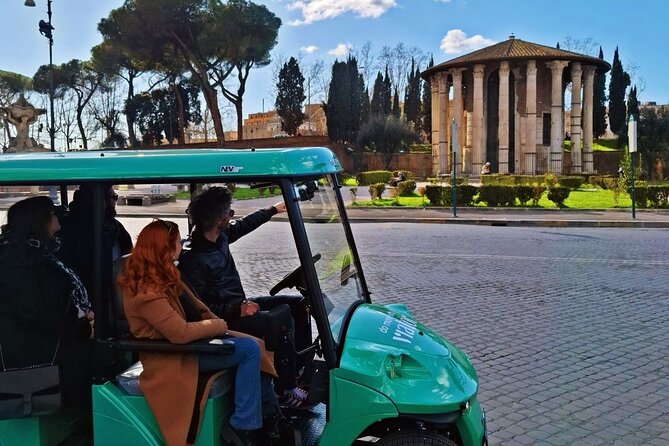
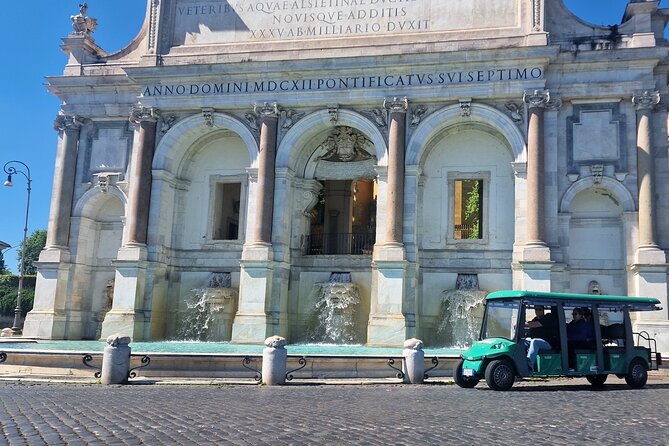
Next up is Trevi Fountain. This is built for photos, and your cart makes it easier to reach without the pre-walk stress. Once you park, you hop out for pictures, then get back in to continue.
The story that makes Trevi more than a pretty fountain: work started in 1732 during the Baroque era, after a papal contest. The famous fountain’s creator didn’t win the contest—yet due to pushback in Rome over a Florentine taking the win, Nicola Salvi still got approval to proceed. That mix of politics, prestige, and art is very Rome.
Watch for: Trevi is one of the busiest spots on any sightseeing route. Even if you only have a short window, plan to shoot from a couple angles quickly—then use your remaining minutes just to take it in, not to wait.





Stop 3: The Pantheon (Architecture Time, With Admission Extra)
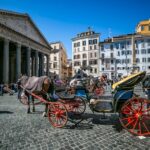
Then you arrive at the Pantheon, one of Rome’s most iconic monuments. You’ll step out from the cart to admire the architecture—especially the circular roof and the oculus that lets in sunlight and even rain.
This stop comes with important context. The Pantheon began as a Roman temple, and it later became a functioning church. It’s also associated with major figures, including Raphael and two kings of Italy. There’s even a famous note attributed to Michelangelo, who said the design was of angels rather than human concept.
Here’s your practical heads-up: Pantheon admission isn’t included. That means your time at the stop is best used for what the tour provides—seeing and absorbing the exterior and the interior access you choose to pay for on your own.
Watch for: if you care most about going inside, use your Pantheon minutes strategically and consider planning for entry costs separate from the tour.
Stop 4: Piazza Navona (Baroque Masterpieces + an Ancient Stadium Shape)
Piazza Navona is one of Rome’s most cinematic squares. You’ll approach by cart, then take in the area’s Baroque masterpieces—one of the key references here is Bernini’s influence in the space. The square’s shape is not random; it preserves the form of an athletics stadium from around 80 AD under Emperor Titus, then later became a market area in the 1500s.
That continuity is part of why Navona feels so compelling. You’re not just looking at buildings; you’re looking at a footprint the ancient city kept using and reusing.
Watch for: this square is visually packed. If you try to “process everything,” you’ll miss the feel of it. Use your time to pick a focal point—statues, fountains, or the layout—and let the rest be atmosphere.
Stop 5: Via Giulia + The Tiber Side Streets
Between the major piazzas, you’ll pass through Via Giulia. This street was designed around 1508 and dedicated to Pope Julius II. It runs from Ponte Sisto to the church of San Giovanni dei Fiorentini, hugging a tight curve shaped by the Tiber.
The layout was placed in the hands of Donato Bramante, who was also working on the works at the new Basilica of Saint Peter across the river. In other words, even a simple street pass here connects politics, Renaissance planning, and how Rome reorganized space.
Why this matters to you: it’s an example of how Rome’s “big sights” sit inside an entire system of streets and intentional urban design. A cart makes it easier to notice that layer without turning your day into a marathon.
Stop 6: Tempio Maggiore di Roma (Jewish Life in the City Center)
Next, you pass through the Jewish district in the heart of the city center, including the Tempio Maggiore di Roma. This is a quick stop, but it’s valuable because it adds variety to a standard “church-and-fountains” route. You get a sense of Rome as a living city made of many communities, not just monuments.
Watch for: this is time-limited, so don’t expect a long exploration unless you plan to return on your own later.
Stop 7: Tiber Island (Two Roman Bridges + a Thousand-Year Church Vibe)
Then comes one of those Rome moments that feels like a trick. You’ll reach Tiber Island, a real island in the middle of the river—made possible by two original Roman bridges still connecting it to the city. The island also has a one-thousand-year-old church.
In warmer months, the place becomes a restaurant and festival zone, which gives you a different side of Rome—less postcard, more social.
Watch for: if you’re visiting outside peak season, the “festival energy” may not be what you expect. The island still works for a calm look and a different river perspective.
Stop 8: Trastevere Area + Historical Layers Along the River
After Tiber Island, you cross toward the opposite bank and get to the Trastevere neighborhood area. This district has seen huge changes over the centuries. It was home to the original Jewish Synagogue of Rome and also the oldest church in the Eternal City. Long before that, from 753–509 BC, it was associated with hostile Etruscans; later, it shifted to fishermen due to its closeness to the river.
Julius Caesar also chose this area for a luxury garden villa, which is an interesting reminder that elite Rome didn’t only live near imperial centers.
Why this matters: Trastevere helps balance your day. You’re not stuck only in the official “tourist core.” You get a feel for how the city’s neighborhoods evolved.
Stop 9: Bocca della Verità (The Mouth Myth You Can See in Person)
You’ll also pass by a mysterious ancient Roman artifact: Bocca della Verità. The original purpose is unclear. Some historians suggest it was used as a drain cover inside an open-air temple area across from where it stands today, while others propose it was used to let blood drip through during animal sacrifices.
Today, it’s famous for a darker-but-funny myth: if a liar places their hand into its open mouth, the hand will be lost forever. Replicas exist, but the origin connected to the covered entrance of Santa Maria in Cosmedin.
Watch for: this is one of those spots where the story matters as much as the object. Listen closely to your driver’s explanation so you understand why the line forms in the first place.
Stop 10: Piazza dei Cavalieri di Malta (Keyhole View of St. Peter’s)
Piazza dei Cavalieri di Malta is small, picturesque, and heavily designed. It’s enclosed on two sides by cypress trees from the Benedictines’ garden and framed by an arrangement of obelisks and stele constructed in 1765, designed by Giovanni Battista Piranesi.
The square also includes the Neo-Romanesque campanile of the Church of San Anselmo and the Benedictine seminary. But the headline feature is the Villa del Priorato di Malta and its keyhole view—Il Buco della Serratura. Looking through that keyhole gives a copper-green view aligned with the dome of Saint Peter’s Basilica at the end of a garden allée.
Practical angle: even if you only get quick time here, it’s one of the most “Rome brain” stops—your guide helps you understand what you’re looking at, and that makes it memorable.
Stop 11: Giardino degli Aranci (Parco Savello on Aventine Hill)
Then you reach Giardino degli Aranci, also known as Parco Savello. It covers about 7,800 square meters and sits on the Aventine Hill. The garden as it looks today was designed in 1932 by Raffaele De Vico, built to give the public access to viewpoints.
Why you’ll like this stop: it’s a change of pace. After fountains and dense central streets, you get open sky and a city view that feels more relaxed than the center.
Stop 12: Circo Massimo (Ancient Spectacle, Still Shaped Like an Arena)
Next is Circo Massimo. You’ll travel through the vast elliptical space where more than 100,000 Romans once gathered for public games. The site connects back to Rome’s earlier legends, including an Etruscan king Romulus commemorating his triumph over the Sabines there.
It’s not the same kind of “look at a building up close” as the Pantheon. Instead, it’s the geography of Rome—how the city was designed to hold massive crowds, then later repurposed and remembered.
Watch for: your stop time is brief, so don’t expect a long lecture. Treat it as a guided orientation moment.
Final Stop at the Colosseum (Plus Optional Pasta Tasting)
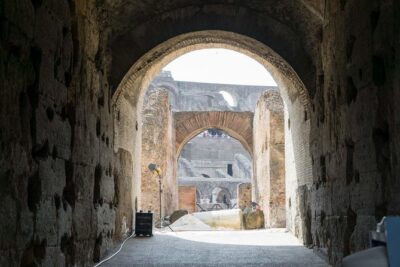
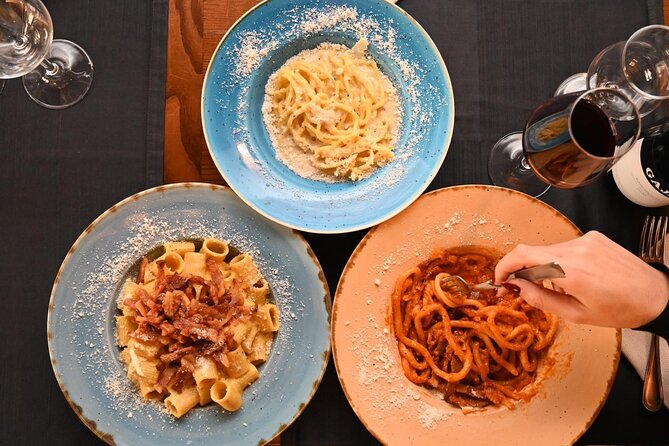
You finish at the Colosseum area, where your Rome adventure becomes real. This is where the day’s theme lands: ancient Rome, up close. If you choose the upgrade, you can also add a pasta tasting experience at the end, featuring three traditional Roman dishes.
I like ending here because it gives you options. After you eat, you can choose to continue exploring the Colosseum area on your own, or just head onward without needing more transportation planning.
Price and Value: Is $449.49 Worth It?
At $449.49 per person, this isn’t a “budget morning in Rome.” But it can be good value for the right traveler, because you’re paying for three things at once:
- the electric cart (meaning less walking fatigue across a long loop of central sights)
- a guide who helps you understand what you’re seeing and where to stand for photos
- a structured route that compresses many landmarks into a manageable 2 hours 30 minutes to 3 hours window
If you’re traveling in a group, the tour offers group discounts, and the operator caps group size at 12. That helps you justify the price compared with paying for multiple separate guided experiences.
The optional pasta tasting upgrade can also improve value if you planned to eat anyway. You get three Roman dishes rather than trying to “pick dinner” mid-sightseeing.
The main cost caveat is the Pantheon admission detail: Pantheon entry isn’t included, so your personal total might rise if you want to go inside. Still, knowing that upfront helps you plan.
Who This Tour Fits Best (And Who Might Prefer Something Else)
This tour is a strong fit if you:
- have limited time and want a “covers the classics” route
- prefer saving your legs for evening wandering or gelato missions
- want a guided day without long transfers between monuments
The praise in the feedback points to comfort and adaptability. People highlighted how drivers handled narrow streets safely and stayed accommodating, including for elderly family members. Guides like Francisco, Dennis, and Fabio came up again and again for being friendly and informative, with practical photo tips and smooth timing.
You might want to choose something else if:
- you hate splitting your attention into short stops and would rather do fewer sites longer
- you’re planning to spend extra time inside multiple buildings, since this route is time-balanced rather than “deep visit” focused
- weather is unstable, because the experience requires good weather
Should You Book This Rome Key Sights Golf Cart Tour?
I’d book it if you’re aiming to see a lot of Rome in a short amount of time while keeping your day comfortable. The combination of electric cart efficiency, tight stop timing, and a guide who knows how to keep things moving (even when streets get weird) makes it a practical choice.
Skip it only if you want unhurried, long museum-style visits or if your itinerary needs lots of flexible stop-and-stay time. For most first-timers and busy schedules, this tour does what it says: key sights, smart pacing, and a fun way to get your bearings fast.
FAQ
How long is the Rome Key Sights Golf Cart Tour?
The tour runs about 2 hours 30 minutes to 3 hours.
Is this tour private or do you join a group?
Both options are available. There can be small groups (with seven travelers mentioned) or private tour options. The experience also notes a maximum of 12 travelers.
What language is the tour offered in, and do I get a ticket on my phone?
The tour is offered in English, and you receive a mobile ticket.
Is the Pantheon admission included?
No. Pantheon stop admission is not included, while other listed stops show free admission tickets.
What is included in the pasta tasting upgrade?
The upgrade includes a pasta tasting of three traditional Roman dishes.
What happens if the weather is bad?
The experience requires good weather. If it’s canceled due to poor weather, you’ll be offered a different date or a full refund.