REVIEW · ROME
Rome Capitoline Museums Private Guided Tour and Panoramic Views
Book on Viator →Operated by Tour In Rome by Tour in the City · Bookable on Viator
Capitoline Hill is Rome’s art-and-view shortcut. I like how this is a private guided tour with a professional art historian who can match the pace to your interests, and I love that you get panoramic Rome views built into the museum route, not tacked on at the end. You’ll move from bronzes and antiquities to major Renaissance and Baroque painting, all while learning what you’re actually looking at.
The main thing to consider: this is a paintings + antiquities tour, so if you want quick photo stops and minimal talking, the time may feel long for the amount of floor space you cover.
Quick hits before you go
- Private, skip-the-line access to Musei Capitolini, plus included admission for the palaces you visit
- Caravaggio and big-name painters inside the Pinacoteca, not just statues
- Marcus Aurelius in the exedra gives you the kind of view that makes the museum feel like a balcony
- An underground tunnel route reveals a Roman Forum view you don’t get from the street
- You’ll walk the Michelangelo-designed Piazza del Campidoglio with its famous central equestrian focus
- You get expert explanation styles highlighted by guides named Emilio and Martin in past tours
In This Review
- Why the Capitoline Museums work so well for a Rome first-timer (or a second-timer)
- Musei Capitolini: bronzes, vases, and the feeling of real antiquity
- Pinacoteca: the painters you came for, plus how to read the walls
- Marcus Aurelius in the exedra: the panoramic payoff
- The underground tunnel route to the Roman Forum view
- Piazza del Campidoglio: Michelangelo’s square and why the design matters
- The replica in Piazza del Campidoglio: what a copy can teach you
- Palazzo Senatorio, Palazzo Nuovo, and Palazzo dei Conservatori: palaces as part of the art
- Palazzo Senatorio: where civic Rome once ran on stone
- Palazzo Nuovo: a museum born from collections
- Palazzo dei Conservatori: sculptures, tapestries, and fresco cycles
- Pace, timing, and who this tour fits best
- Price and value: what $288.97 per person actually buys you
- Should you book this private Capitoline Museums and views tour?
- FAQ
- FAQ
- How long is the Rome Capitoline Museums private tour?
- Is this a private tour?
- What language is the tour offered in?
- Is skip-the-line entry included?
- Are museum and palace admission tickets included?
- What are the main sites you’ll see?
- Does the tour include panoramic views?
- What should I wear?
- Are food and drinks included?
- What is the cancellation policy?
- Where does the tour start and end?
Why the Capitoline Museums work so well for a Rome first-timer (or a second-timer)
The Capitoline Museums sit on Capitoline Hill, a place that once hosted temples and an ancient settlement. Today, it’s one of Rome’s best “start here” museums because it connects the dots between Roman antiquity and the way later artists (Renaissance and Baroque) looked back at it.
This tour format matters. You’re not stuck with a group shuffle. It’s private, and it’s led by a professional art historian. That turns the usual museum problem—wandering room to room hoping something makes sense—into a planned walk where the guide points you toward the meaning behind the masterpieces. And because the tour includes guaranteed skip the lines, you lose less daylight to bottlenecks at the entrance.
Musei Capitolini: bronzes, vases, and the feeling of real antiquity
Most people think “Capitoline Museums” means statues. Sure, there are plenty. But the experience is smarter when you treat it like a story in three chapters: Roman symbolism, Greek and Etruscan material, and then the moment the museum starts talking directly to Renaissance and Baroque taste.
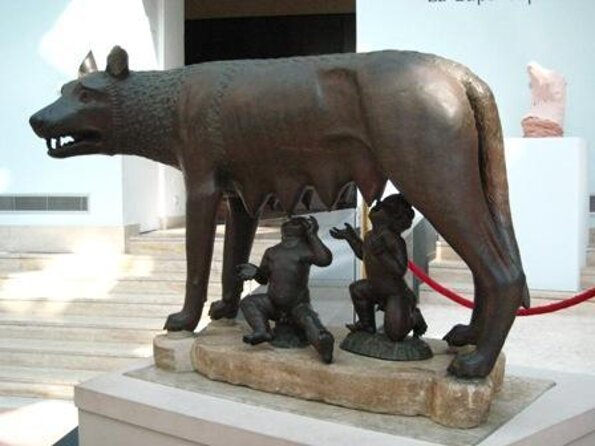
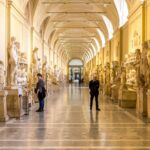
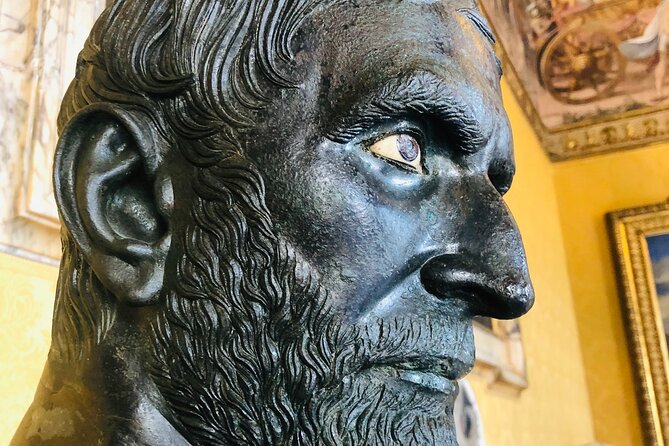
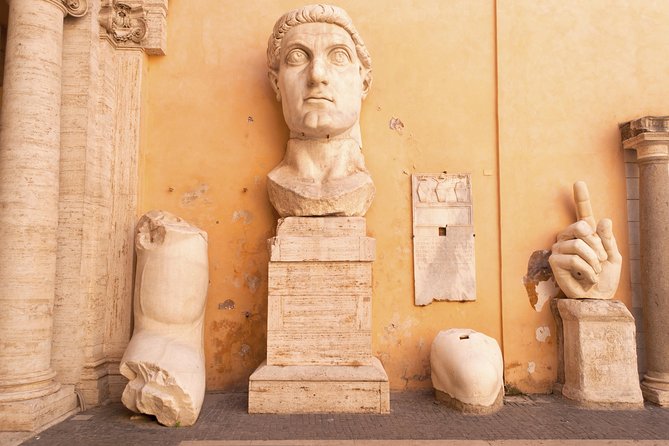
You begin inside Musei Capitolini, where you’ll see standout bronzes and sculptures. The bust of Capitoline Brutus gets you into the Roman obsession with civic identity and character—why these people mattered enough to keep showing up in art and politics. Then comes the Spinario (the boy pulling a thorn), a sculpture that rewards slower looking: the pose is simple, but the realism and expression take work to notice. And the famous Capitoline Wolf is part of what makes this museum feel like a symbol factory. The legend of Romulus and Remus isn’t just a story here—it’s a visual anchor for Rome’s identity.
You’ll also spend time with the museum’s collection of Greek and Etruscan vases. That’s an underrated move. Vases aren’t just decorative. They show how images, gods, and daily life traveled across cultures around the Mediterranean, and they help you understand why Roman collectors and artists cared so much about earlier styles.
You can also read our reviews of more guided tours in Rome
Pinacoteca: the painters you came for, plus how to read the walls
After the sculpture-focused start, the tour shifts into the Pinacoteca, which is described as the oldest public collection of paintings. That alone is a good reason to go, but the better reason is the lineup.
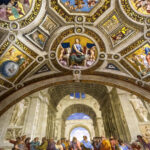
You’ll have time to see paintings by major artists including Caravaggio, Guido Reni, Carracci, Guercino, Domenichino, Veronese, Titian, Tintoretto, Rubens, and Pietro da Cortona. It’s a long list, but the guide’s job is to keep it from becoming name-dropping. You should expect help with what to look for: composition, style differences, and why certain subjects show up in particular periods.
Then you’ll add statues from Renaissance and Baroque Rome. This is where the tour becomes more than “ancient objects.” You start seeing how later centuries didn’t just preserve old things—they built new meaning on top of them.
If you’re the kind of person who hates being rushed, this is your sweet spot. One of the best notes from past guests is that the guide can keep it structured without turning it into a lecture that ignores you.
Marcus Aurelius in the exedra: the panoramic payoff
The museum’s big view moment happens at the exedra, where the equestrian statue of Emperor Marcus Aurelius takes center stage. You’re not just looking at a sculpture. You’re looking at a sculpture that functions like a focal point in a larger architectural frame—almost like Rome designed a scene around it.
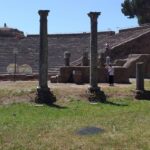
What makes the view special here is the combination: the statue sits among remains of ancient temples you can still see around the space. This is the kind of setting where the museum feels less like a room and more like a layered time machine.
Plan to slow down. Equestrian statues are easy to skim in a museum because they look grand from far away. The guide’s explanation is what helps you notice the details in the horse, the posture, and why the artwork became such a lasting symbol.
The underground tunnel route to the Roman Forum view
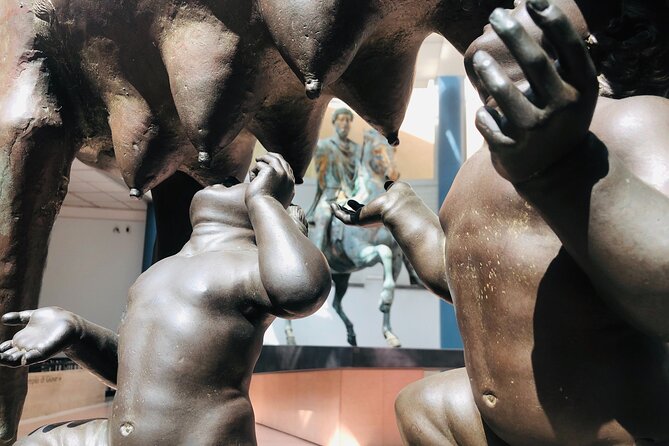
Rome rewards you when you let it surprise you. This tour includes an underground tunnel through the Tabularium remains, and that route changes the feel of the whole experience.
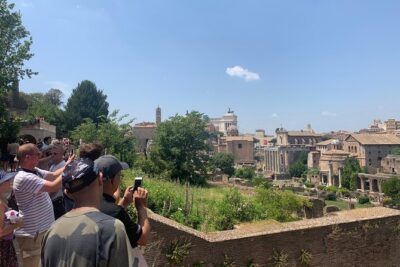
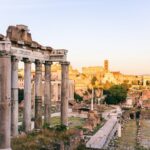
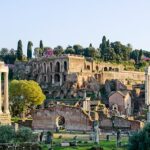
From down there, you can enjoy a magnificent view of the Roman Forum. It’s not the same view you get standing outside. The angle and the framing make the Forum feel like it’s part of a larger, older plan—one that predates most modern street grids.
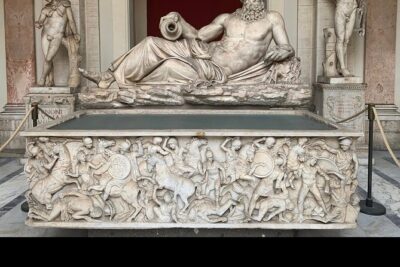
You’ll also see more museum highlights along the way: sarcophagi, busts, and mosaics, plus pieces like Marforio, the Dying Gaul, and the figure of Cupid and Psyche. This part is less about ticking items off a list and more about learning what kind of images Rome kept returning to: power, emotion, myth, and memory.
Piazza del Campidoglio: Michelangelo’s square and why the design matters
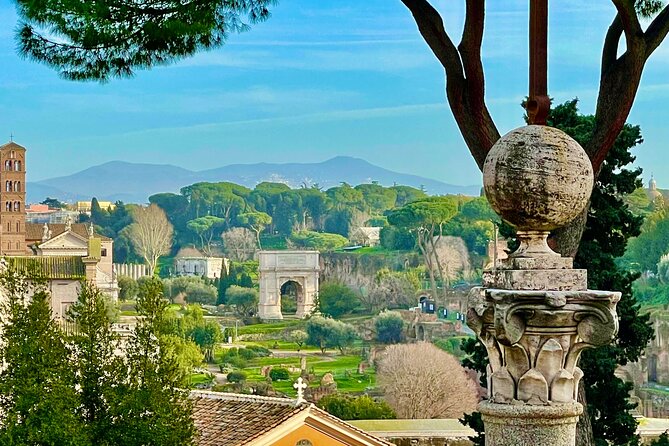
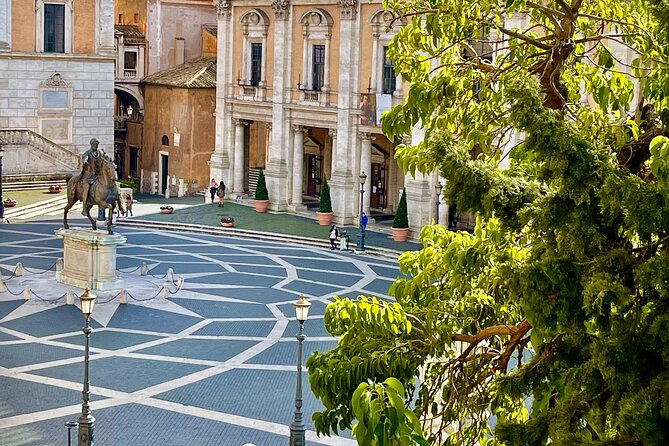
After Musei Capitolini, you shift to Piazza del Campidoglio, and that’s not a random break. It’s one of the best examples of how Rome’s art world doesn’t stop at painting and sculpture—it extends into urban design.
This square is linked to the idea of a uniform project on the Capitoline hill, thanks to Michelangelo. In 1536, it went through major transformations because the Spanish emperor Charles V visited Rome. Pope Paul III commissioned Michelangelo to complete the layout after the hill had been in serious abandonment.
Here’s what you’ll notice during your walk:
- A central podium for the equestrian statue of Marcus Aurelius, set up as the project’s fulcrum
- Michelangelo’s staircase with giant steps that guides you up with ceremony
- A balustrade topped by classic marble groups
It’s one of those places where the design tells you what to feel before you even interpret a single artwork. The view over the Forum and city is part of the emotional punch.
You can also read our reviews of more private tours in Rome






The replica in Piazza del Campidoglio: what a copy can teach you
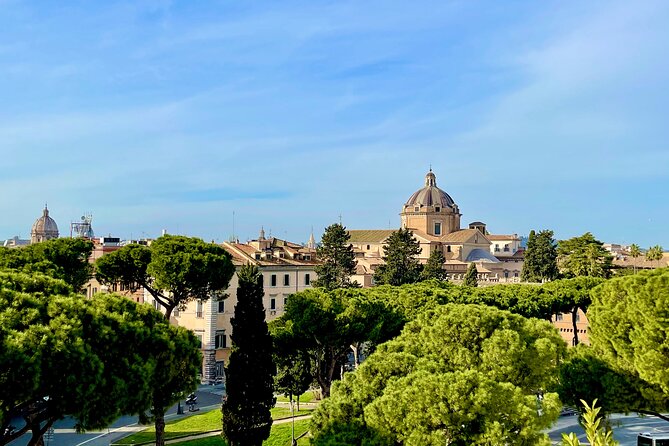
You’ll also spend time at the Replica Statua Equestre di Marco Aurelio. Since 1997, a gilded bronze copy of the Marcus Aurelius group has been placed in Piazza del Campidoglio.
The interesting part isn’t just that it’s a replica. The copy is described as absolutely faithful, created using a photogrammetric survey so the composition matches the original. And the original’s story matters too: it was removed from Piazza del Campidoglio in 1981 for restoration and diagnostic tests, with work needed due to exposure to atmospheric agents and pollution.
So yes, this is a copy. But it’s also a lesson in how Rome balances access, preservation, and authenticity.
Palazzo Senatorio, Palazzo Nuovo, and Palazzo dei Conservatori: palaces as part of the art
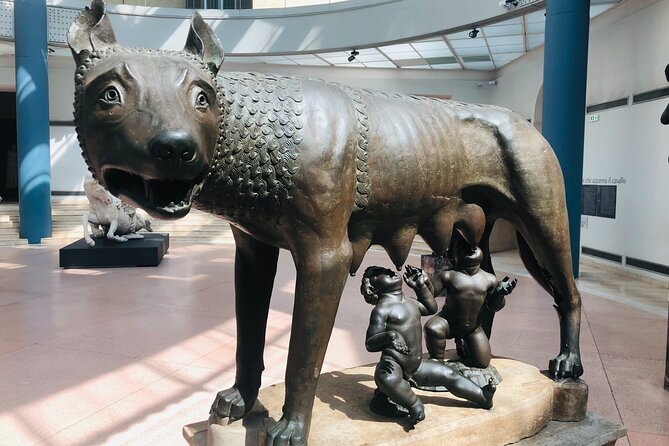
The rest of your tour takes you through a cluster of palaces around Piazza del Campidoglio, and each one adds a different layer.
Palazzo Senatorio: where civic Rome once ran on stone
Palazzo Senatorio was built between the mid-12th century and the last quarter of the 13th century, on ruins of the ancient Tabularium. From 1144, it served as the seat of the Municipality of Rome, with the Senator as its highest representative.
Look for the facade’s loggias with round arches arranged on three levels. You’ll also spot recovered ancient columns with Ionic capitals. This stop is included, so you get a chance to connect the art inside with the political and civic setting that shaped what Rome wanted to remember.
Palazzo Nuovo: a museum born from collections
Palazzo Nuovo dates to the 17th century and sits opposite the mirrored Palazzo dei Conservatori. Its construction began in 1603, designed from a plan by Michelangelo (as the text credits), with completion in 1654 by the Rainaldi.
It became an official museum in 1734 under Clement XII Corsini. A big part of what made it matter is the acquisition of the Albani collection—418 sculptures—added to whatever was already on display. If you like museums that show you not only objects but also collecting tastes over time, you’ll probably enjoy this stop.
Palazzo dei Conservatori: sculptures, tapestries, and fresco cycles
Palazzo dei Conservatori was the residence of the Conservators, magistrates elected by the people to administer the city since the 13th century. For the Jubilee of 1500, Pope Nicholas V entrusted Michelangelo with rebuilding and reorganizing the square.
After Michelangelo’s death, the work was continued and then finished in 1568 by Giacomo della Porta, who followed Michelangelo’s designs (with one noted exception involving a larger representation room).
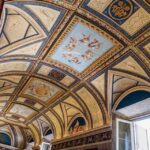
Inside, you’ll see the art gallery, tapestries, and bronze sculptures including the Capitoline Wolf. The apartments include fresco cycles, credited among authors to Pietro da Cortona, dated between the 16th and 17th centuries, relating to ancient history of Rome.
This is where the tour makes a strong case that Rome’s story isn’t only on stone statues. It’s in interior decoration too.
Pace, timing, and who this tour fits best
The full experience runs about 2 hours 30 minutes to 3 hours. The museum portion is the longest stretch, and then you walk through the square and palaces.
That means you’ll want to go into it with the right mindset:
- If you like structured museum visits where someone turns names and styles into meaning, this works well.
- If you want mostly casual sightseeing, you might find the museum focus and amount of explanation challenging.
One good note from past guests: this tour can feel ideal in summer because the museum circuit can still be manageable compared with some other high-traffic Rome sites. Still, bring patience. You’re dealing with marble, stairs, and a lot of looking.
Also note the practical dress code: smart casual. You don’t need to dress like you’re attending a gala, but leave the sloppy sneakers-and-hoodie look at home if you can.
Price and value: what $288.97 per person actually buys you
At $288.97 per person, the price isn’t low. So here’s the value logic you should use.
You’re paying for:
- A private tour (so no waiting for slow walkers in your group)
- A professional art historian guide
- Guaranteed skip-the-line tickets
- Included admission for key museum/palace portions
- Panoramic views integrated into the route, including the Forum view from the underground tunnel and the exedra setting
If you were doing this solo, you’d still spend time entering the museums, and you’d still face the problem of figuring out which works matter and why. The guide’s role is what converts a collection into an experience.
Where the price may feel less worth it is if you prefer a light-touch museum experience. One past guest specifically said this wasn’t the best fit for casual art fans and found the pace too long for the space. That’s fair. Choose this tour when you want the backstory, not just the photos.
Should you book this private Capitoline Museums and views tour?
Book it if:
- You want skip-the-line access and a private art historian guide
- You care about both antiquity and the jump to Renaissance/Baroque painting and sculpture
- You want Rome’s best “art + view” combo from the same hill
Consider skipping if:
- You prefer short, fast stops with minimal explanation
- You mostly want sweeping city panoramas and don’t care about the painting and sculpture side
If you’re on your first big museum day (or you’re planning a concentrated Rome art block), this is a smart anchor stop. It’s a focused mix of masterpieces and viewpoints, without forcing you to spend your time guessing what to look at next.
FAQ
FAQ
How long is the Rome Capitoline Museums private tour?
It lasts about 2 hours 30 minutes to 3 hours.
Is this a private tour?
Yes. It’s private, meaning only your group participates.
What language is the tour offered in?
The tour is offered in English.
Is skip-the-line entry included?
Yes. The tour includes guaranteed skip-the-lines tickets.
Are museum and palace admission tickets included?
Admission is included for the Musei Capitolini portion and for the palaces (Palazzo Senatorio, Palazzo Nuovo, and Palazzo dei Conservatori). The Piazza del Campidoglio and the replica statue are free.
What are the main sites you’ll see?
You’ll visit Musei Capitolini, Piazza del Campidoglio, and then the nearby palaces: Palazzo Senatorio, Palazzo Nuovo, and Palazzo dei Conservatori. You’ll also see the replica equestrian statue of Marcus Aurelius.
Does the tour include panoramic views?
Yes. It’s specifically described as including panoramic views of Rome, including a view of the Roman Forum from an underground tunnel.
What should I wear?
The dress code is smart casual.
Are food and drinks included?
No. Food and drinks are not included.
What is the cancellation policy?
You can cancel for a full refund up to 24 hours in advance. Also note that refund requests must be made within and not later than 48 hours from the day of the tour.
Where does the tour start and end?
It starts at Capitoline Museums, Piazza del Campidoglio 1, 00186 Roma RM, Italy, and ends back at the meeting point.