REVIEW · ROME
Private Tour of Rome by Bike – A Ride Around The Most Famous Places of Rome
Book on Viator →Operated by Dearoma Tours · Bookable on Viator
Rome clicks into place fast on two wheels. I love the bike and helmet rental included (so you start riding without extra steps) and the private guide experience that keeps things focused on what you’re seeing. One heads-up: this is still Rome on busy streets, so you’ll be sharing space with pedestrians and you’ll need to stay alert.
In about three hours, you get a guided sweep of Rome’s big-name sights and key ancient landmarks. The guides Federico and Valerio come through in the reviews for being informative and funny, keeping riders comfortable, and explaining what to do—without hiding behind a headset. If it’s your first day, it’s a smart way to get your bearings fast and see a lot without sore feet.
In This Review
- Key Highlights You’ll Feel Right Away
- Meeting Federico/Valerio’s Rome: Getting Oriented and Rolling Out
- Largo Argentina to Capitoline Hill: Caesar’s Shadow and Michelangelo’s Staircase
- Piazza Venezia and the Vittoriano: The Monument You Can’t Ignore
- Imperial Rome on Wheels: Forum Romano, Augustus, and Trajan’s Column
- Colosseum Area, Trevi Coin, and the Photo Stops Everyone Plans
- Pantheon Entry Included: One Ticket, One Big WOW
- Piazza Navona and Palazzo Farnese: Finishing in the Roman Postcard Zone
- How Much You Really See in 3 Hours (and What You Might Miss)
- Price and Value: Is $142.97 Worth It?
- Who This Bike Tour Suits Best (and Who Should Consider Alternatives)
- Should You Book Private Tour of Rome by Bike?
- FAQ
- How long is the bike tour?
- What is included in the tour price?
- Is this a private tour?
- Where does the tour start and where does it end?
- What languages is the tour offered in?
- Are there age limits for riding?
- Is a mobile ticket used?
- When do I get confirmation after booking?
- Can I cancel for a full refund?
Key Highlights You’ll Feel Right Away
- Bike + helmet included so the start is smooth and you’re not hunting rentals.
- Private pace: you can pause for photos or ask questions without waiting on a bigger group.
- Safety-first guidance: you get a rundown of traffic and bike rules before you roll out.
- Ancient Rome, compact: Caesar’s assassination site to the Imperial ruins, all in one ride.
- Pantheon ticket is included, not just a quick stop for photos.
- You finish in the heart of the action around Piazza Navona and then head back to the meeting point.
Meeting Federico/Valerio’s Rome: Getting Oriented and Rolling Out
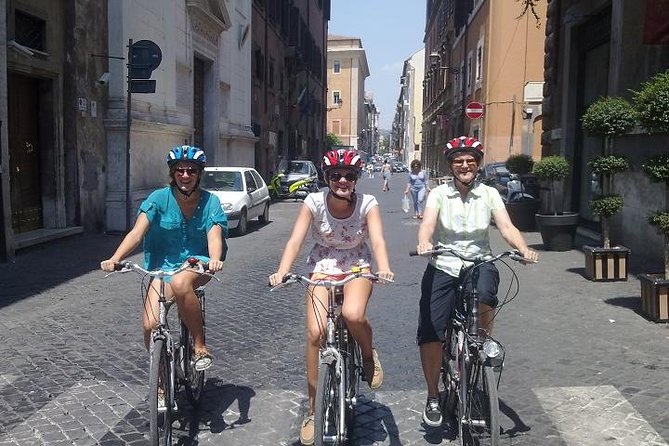
Your tour starts at Dearoma Tours & Travel, Via dei Balestrari, 11 (near public transportation). You’ll meet your guide and then get set up to ride—bike and helmet are included—which matters in Rome. It’s one less thing to manage in a city where even “simple” logistics can eat time.
Before you head into the historic center, the guide explains Rome traffic and biking rules. This isn’t about taking formal driving tests. It’s more practical: how to move, how to read the street, and how to handle weaving through pedestrians. In the reviews, the strongest praise is how guides keep people calm. Federico is singled out for welcoming riders and answering questions, and Valerio is praised for reassuring everyone that the route would be mostly away from heavy car lanes.
One small detail I like: you’re not relying on earpieces. The guide talks directly, and you can ask things as you go. That makes the ride feel like a conversation, not a scripted lecture.
You can also read our reviews of more cycling tours in Rome
Largo Argentina to Capitoline Hill: Caesar’s Shadow and Michelangelo’s Staircase
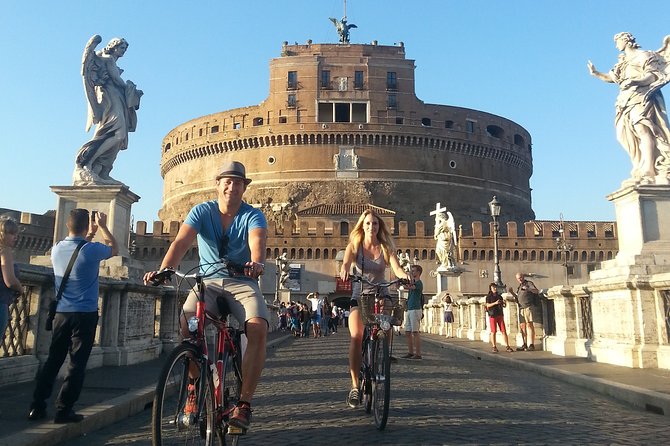
Early on, you hit Area Sacra di Largo Argentina, the place tied to Julius Caesar’s assassination. The tour keeps it short—around five minutes—but that’s exactly why a bike tour works. You get the location and the story without spending half a day trying to connect multiple stops on foot.
Next comes Colle Capitolino, with a stop at the monumental staircase Michelangelo designed for the Capitoline Hill area. This is one of those Rome moments where the scale hits you fast. Even if you’ve seen photos, standing near the staircase gives you a real sense of how Rome was built for ceremony, not casual strolling.
Admissions: both of these are listed as free stops in the plan. That means you’re paying for guidance and time, not entry fees at every corner.
Practical note: the streets around these areas can be busy. You’ll likely park your bike briefly, look around, and then roll on—good for keeping energy up in the middle of a sightseeing day.
Piazza Venezia and the Vittoriano: The Monument You Can’t Ignore
Then the route shifts toward Piazza Venezia, with a stop focused on the Vittoriano monument (described in the tour plan as the enormous Ala Brasini complex). The highlight here is not just the size—it’s the story behind it, tied to the unification of Italy.
This kind of stop is ideal on a bike tour because you can approach quickly and get the context before you move on. If you were trying to walk the same path, you’d spend more time crossing streets and waiting for gaps in traffic.
It’s also a good example of how this tour blends different eras of Rome. You move from ancient power struggles (Caesar) to the symbolism of modern nation-building (Vittoriano). That contrast is part of the fun.
Imperial Rome on Wheels: Forum Romano, Augustus, and Trajan’s Column
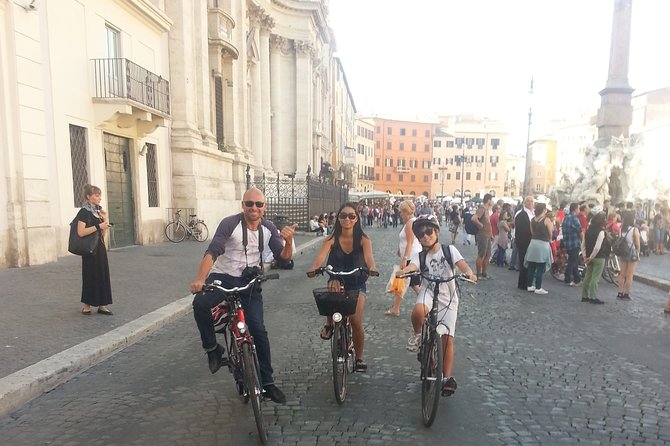
This is where the tour gets seriously “wow” for ancient Rome fans. You glide by or stop near the Forum Romano (the oldest public square of ancient Rome), then continue to the Forum of Augustus ruins, and on to Trajan’s Column.
These are listed as non-included admissions, which is normal for many ruin areas where you’re viewing from outside or in open archaeological spaces. The value is the guide’s sequencing—helping you understand what you’re seeing instead of just scanning stones.
Why a bike tour helps here:
- You can cover multiple archaeological sites without losing your entire morning to walking.
- You get orientation as a set, so it starts to click: forum spaces, imperial messaging, and the way Rome organized public life.
Trajan’s Column is a great mid-ride anchor. It’s visually distinct, and it gives you a narrative “spine” for the earlier forum stops.
Colosseum Area, Trevi Coin, and the Photo Stops Everyone Plans
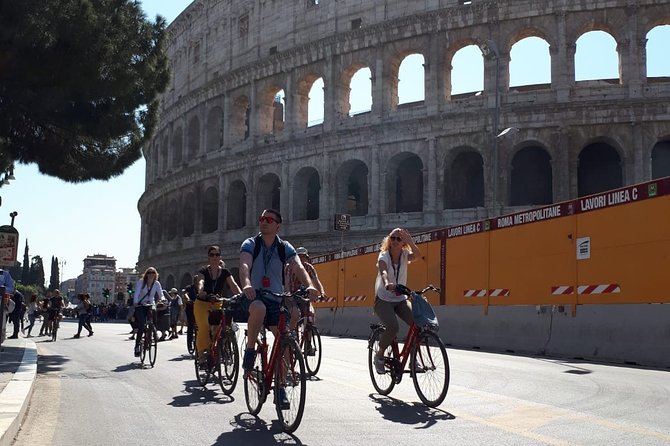
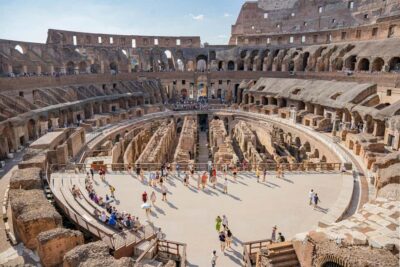
The tour route is described as reaching the Colosseum, with a story about the violent battles that once took place inside. Even if your time there is brief compared to a dedicated Colosseum-focused day, you’ll still come away with the “why it mattered” context—often the missing piece when you just snap pictures.
From there, you roll toward Fontana di Trevi. You’ll pause at the fountain for the classic coin moment—throw in a coin, then keep riding. Trevi is one of those places where the surroundings can swallow your time if you’re unprepared. Seeing it as a stop inside a planned ride helps you enjoy it without turning the whole day into a queue.
Next: Spanish Steps. The tour frames it around the staircase as a symbol of Rome’s beauty, and it’s a great break from the ruins-heavy stretch before it. It also offers space to reset your legs—because by now you’ve done a mix of looking, stopping, and riding.
Then you pass through Piazza del Popolo, where a 33,000-year-old Egyptian obelisk stands in the middle of the square. That obelisk detail is the kind of thing that makes a guided stop feel worth it. It’s easy to walk through a square without clocking what’s actually there. The guide gives it a hook.
A final street highlight here is Via del Corso, described as the central boulevard of the city of the Popes. Even a quick segment helps you feel the city’s “spine” linking major sights.
You can also read our reviews of more private tours in Rome



Pantheon Entry Included: One Ticket, One Big WOW
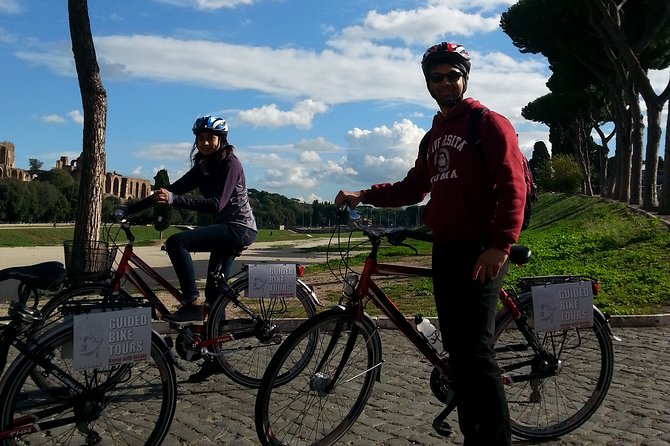
The Pantheon stop is special because the plan lists admission included. That means you’re not just stopping outside—you should be able to go in as part of the experience.
The Pantheon is described as the best preserved Roman temple and a building that still amazes people 19 centuries later. That’s not marketing fluff. The architecture is so intact that it’s hard to understand until you’re standing inside and seeing how Roman design still controls the space.
One thing I’d manage expectations on: the overall tour is about three hours, so any single stop won’t be long. If you want slow, detailed museum-style time, you might need a second visit later. But as a first-or-second day plan, having the ticket included and getting there on a bike route is a strong use of your time.
Piazza Navona and Palazzo Farnese: Finishing in the Roman Postcard Zone
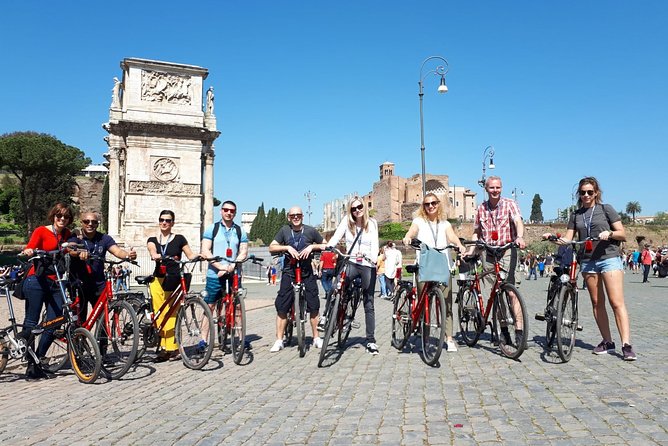
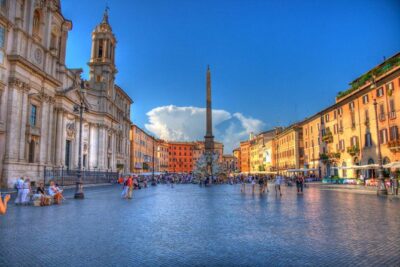
You end up in Piazza Navona, which is described as the most beautiful plaza of Rome, with the Four Rivers Fountain shining in the middle. This is classic Rome theatre. The square gives you a “relief” moment after ancient ruins and big monuments—more human scale, more street-life energy.
The tour also includes Campo de’ Fiori, the colorful and noisy market area. It’s a good last stop because it feels like Rome doing Rome. You can walk a bit while still keeping the momentum of the ride.
The plan notes you finish in front of Palazzo Farnese on Piazza Navona, and the activity ultimately ends back at the meeting point. So think of it as: you wrap near the grand postcard area, then cycle back to where you started.
If you’re the type who likes to know you’ve got a clean ending, this setup helps.
How Much You Really See in 3 Hours (and What You Might Miss)
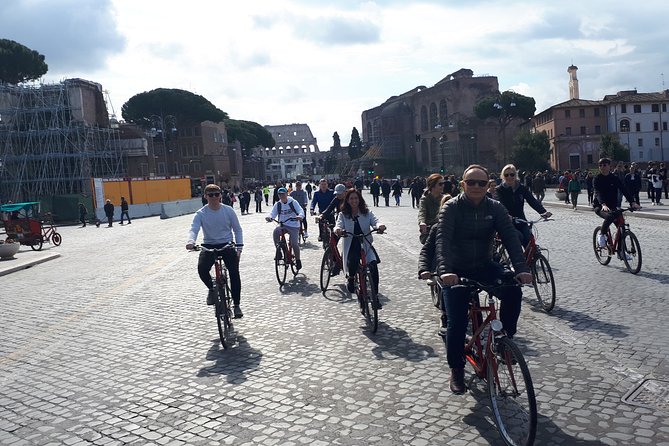
This tour is designed for “first sweep” Rome. In three hours, you cover a wide range: assassination-site lore, Michelangelo’s staircase, the Vittoriano, Roman forums and columns, Trevi, Spanish Steps, Piazza del Popolo, the Pantheon, Piazza Navona, and Campo de’ Fiori.
That’s the big win: it compresses a lot of Rome into one guided loop without making you choose between ancient Rome and the most famous city sights.
What you might miss is depth. Each stop is short. That’s not a flaw—just the math of three hours. If a stop is a top priority for you (like the Colosseum, the Pantheon, or one specific ruin area), you’ll likely want a follow-up visit later for longer time on your own.
Price and Value: Is $142.97 Worth It?
At $142.97 per person for a private 3-hour tour, the value is less about “cheap sightseeing” and more about paying for efficiency and personalization.
Here’s what you’re getting that supports the price:
- Bike + helmet rental included (so you don’t add separate costs or waste time).
- Private guide time, meaning you can move at the pace of your group.
- A structured route that hits major ancient and iconic stops without the “cross-town scramble.”
- Pantheon admission included, which adds real value compared to tours that only show sights from outside.
Reviews also emphasize practical perks that affect the value: people liked that the guide kept them safe in busy areas, shared information at a comfortable pace, and didn’t drown the experience in devices like earpieces. One review even highlights that the ride is a way to see a lot while avoiding blister-producing walking.
If you’re traveling as a small group or you want an efficient first day, this price can feel very fair. If you’re solo and only want a few monuments in depth, you might find better value with a shorter route—or add a second day on foot.
Who This Bike Tour Suits Best (and Who Should Consider Alternatives)
This tour fits well if you:
- Want a first-day overview of Rome’s top sights.
- Prefer staying on a bike to avoid constant walking.
- Like the idea of asking questions directly, not just following a group behind a guide.
- Are comfortable riding through busy streets with a guide managing the route.
It’s also relevant for families, with a key requirement: children must be older than 6 to ride a bike. A child rate applies only when sharing with two paying adults, and you must provide passenger ages at booking.
Who should pause and think twice:
- If you’re nervous about riding among pedestrians, even with careful guidance, you might feel tense. The guides are good at reducing fear, but it’s still a street ride.
- If you want long time inside major sites, this is a sampler, not a full-day deep dive.
Should You Book Private Tour of Rome by Bike?
I’d book it if you want an efficient, guided way to see Rome’s biggest “musts” and several major ancient landmarks in one go—without burning your day on logistics. The private format, the included bike/helmet, and the included Pantheon admission make this feel like more than a basic city ride.
Book it especially if:
- You’re short on time in Rome.
- You want a guide like Federico or Valerio who keeps riders comfortable and answers questions in real time.
- You’d rather feel the city from the saddle than work through Rome on foot.
FAQ
How long is the bike tour?
The tour lasts about 3 hours.
What is included in the tour price?
The tour includes bike and helmet rental. The plan also lists Pantheon admission as included.
Is this a private tour?
Yes. It’s private, so only your group participates.
Where does the tour start and where does it end?
You meet at Dearoma Tours & Travel, Via dei Balestrari, 11, 00186 Roma RM, Italy. The activity ends back at the meeting point.
What languages is the tour offered in?
The tour is offered in English.
Are there age limits for riding?
Yes. Children must be older than 6 to ride a bike. You also need to advise all passenger ages at booking.
Is a mobile ticket used?
Yes. The tour includes a mobile ticket.
When do I get confirmation after booking?
You receive confirmation at booking time, unless you book within 9 days of travel—in that case, confirmation comes within 48 hours, subject to availability.
Can I cancel for a full refund?
Yes. Free cancellation is available if you cancel at least 24 hours in advance of the experience start time for a full refund.