REVIEW · ROME
Exploring Rome on a Vintage Vespa Adventure Journey
Book on Viator →Bookable on Viator
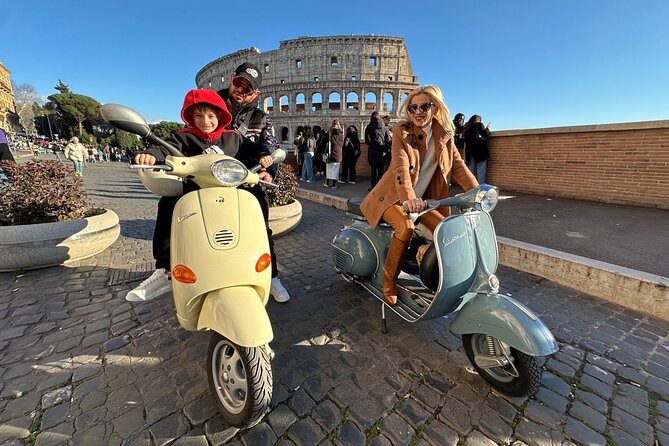
Rome gets way easier when you’re not stuck in a car. This vintage Vespa tour lets you glide through narrow lanes and quick turns, while a licensed guide keeps the story going in real time, in English, Spanish, or Italian.
I like the mix of major monuments and quick detours that feel made for two wheels. I also like that you get short stops at each place, so you can spot the important details without spending half your day waiting around. One thing to consider: the route depends on good weather, and the pacing is fast—great for seeing a lot, less great if you want long, slow time inside every site.
In This Review
- Key Takeaways Before You Go
- Why a Vintage Vespa Works So Well in Rome’s Tight Streets
- Price, Time, and What $177.44 Really Buys You
- The Route in Plain Terms: Major Icons Plus Less-Easy-to-Access Corners
- Stop-by-Stop: The Pantheon, Piazza del Popolo, and Piazza Navona
- Pantheon: The Oculus Still Does the Heavy Lifting
- Piazza del Popolo: People’s Square With a Real Name-Story
- Piazza Navona: An Ancient Stadium Under Your Feet
- Trevi Fountain to Campo de’ Fiori: Baroque Icon Meets Market Life
- Fontana di Trevi: Big Baroque, Built to Be Seen
- Campo de’ Fiori: Market Energy and a Darker Side
- Spanish Steps to Piazza Venezia: Stairs, Symbols, and the Unknown Soldier
- Piazza di Spagna and the 135 Steps
- Piazza Venezia and the Monumento a Vittorio Emanuele II
- Piramide Cestia, Circus Maximus, and Janiculum Views That Feel Like Rome From Above
- Piramide Cestia: A Nubian-Style Tomb With Roman Fortification
- Circus Maximus: The Ancient Party Stadium
- Terrazza del Gianicolo: One of Rome’s Best View Wins
- Trastevere Charm and Vatican Grandeur: Two Very Different Roman Moods
- Trastevere: Narrow Streets and the River’s Long Story
- St. Peter’s Square: Bernini’s Embrace in Stone
- Colosseum Time: Seeing the Flavian Amphitheatre in Context
- Language Choice and the Guide’s Role (Erion’s Style, as an Example)
- Who Should Book This Vespa Tour (And Who Might Reconsider)
- Should You Book the Vintage Vespa Adventure in Rome?
- FAQ
- How long is the Vespa tour?
- What does the tour cost?
- Is it private or shared with other people?
- What languages are offered for live guidance?
- Where does the tour start and end?
- What’s included in the price?
- Are tickets included for the sights?
- Is the tour dependent on weather?
- When do I receive confirmation after booking?
- What is the cancellation policy?
Key Takeaways Before You Go
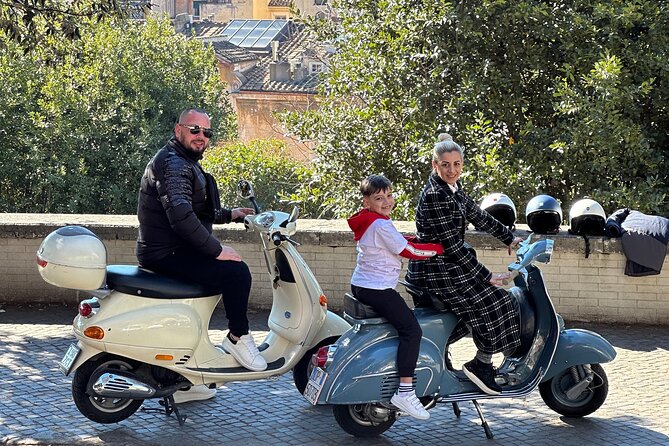
- Vintage Vespa, real city streets: Narrow streets are the point, not a problem.
- Live multi-language guiding: Choose English, Spanish, or Italian for the talk while you ride.
- Short, focused landmark stops: You’ll hit big names like the Pantheon and Colosseum with tight timing.
- Snacks and soda included: A small comfort that helps you stay sharp for 3 hours.
- Off-car access vibe: Some corners are hard to reach any other way, and that’s where the Vespa shines.
Why a Vintage Vespa Works So Well in Rome’s Tight Streets
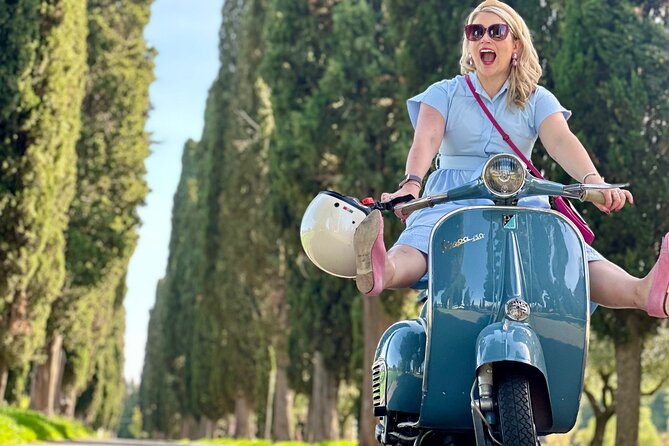
Rome is one of those cities where the map and the reality don’t always match. Cars struggle in narrow streets, and foot travel can eat time fast when you’re crossing busy crossings and doubling back.
A Vespa flips that equation. You’re able to move with the flow, reach street-level views faster, and take the tight routes that buses and cars often can’t. It’s not about rushing for speed; it’s about getting positioned for photos, viewpoints, and the best approach to each monument.
And since this is a guided ride, you’re not just looking at buildings—you’re getting the why behind what you’re seeing while the city is rolling by. That matters in Rome, where the same street can contain layers from different eras.
You can also read our reviews of more tours and experiences in Rome

Price, Time, and What $177.44 Really Buys You
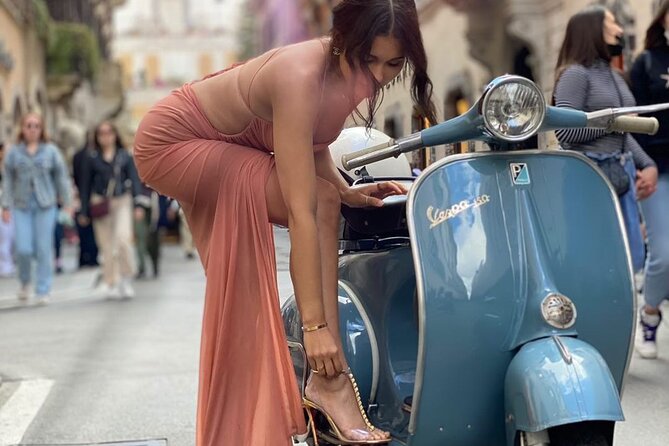
At $177.44 per person for about 3 hours, the value comes from the combination: transport + guide + built-in stops. You’re not paying just for scenery; you’re paying for a smooth route through multiple districts with a licensed person speaking directly to you.
You also get practical perks. Snacks and soda/pop are included, which sounds small until you’re doing multiple stops and want an easy break without hunting for a cafe. Plus, the tour is private for your group, so you’re not squeezed into a giant crowd experience with constant stop-and-go.
One more piece of value is the mobile ticket and the in-person guide at the meeting point. It reduces the friction of figuring out where to go and helps keep the ride time on task.
The Route in Plain Terms: Major Icons Plus Less-Easy-to-Access Corners
This tour is built like a highlights reel, but not the boring kind. You start near Piazza di Pasquino (1, 00186 Roma RM) and work your way past major landmarks, then out to spots that usually require extra planning if you’re doing everything on foot or by car.
What you’ll feel most is the rhythm: ride, stop, walk a little, absorb a key detail, then hop back on the Vespa. Each stop is short enough to keep momentum, but long enough for a real orientation moment—especially helpful in Rome, where first-time confusion is normal.
Also, the tour ends back at the meeting point, which is a relief if you don’t want to end across town and scramble for a last ride home.
Stop-by-Stop: The Pantheon, Piazza del Popolo, and Piazza Navona
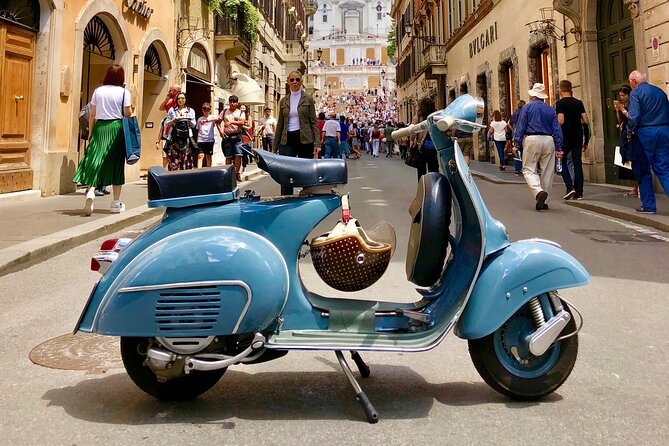
Pantheon: The Oculus Still Does the Heavy Lifting
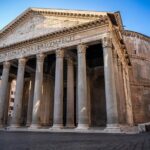
The Pantheon is one of those places that instantly changes how you look at ancient Rome. This building—completed in 126 AD—is often described as the best preserved ancient structure in the city. The standout feature is the oculus, the open center that acts as the main source of natural light.
You’ll get about 20 minutes here, with admission listed as free. In that time, I’d focus less on trying to read everything and more on noticing how the lighting shifts as you move. Even a short visit can feel satisfying because the space is designed to guide your eyes.
A caution: it’s a top stop for a reason, so the attention level will be high. If you want quiet, plan for it by leaning into details quickly: the scale, the geometry, and the light.
You can also read our reviews of more tours and experiences in Rome

Piazza del Popolo: People’s Square With a Real Name-Story
Next up is Piazza del Popolo, a huge urban square whose name comes from people’s square, but the historical roots point to poplars—populus in Latin. The northeast corner includes Santa Maria del Popolo, which connects the square to a specific church identity rather than it being only open space.
You’ll have about 10 minutes. That’s just enough for a clear orientation: where the streets branch out, where you can look back toward key views, and how the square frames walking routes.
Piazza Navona: An Ancient Stadium Under Your Feet
At Piazza Navona, you’re standing on top of something that once worked like an entertainment machine. In ancient Rome, it was the Stadium of Domitian, built in 85 and later restored in the 3rd century by Alexander Severus. The measurements—265 meters long and 106 meters wide—help explain why it could hold about 30,000 spectators.
You’ll get around 20 minutes here, with admission listed as free. Since the site has such a strong ancient purpose, it’s worth listening closely to your guide’s explanation before you drift into photo-taking. The moment you understand what this place used to host, the square feels different.
Trevi Fountain to Campo de’ Fiori: Baroque Icon Meets Market Life
Fontana di Trevi: Big Baroque, Built to Be Seen
The Trevi Fountain is the kind of landmark that lives in photos—yet it lands better in person. It’s an 18th-century fountain, designed by Nicola Salvi and completed in 1762 with Giuseppe Pannini and others. It’s also huge: 26.3 meters high and 49.15 meters wide.
You’ll stop for about 15 minutes, with admission listed as free. This is one of those spots where your time is best spent watching the edges and the architecture, not only the water. Your guide can help you spot the design logic that makes it feel grand without needing a long lecture.
If you’re the kind of person who hates crowds, treat this stop as a quick yes-and-move-on moment. The Vespa rhythm helps: you can enjoy it without losing your whole afternoon.
Campo de’ Fiori: Market Energy and a Darker Side
Between Piazza Navona and Piazza Farnese, you’ll reach Campo de’ Fiori. It’s known for its lively market context, with wooden stalls where you can buy fresh items like flowers, fruit, meat, and fish. The proximity to Piazza Farnese matters too—since 1874, the palace there has been the seat of the French Embassy.
You’ll have about 15 minutes. This square also has a darker story: it was the site of executions, including Giordano Bruno, burned alive on 17 February 1600 after being accused of heresy.
It’s a good reminder of why guided stops work. Your guide can connect everyday market life to what happened here centuries ago, and suddenly the square isn’t just a postcard stop.
Spanish Steps to Piazza Venezia: Stairs, Symbols, and the Unknown Soldier
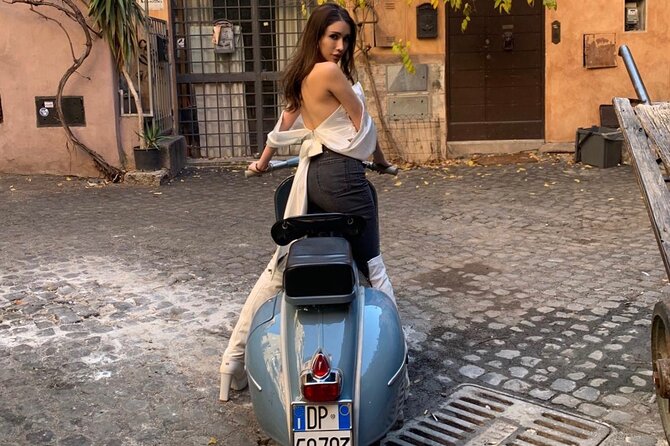
Piazza di Spagna and the 135 Steps
The Spanish Steps—the Scalinata di Trinità dei Monti—climb between Piazza di Spagna at the base and Piazza Trinità dei Monti at the top, where the Trinità dei Monti church sits. The staircase has 135 steps and is linked with French patronage, tied to the Bourbon kings of France.
Design credit is given to Francesco de Sanctis and Alessandro Specchi. You’ll have about 15 minutes here, with admission listed as free.
What you’ll like most is the viewpoint effect. This stop isn’t only about standing at the bottom; it’s about using the steps as a way to read the city’s angles.
Piazza Venezia and the Monumento a Vittorio Emanuele II
At Piazza Venezia, you’ll see the Monumento a Vittorio Emanuele II, also known as Altare della Patria. It was started in 1885 by Giuseppe Sacconi and finished in 1911 with work by Gaetano Koch, Manfredo Manfredi, and Pio Piacentini.
The monument is designed like an ascending path: stairways and terraces lead upward to a colonnaded portico topped with bronze chariots and allegories for Unity of the Homeland and Freedom. In the crypt, the Unknown Soldier was buried in 1921, a detail designed by Armando Brasini.
You won’t be here for a long sit-down visit, so your best move is to let the guide give you a simple map of what you’re looking at. Once you understand the design intent, the monument reads like a story instead of just a wall of stone.
Piramide Cestia, Circus Maximus, and Janiculum Views That Feel Like Rome From Above
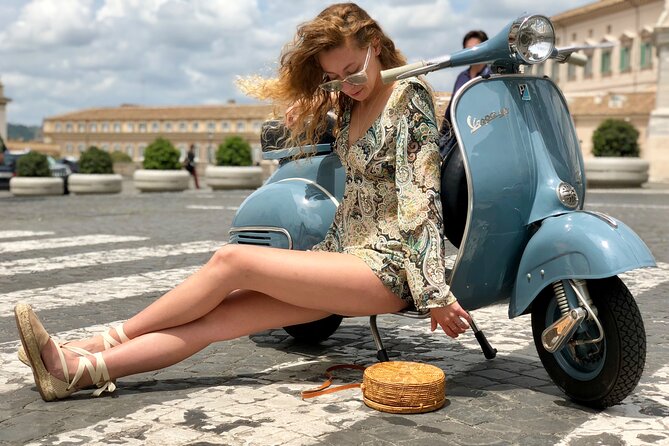
Piramide Cestia: A Nubian-Style Tomb With Roman Fortification
The Piramide Cestia is an ancient Roman pyramid near Porta San Paolo and the Protestant Cemetery. It was built in the style of Nubian pyramids as a tomb for Gaius Cestius, associated with the Epulones religious corporation.
It sits at a fork between ancient roads, including the Via Ostiensis and another route that ran toward the Tiber along the modern Via Marmorata line. One reason it’s preserved so well is that it was incorporated into Rome’s fortifications.
You’ll have about 15 minutes for this stop, with admission listed as free. This is a great moment if you like variety—Rome isn’t only emperors and temples. This feels like an outsider detail, the kind that makes the whole tour feel less cookie-cutter.
Circus Maximus: The Ancient Party Stadium
Circo Massimo was the first and largest stadium in ancient Rome, sitting in the valley between the Aventine and Palatine hills. It measured 621 meters long and 118 meters wide and could hold over 150,000 people. In its developed form, it became a model for circuses across the Roman Empire.
You’ll stop for about 10 minutes. Today, it’s a public park for events and festivals, so you’re seeing continuity: entertainment replaced by open-air public space.
Terrazza del Gianicolo: One of Rome’s Best View Wins
Then you’ll head to Terrazza del Gianicolo, linked with the Janiculum Hill. The Janiculum is the second-tallest hill in the modern city (with Monte Mario being the tallest). It sits west of the Tiber and is outside the ancient boundaries, which is why it doesn’t make the famous Seven Hills list.
Janiculum also holds the Fontana dell’Acqua Paola, built by Pope Paul V in the late 17th century. You’ll have about 20 minutes here, with admission listed as free.
This stop is pure strategy. Even if you know Rome’s monuments by name, a hill viewpoint helps you connect them like pieces on a single board.
Trastevere Charm and Vatican Grandeur: Two Very Different Roman Moods
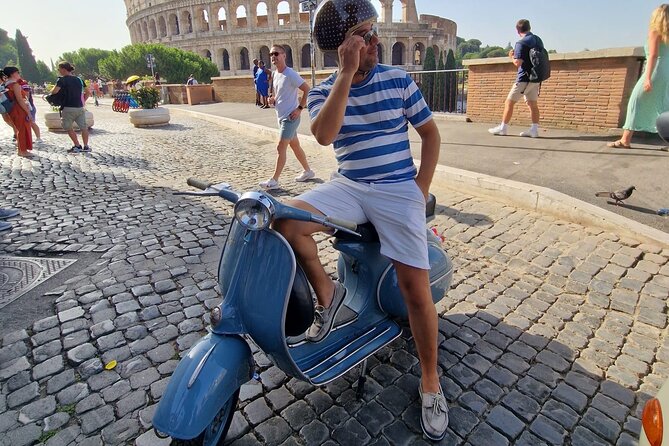
Trastevere: Narrow Streets and the River’s Long Story
You’ll ride through and get a feel for Trastevere, across the Tiber. In Rome’s early Regal period, the area across the river was called Ripa Etrusca by the Romans, tied to Etruscans and control of river access. At the time, the only connection between Trastevere and the rest of the city was the small Pons Sublicius bridge.
Today, Trastevere keeps its character through narrow cobbled streets lined with ancient houses. At night, locals and tourists gather around pubs and restaurants, but the older street feel still lingers.
This part of the ride is less about one single monument and more about tone. After intense sites, the vibe shift is a breather.
St. Peter’s Square: Bernini’s Embrace in Stone
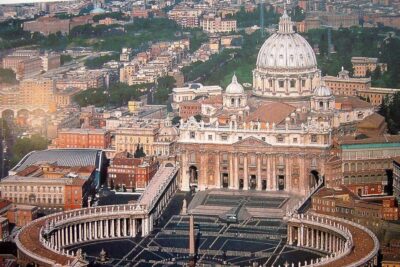
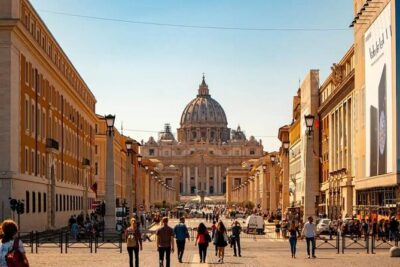
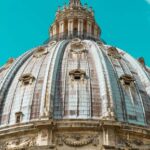
At St. Peter’s Basilica and St. Peter’s Square, you’ll see the Vatican’s most famous public forecourt. The square includes an ancient Egyptian obelisk erected at the current site in 1586. Later, Gian Lorenzo Bernini designed the square almost 100 years after that, adding the massive Doric colonnades with four columns deep, meant to embrace visitors in a kind of maternal way.
There’s also a granite fountain constructed by Bernini in 1675, matching another fountain designed by Carlo Maderno in 1613.
You’ll have about 15 minutes for this stop, with admission listed as free. This is where the guide’s real-time context really helps. If you only look at size, you miss the design choices that make people feel pulled inward.
Colosseum Time: Seeing the Flavian Amphitheatre in Context
The final big anchor is the Colosseum. It’s an elliptical amphitheatre in the center of Rome, east of the Roman Forum. Construction started under Emperor Vespasian in 72 and finished in 80 under his successor and heir Titus. Later modifications happened during Domitian’s reign.
This is why you’ll hear references to the Flavian dynasty. The amphitheatre was also known as the Flavian Amphitheatre, and the later naming sticks because the building is so linked to that family’s building era.
You’ll have about 20 minutes, with admission listed as free. In that window, I suggest treating it as orientation plus one key detail. Ask your guide to frame the space as more than a stadium: it was a mass entertainment platform with serious engineering behind it.
Then you wrap back toward the meeting point. Ending where you started keeps this day from turning into a scavenger hunt.
Language Choice and the Guide’s Role (Erion’s Style, as an Example)
A big reason this tour works is the way the guide talks while you ride. You can choose English, Spanish, or Italian, and the guide is in person throughout.
In the stories shared about one licensed guide named Erion, the emphasis is on showing hidden corners and explaining Rome in a way that makes you feel like you’re in on the city’s internal logic. The ride isn’t just moving you from one photo spot to another. It’s giving you a running mental map so each stop clicks into the next.
Even if your guide isn’t Erion, the format should feel similar: real-time facts, short pauses for meaning, and a focus on places cars and crowds don’t always handle well.
Who Should Book This Vespa Tour (And Who Might Reconsider)
This is a strong fit if you want to cover a lot of Rome in a compact window and you like the feel of street-level travel. It also works well if you’re the type who gets turned around easily on foot—because the Vespa route keeps you moving with guidance.
You might reconsider if you prefer long museum-style time at a single site. The stops are built to be brief, even at major sites like the Pantheon and Colosseum, so this is more about first understanding than deep study.
Also remember the tour depends on good weather. If you’re going during a season of frequent rain, have a Plan B mindset.
Should You Book the Vintage Vespa Adventure in Rome?
Yes, if your goal is a high-impact Rome day that feels local instead of stuck in long lines. The private group format, live multi-language guidance, and included snacks make it feel smoother than the usual catch-a-bus-and-wander plan.
I’d book it especially if you like cities with texture—small streets, sudden viewpoints, and monument stops that feel connected rather than random. If you want one “best day to get oriented” experience, this is a solid choice.
FAQ
How long is the Vespa tour?
It’s approximately 3 hours.
What does the tour cost?
The price is $177.44 per person.
Is it private or shared with other people?
It’s a private tour/activity, so only your group participates.
What languages are offered for live guidance?
Live guidance is available in English, Spanish, and Italian.
Where does the tour start and end?
The meeting point is Piazza di Pasquino, 1, 00186 Roma RM, Italy. The activity ends back at the meeting point.
What’s included in the price?
The tour includes snacks, soda/pop, and a licensed guide with in-person guidance.
Are tickets included for the sights?
The tour lists stops with admission ticket free for the time at each landmark.
Is the tour dependent on weather?
Yes. It requires good weather, and if it’s canceled due to poor weather, you’ll be offered a different date or a full refund.
When do I receive confirmation after booking?
You’ll receive confirmation within 48 hours of booking, subject to availability.
What is the cancellation policy?
Free cancellation is allowed up to 24 hours in advance for a full refund. If you cancel less than 24 hours before the start time, the amount paid won’t be refunded.