REVIEW · ROME
Christian Rome Private Tour: Papal Basilica/Catacombs/Appian way
Book on Viator →Operated by Eternal City Private and Guided Tours · Bookable on Viator
Rome has a way of turning history into a walk you can feel. This Christian Rome private tour strings together the Appian Way and the Papal Basilica of Saint Paul Outside the Walls with stop-ins that are equal parts moving and practical. You get guided time in the catacombs, then plenty of fresh-air Roman-road scenery to balance the underground stuff. I like that the pace is built for attention, not sprinting, and I also like the clear focus on major Christian sites paired with real ancient infrastructure. One thing to consider: the “don’t miss it” route is packed into about 4 hours, so comfortable shoes matter more than looking cute.
If you want Rome in a straight line—gate, road, underworld, then basilica—this fits. The private format and hotel pickup/drop-off help you avoid the worst of commuter chaos, and the itinerary keeps you moving between neighborhoods rather than looping around the same few blocks. Still, because most of the route is outdoors and you’re visiting religious sites, it’s smart to plan for church hours, light crowds, and some time standing.
Based on this company’s consistently strong feedback (including praise for guides such as Michael keeping visits at a good pace), you can expect a smooth, guided experience rather than a free-for-all. You’ll have a guided group tour for Catacombe di San Callisto, plus guided orientation to help you understand what you’re looking at. Pack water if you need it, because food and drinks aren’t included.
In This Review
- Key Highlights You’ll Actually Feel
- Porta San Sebastiano and the Appian Way: Rome’s Road to Nowhere
- Catacombe di San Callisto: Underground, Guided, and Worth Your Time
- Stroll the Via Appia Antica: Regina Viarum in Real Life
- Chiesa del Domine Quo Vadis: The Peter Story at Street Level
- Villa di Massenzio: Empire Power on the Appian Way
- Pyramid of Caius Cestius: A Small Tomb With Big Preservation
- Basilica Papale di San Paolo Fuori le Mura: A Major Papal Church
- Giardino degli Aranci and Aventine Hill: Views That Actually Matter
- Circus Maximus: Ancient Entertainment in the Valley
- Price and Logistics: Is $220.13 Worth It?
- Who This Tour Suits Best
- Should You Book This Christian Rome Tour?
- FAQ
- How long is the Christian Rome private tour?
- What sites are included on this tour?
- Is the catacombs admission included?
- Do I need to pay for the basilica at Saint Paul Outside the Walls?
- Is there hotel pickup and drop-off?
- What’s the language of the tour?
- Is food included during the tour?
- Is this tour private or shared?
- Is public transportation nearby?
- Is cancellation possible if plans change?
Key Highlights You’ll Actually Feel
- Catacombe di San Callisto with a guided group walkthrough so the underground layout makes sense
- A hands-on look at the Via Appia Antica through Porta San Sebastiano and beyond
- Stops tied to Christian tradition, including Chiesa del Domine Quo Vadis
- Imperial drama on the Appian Way with Villa di Massenzio
- Big view time from Giardino degli Aranci on the Aventine Hill
- A photo-friendly finish with Circus Maximus from the valley-side area
Porta San Sebastiano and the Appian Way: Rome’s Road to Nowhere

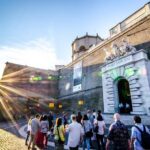
Your tour starts at Porta San Sebastiano, the gate once known as Porta Appia, sitting astride the legendary Appian Way. It’s the kind of introduction that instantly gives you context: you’re not just visiting a gate, you’re stepping into the start point of a road Roman writers called the queen of roads.
What I like here is how you get the “why” before the “what.” The Appian Way connected Rome to Brindisi and was built for strategic importance starting in 312 BC. That means every time you look at the route, you’re thinking beyond tourism—this was infrastructure meant to move armies, goods, and people.
The practical upside: early on the Appian Way, you get a breather from central Rome crowds. The drawback is that you’ll be outside right away, so dress for weather and bring what you need for sun or shade.
You can also read our reviews of more private tours in Rome


Catacombe di San Callisto: Underground, Guided, and Worth Your Time
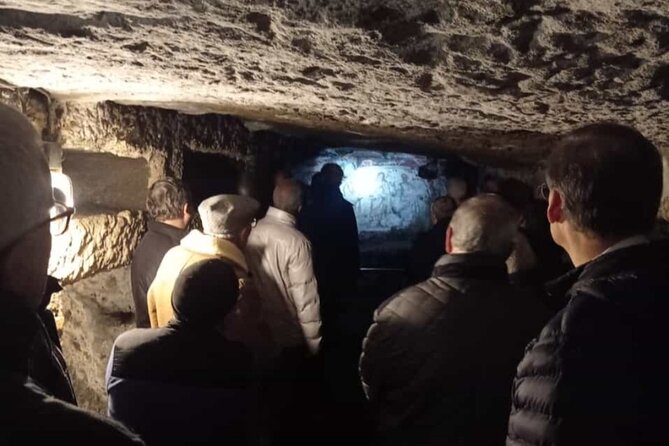
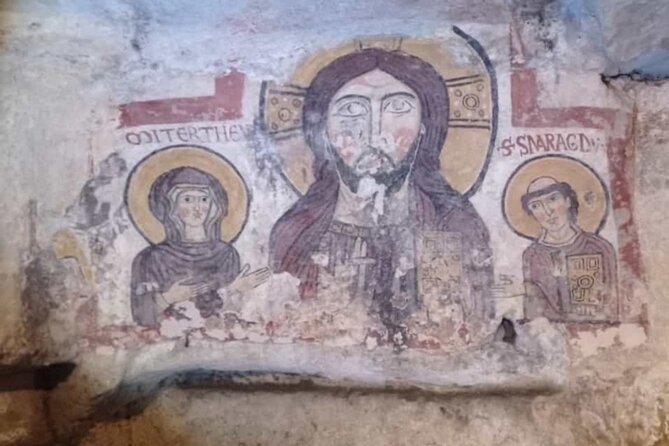
Next up is Catacombe di San Callisto. These are ancient burial catacombs in and around Rome, and there are at least forty across the city. That matters because it helps you understand why catacombs feel like a city underground—Rome’s Christian story isn’t only about churches above ground.
This stop includes the entry ticket and a guided group tour, which is the key difference between a confusing walk and an experience that clicks. The guidance helps you see how the burial spaces relate to each other, and it puts names, layout, and tradition into a story you can follow.
Plan for an “inside voice” pace. Catacombs are quieter, darker, and more physically involved than you’d expect, even if you’re not doing anything strenuous. If you’re sensitive to tight underground spaces or low light, you might want to take your time and pause when you can.
Stroll the Via Appia Antica: Regina Viarum in Real Life
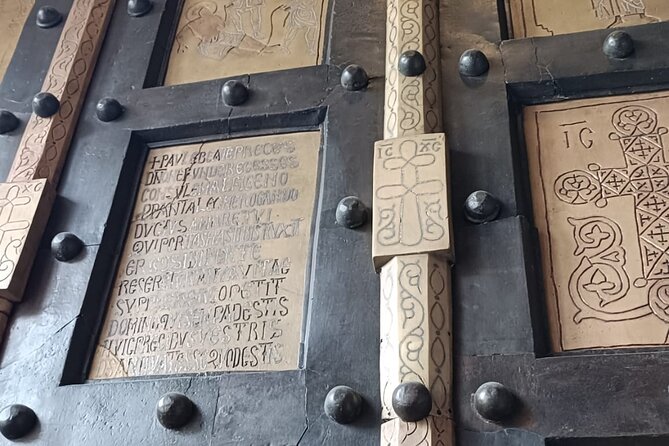
After the catacombs, you move along the Appian Way (Via Appia Antica) itself. You’ll see why the road earned its nickname: it’s one of the earliest and most strategically important roads of the ancient republic. The name also links directly to Appius Claudius Caecus, the Roman censor who began and completed the first section as a military road in 312 BC during the Samnite Wars.
This is where the tour earns its “more than a checklist” feel. The Appian Way isn’t just scenery. It’s a working timeline. Even short stretches can make you understand how Rome built routes that lasted.
Time is short here, so don’t expect a long, slow meander. Treat it like a curated walk: enough time to feel the scale and take photos, without turning the whole day into a history lecture.
Chiesa del Domine Quo Vadis: The Peter Story at Street Level
Then you’re at the Chiesa del Domine Quo Vadis, also known as Santa Maria in Palmis. It’s a small church southeast of Rome, about 800 meters from Porta San Sebastiano, near where the Via Ardeatina branches off the Appian Way.
The main reason this stop hits is the tradition attached to the site. According to the apocryphal Acts of Peter, Saint Peter met the risen Christ while fleeing persecution in Rome, and the famous question is linked to the church: Lord, where are you going? The response tradition connects to Christ going to Rome to be crucified again.
A word of advice: because this is an apocryphal-linked tradition, your experience might feel more spiritual than academic. If you like faith stories, it’s moving. If you prefer strict historical proof only, you may treat it as a powerful legend tied to place.
It’s also a good palate cleanser between the catacombs and the heavier architectural stops coming next.
Villa di Massenzio: Empire Power on the Appian Way
After that comes Villa di Massenzio, the Villa of Maxentius, an imperial complex built by the Roman emperor Maxentius. It sits between the second and third miles of the ancient Appian Way, which again keeps the tour grounded in geography rather than random hopscotch.
The complex includes three main parts: the palace, the circus of Maxentius, and a dynastic mausoleum. The architecture was designed as an inseparable unit to honor Maxentius, so you’re looking at a planned political statement—rule plus spectacle plus legacy.
One consideration: this stop is built for meaning, not for long roaming. Admission is free, and the tour time is set to keep you moving, which is great if you want variety. But if you’re the kind of traveler who wants to linger at every wall and corner, you may find the pacing a little quick.
Still, it’s a memorable contrast to the earlier Christian-linked stops. You see how the same stretch of roads carried very different kinds of power.






Pyramid of Caius Cestius: A Small Tomb With Big Preservation
The tour also includes the Pyramid of Caius Cestius. It’s a Roman-era pyramid near Porta San Paolo and the Protestant Cemetery, built as the tomb of Gaius Cestius, who was part of the Epulones religious corporation.
What I like about this stop is how it illustrates Rome’s layers without requiring you to commit to an entire museum visit. Because it was incorporated into the city’s fortifications, it’s one of the best-preserved ancient buildings of its type.
Admission isn’t included here, and the stop is short. Expect a quick, meaningful look rather than an extended deep study. If you like photos and quick wins, it’s a strong add-on.
Basilica Papale di San Paolo Fuori le Mura: A Major Papal Church
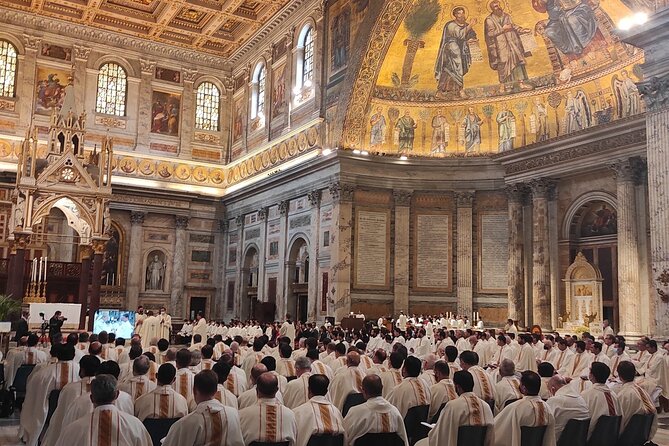
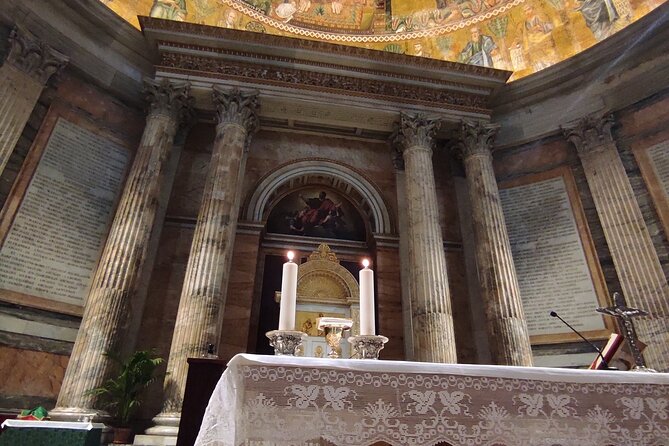
Next is Basilica Papale di San Paolo Fuori le Mura—Saint Paul Outside the Walls. It’s one of Rome’s four major papal basilicas, along with Saint Peter’s, Saint John in Lateran, and Saint Mary Major. It’s also listed among the Seven Pilgrim Churches of Rome, so it has a clear place in Christian travel tradition.
Admission is free on this itinerary, which makes it easier to enjoy the church without feeling like you’re constantly budgeting additional entry fees. The stop lasts about 25 minutes, which is enough time to get your bearings and spend a moment where it matters to you—even if you don’t have the stamina for a long interior tour.
Practical tip: even when admission is free, religious sites can have rules. Plan for respectful dress, quieter behavior, and potential waiting depending on service schedules.
Giardino degli Aranci and Aventine Hill: Views That Actually Matter
Then you shift to a calmer, scenic section with Giardino degli Aranci, also called Parco Savello, on the Aventine Hill. This garden is about 7,800 square meters, and the design you see today dates to 1932, created by Raffaele De Vico.
This stop is about payoff. You get excellent city views, and the Aventine setting gives you a break from the densest parts of central Rome. It’s not just pretty. It helps you understand the city’s layout, because from here you can see Rome’s geometry more clearly.
Right after that, you visit the Aventine itself. Since the Aventine is the southernmost of Rome’s seven hills, it’s a neat way to connect the garden views to the larger city map.
If you care about views and not just ruins, don’t treat this as filler. It’s one of the nicer “exhale moments” in the whole route.
Circus Maximus: Ancient Entertainment in the Valley
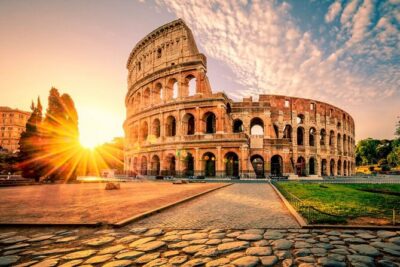
You finish with Circus Maximus, the ancient chariot-racing stadium and mass entertainment venue in Rome. It sits in the valley between the Aventine and Palatine hills, and it was the first and largest stadium in ancient Rome and its later Empire.
The stop is short—around 10 minutes—so you’ll want to keep expectations realistic. You’re not touring a massive indoor complex. You’re looking at the scale and imagining the crowds.
I like this ending because it ties together the day’s themes: roads built for movement, imperial spaces built for power and spectacle, and a city that kept repurposing its oldest bones.
Price and Logistics: Is $220.13 Worth It?
The price is $220.13 per person for about 4 hours in English on a private tour with hotel pickup and drop-off, plus catacombs entry and a guided group tour there. You also get admission included for the major religious and major historical stops listed, while a couple of spots have tickets not included (like the Pyramid of Caius Cestius).
Here’s how I’d judge the value. If you’re doing this itinerary on your own, you’d spend time coordinating transport, figuring out entry logistics, and trying to understand underground spaces without a guide. In that sense, the included guided time and private transportation can be good value, especially if your group is small and you want control over pace and timing.
If you’re traveling solo with very flexible plans and you’re comfortable building your own route, a self-guided version could be cheaper. But you’d trade away the guided catacombs piece and the pickup convenience.
Bottom line: this is a strong choice when you want a guided Christian-focused route plus the Appian Way without wasting half your day on logistics.
Who This Tour Suits Best
This tour fits well if you want a faith-and-history day that doesn’t feel random. The sequence makes sense: gate and road, catacombs and tradition, imperial architecture, then a major basilica, then views and a closing Roman spectacle site.
You’ll likely enjoy it most if:
- you like Christian sites but also want the Roman context around them
- you value guided explanation, especially underground
- you prefer pickup/drop-off to public transit wrangling
- your group wants a private experience rather than joining a big crowd
If you strongly prefer long museum time or very slow wandering, you might find the schedule a bit tight. The tour is designed for variety in a limited window.
Should You Book This Christian Rome Tour?
I’d book it if your goal is a structured, efficient route through the Appian Way, San Callisto, and Saint Paul Outside the Walls, with guidance where it counts. The included guided portion in the catacombs plus the careful mix of outdoors, churches, and Roman monuments makes it feel more intentional than a typical quick-hit sightseeing day.
Skip it only if you know you want hours inside one big venue, or if you’re sensitive to the darker underground environment of catacombs and would rather avoid that entirely.
FAQ
How long is the Christian Rome private tour?
It runs about 4 hours (approx.). The itinerary is arranged as a sequence of short to medium stops, with the catacombs visit taking the most guided time.
What sites are included on this tour?
You’ll visit Porta San Sebastiano, Catacombe di San Callisto, the Appian Way (Via Appia Antica), Chiesa del Domine Quo Vadis, Villa di Massenzio, the Pyramid of Caius Cestius, Basilica Papale di San Paolo Fuori le Mura, Giardino degli Aranci, Aventine, and Circus Maximus.
Is the catacombs admission included?
Yes. Entrance to Catacombe di San Callisto is included, and there is also a guided group tour there.
Do I need to pay for the basilica at Saint Paul Outside the Walls?
No. The Basilica Papale di San Paolo Fuori le Mura stop lists admission ticket free on this tour.
Is there hotel pickup and drop-off?
Yes. The tour includes hotel pick up/drop off, and pickup is offered (you’ll provide your pick-up place).
What’s the language of the tour?
The tour is offered in English.
Is food included during the tour?
No. Food and drinks are not included, so plan to grab something before or after.
Is this tour private or shared?
This is a private tour/activity. Only your group participates.
Is public transportation nearby?
Yes. The tour notes that it is near public transportation, even though pickup is offered.
Is cancellation possible if plans change?
The tour offers free cancellation if you cancel up to 24 hours in advance for a full refund.