REVIEW · ROME
Rome Golf Cart Tour: Discover the Pinnacle Experience
Book on Viator →Operated by Dolce Vita Tours · Bookable on Viator
Three hours, a whole lot of Rome. This golf cart tour is built for seeing both famous and off-to-the-side places without burning a full day on foot, and it’s paced so you can actually enjoy the views. I love the easy hotel pickup in central Rome and the way guides like Francesco and Marco turn quick stops into real stories. The main thing to consider is the tempo: you’ll spend limited minutes at each site, and attraction access is not included.
The route is a smart mix of big-hitters and Roman weirdness, from the Pantheon to the Mouth of Truth myth. You also get real flexibility with morning, afternoon, or evening start times, plus a driver who handles traffic while you sit back in an open cart. The vibe is casual, not museum-silent, and that fits a first trip or a trip where your legs are done early.
One more practical note: you may be offered chances to add or adjust stops depending on your guide and what’s happening in the city. Still, have a Plan A for the core highlights, because routes and access can change with crowds and logistics. For the best experience, pick the sights that matter most to you and don’t try to cram Rome’s entire history into 3 hours.
In This Review
- Key Things You’ll Notice on This Rome Golf Cart Tour
- Why a Golf Cart Works for Rome’s First-Time Big Sights
- Price and Logistics: What $396.48 Buys (and What It Doesn’t)
- Pickup, Meeting Point, and Timing That Actually Saves You Energy
- Pantheon to Spanish Steps: Classics, Short Stops, and Real Orientation
- Campo dè Fiori, Borghese, Palatine Hill, and the Seven-Hills Swing
- Aventine Views and the Orange Garden Stop You’ll Actually Remember
- Piazza della Bocca della Verità: Myths, Photo Ops, and Quick Ancient Fun
- Imperial Rome Highlights: Augustus, Marcus Aurelius, Piazza Venezia, and Trajan’s Markets
- Boarium, Hercules Temple, and the Theatre of Marcellus
- Guides Make or Break It: Ask for the Style You Want
- Should You Book This Rome Golf Cart Tour?
- FAQ
- How long is the Rome golf cart tour?
- Is hotel pickup included?
- What language is the driver?
- Are attraction tickets included?
- Where does the tour start?
- What is the cancellation policy?
Key Things You’ll Notice on This Rome Golf Cart Tour
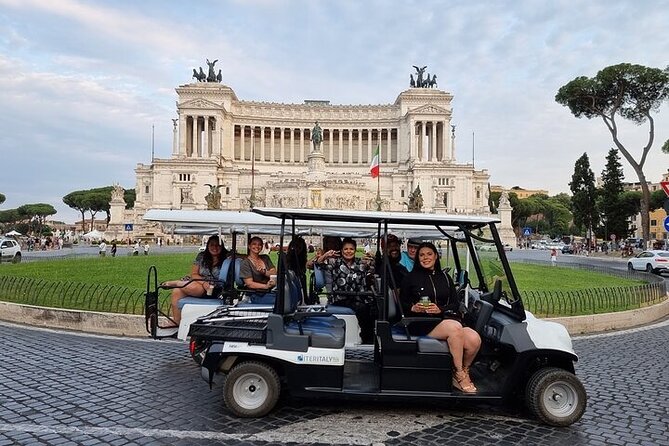
- Hotel pickup in central Rome: Less time navigating alleys, more time getting oriented and enjoying the ride.
- Quick-hit stops with context: You’ll see the landmark, then learn what makes it important before you move on.
- Big variety in the route: Pantheon, Navona, Trevi, Spanish Steps, plus viewpoints like the Orange Garden and sights on the Seven Hills.
- Guides who steer the fun: Several guides (Francesco, Sabrina, Claudio, Ivanna/Ivana, Nadia) are praised for humor and engaging explanations.
- Admissions aren’t bundled: You’ll want to handle paid entries yourself if you want a deeper stop than the short viewing window.
- You sit low and see far: The open cart helps you take in Rome’s shapes, street life, and skyline without craning your neck.
Why a Golf Cart Works for Rome’s First-Time Big Sights
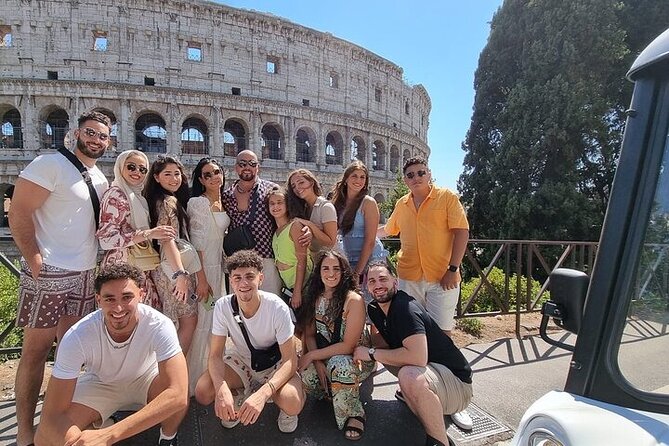
Rome punishes slow touring. Not in a mean way. Just in a physics way: distance adds up fast, sidewalks get crowded, and getting from one “must-see” to the next can turn into a side quest. A golf cart solves the time problem by letting you cover a lot of ground with minimal walking.
What I like about this setup is that it doesn’t try to replace walking in Rome. It acts like a fast map you can feel. Within about 3 hours, you’ll get your bearings on landmarks that anchor the city. Then, if you want to return later, you already know what direction to head and why that place matters.
The experience also fits different styles. If you want big icons, you get them: the Pantheon, Piazza Navona, Trevi Fountain, and the Spanish Steps. If you prefer the quieter puzzle pieces, you’ll also see areas like Campo dè Fiori and viewpoints on hills. That mix makes the time feel useful, not repetitive.
And yes, the ride is part of the charm. Being in an open-air cart means you catch smells and street sounds you’d miss in a closed car. You also get a different perspective—straighter lines, longer sightlines, and less time getting stuck in slow foot traffic.
You can also read our reviews of more tours and experiences in Rome.



Price and Logistics: What $396.48 Buys (and What It Doesn’t)
At $396.48 per person for about 3 hours, this isn’t a bargain tour. So you should ask yourself a simple question: are you paying to save your time and energy, or are you paying to see something no one else can?
Here’s what you are paying for, based on what’s included:
- Complimentary hotel pickup in central Rome
- An English-speaking driver
- A route that stacks major sights plus several Roman classics in a short window
Here’s what you’re not paying for:
- Access to attractions (and you’ll see this explicitly at places like the Pantheon, where an admission ticket is not included)
So the value math is really about how you travel. If you’re the type who spends hours in line and still ends up exhausted, the cart’s “efficiency” can be worth the premium. If you prefer a slow, deep dive into one museum, you may feel shortchanged because many stops are brief.
A fair strategy: treat this as your Rome orientation sprint. Then schedule your deeper visits (especially any sites that require tickets) on another day when you can linger.
Pickup, Meeting Point, and Timing That Actually Saves You Energy
This tour is designed to start from central Rome with hotel pickup. If you’re farther out, the plan is to contact the provider, and they may arrange a private car. The meeting point is Piazzale delle Canestre, SNC, 00197 Roma RM, and the activity ends back there.
You also get a choice of start times: morning, afternoon, or evening. That matters more than it sounds. Morning often feels calmer for photos and traffic flow. Late day can be better for softer light at fountains and viewpoints. Pick based on your energy level and what you’ve already done that day.
One other practical detail: you’ll likely be hopping between areas that can be crowded. The driver’s skill in traffic and quick navigation is part of why this works. Several guides were praised for getting the group through safely and efficiently, so you should assume the driver is steering the pacing.
If you’re sensitive to meeting points, build in buffer time. A cart tour lives and dies on being at the right place at the right moment. In a city like Rome, that’s not the tour operator’s job alone. It’s yours too: double-check the exact pickup or meeting instruction you received, and arrive early enough to avoid stress.
Pantheon to Spanish Steps: Classics, Short Stops, and Real Orientation
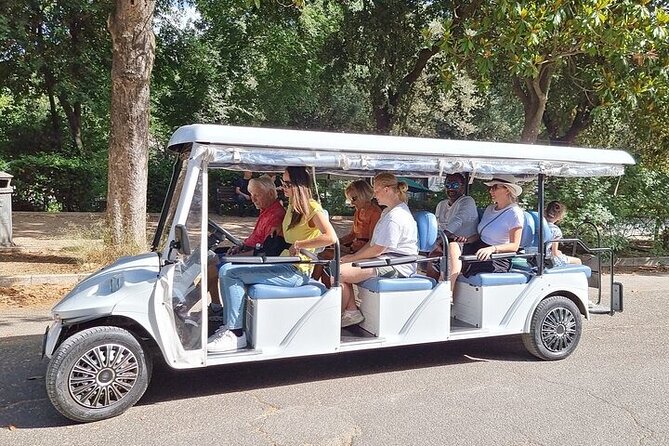
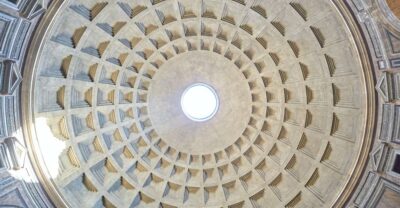
This route starts with Pantheon, a former Roman temple later used as a Catholic church since 609 AD. It sits on the site of an earlier temple associated with Marcus Agrippa under Augustus. On this tour, the stop is about 15 minutes, and admission is not included.
Fifteen minutes sounds tight because it is tight. But it’s enough time to do three useful things:
- See the exterior and get your photos in
- Understand why this building matters in Rome’s long timeline
- Decide if you want to come back for more time when you have tickets and patience
Next up is Piazza Navona for about 10 minutes. It’s built on the remains of the Stadium of Domitian and is one of Baroque Rome’s most distinctive squares. For me, the value here is orientation: after Navona, you start recognizing how Rome uses grand spaces as social stages.
Then comes Trevi Fountain for around 10 minutes. You’re looking at an 18th-century fountain designed by Nicola Salvi and completed by Giuseppe Pannini and others. Trevi is crowded by nature, so a quick viewing window can still be satisfying if you use it well. Take your shot, read the scene, and don’t let the crowd steal your mood.
The next visual reset is the Spanish Steps (about 5 minutes). They climb between Piazza di Spagna and the church of Trinità dei Monti. The stop is short, but it’s useful because it’s one of the best places to see Rome’s elevation changes in real life. You’ll understand why some neighborhoods feel higher, airier, or harder to reach.
At this point in the tour, you should feel like you’ve “placed” the map in your head. These are the landmarks people come for. The cart tour is how you connect them fast.
Campo dè Fiori, Borghese, Palatine Hill, and the Seven-Hills Swing
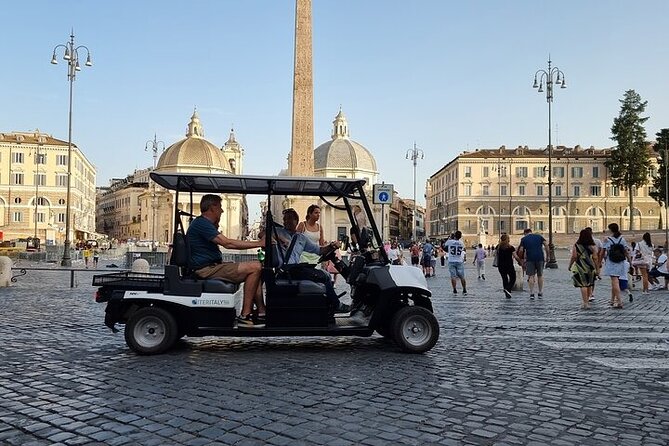
After the classics, the route shifts into “Rome in layers.” You’ll stop at Campo dè Fiori, described as one of the souls of Rome, with a central statue of philosopher Giordano Bruno, burned alive in the piazza. This is one of those stops that feels like street life history. Even if you don’t linger, it gives you texture.
You may also visit Villa Borghese, Rome’s third-largest public park, with buildings, museums, and attractions. The key word here is range. Borghese is huge, so even a short stop helps you understand that Rome isn’t only stone monuments. It’s also green space and strolling corridors.
Then the tour heads to ancient gravity points:
- Palatine Hill, called the center most of Rome’s seven hills and described as the first nucleus of the Roman Empire.
- Circus Maximus, the ancient chariot-racing stadium and mass entertainment venue, described as the first and largest stadium in ancient Rome.
From a planning point of view, these stops are valuable because they tie the present city to its underlying map. You’ll start recognizing how the city grew outward from these key zones.
Next is Aventine Hill, another seven-hill stop. It’s part of Ripa, the modern 12th rione, or ward, of Rome. Aventine is also where the tour connects to the big viewpoint moment later at the Orange Garden.
If you’re the type who usually skips archaeological areas because you think they’ll be boring, don’t. The cart tour’s approach is to add just enough story to make ruins feel like living places instead of piles of stones.





Aventine Views and the Orange Garden Stop You’ll Actually Remember
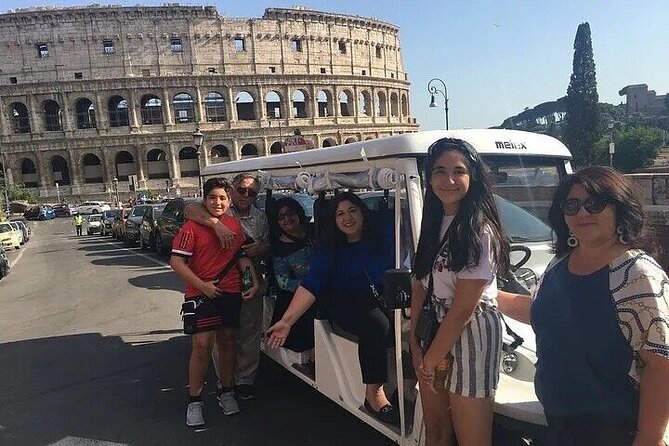
One of the best “wait, wow” moments is the Giardino degli Aranci (Orange Garden). It’s described as one of the most beloved natural areas on the Aventine hill, covering almost 8,000 square meters and offering a panorama over Rome.
This is the kind of stop that turns the tour from sightseeing into a break. You get a view, you get breathing room, and you get a reminder that Rome is built on hills and sightlines. Even if you only have about 15 minutes, the payoff can feel longer.
There’s also a chance you’ll stop for the Keyhole of Rome if there’s time. That’s a small detour, but it’s exactly the sort of silly, iconic Rome moment people remember because it’s quick and different.
As for the style of the experience, guides have a way of making viewpoint stops land well. Some were praised for humor and quick side stories, and those little jokes matter more than you’d think when you’re moving fast. They help you not just see things, but enjoy seeing them.
Piazza della Bocca della Verità: Myths, Photo Ops, and Quick Ancient Fun
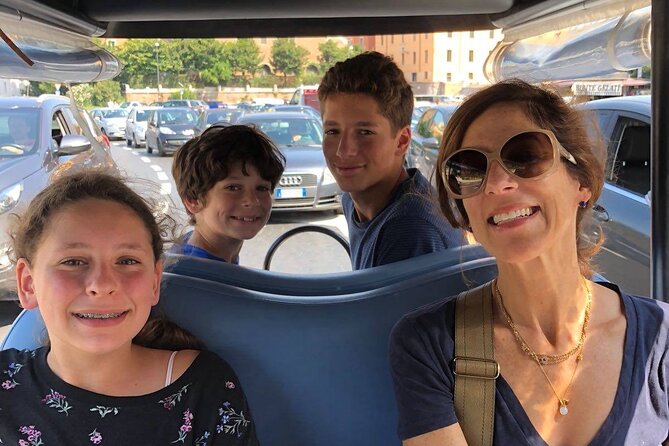
After the Orange Garden, the route reaches Piazza della Bocca della Verità, where you’ll find the Bocca della Verità (Mouth of Truth). The tour description leans into the myth: long before modern lie detector ideas, the superstitious feared that liars would face a severe fate between its jaws.
This is a rare kind of stop: it’s not only historic. It’s playful. Even if you don’t care about the superstition part, it’s a fun pause on a packed itinerary. And if you travel with kids, this is the sort of stop that usually gets big reactions fast.
The stop is about 5 minutes, so aim to be ready with your camera and your curiosity. You don’t want to spend your whole window figuring out what you’re looking at.
Imperial Rome Highlights: Augustus, Marcus Aurelius, Piazza Venezia, and Trajan’s Markets
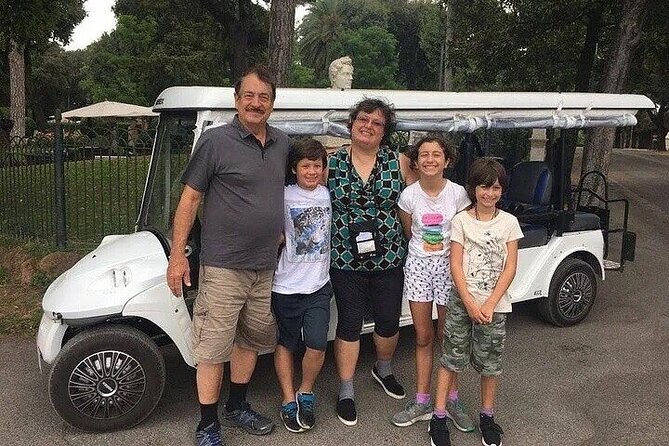
The tour then moves into “imperial scale” territory. You may stop at the Mausoleum of Augustus, described as a large circular tomb and a key monument for how antiquities have been reused, reinterpreted, and rediscovered over time.
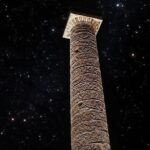
Next is the Column of Marcus Aurelius and Faustina in Piazza Colonna. The description notes it’s thought to have been erected by Commodus around 180 CE in memory of his father and mother. Even if you can’t read every inscription, seeing the column in its setting helps you grasp how public art was used as messaging.
Then comes Piazza Venezia, shaped by the remaking of the area for the construction of the Monumento a Vittorio Emanuele II. Piazza Venezia is one of those places where the geometry makes sense once you’re standing there, not when you’re looking at it from across the street.
After that, you may visit the museum showcasing Mercati di Traiano (Trajan’s Markets). The description says it provides multimedia displays, explanatory panels, and archaeological artifacts, and it also gives an introduction to the Imperial Forums.
This is one place where you should temper expectations. If you want to read every panel slowly, you may not have enough time. But if you want the big picture and a visual orientation for the forums area, this stop can be a strong “learning multiplier” for the rest of your Rome days.
Boarium, Hercules Temple, and the Theatre of Marcellus
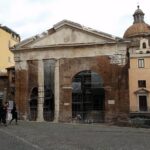
Near the Tiber River in the area called Boarium, you may visit the Temple of Hercules and Portunus. It’s described as a well-preserved example of ancient Roman architecture that overlooked Rome’s fluvial port, watching over goods entering the city.
Then there’s the theatre of Marcellus, described as the largest and most important theatre in Rome when completed in the late 1st century BCE. It notes that theatre architecture became a standard feature across the empire and influenced iconic building façades like the Colosseum.
These stops are valuable because they show a different side of Rome’s “public works.” It’s not only temples and political monuments. It’s also entertainment and trade infrastructure. Seeing them on a cart tour helps because you don’t have to jump between far-flung points under your own power.
The main drawback here is the same as the whole tour: time. You’ll get glimpses. You won’t get the slow, sit-down appreciation unless you plan return visits.
Guides Make or Break It: Ask for the Style You Want
The biggest theme in positive experiences is the guides. Names like Francesco, Claudio, Marco, Sabrina, Nadia, Ivanna/Ivana, Valeria, and Peter came up with the same kind of praise: fun energy, clear explanations, and a pacing that keeps you engaged.
Some guides were described as especially comedic, almost like a mobile performance for families. If you’re traveling with kids, that matters. A short stop becomes more meaningful when someone makes it memorable.
Others were praised for customization. If you have priorities beyond the core route—like areas outside the central district—you should ask. Not every guide will do the same adjustments, and traffic and access can limit options, but the tour model is flexible enough that it’s worth trying.
The safest way to get what you want is to pick your top 4 to 6 stops before you go. Then communicate those priorities at the start. The more specific you are, the better chance you have of a route that fits your trip.
Should You Book This Rome Golf Cart Tour?
I’d book it if you fit one of these profiles:
- You want a 3-hour overview that covers major landmarks plus several Roman classics
- You want hotel pickup and a low-stress way to move through crowded central Rome
- You’d like a guide who can keep the experience fun and story-driven, not stiff and silent
- You’re ready to treat paid entries as optional add-ons you handle on your schedule
I wouldn’t book it if:
- You want long time inside major sites like the Pantheon and plan to rely on the tour for admission
- You prefer slow travel with lots of walking and minimal moving around
- Your schedule requires very exact time windows at multiple attractions, because short stops are part of the design
If you do book, go in with the right mindset: this is your Rome orientation and your best chance to “place” the city quickly. Then you come back on foot for the places you want to linger.
FAQ
How long is the Rome golf cart tour?
It runs for about 3 hours.
Is hotel pickup included?
Yes, there is complimentary hotel pickup in central Rome for the private experience. If you are not in central Rome, you’re asked to contact the provider to see if a private car can be arranged.
What language is the driver?
The tour includes an English-speaking driver.
Are attraction tickets included?
No. Access to attractions is not included, and the Pantheon stop specifically notes that an admission ticket is not included.
Where does the tour start?
The start point is Piazzale delle Canestre, SNC, 00197 Roma RM, Italy.
What is the cancellation policy?
Free cancellation is available. You can cancel up to 24 hours in advance of the experience for a full refund.