REVIEW · ROME
Rome: Golf Cart (Buggy) Tour
Book on GetYourGuide →Operated by LaGoGo · Bookable on GetYourGuide
Rome does not like standing in lines.
That is exactly why an electric golf cart tour feels smart. I love how it keeps you comfortable while you hop square to square, and I also love the local guide angle that helps you connect the dots fast (plus they may steer you toward quieter viewing spots as you go). The trade-off: you only get short stops for photos and quick visits, and the tour price does not include entrance tickets.
You start at Via Merulana 281, right in front of the bar Mulino, and you loop through Rome’s greatest hits in about 2 hours. The guide is live and speaks Azerbaijani, English, Russian, and Turkish, and the format is private or small groups. It’s also a true “sit and ride” setup: you are a passenger, and kids must be six and above.
In This Review
- Key things I’d pay attention to
- Getting started at Via Merulana 281 and Bar Mulino
- How the electric golf cart changes your Rome pace
- Stop-by-stop: Colosseum and Circus Maximus without the long slog
- Mouth of Truth, Giardino degli Aranci, and Trevi: photos plus quick context
- Pantheon and Piazza Navona: two more icons in a final sprint
- Languages, groups, and how to get the most from your guide
- Price and value: what $112.15 gets you (and what it doesn’t)
- Should you book this Rome golf cart tour?
- FAQ
- Where is the meeting point for the Rome golf cart tour?
- How long is the tour?
- What sights are included on the route?
- Does the tour include entrance tickets or guided tours inside monuments?
- Is this tour private or small-group?
- What languages does the guide speak?
- Are children allowed?
- Will I be driving the golf cart?
Key things I’d pay attention to
- Electric transport for less walking: you still enjoy the sights, but with far less foot slog between them
- Short, guided photo stops: plan on lots of quick looks, not long museum time
- A guide who shapes the experience: you are not just following a script; you can influence what to emphasize
- A classic Rome route with a cart twist: the big names are there, but the pace feels different
- No entrance tickets included: if you want interiors, you’ll need separate plans
- Meeting at Bar Mulino (Via Merulana 281): show up a bit early so you don’t miss the start
Getting started at Via Merulana 281 and Bar Mulino
Your tour kicks off at Via Merulana 281, and the guide waits in front of the bar Mulino. That detail matters more than it sounds, because cart tours run on tight timing. Rome is big, streets change names, and you don’t want to be sprinting while everyone else is already loaded into the carts.
I like that the start and end both return you to the same meeting spot area. It makes the rest of your day easier to plan. One good practical move: arrive a few minutes early, not because you’ll be late in a dramatic way, but because it lets you settle—bathroom check, regroup, and get your first photos from the right angle.
If you’re the type who gets nervous about timing, keep this in mind: there have been issues raised about last-minute time changes and late arrivals. I’m not saying you should expect problems, but I do think it’s wise to confirm your time the day before and have a backup plan if your schedule is tight.
You can also read our reviews of more tours and experiences in Rome.



How the electric golf cart changes your Rome pace
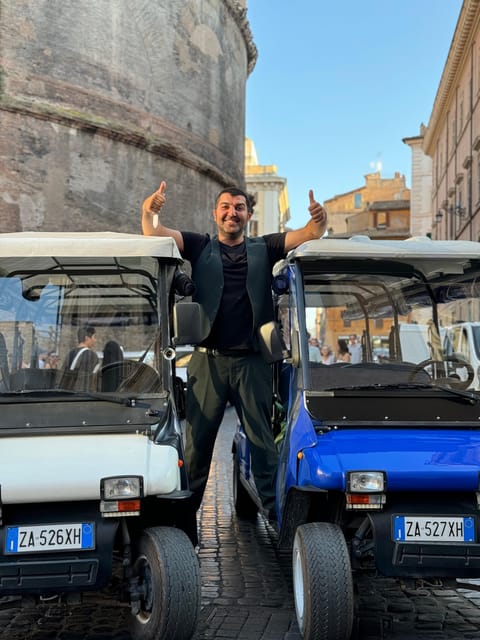
Riding in a golf cart (buggy) is not just a novelty. It’s a practical solution to Rome’s “walk-walk-walk” reputation. In about two hours, you cover major stops that would normally eat up more energy and time than you expect—especially if you’re visiting in warmer weather or you just want to save your legs for later neighborhoods.
A key detail: everyone is a passenger. So you aren’t trying to steer through traffic or figure out how the cart handles corners. That keeps the experience relaxed and lets you focus on spotting photo angles, street textures, and the changing views as you move.
Also, because the tour is built around moving between landmarks, it tends to feel like a guided sprint with breaks. That works well if your goal is to see the big icons and get a clean introduction to where everything sits. If your goal is deep, slow, inside-the-building time, you’ll probably want to pair this with separate museum or church visits afterward.
Stop-by-stop: Colosseum and Circus Maximus without the long slog
The first major photo/visit stop is the Colosseum, with about 10 minutes for photo stop, visit, and a guided tour segment. Ten minutes sounds short until you remember what you’re doing: getting context, seeing the structure from a useful viewing point, and understanding how it fits into ancient Rome’s layout. You won’t be doing a full “spend hours here” plan, but you’ll likely leave with a much clearer mental map.
After that you head to Circus Maximus for another roughly 10 minutes of photo stop, visit, and guided tour. This is the kind of site where a guide helps you look at what remains—rather than only what’s missing. Even if you’ve seen photos online, the scale usually hits differently when you see it in person and someone explains the flow of the space.
One reason people love this format: your guide can adjust the focus. In my view, that matters because Rome’s best moments aren’t always the official “must-do” photo. If you care about great angles, they can help you aim your camera and your eyes, not just your feet.
Possible drawback: since each major stop is brief, you may feel like you’re skimming unless you come with a short list of what you most want to understand. If you do, the stops land better.
Mouth of Truth, Giardino degli Aranci, and Trevi: photos plus quick context
Next up is the Mouth of Truth, again with a photo stop, visit, and guided tour segment around 10 minutes. This is a classic Rome stop, and the value here is less about lingering and more about getting the background so the place makes sense beyond a single iconic photo.
Then comes Giardino degli Aranci (Garden of the Oranges). Even when you only have a short time, this stop can be one of the most satisfying because it gives you a break from the densest streets while still staying close to key sights. Expect quick guided orientation and time for photos—enough to feel the atmosphere and get that “Rome view” moment.
After that: Trevi Fountain. Again, it’s photo stop, visit, and guided tour around 10 minutes. Trevi is always a scene, so the cart pace helps you arrive with a plan instead of just getting swept up in wandering. The guide’s job here is to help you appreciate what you’re seeing quickly—plus point you toward a better viewing rhythm so you’re not fighting for the same angle as everyone else.
A small note on expectations: the tour does not include entrance tickets to monuments or guided tours inside them. For Trevi, that’s not a deal-breaker because you mainly view it from outside. But for other sites on your Rome agenda, it does affect how you should think about “included value.”
Pantheon and Piazza Navona: two more icons in a final sprint
The next stop is the Pantheon. You get another photo stop, visit, and guided tour segment for around 10 minutes. The Pantheon is the kind of place where even a quick explanation improves everything—materials, layout, why it’s so famous, and what to notice as you look around. If you dream about going inside, remember the tour information says entrances and guided tours inside monuments are not included, so you’d need a separate plan for that.
Then your tour finishes at Piazza Navona, with the same structure: photo stop, visit, and guided tour around 10 minutes. This is a great closer because Navona’s open square feel gives you room to absorb the scene. Even if your time is limited, you still get that “I’m in the middle of Rome” sensation—street life, historic geometry, and the sense that you’ve ended your loop in a place built for lingering.
If you’re traveling with family or friends, this part can feel especially fun. The pace keeps energy up, and the square ending works well for everyone regrouping after the carts.





Languages, groups, and how to get the most from your guide
This tour is run with a live guide who speaks Azerbaijani, English, Russian, and Turkish. That’s a practical win if you want real conversation rather than just a standard headset audio track. I’d treat the guide like your on-the-ground translator for how to look at Rome, not only what to see.
You can book as a private or small group, which can change the whole vibe. Small groups typically mean better interaction and less crowd juggling. Private is ideal if you want a smoother experience with your preferred pace—especially if you have mobility needs or you simply don’t want to coordinate with strangers.
One more detail worth repeating: kids must be six or above. Also, since you’re passengers, the cart format can be easier for kids than constant walking—though short visits still involve getting out for photos and quick looks.
Price and value: what $112.15 gets you (and what it doesn’t)
At $112.15 per person for about 2 hours, you’re paying for three things:
- electric transport that reduces walking time
- a live local guide
- a fast route connecting major landmarks
To me, the value is strongest when you want Rome’s “greatest hits” but you don’t want a long day of grinding feet. It’s also a good way to orient yourself—after this, you often feel more confident choosing where to go on your own.
What you do not get:
- entrance tickets to monuments
- guided tours inside monuments
So if your must-do list includes interior visits (not just exterior viewing), factor that cost and time separately. The tour can still be a great first step, but it should be part of a bigger plan.
Also consider how you like touring. This is efficient and structured. If you’re the kind of traveler who loves slow wandering and long stops, you might find the schedule a bit brisk. If you want a guided highlights pass with comfort, it fits well.
Should you book this Rome golf cart tour?
I’d book it if you want a comfortable, guided highlights route that covers major Rome icons in a short window. It’s especially appealing for first-timers, families (kids six and up), and anyone who wants to save energy for later neighborhoods.
Skip it—or at least plan differently—if you need lots of inside time at the Pantheon or other monuments. Since entrance tickets and inside guided tours are not included, you’ll either pay extra elsewhere or you’ll leave with the feeling that you saw the exterior context but didn’t fully experience the interior.
Finally, if your itinerary is tight, be proactive about timing. There have been concerns raised about last-minute changes and late arrival. You don’t need to panic, but do confirm your start time and keep a little buffer.
FAQ
Where is the meeting point for the Rome golf cart tour?
The guides wait in front of the bar Mulino at Via Merulana, 281.
How long is the tour?
The tour lasts about 2 hours.
What sights are included on the route?
The tour includes stops for photo/visit/guided segments at the Colosseum, Circus Maximus, Mouth of Truth, Giardino degli Aranci, Trevi Fountain, the Pantheon, and Piazza Navona.
Does the tour include entrance tickets or guided tours inside monuments?
No. Entrance tickets and any guided tours inside the monuments are not included.
Is this tour private or small-group?
Yes, it offers private or small groups.
What languages does the guide speak?
The live guide speaks Azerbaijani, English, Russian, and Turkish.
Are children allowed?
Children aged six and above are welcome, and it is not suitable for children under 6.
Will I be driving the golf cart?
No. All guests are passengers during the tour.