REVIEW · ROME
Rome: Capuchin Crypts Skip-the-Line Ticket and Tour
Book on GetYourGuide →Operated by Gaudium Travel · Bookable on GetYourGuide
Rome’s Capuchin Crypt is not your average museum. This guided visit takes you underground to see how thousands of human remains were shaped into art, symbols, and a very particular idea of faith.
What I love most is the focus on the stories behind the bones, not just the shock factor. You’ll also get real time in the site with a small group and an English-speaking guide who keeps it moving and makes the details click.
The main thing to plan for is the mood. If you’re squeamish or easily bothered by religious imagery made from remains, this may feel heavy even with a lighter, human guide style.
In This Review
- Key highlights you’ll notice fast
- Rome’s Capuchin Crypt, explained in human terms
- Skip-the-line ticket and a small group (why it’s a big deal)
- Where you meet: Via Vittorio Veneto’s bronze gate
- Capuchin Museums first: context before the bones
- Crypt of the Three Skeletons: the one complete skeleton
- The bone crypts: leg, thigh, pelvis, and the crosses on the ground
- Crypt of the Skulls and the hourglass symbolism
- Where the bones came from: the Trevi Fountain connection
- The Mass Chapel: faith that feels physical
- How long it takes and how to plan your day
- Dress code: the practical rule people forget
- Price and value: is $44.41 worth your time?
- Who should book this tour
- Should you book the Capuchin Crypt skip-the-line tour?
- FAQ
- How long is the Capuchin Crypt guided tour?
- Is the guide available in English?
- What is the group size?
- What’s included in the price?
- Do I need a skip-the-line ticket?
- Where do I meet the guide?
- Where does the tour end?
- What will I see during the tour?
- Are there dress code rules to enter the crypts?
- Is there free cancellation?
- Can I reserve without paying right away?
Key highlights you’ll notice fast
- Small group size (up to 10) helps you actually hear the guide and keep your pace
- Skip-the-line entry saves time for a site with limited flow
- The Crypt of the Three Skeletons is the only place with a complete skeleton on display
- Skulls crypt details, including the hourglass, plus bone arrangements with clear meanings
- Museum-to-crypt route gives context before you enter the underground chambers
- Dress-code requirement (shoulders and knees covered) matters more than you’d think
Rome’s Capuchin Crypt, explained in human terms
If you picture the Capuchin Crypt as simply creepy, you’ll miss the point. Yes, it uses human bones. But the experience is also about how people tried to explain death, faith, and memory when burial and space ran out.
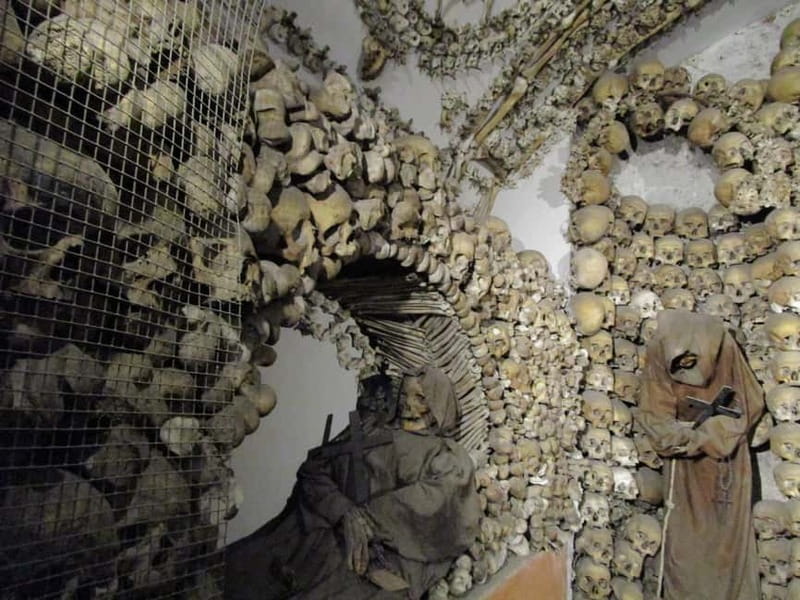
What makes this visit work is the order. You start with the Capuchin Museums, where the history and purpose are laid out in a way that prepares you for what you’ll see below. Then you move into a sequence of crypts where the bone displays are arranged like a language—crosses on the ground, linked joints in separate sections, and skull-focused symbolism that feels both organized and unsettling.
A guided visit matters here. The bones are striking, but the meaning is what sticks with you after you walk back out into Rome daylight.
You can also read our reviews of more tours and experiences in Rome

Skip-the-line ticket and a small group (why it’s a big deal)
This tour includes a skip-the-line ticket, which is a practical win in Rome. The Capuchin Crypt can have bottlenecks, and you don’t want to spend your time standing around with nothing to do.
The group is kept small—up to 10 people—and that changes the feel of the tour. Smaller groups tend to get better explanations, fewer rushed moments, and easier questions. In the reviews you can see a pattern: guides were praised for keeping people engaged and making the topic easier to follow. Names like Luigi and Slobodan pop up often, with feedback that they balanced facts with humor.
Duration is also tight and realistic: plan on about 50 minutes to 1 hour. That’s enough time to see the highlights without turning it into a long endurance test.
Where you meet: Via Vittorio Veneto’s bronze gate
You’ll meet at Via Vittorio Veneto 27, street level next to the bronze gate. This sounds simple, but it’s the kind of detail that can save you stress later—especially in Rome, where streets can look the same fast.
The tour ends back at the same meeting point. That means you don’t have to figure out your way out with a map while your brain is still processing what you just saw underground.
Capuchin Museums first: context before the bones
You begin at the Capuchin Museums, and I think this is the smart part of the format. The crypt is memorable, but it can also become just a collection of skulls and odd bone shapes if you don’t know the why.
In the museum portion, the guide helps connect the site to cultural and spiritual meaning. That matters because the displays aren’t random. They reflect a specific approach to death and a strict set of ideas about what could be done with remains and where.
If you’ve ever walked into a major site and felt like you didn’t get the “why,” this tour aims to fix that. You get the background first, then the crypts make more sense.
Crypt of the Three Skeletons: the one complete skeleton
Next you’ll enter the underground chambers and head to the Crypt of the Three Skeletons. The standout here is that this is described as the only area where a complete human skeleton is shown in its natural state.
That detail changes the impact. Separate bone categories can feel like “parts.” A complete skeleton is more immediate. It brings back the idea of a whole person, not just an arrangement.
Even if you’re not usually into macabre stuff, this stop often becomes the moment where your brain adjusts from curiosity into attention.
You can also read our reviews of more tours and experiences in Rome
- Skip-the-Line Group Tour of the Vatican, Sistine Chapel & St. Peter’s Basilica
★ 4.5 · 12,779 reviews




The bone crypts: leg, thigh, pelvis, and the crosses on the ground
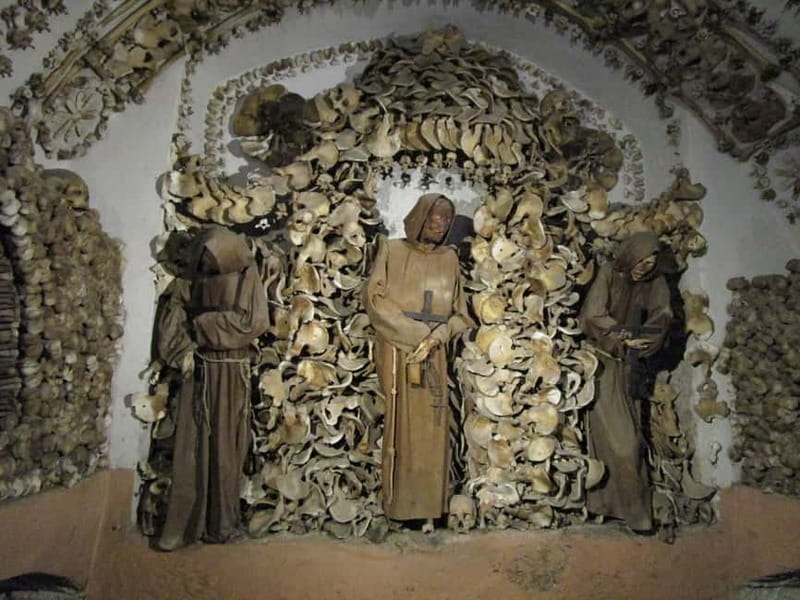
After the three skeleton focus, you move through several bone crypts, each one separated into its own theme.
You’ll see areas like:
- a crypt with leg bones and thigh bones
- a crypt of pelvises, featuring two Capuchin friars posed in an arched formation
- sections marked with crosses on the ground, which signify the resting places of seven Capuchins
This is where the guided aspect really pays off. A self-guided walk can still be interesting, but it’s easy to miss how much the design communicates. With a guide, the bone groupings become a map: this section is about identity, that one is about faith language, and another is about how remains were organized over time.
Crypt of the Skulls and the hourglass symbolism
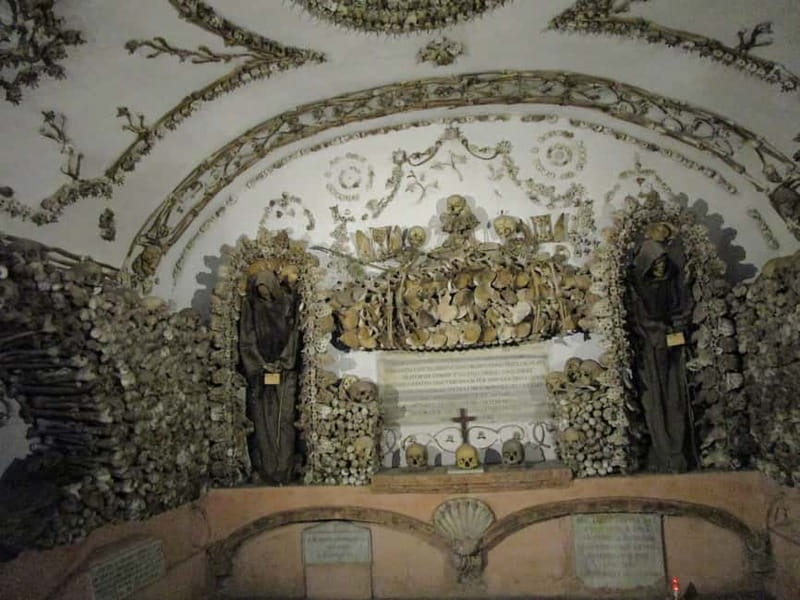
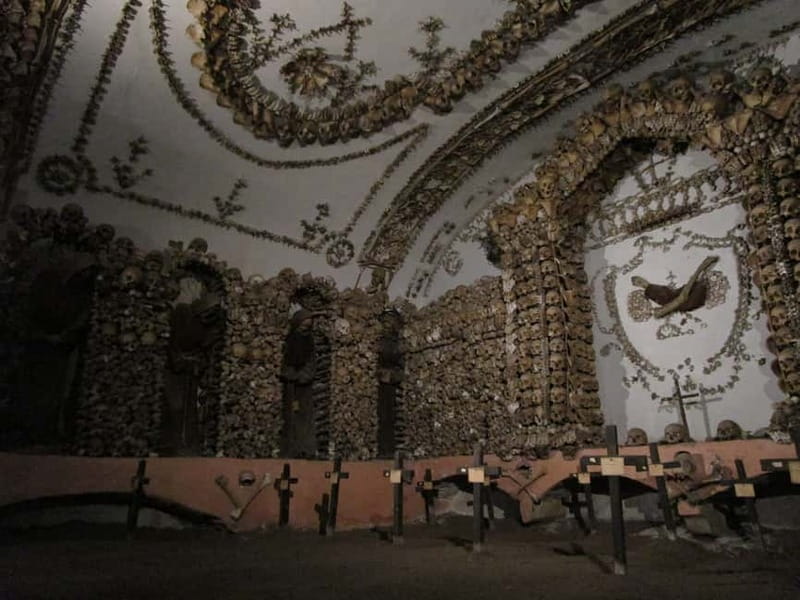
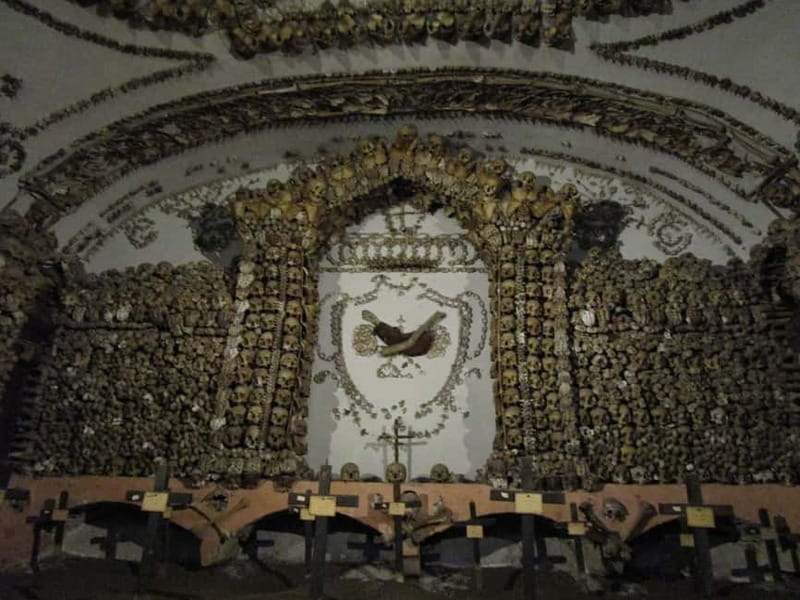
The Crypt of the Skulls is one of the famous stops, and for good reason. You’ll also notice the hourglass detail, which ties the visual impact to a theme: time, mortality, and the passing of life.
This is the part that can feel the most intense. It’s not just “bones.” It’s bones presented as message—skulls arranged in a way that makes you think about the person behind them, and then about what the display is trying to say to the living.
If you can handle it, this section is one of those places where you walk out with thoughts you didn’t plan to have.
Where the bones came from: the Trevi Fountain connection
One of the more interesting historical threads you’ll hear is how the bone collection ended up here. The guide explains that bones of friars were moved from an older friary near the Trevi Fountain area to this site.
The reason is practical and religious at the same time: the Capuchins had a law that prohibited burials inside churches. That meant they needed an underground cemetery elsewhere, and over time this crypt became the final resting place for the Capuchins.
It’s a key part of the tour because it turns the crypt from a weird attraction into a real historical response. People followed rules. Space changed. And the result is this unusual underground museum of remains and meaning.
The Mass Chapel: faith that feels physical
The highlights include the Mass Chapel, and it’s the kind of stop that can change your emotional temperature.
Even if the bones start out as shocking, the chapel context adds a different layer. It reminds you the site isn’t presenting death as a spectacle only. It’s also making an argument about belief, ritual, and the way a community understands what comes next.
You don’t need to be religious to appreciate what it’s doing. You just have to let the contrast land: sacred space using human remains.
How long it takes and how to plan your day
Plan for about an hour, give or take. That’s not a long time for what you’ll see, but it’s long enough to let the details register.
Because you’ll be walking through underground chambers, wear shoes that feel stable. The tour is paced like a walk-through guided visit, not a long hike. Still, you’ll want comfort, especially if you’re sensitive to cool or dim spaces.
If you’re trying to design your Rome day, I like pairing this with lighter sightseeing afterward. The crypt can make you think. A nearby café stop usually helps your brain reset.
Dress code: the practical rule people forget
To enter the crypts, shoulders and knees must be covered. That’s not a vague suggestion. If you show up uncovered, you might get turned away from parts of the experience.
So bring a light layer for your shoulders and avoid shorts. In summer, thin trousers or longer skirts usually solve it fast. It’s the kind of rule that can derail a trip if you ignore it until the last minute.
Price and value: is $44.41 worth your time?
At $44.41 per person, this is not a budget add-on. But it’s also not priced like a major five-hour mega tour. The value comes from three things you can feel immediately:
- Skip-the-line entry, which reduces wasted time.
- A live English guide, which helps you understand the symbols and history behind what you’re seeing.
- A small group (up to 10), which tends to improve the quality of explanations.
If you were planning to visit on your own, you might still find the crypt fascinating. But you’d likely spend more time trying to connect the dots with signs. With a guide, the bones become organized meaning instead of just an eerie visual.
For me, the price is easiest to justify if you’re curious about history, symbolism, and the way religious communities handled burial rules. If you only want quick photos and don’t want context, you might question the cost.
Who should book this tour
This tour fits best if you:
- want a short guided experience with a clear route through multiple crypt rooms
- enjoy learning how places work and what symbolism means
- can handle a macabre theme without panicking
- prefer small groups and live explanation
It’s less ideal if you:
- are very sensitive to bones and remains
- hate religious spaces that use unsettling visual methods
- can’t meet the shoulders-and-knees dress requirement
Should you book the Capuchin Crypt skip-the-line tour?
I’d book it if you want the crypt to make sense, not just register as strange. The combination of skip-the-line access, English guide, and a small group turns a potentially overwhelming experience into something you can follow and even talk about later.
If you decide to go, plan your outfit around that dress code. And give yourself a little mental room after the tour. This is the kind of site that leaves an impression fast—on purpose.
If you like, tell me when you’re visiting Rome and what other sights you’re pairing with it, and I’ll suggest a smart order for your day.
FAQ
How long is the Capuchin Crypt guided tour?
The tour lasts about 50 minutes to 1 hour. Check available starting times for the exact schedule.
Is the guide available in English?
Yes. The tour is listed as an English-language live guide.
What is the group size?
It’s a small group, with a maximum of 10 participants.
What’s included in the price?
You get an English-speaking guide and a Capuchin Crypt entry ticket.
Do I need a skip-the-line ticket?
Yes, this experience includes skip-the-line entry.
Where do I meet the guide?
Meet in front of Via Vittorio Veneto 27 at street level next to the bronze gate.
Where does the tour end?
The tour ends back at the meeting point.
What will I see during the tour?
You’ll visit the Capuchin Museums and then move through crypts including the Crypt of the Three Skeletons, the Crypt of the Skulls (with the hourglass), and additional bone crypts such as the Crypt of the Leg Bones and Thigh Bones, the Crypt of the Pelvises, and the Mass Chapel.
Are there dress code rules to enter the crypts?
Yes. Shoulders and knees must be covered to enter the crypts.
Is there free cancellation?
The experience offers free cancellation up to 24 hours in advance for a full refund.
Can I reserve without paying right away?
Yes. It offers a reserve now & pay later option, where you can book a spot and pay nothing today.