REVIEW · ROME
Roman Forum Myths and Legends Private Guided Tour
Book on Viator →Operated by Kirba Tours · Bookable on Viator
One part Forum, two parts storytelling magic. I like how this private walk turns scattered ruins into clear myths, politics, and everyday Roman life in about two hours. You move through the heart of the ancient city while a live guide explains the legends tied to gods, heroes, and real figures like Julius Caesar. Private guide time plus included Forum access means you’re not just looking at stones—you’re learning what people believed and why it mattered. Only heads-up: with so many stops packed into a short visit, it can feel a bit fast if you like to linger.
What I really like is the stop-by-stop focus on famous legends—from Romulus’ shadow (Lapis Niger) to the Vestal Virgins’ sacred flame (Temple of Vesta) and the deification of Julius Caesar (Temple of Divus Julius). Second, I love the way a strong guide helps you visualize what the Forum once looked like; on this tour, the guide experience can include artist-style reconstructions to make the remains easier to understand. One possible drawback is that this is a walking tour built around a structured route, so if you hate a timed pace, you may wish you had more time for photos or independent exploring.
In This Review
- Key highlights worth planning for
- Why the Roman Forum myths-and-legends format makes sense
- Entering the Forum: tickets, headset audio, and the 2-hour reality
- Stop-by-stop: legends and power at the heart of Rome
- Lapis Niger: Romulus’ legend starts with a black stone
- Basilica Emilia: where public business and meetings happened
- Temple of Antoninus Pius and Faustina: devotion wrapped in marble
- The Regia: kingship, priesthood, and sacred advice
- Temple of Vesta + Casa delle Vestali: the flame, the rules, the stakes
- Fonte di Giuturna: a spring with mythic healing powers
- Castor and Pollux (Dioscuri) temple: victory announced from the sky
- Lacus Curtius: the chasm that swallowed a hero
- Temple of Saturn: agriculture, state treasury, and Saturnalia
- Umbilicus Urbis: the center of the living and the dead
- Arco di Settimio Severo: Roman victory, later reused
- Miliarium Aureum + Basilica Julia: Rome’s measurements and its courts
- Curia Julia: where the Senate met
- Temple of Divus Julius: the first “human” temple for Caesar
- Why the private guide experience matters (especially here)
- Price: what $286.60 really buys you in the Forum
- Who this Roman Forum myths tour fits best
- Should you book this tour?
- FAQ
- How long is the Roman Forum myths and legends private tour?
- Where does the tour start, and where do you end?
- Is this a private tour?
- What’s included in the ticket price?
- Is a mobile ticket used?
- Do I need ID to enter?
- Is the Colosseum included?
- Do I get help hearing the guide?
- What about hotel pickup and transportation?
- What’s the cancellation policy?
Key highlights worth planning for
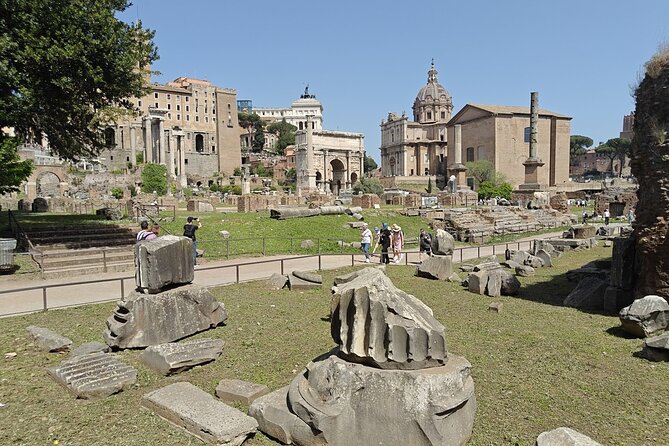
- Lapis Niger legend tied to Romulus, plus the real archaeological twist of its 19th-century discovery
- Vestal Virgins sites—Temple of Vesta and the Casa delle Vestali—explained with clear context about their 30-year role
- Big myth moments like Lacus Curtius and the Dioscuri (Castor and Pollux) showing how legend served Roman identity
- Politics gets real at places like Curia Julia and Basilica Julia, where governance and courts happened
- Headset audio included, helpful for clear listening even when your group is larger
Why the Roman Forum myths-and-legends format makes sense
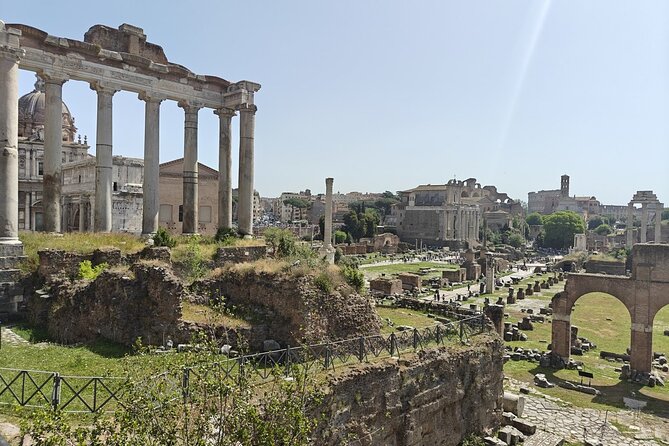
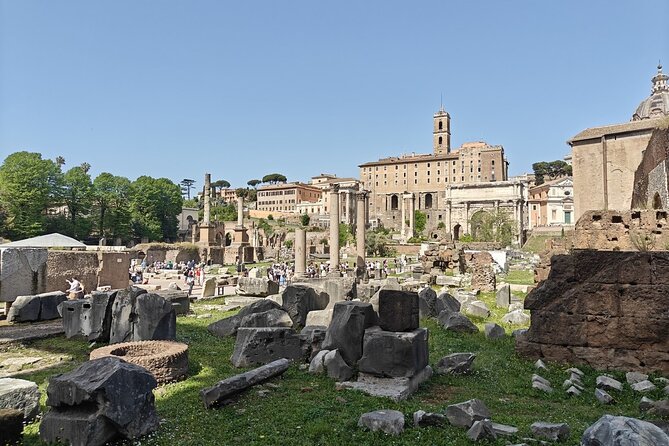
The Roman Forum can feel like a maze—lots of walls, columns, fragments, and dates. What changes everything on this tour is the framing: you’re not wandering. You’re walking with a purpose, guided by the stories Romans told themselves about power, protection, and the sacred order of the city.
I like that the myths aren’t treated like bedtime tales. They show you how religion, state authority, and public life blended together. A legend like Romulus founding Rome or the Vestal Virgins maintaining the flame isn’t just dramatic. It becomes a map for understanding why Romans believed their city would survive—and what they thought could threaten it.
You can also read our reviews of more guided tours in Rome



Entering the Forum: tickets, headset audio, and the 2-hour reality
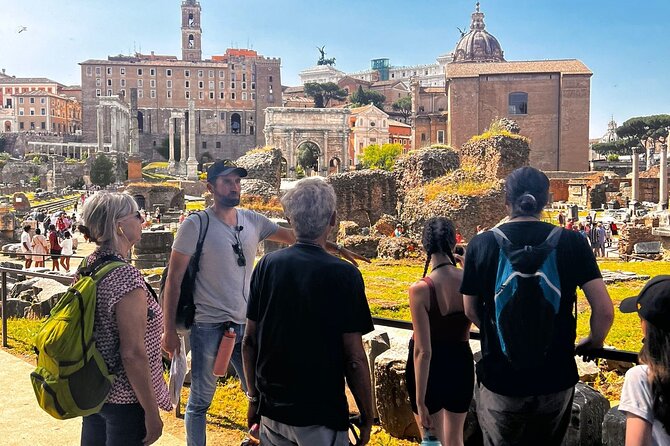
This is a private tour, and it uses a mobile ticket. You’ll meet at Largo della Salara Vecchia, 00186 Rome and end back there. Entrance is included for the Roman Forum, Palatine Hill, and Imperial Forums, so you’re not hunting down separate tickets before you start.
The tour runs about 2 hours, so I’d plan on a concentrated visit rather than a slow museum hour. You’ll also get a headset to hear the guide clearly (the tour includes this especially when groups are larger than six). That matters here because the Forum is noisy and you’ll often be turning your head while listening.
One important practical note: you’ll need the full names exactly as on your ID or passport when booking, and ID is mandatory for entrance. If anything doesn’t match, you can risk not getting in.
Stop-by-stop: legends and power at the heart of Rome
This route moves through the Forum like a guided storyline. Below is what to expect at each major stop—and what makes each one click once a guide gives you the context.
Lapis Niger: Romulus’ legend starts with a black stone
The Lapis Niger is a small but legendary shrine area tied to Romulus. The story says it marks the spot where Romulus’ body was found after a murder tied to his own people. What I find especially fun is the contrast between legend and archaeology: the Lapis Niger was discovered accidentally in 1899 during excavations beneath a medieval pavement, which shocked scholars at the time.
You’ll get a clear reason why this matters: in Rome, even a buried king could become part of the city’s sacred political language.
Basilica Emilia: where public business and meetings happened
Next up is Basilica Emilia, a key public building for senators, meetings, and legal and commercial activity. It started in the 2nd century BCE, but fire destroyed it, and it was rebuilt multiple times.
The takeaway for you: once you hear how basilicas functioned, the Forum’s layout makes more sense. It’s not only temples and statues—it’s where Romans handled decisions and daily civic traffic.
You can also read our reviews of more private tours in Rome





Temple of Antoninus Pius and Faustina: devotion wrapped in marble
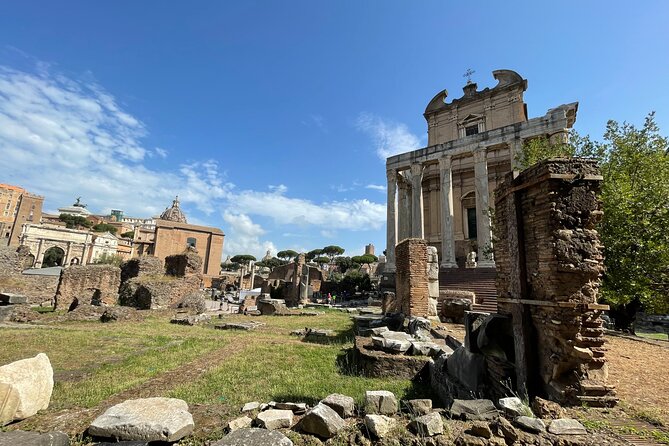
At the Temple of Antoninus Pius and Faustina, you’ll hear the legend of a temple built to commemorate the couple’s love. The facts you can hold onto are the personalities and the style: Antoninus Pius is linked with a peaceful reign and dedication to arts and sciences, while Faustina the Elder is remembered for beauty and philanthropy. The temple is described as one of the largest and most ornate, with intricate carvings and statues.
If you like your myths with a political edge, this one fits. Deified emperors were a way to blend power with faith.
The Regia: kingship, priesthood, and sacred advice
The Regia served as the official residence of Rome’s kings and later the pontifex maximus, the high priest. The legend says it was built after advice from the goddess Egeria, who helped Numa Pompilius with matters of state and religion.
What you’ll notice during the stop is how religion and government were not separate jobs. Even the buildings meant to house authority were part of the sacred system.
Temple of Vesta + Casa delle Vestali: the flame, the rules, the stakes
This is one of the best segments because it turns an idea—eternal Rome—into human responsibility.
At the Temple of Vesta, you’ll learn about the Vestal Virgins, six priestesses selected young who had to remain celibate for thirty years. They tended a sacred flame representing Rome’s eternal life. Their purity was treated as vital for the state’s well-being. The punishment for breaking the vow is described in harsh terms—Vestal Virgins found guilty could be buried alive.
Then the tour continues to Casa delle Vestali, the larger complex tied to their living quarters, a temple space, and administrative and ritual areas. You’ll hear about the selection age (girls between six and ten) and also their privileges, including the right to own property and the power to grant clemency to condemned prisoners.
If you want one reason this tour feels worth it, it’s this: it shows how religion protected Rome, but it also shows how Rome controlled people through religion.
Fonte di Giuturna: a spring with mythic healing powers
At Fonte di Giuturna, you’ll hear the story of Juturna, the goddess of fountains, wells, and springs. The legend says Jupiter desired her, she escaped and transformed into a spring, and the resulting waters were believed to have healing powers.
It’s a short stop, but it’s a reminder that Romans didn’t treat nature as separate from gods. Water in the city carried meaning, not just utility.
Castor and Pollux (Dioscuri) temple: victory announced from the sky
The route includes a site tied to the Dioscuri, the twin gods Castor and Pollux. The legend connects them to the Battle of Lake Regillus, where they supposedly appeared on horseback at the Forum and announced Roman victory. A temple was dedicated to them in the Forum to honor their protection of the Roman state.
You’re learning a pattern here: myths weren’t only for explaining the past. They were used to claim divine backing in the present.
Lacus Curtius: the chasm that swallowed a hero
At Lacus Curtius, the story becomes dramatic. A deep chasm opens in the Forum. The Sibylline Books prophesize Rome will be saved only if its most valuable possession is thrown into the abyss. Curtius, in armor on horseback, rides into the chasm and disappears, and the chasm closes—so a small lake forms where it happened.
This is one of the clearest “values lesson” myths in the tour: self-sacrifice as a way to defend the city.
Temple of Saturn: agriculture, state treasury, and Saturnalia
The Temple of Saturn is tied to the god of agriculture, with a legend claiming Saturn established reign in Italy and taught agriculture. The temple also housed the state treasury. During Saturnalia (December 17 to 23), the treasury was opened and gifts were exchanged.
If you want context for why Romans celebrated with structure and ritual instead of just partying, this stop gives it. Religion and economy are braided.
Umbilicus Urbis: the center of the living and the dead
The Umbilicus Urbis, a conical brick structure, relates to the idea of Rome’s center through the Mundus. According to Plutarch, Romulus dug a pit in the Comitium, threw in offerings, and used soil from followers’ homelands. The pit was opened only three days a year to communicate between the living and the dead, and public activities were considered impious during those days.
This one can feel abstract at first. A good guide keeps it grounded by explaining how a city can treat space as sacred order.
Arco di Settimio Severo: Roman victory, later reused
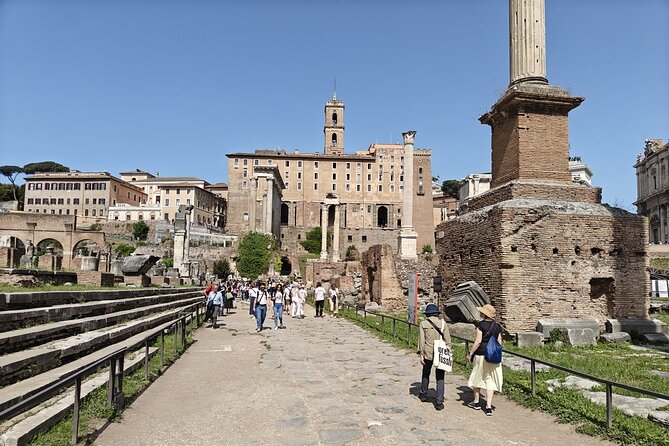
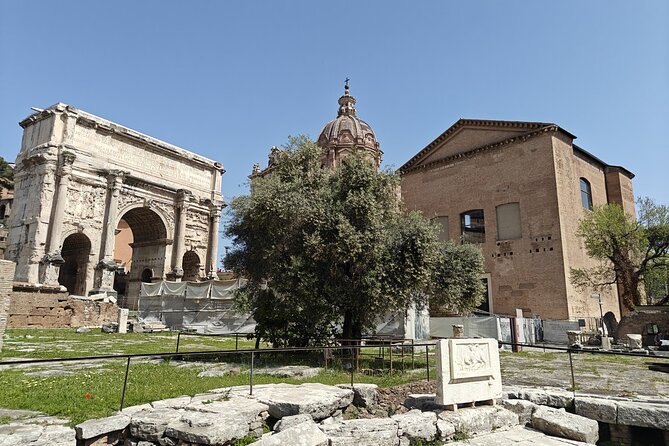
At the Arch of Septimius Severus, you’ll see reliefs depicting scenes from the emperor’s military campaigns. The arch is also noted as a model for the Arc de Triomphe in Paris. The fun added detail is how long it has endured: it survived earthquakes and floods and even served as a medieval fortress in the 14th century.
You get more than photos here. You learn how Roman symbols were reused across centuries, not just admired in place.
Miliarium Aureum + Basilica Julia: Rome’s measurements and its courts
The Miliarium Aureum is described as the monument measuring distances to other cities across the empire. Erected by Augustus in the early 1st century AD, it’s one of the oldest surviving milestones in the world. It also ties into the idea that all roads radiated from Rome.
Then you’ll reach Basilica Julia, a legal hub with a raised tribunal where judges sat and spaces where parties and witnesses waited. It functioned as a courthouse and also housed government offices and meeting spaces linked to the Senate. The tour frames this as part of a legal tradition that influenced systems beyond Rome.
If you’re trying to understand why Romans cared about institutions, these stops give you direct evidence.
Curia Julia: where the Senate met
The Curia Julia was the Senate meeting place, built by Julius Caesar in 44 BC after he became dictator and replacing an older senate house. The Senate met there regularly, discussed policy, and had powers to pass laws and approve or reject treaties.
This is where you stop seeing the Forum as purely ceremonial. It becomes political machinery.
Temple of Divus Julius: the first “human” temple for Caesar
The final major stop is the Temple of Divus Julius, built by Augustus after Julius Caesar’s death. It’s described as the first temple in Rome dedicated to an individual who was not a god or goddess. The tour connects this to the emotional politics of Caesar’s death: the plebs were devastated, mourned him deeply, and his funeral procession was reportedly massive—over 100,000 people by estimate.
That’s the myth-to-reality bridge. Caesar wasn’t just a leader. He became a public religious story.
Why the private guide experience matters (especially here)
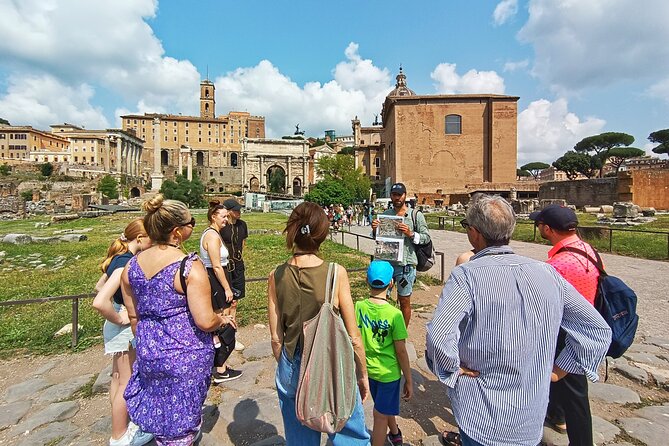
The Roman Forum is hard to decode without help. A private guide turns confusion into a sequence you can follow. I also like that the experience is designed so your guide can keep up with your pace instead of herding you through the same photo spots.
In particular, I appreciate how strong storytelling helps you picture buildings that no longer stand. On this tour, the guide experience may include artist renderings to help you reconstruct what you’re seeing—so your brain doesn’t have to do the hardest work alone.
Price: what $286.60 really buys you in the Forum
At $286.60 per person for about 2 hours, this isn’t a bargain-basement deal. The value comes from three places:
- You get official entry for the Roman Forum, Palatine Hill, and Imperial Forums included with the tour.
- You get a private guided walk instead of self-guiding through confusing ruins.
- You get headset support designed to keep the guide audible, which helps you actually absorb what you’re paying for.
Also, note the limit: Colosseum access isn’t included, so you’re paying for a focused Forum experience, not a multi-attraction day.
If you’re the kind of traveler who learns fast when a guide puts stories into spatial context, the price starts to look fair. If you prefer reading on your own and moving slowly, you might feel it’s too structured.
Who this Roman Forum myths tour fits best
This tour is a good match if you want:
- a guided explanation of major Roman legends tied to specific Forum sites
- clear context for Julius Caesar, the Vestal Virgins, and Rome’s founding myths
- a private format where you can ask questions and not feel rushed by a big group
It can also work well for history lovers who want the Forum to feel like a coherent place, not random ruins.
If you’re traveling with limited time and still want the highlights—this gives you the Forum’s most story-rich anchor points in one go.
Should you book this tour?
If the Roman Forum feels intimidating to you—and you want it to make sense—this is an easy yes. The included entrance, private guide focus, and headset audio are exactly the kinds of details that turn a short visit into real understanding.
I’d hold off only if you know you want total freedom to roam, or you don’t care about myths and politics and would rather stick to independent exploration.
FAQ
How long is the Roman Forum myths and legends private tour?
It lasts about 2 hours.
Where does the tour start, and where do you end?
You start at Largo della Salara Vecchia (00186 Rome) and the tour ends back at the same meeting point.
Is this a private tour?
Yes. Only your group participates.
What’s included in the ticket price?
Entrance is included for the Roman Forum, Palatine Hill, and Imperial Forums, plus the Roman Forum guided tour, an official guide, and a headset to hear clearly.
Is a mobile ticket used?
Yes. The tour uses a mobile ticket.
Do I need ID to enter?
Yes. Full names matching your ID or passport are required at booking, and you need ID or passport for entrance.
Is the Colosseum included?
No. Colosseum access is not included.
Do I get help hearing the guide?
Yes. Headsets are provided to hear the guide clearly, especially helpful if the group is larger than six people.
What about hotel pickup and transportation?
Hotel pickup and drop-off are not included, and transportation to and from attractions isn’t included either.
What’s the cancellation policy?
Free cancellation is available up to 24 hours before the experience starts for a full refund.