REVIEW · ROME
Colosseum Underground Private Tour with Palatine Hill & Forum
Book on Viator →Operated by RomaExperience Tours · Bookable on Viator
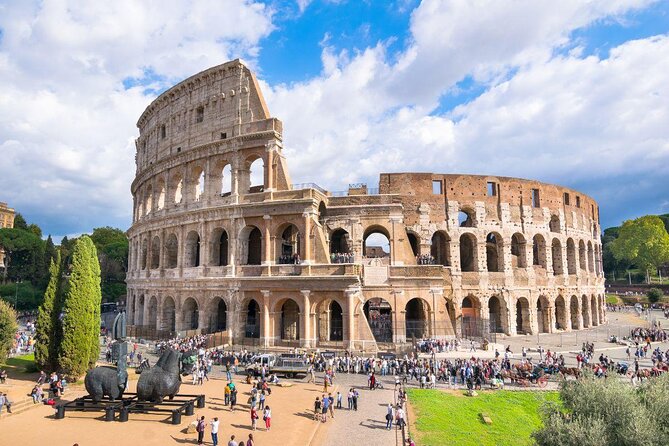
The Colosseum has a second stage. This private tour pairs Colosseum underground access with Palatine Hill and the Roman Forum, so you don’t just look at ruins—you get the full “how it worked” story. I like the chance to see restricted spaces tied to gladiators and animals (not just the show floor), and the smoother flow you get with private access and skip-the-line entry. One thing to weigh: underground access is limited and the plan can shift if the Colosseum closes that section due to heavy rain, so this isn’t the best pick if you hate changes.
You’ll spend about 3 hours 10 minutes moving between the sites, with a maximum of 6 people per booking and only your group. You’ll meet at Via Labicana, 125 and end at Largo della Salara Vecchia, and the tour includes a Colosseum reservation plus an entrance ticket value called out as €18. Moderate walking ability helps, and you’ll need to bring an ID that matches the names on your reservation.
In This Review
- Key things to know before you go
- Colosseum Underground: seeing the backstage machinery
- Roman Forum stop: Caesar, temples, arches, and Via Sacra
- Palatine Hill viewpoints: emperors’ homes and modern Rome in the same frame
- Colosseum time for photos and the arena-at-your-feet feeling
- Private guiding that doesn’t rush you
- Price and value: what $576.10 really covers
- Meeting point, tickets, and the name-match rule
- Weather and underground access: your backup plan is part of the package
- Who this tour suits best
- Should you book the Colosseum Underground private tour?
- FAQ
- How long is the Colosseum Underground private tour with Palatine Hill and Forum?
- Is this tour private, and what group size should I expect?
- What’s included with Colosseum entry for this experience?
- Do I need to bring my passport or ID?
- What happens if the Underground Section closes due to heavy rain?
- Is the tour refundable if plans change?
Key things to know before you go
- Limited-access Colosseum Underground areas that show pits, tunnels, and the staging setup behind the action
- Private guiding for up to 6 people, which helps you move faster and ask more questions
- Time at the Forum and Palatine Hill that connects the city’s power (emperors) to its politics (the Forum)
- Photo-focused stops (including viewpoints from the arena) with guides who are willing to help you get the shot
- Backup plan if underground tickets aren’t confirmed, with an alternative visit to the Tiberian House in the Forum
- Weather matters: heavy rain can shut the underground section without notice, changing where you spend time
Colosseum Underground: seeing the backstage machinery
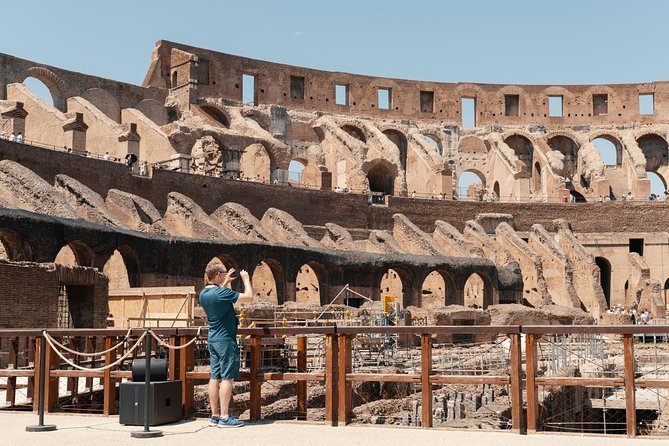
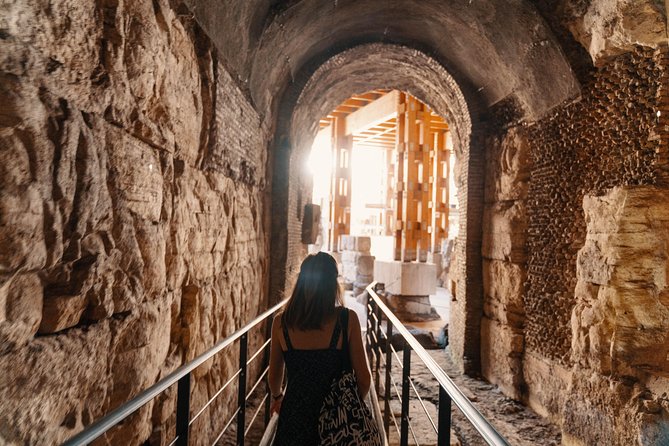
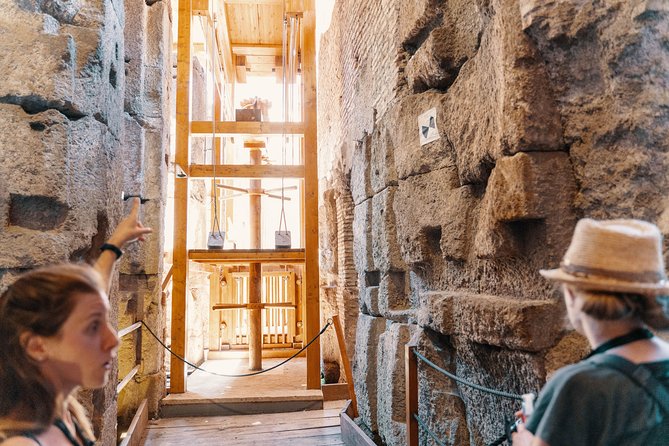
The big reason to book this one is the Colosseum Underground. Instead of only standing in the seats and looking down, you get to see how the spectacle was staged—tunnels, pits, and the systems used to bring gladiators and animals into position. The effect is hard to explain until you’re standing in it: you start to picture the rush of sound, the timing, and the chaos that the audience couldn’t see.
A useful detail: the underground portion isn’t a total underground darkness-fest. You’ll likely notice open sightlines because parts of the arena floor above relate directly to what you see below. That means you can often take photos without fighting for a workable angle.
This is also where a strong guide makes the difference. In the past, guides have included people like Elisa (an archaeologist with hands-on Forum work) and Ellie (with a PhD and active work in Rome). When your guide can translate the space into real-world logistics—where people waited, how the platforming worked, why certain passages existed—you walk away with a much clearer mental model than you’d get from a basic overview.
You can also read our reviews of more private tours in Rome



Roman Forum stop: Caesar, temples, arches, and Via Sacra
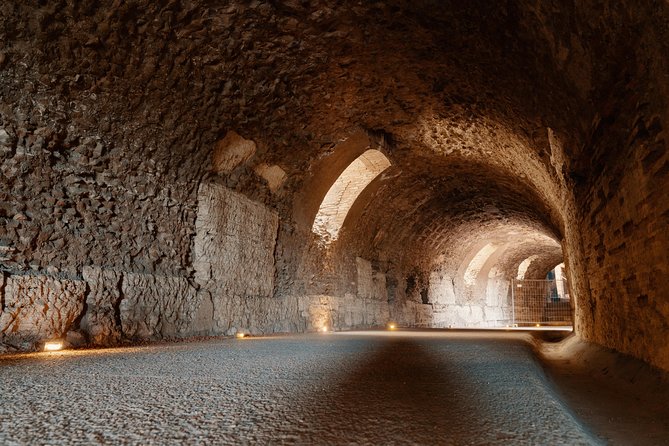
The tour starts in the Roman Forum (about 1 hour 5 minutes). This is the political heart of ancient Rome, and the ruins hit differently when you know what to look for. You’ll see where Julius Caesar was assassinated, plus major architectural pieces like temples and victory arches. The point isn’t just to name monuments; it’s to connect them to how power operated day to day.
A practical tip: the Forum can feel like a million stone fragments until your guide turns them into a map. With a private group, you can ask questions on the spot—like why the Forum looked the way it did, or how different structures fit into ceremonies and public life. That’s where this kind of format earns its keep.
Also, keep an eye out for the Via Sacra, Rome’s main street, which connects the Forum area toward the Colosseum. On the tour, you’ll pause for key sights along the way—so the “this is where it happened” feeling is continuous rather than stop-and-start.
Palatine Hill viewpoints: emperors’ homes and modern Rome in the same frame
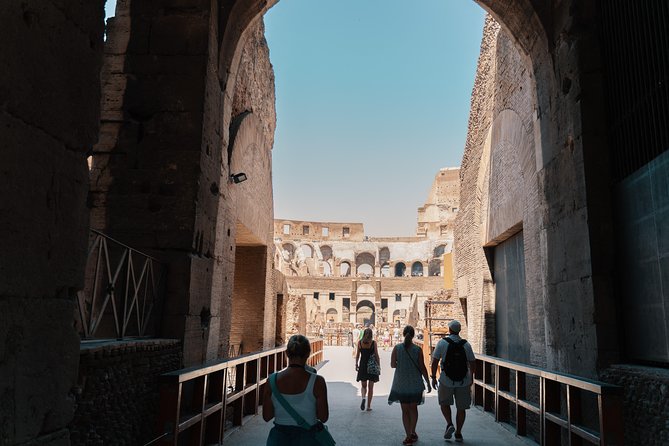
Next comes Palatine Hill (also about 1 hour 5 minutes). This is where the story of Roman power becomes personal. Palatine is famous as the home of emperors, and your guide will point out where rulers lived and what daily luxury looked like in practical terms.
What I really love here is the contrast. From Palatine you get views of both Ancient and modern Rome, so you can understand why this spot was so strategically valuable. Even if the buildings are gone, the vantage point and the terrain explain a lot.
Expect uneven ground and stairs in parts. The tour notes moderate physical fitness for a reason—this isn’t “sit down and admire” sightseeing. Good walking shoes matter, and if you’re sensitive to heat, plan to move at a slower pace than you do at museums.
Colosseum time for photos and the arena-at-your-feet feeling
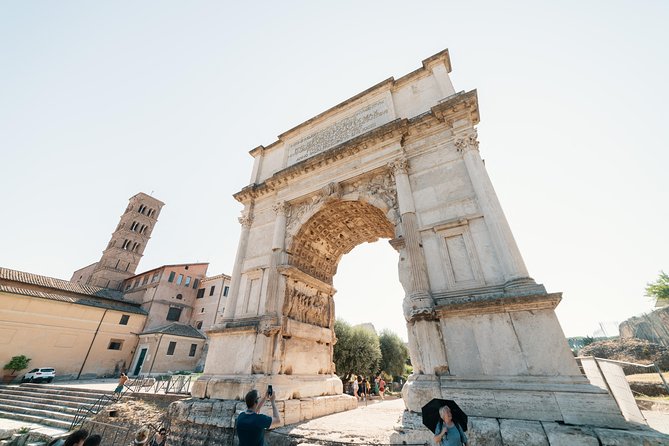
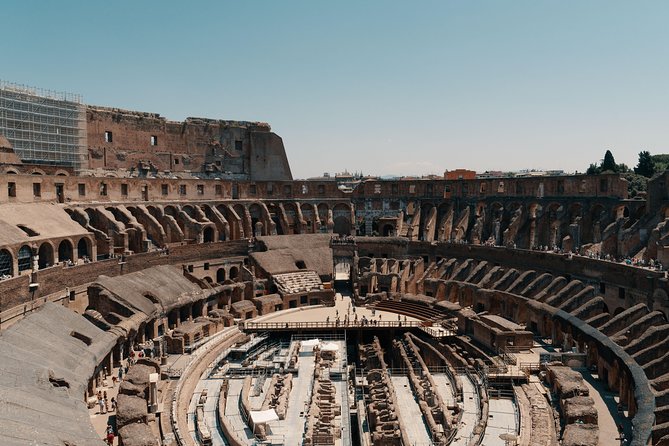
The Colosseum portion is about 50 minutes for the amphitheater walk, including time that helps you take photos. One highlight: you’ll get a chance to shoot from a point near the center of the arena, which gives a much stronger sense of scale than photos from the perimeter.
If you’ve been to the Colosseum before, here’s why this still works: the underground access changes your understanding of what you’re looking at. After you’ve seen the staging area below, the arena floor feels like it has purpose instead of just drama.
You’ll also get pauses outside the main focus areas. On this tour, those exterior moments matter because they connect separate monuments into a single walkable story:
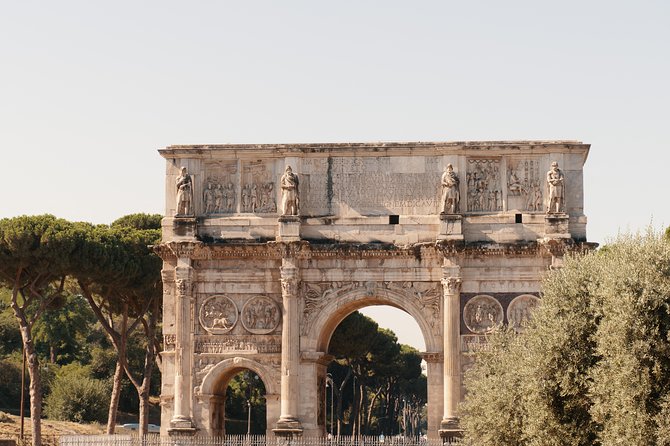
- Arch of Constantine gets highlighted, including its significance tied to Constantine as a Christian-era emperor
- A Roman victory arch (called out as one of the best-preserved examples) is included
- A victory arch is specifically linked to the design that inspired the Arc de Triomphe
- You’ll see key streets and settings, including the path role of the Via Sacra
- Major religious and ceremonial architecture shows up too, including a great basilica of secular Roman Rome and the Temple of Antoninus and Faustina, which was converted into a church in the 7th century
These pauses are short, but they keep you from leaving with only one landmark in your head.
Private guiding that doesn’t rush you
This is a private tour with only your group, capped at 6 people. That changes everything about the experience. You spend less time waiting for the slowest person, and you spend more time with questions in your own voice.
Guides for this tour have shown up with strong credentials in the Rome archaeology world. People like Stephanie, Elisa, Andrea, Luca Romano, Marta, and Ellie have led past groups, and the common thread is storytelling that turns stone into a sequence. One guide, for example, is described as an archaeologist who worked in the Forum, and that shows up in the way the details come fast and make sense instead of feeling like random facts.
You’ll also notice the tour’s practical pacing. One family guide experience stood out for staying mindful of heat—making shade stops and water breaks a priority. Even if your guide doesn’t explicitly manage the weather, you should. Rome in the daytime can be brutal, and you’ll be moving between three major sites.
Photo help is another real value point. In prior experiences, guides have offered to take photos for you at strong viewpoints, so you’re not stuck with the classic selfie-shoulder shuffle. Ask early if you want a couple of quick posed shots; private time makes that easy.






Price and value: what $576.10 really covers
At $576.10 per person, this tour isn’t trying to be a budget option. You’re paying for three things that add up fast in Rome:
1) Private guidance across multiple sites (not just one monument)
2) Entrance and reservation costs for the Colosseum (the included info calls out a ticket value of €18 and a reservation fee of €2)
3) Access to the limited underground areas, which aren’t available on every standard Colosseum visit
Is it worth it? If you care about the “inside mechanics” of the Colosseum—the tunnels, pits, and how the spectacle moved—this is the kind of ticket that makes the Colosseum feel new. You’ll also save time by skipping long waits and getting a guided route that links the Forum, emperors’ hill, and the arena.
If you only want quick sightseeing photos, you might feel you’re paying extra for storytelling you don’t need. But if you’re the type who reads signage and asks why things are positioned a certain way, you’ll get your money back in understanding.
One more clue: this tour is commonly booked about 102 days in advance on average. Demand is real, and that usually means fewer last-minute openings.
Meeting point, tickets, and the name-match rule
The meeting point is Via Labicana, 125, 00184 Roma RM, and you finish at Largo della Salara Vecchia, 00186 Roma RM. It’s described as near public transportation, which helps because you don’t need a hotel pickup.
For entry, the tour is strict about identity matching:
- Each traveler must present a valid passport or ID
- The document must match the name provided when booking
- You must provide the full names of all travelers
- Failing to present the voucher with full names at the ticket office can mean denied entry
It’s not just bureaucracy. For timed entry sites like the Colosseum and Forum, those rules prevent you from losing your window.
You’ll also receive a mobile ticket. That’s convenient, but still save a screenshot or keep it accessible offline just in case network coverage acts up.
One more practical note: sprays aren’t allowed inside the Colosseum. If you plan to pack sunscreen, choose a stick or cream style, or plan to apply before you enter.
Weather and underground access: your backup plan is part of the package
This tour includes an important heads-up about the underground section:
- If it rains heavily, the Colosseum may close the Underground Section without notice
- If the underground tickets can’t be confirmed about a month before the tour, the provider offers a special entrance to the Tiberian House in the Forum
What that means for you: your day will still have strong archaeological focus, but the exact “behind-the-scenes” portion depends on conditions and availability. If you’re traveling in storm season or you’re on a tight schedule where a reroute would ruin your plans, it’s worth thinking twice.
The good news is the tour is designed to pivot. In rain situations, you won’t be left standing around—you’ll keep exploring other sections with your guide.
Who this tour suits best
This is a strong fit if you want:
- A private, small-group experience in the Colosseum–Forum–Palatine triangle
- The limited-access underground component
- Clear storytelling tied to architecture and how the games worked
It’s also a smart choice for families who want a guide to manage pace and explanation. One prior family experience with two daughters described the guide as thoughtful about heat and able to connect across ages.
This might be less ideal if:
- You want a mostly self-guided museum day
- You hate timed entry and any chance of weather-based changes
- You’d rather spend extra time wandering without direction at each site
Should you book the Colosseum Underground private tour?
Book it if your must-do list includes the Underground Colosseum and you value a guide who can turn space into story. The combination of underground access, Forum context, and Palatine views makes the Colosseum feel like part of a larger system, not a standalone attraction.
If you’re price-sensitive, keep your expectations realistic. This costs a lot because it’s paying for private access, timed entry, and limited underground capacity. That’s also why it’s popular—plan ahead, and make sure your ID name matches exactly.
If you want my quick rule of thumb: history nerds, architecture fans, and anyone who’s ever wondered how the gladiator staging actually worked will feel like they got the best version of the Colosseum experience.
FAQ
How long is the Colosseum Underground private tour with Palatine Hill and Forum?
It’s approximately 3 hours 10 minutes.
Is this tour private, and what group size should I expect?
It’s a private tour, and the maximum is 6 people per booking. Only your group participates.
What’s included with Colosseum entry for this experience?
Entrance fee is included, along with the Colosseum reservation fee and a Colosseum entrance ticket (valued at €18 per person). Headsets are included for groups of 6 or more.
Do I need to bring my passport or ID?
Yes. Each traveler must present a valid passport or ID document that matches the name provided at booking.
What happens if the Underground Section closes due to heavy rain?
The Colosseum may close the Underground Section without notice. In that case, your guide will explore other sections of the Colosseum and archaeological site.
Is the tour refundable if plans change?
No. The experience is non-refundable and cannot be changed for any reason.