REVIEW · ROME
Colosseum, Roman Forum and Palatine Hill Skip Line Private Tour
Book on Viator →Operated by Crazy4Rome Private Tours · Bookable on Viator
Rome hits different in the open air. This private skip-line tour strings together the Colosseum, Roman Forum, and Palatine Hill with a guide who helps you read what you’re seeing. I especially like that you get a controlled pace for a ~3-hour visit, and you’re not just wandering—you’re getting the why behind the stones.
The second big win is the entry setup. You’ll go inside the Colosseum and then step onto the arena floor through doors used by gladiators, with the guide filling in the context as you walk. One consideration: this is still a walking-and-standing experience on uneven ancient surfaces, so plan around moderate physical fitness.
If you’re shopping for value, the price is not cheap at $300.37 per person—but you’re also paying for reserved entry and a private guide time slot for the core highlights. That’s worth it most when you care about details, want to dodge long waits, or you’re traveling as a small group that benefits from a custom itinerary.
In This Review
- Why this tour works so well on a tight Rome schedule
- Entering the Colosseum with your reserved time slot
- Colosseum interior: what to notice once you’re inside
- Stepping onto the arena floor through the gladiator doors
- Palatine Hill: where Rome’s power started to look like power
- Roman Forum: the civic center that made everyday politics real
- Arch of Constantine: a short stop with big meaning
- What makes this tour worth $300.37 per person
- Getting the smooth entry experience right: names, IDs, and pacing
- Should you book this skip-line private tour?
- FAQ
- What’s the duration of the Colosseum, Roman Forum and Palatine Hill skip line private tour?
- Is this tour really private?
- What language is the tour guide?
- What stops are included during the tour?
- Are tickets included?
- Can I add the Underground Level?
- Where do we meet, and where does the tour end?
- What do I need for entry to the Colosseum and Roman Forum?
- What should I know about timing and cancellations?
Why this tour works so well on a tight Rome schedule
- Reserved Colosseum + arena access means less time in lines and more time learning on-site
- Private pacing helps you move at a speed that fits your group, not some factory schedule
- Gladiator-door moment: you enter the arena through the same-style doors used in ancient times
- Palatine Hill context turns “ruins” into a map of power—Imperial palaces, rich homes, and the hill’s two summits (Palatium and Germalus)
- Forum specifics: law courts, public meetings, and the kind of civic life that happened between the Palatine and Capitoline hills
- Strong guide track record, with named guides like Romina, Giuseppe, Fabio, Zev, and Yevgeny tied to thoughtful explanations and good energy
Entering the Colosseum with your reserved time slot
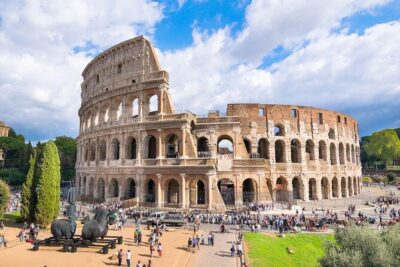
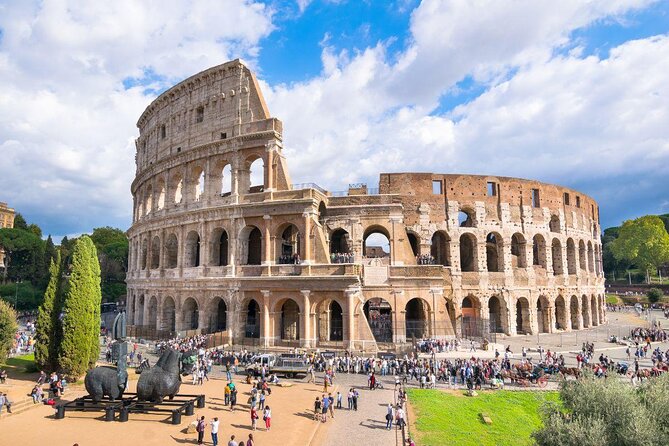
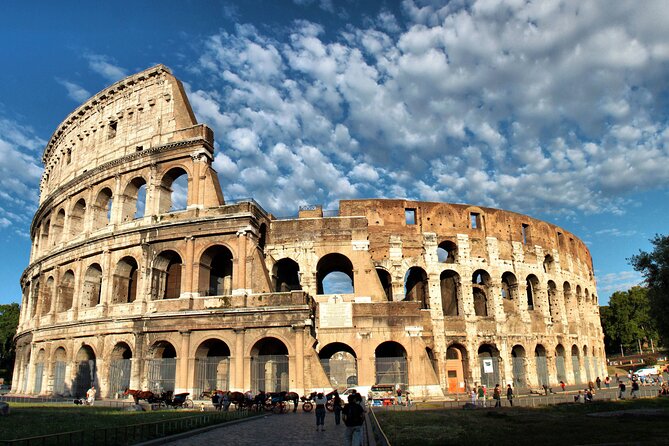
The Colosseum is huge, but what’s easy to miss is how intentional it is. Built under the Flavian emperors as the Flavian Amphitheatre, it’s an elliptical structure made of stone, concrete, and tuff, rising to four stories at its highest point. A good guide helps you connect those facts to what you see—where the crowd would have sat, how the building functioned, and why certain sections matter.
This tour includes entry to the Colosseum and the reservation fee tied to that access. In practice, that matters because the Colosseum draws long lines, and timing can make or break your day. When you get in on a reserved slot, you spend your Rome time inside, not stuck waiting outside.
You’ll meet at Caffè Roma, on Via del Colosseo 31 (00184), and the tour ends back at the same meeting point. It’s listed as starting within opening hours of 8:30 AM to 4:00 PM, Monday through Sunday, so you can plan around your other sights without guessing too much.
You can also read our reviews of more private tours in Rome



Colosseum interior: what to notice once you’re inside
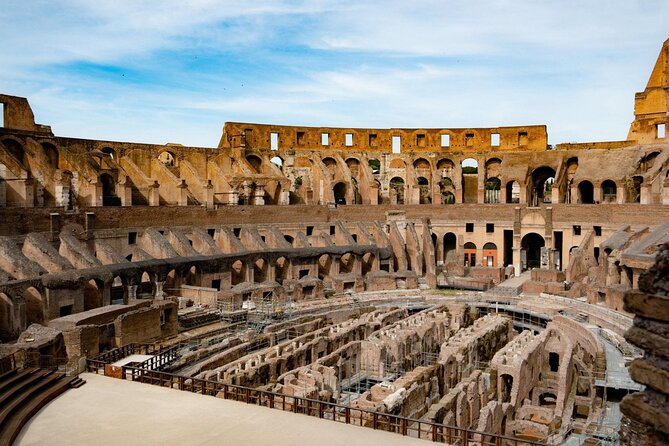
Inside the Colosseum, the space can feel confusing until someone gives you the landmarks. Your guide’s job is to turn the big shapes into a mental model. You’ll cover the Colosseum itself first, with enough time to register the scale and spot the elements that define how it worked.
A helpful sign this tour is built for real understanding: it doesn’t treat the Colosseum like a quick photo stop. You’re given time to orient yourself, then your route leads naturally toward the arena area where the story becomes physical.
If you’re the kind of traveler who likes to know what you’re looking at, this is the sweet spot. If you just want a fast highlights tour, you might feel the urge to speed up; but with a private format, your guide can usually adjust your pace to your group’s interest level.
Stepping onto the arena floor through the gladiator doors
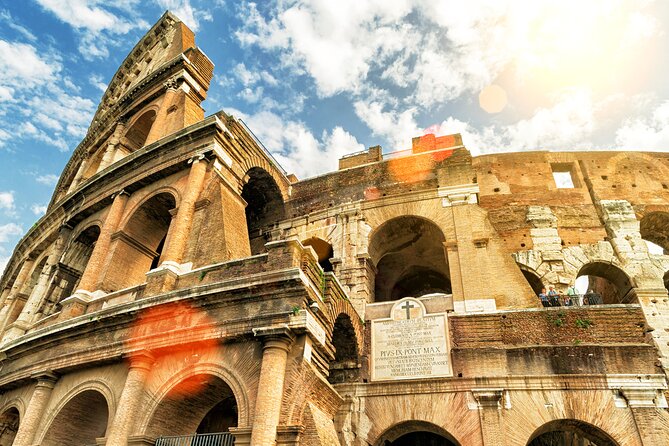
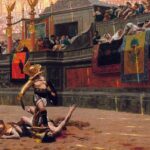
The arena is the moment most people remember. The word arena comes from Latin and means sand, because in ancient Rome the floor was covered with a layer of sand. That detail may sound small, but it changes how you picture the fights—this wasn’t a bare stone stage.
On this tour, you get arena time and you can enter through doors connected to the gladiators’ routes. Even if you don’t care about gladiator lore, the impact is real: the building suddenly feels like a machine built for spectacle, not just a monument.
Also, arena access is included as part of the Colosseum ticketing covered by the tour price (the ticket value is listed for Colosseum and Arena entry). That’s one of the clearest examples of what you’re paying for: not just a guide, but the access that can be hard to get.
Palatine Hill: where Rome’s power started to look like power
After the Colosseum, you head to Palatine Hill, Rome’s central hill among the seven hills of the city. The Palatine is often described as the first nucleus of the Roman Empire, and the on-site experience reflects that. Today it’s mostly an open-air museum, while the Palatine Museum houses finds from excavations here and from other ancient Italian sites.
This stop is also a great bridge between myths and real architecture. You’ll learn that imperial palaces were built here starting with Augustus, while before imperial times the hill was mainly occupied by the homes of the rich. In other words, it’s not just about emperors living lavishly—it’s about the shift from elite private space to state power.
Here’s a detail I love because it adds a mental map: the hill originally had two summits separated by a depression—Palatium (the higher part) and Germalus (or Cermalus). Even the scale is part of the story, with descriptions that use the Forma Urbis to enclose about 63 acres (25 hectares). It’s the kind of information that helps you walk and actually understand where you are.
Your Palatine Hill time is listed at about 45 minutes. That’s usually enough to get the big layout without rushing, especially with a guide pointing out what’s worth your attention.
Roman Forum: the civic center that made everyday politics real
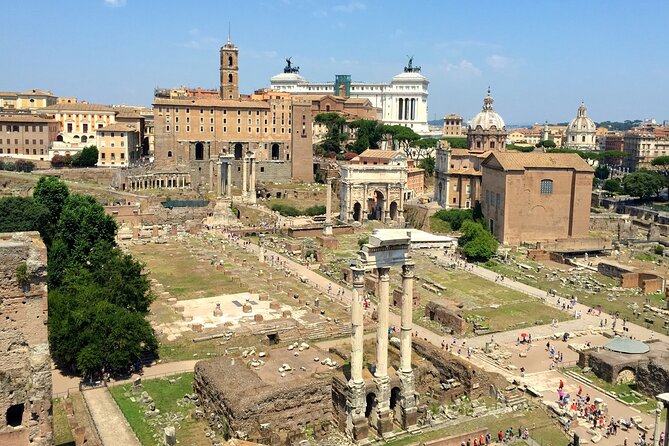
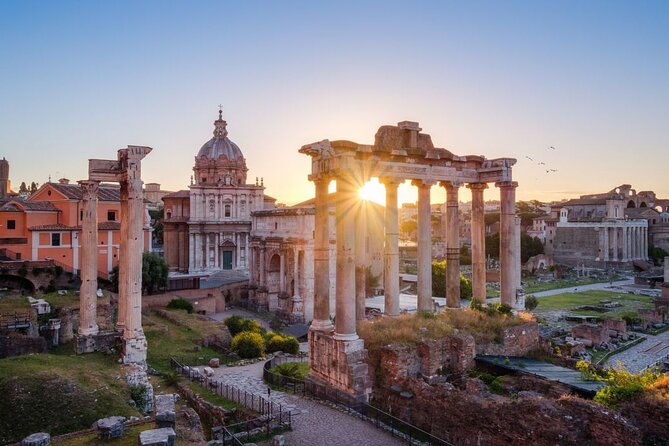
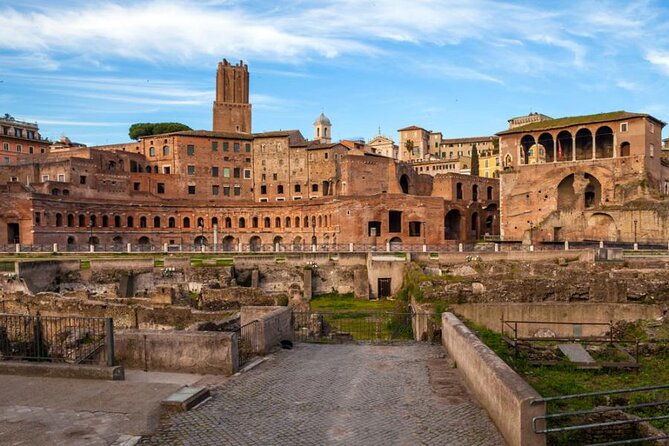
Then comes the Roman Forum, and this is where the ruins stop being just architecture and start feeling like a real city. The Forum was on low ground between the Palatine and Capitoline hills, and it served as a stage for public meetings and law courts. In republican times, it was also connected to gladiatorial combats, which shows how entertainment and politics overlapped.
Your Forum time is about 45 minutes, which is a practical amount for a walking-heavy stop. You’ll see how the Forum was lined with shops and open-air markets, so it’s not only temples and speeches. It’s also commerce and daily movement—people getting things done.
If you like stories about ordinary Roman life, this stop rewards you. A good guide can also help you avoid the common trap of seeing the Forum as one big pile of columns. With the right pointers, you begin to place each ruin in a bigger picture of how the city functioned.






Arch of Constantine: a short stop with big meaning
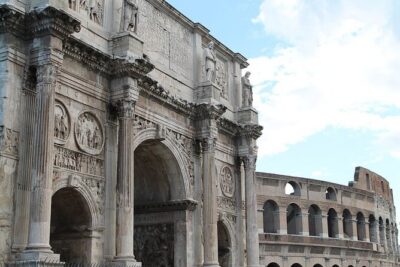
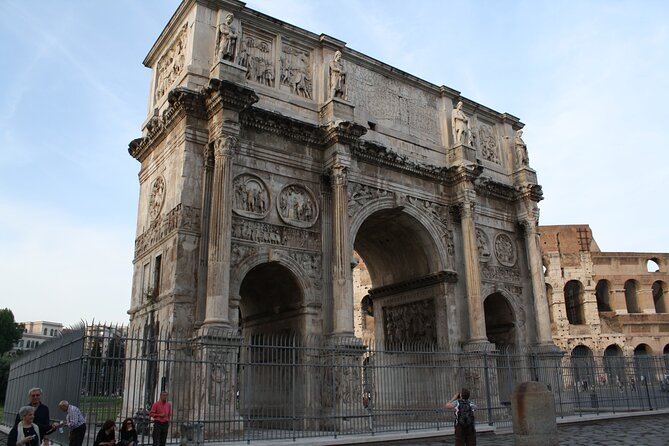
Between the Colosseum and Palatine Hill sits the Arch of Constantine, and you’ll pass it for about 15 minutes. It’s a triumphal arch dedicated to Constantine the Great and it spans the Via triumphalis, the route used by victorious military leaders when they entered Rome in triumphal procession.
This is a great breather in the route. It’s short enough that it won’t eat your time, but it adds a layer: you go from arenas and courts to state spectacle. In just a few minutes, it helps you see how Rome celebrated power in public space.
What makes this tour worth $300.37 per person
Let’s talk value without pretending it’s a bargain. At $300.37 per person for about 3 hours, this is a premium price. The tour is also explicitly private, and the included items help explain why.
Included in the price:
- Colosseum and arena entrance ticket (listed value €24 per person)
- Colosseum reservation fee (listed €2 per person)
- A private guiding service (and it’s offered in English)
- A mobile ticket
So part of what you’re buying is access. In the Colosseum, reserved entry isn’t just a convenience—it can be the difference between enjoying the visit and losing your day to line management.
The other part is time with a guide who can tailor pacing. That matters because the Colosseum, Palatine Hill, and Forum each reward different attention styles. One person might want architecture and dates; another might want how Romans lived and moved through the city. When a guide can adapt, you feel it fast, especially in a three-stop structure.
There’s also a note worth taking seriously: one experience mentioned in feedback said a private tour can sometimes end up feeling like a larger group than expected. That doesn’t change that the tour is sold as private, but it does mean you should confirm headcount for your specific booking and ask the provider how group size will work for your day.
Getting the smooth entry experience right: names, IDs, and pacing
This tour is picky about entry details, and that’s actually a good thing. You’ll need to provide full names of all travelers when booking. At the ticket office, everyone must present a valid passport or ID document that matches the name provided. If names don’t match, entry to the Colosseum and Roman Forum can be denied.
Also, this is listed as being near public transportation. You won’t need a long taxi ride just to get to the meeting point at Via del Colosseo 31. Still, give yourself time to find the exact spot and check in with the guide.
Physical side: the tour says moderate physical fitness is recommended. That usually means plan on steady walking, stairs or uneven steps around ancient sites, and a bit of standing. If mobility is a concern, it’s smart to ask questions before you book so you don’t end up with a frustrating day.
Should you book this skip-line private tour?
Book it if:
- You want a private guide and you’re happy paying more for time saved and better explanations
- You care about understanding what you’re seeing at the Colosseum, not just taking pictures
- You want a tight itinerary that hits Colosseum interior + arena, Palatine Hill, and the Roman Forum in about 3 hours
- You like the idea of arena access and the gladiator-door story detail
Consider something else if:
- You’re on a strict budget and don’t mind spending your time negotiating lines
- You want the sites with minimal walking and minimal talking
- You’re traveling with very small kids or mobility challenges, and you want a more accommodating route (you may need to ask the operator about options)
One extra thought: if underground access is on your must-do list, the operator notes that you can request adding the underground level after booking. If that matters to you, contact them early so you don’t end up disappointed on the day.
FAQ
What’s the duration of the Colosseum, Roman Forum and Palatine Hill skip line private tour?
It runs for approximately 3 hours.
Is this tour really private?
Yes. It’s listed as a private tour/activity, and only your group participates.
What language is the tour guide?
The tour is offered in English.
What stops are included during the tour?
You visit inside the Colosseum, the arena area, Palatine Hill, the Roman Forum, and you also pass the Arch of Constantine.
Are tickets included?
Yes. The Colosseum and Arena entrance ticket is included, along with the Colosseum reservation fee.
Can I add the Underground Level?
The information provided says the Underground Level is not included, but you can contact the provider after booking to add it.
Where do we meet, and where does the tour end?
You meet at Caffè Roma, Via del Colosseo 31, 00184 Rome. The activity ends back at the meeting point.
What do I need for entry to the Colosseum and Roman Forum?
You must provide the full names of all travelers when booking, and each traveler must show a valid passport or ID that matches the name on the booking voucher.
What should I know about timing and cancellations?
Tours run within the listed hours of 8:30 AM to 4:00 PM (Monday–Sunday). You can cancel up to 10 days in advance for a full refund.