REVIEW · ROME
Ancient Ostia Antica Semi-Private Day Trip from Rome by Train with Guide
Book on Viator →Operated by City Wonders Ltd · Bookable on Viator
Ostia Antica feels like a Rome timeout. This semi-private day trip trades big-bus chaos for a small group and a guided walk through one of Italy’s best-preserved Roman port cities. You’ll ride by train with your guide, then follow their storytelling along Decumanus Maximus, the Baths of Neptune mosaics, and the steep amphitheater. The payoff is clarity: the ruins make sense fast when someone connects the dots for you.
What I especially like is that the essentials are handled for you: round-trip train tickets and entry to Ostia Antica are included. You also get a relaxed pace, not a rushed highlight dash, because the group is capped at 12. One thing to keep in mind: this is still a walk through an ancient site with uneven ground and some stairs, so you’ll want moderate fitness and a willingness to move at street level.
You meet the group near Piramide metro, and the tour starts at P.za Ostiense 11. From there, the guide keeps everyone together on the train and steers you straight to the parts that explain how people actually lived in a working Roman city.
In This Review
- Key things that make this tour work (and not feel like homework)
- Train logistics from Rome: the smooth part you’ll actually appreciate
- Getting inside Ostia Antica: why a guide changes everything
- Decumanus Maximus walk: the spine of the ancient city
- Baths of Neptune and mosaics: where Roman comfort shows up
- The amphitheater: Roman drama without the stadium hype
- Forum spaces, temples, and everyday buildings you can actually imagine
- How the 2.5-hour walk stays manageable
- Price and value: what you’re paying for beyond the headline $59.26
- What your guide experience can feel like on real days
- What to bring and how to make the day easier
- Can you treat this as a Pompeii alternative?
- Should you book this Ostia Antica train day trip?
- FAQ
- Where do we meet for the tour in Rome?
- How long is the Ostia Antica portion of the tour?
- Is the train ride included?
- What’s included in the price?
- Is there a fitness requirement?
- What if weather is bad?
Key things that make this tour work (and not feel like homework)
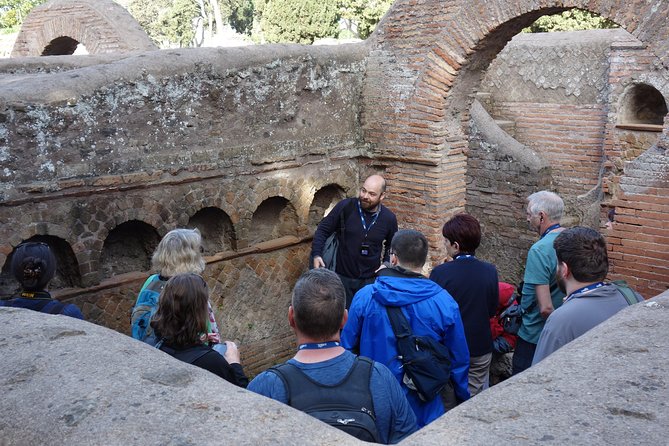
- Small group, max 12: easier questions, less waiting around, and a more human pace
- Train-and-guide combo: less planning stress and fewer chances to miss the right stop
- Included tickets: no last-minute surprises for entry or transport
- Ostia’s “daily life” focus: shops, apartments, baths, forum spaces, and street layout
- Heat-smart on-site breaks: guides often manage shade and pacing on hot days
Train logistics from Rome: the smooth part you’ll actually appreciate
The best part of this tour is how little you need to figure out. You start in central Rome at P.za Ostiense 11, and your guide meets you near the Piramide metro area before you head onto the train together. That matters because train rides can be simple in theory but stressful in practice, especially when you’re matching platforms and timing after a long morning of sightseeing.
The schedule is built for a half-day rhythm. The total time is about 4 hours, and once you’re at Ostia Antica you’ll get about 2.5 hours of walking with your guide. You’re not trapped there for a full day, and you’re not stuck doing a quick drive-by either.
You’ll also be traveling by the most Rome-friendly transportation style: rail. That gives you two wins. First, it keeps the day moving. Second, it means you’re not fighting local traffic or parking hassles.
You can also read our reviews of more guided tours in Rome



Getting inside Ostia Antica: why a guide changes everything
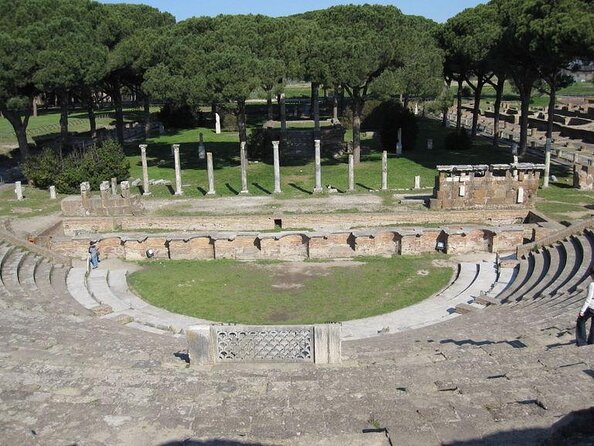
Ostia Antica is sometimes compared to Pompeii, but that comparison is mostly about the “you can still walk through it” feeling. What makes Ostia special is how it reads as a port city. This wasn’t a single-temple site or a scenic ruin. It was a working urban machine serving ancient Rome.
Your guide’s job is to keep you from getting lost in the scale. The site stretches out, and if you wander alone you can end up treating everything like random pretty stone. With a guide, you’ll understand why certain streets and buildings matter, and what you’re looking at when you see mosaics, forum spaces, baths, shops, and living quarters.
It’s also the kind of site where details matter. The ruins are well preserved, including structures dating back as far as the 4th century BC, and Ostia once had over 100,000 residents. A guide helps you mentally rewind from ruins back to a real neighborhood full of people moving through streets, visiting baths, trading in shops, and meeting in public spaces.
Decumanus Maximus walk: the spine of the ancient city
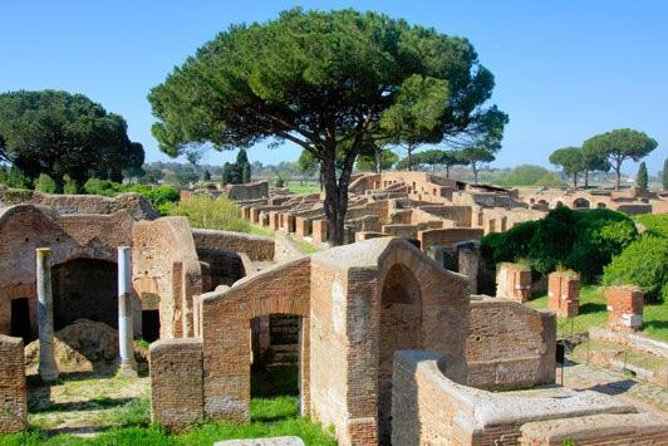
Your guided walk follows the main street, Decumanus Maximus, and it’s the right place to start. This is where the city layout becomes clear. You see how movement worked in an active port town: straight-line street planning, shopfront rhythms, and the way public buildings cluster along the main thoroughfare.
As you walk, you’ll spot Roman statues placed along the route and learn how the town functioned beyond the flashy big-ticket imagery. The guide talks through the street-life logic so it doesn’t feel like a museum aisle. Instead, it starts to feel like a place where people had errands, routines, and social habits.
There’s also a practical benefit. This street-centered structure keeps the tour organized. You get the sense that you’re covering the city in a meaningful order, not jumping around to whatever is nearest.
Baths of Neptune and mosaics: where Roman comfort shows up
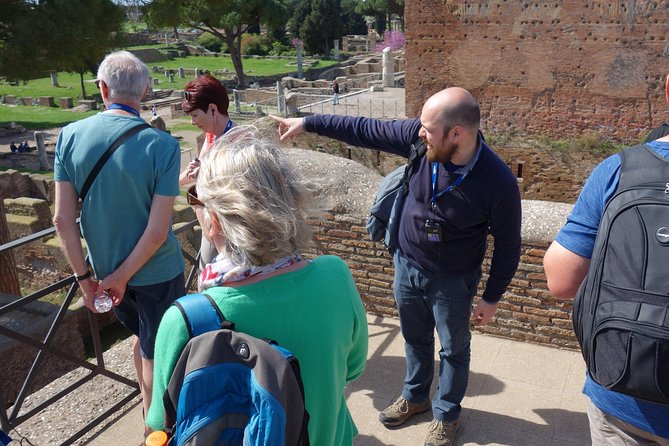
If you like your Roman history with color and texture, the Baths of Neptune are a highlight. You’ll see the bath complex and learn about the mosaic that depicts the sea god and a four-horse chariot scene.
What I like about this stop is that baths weren’t just hygiene. In Roman life, they were entertainment, meeting space, and a daily social hub. When you connect the building to that routine, the ruins stop being only archaeological objects. They become practical: this is where people relaxed, talked, and spent time.
The bath stop also gives you a visual “anchor.” Even if you forget street names later, you’ll remember the mosaic imagery and the feeling of stepping into a place designed for leisure and public life.
The amphitheater: Roman drama without the stadium hype
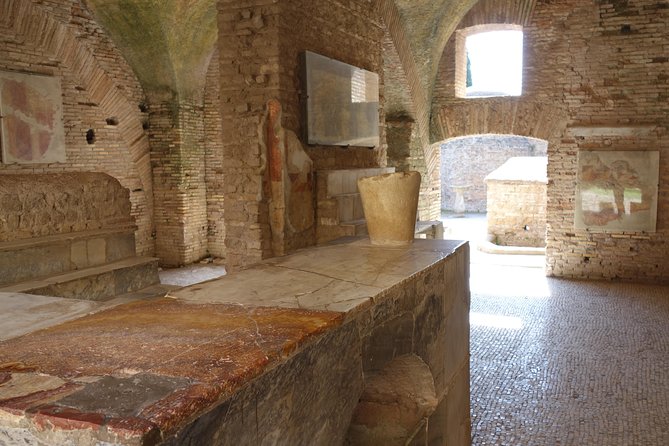
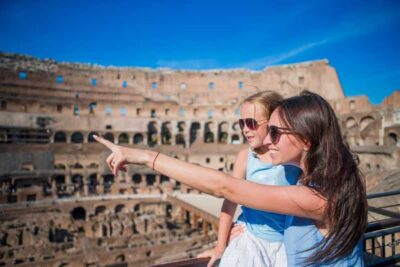
Ostia’s amphitheater is a standout, and your guide helps you read it. It’s steep and built for viewing action. It dates back to 12 BC and was made to hold around 3,500 spectators.
On your visit, you’ll take photos from the amphitheater and get context for why an entertainment venue mattered in a port city. People didn’t live for only trade and work. They needed distraction. They needed communal events. A venue like this turns Ostia into a city with shared culture, not just shipping traffic.
One more useful point: the amphitheater gives you a natural pause in the walking rhythm. Even if the whole site feels busy, this area helps you reset and reorient.
You can also read our reviews of more private tours in Rome






Forum spaces, temples, and everyday buildings you can actually imagine
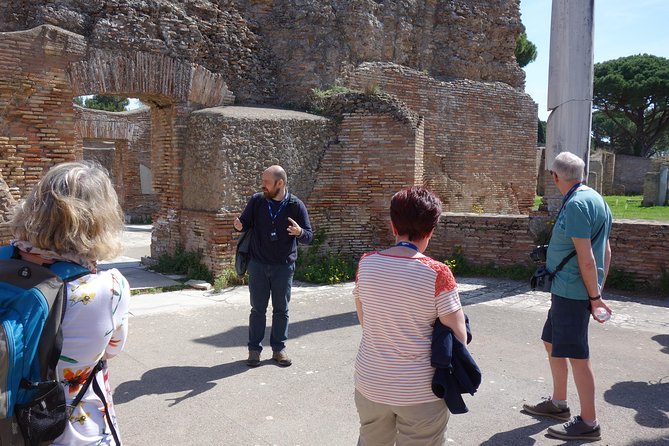
Ostia doesn’t only have monuments. It has the things that make a city feel human: practical public spaces and the smaller buildings that supported daily life.
Your guided walk includes or references key areas such as the Forum of the Corporations and the Collegiate Temple, along with taverns and public baths. You’ll also see ruined shops and apartment-style living quarters.
For me, this is where the guide really earns their pay. Roman cities can feel like a list of structures until someone explains the roles. With a guide, you start to see a pattern: where people gathered, where workers and traders did business, where civic-religious life intersected with daily routines, and how entertainment and leisure fit in.
This is also why Ostia is a strong choice if you don’t have time for Pompeii. You still get big ruins, but the focus leans toward how a real Roman city functioned week after week.
How the 2.5-hour walk stays manageable
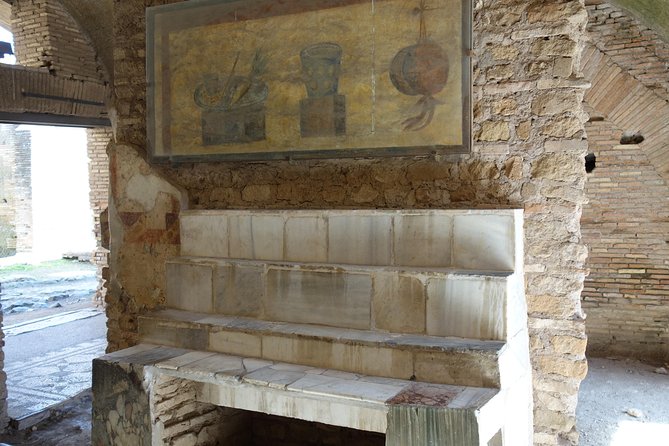
The tour is about keeping your feet moving without turning it into a slog. You’re on site for around 2.5 hours, which is long enough to understand the layout but short enough to stay comfortable, especially if you pace yourself.
That said, plan for physical reality. Expect walking on uneven ground, some stairs, and frequent short transitions between points of interest and viewpoints. Your comfort will depend on your pace and your tolerance for steps.
There’s also the transfer rhythm of any train day. You’ll get on and off the train with the group, which takes coordination even when everything runs smoothly. A guide helps by keeping you from getting “branch lost” while everyone figures out where to stand.
If you’re traveling with kids or teens, this time window often works well. It’s long enough to learn real context, and short enough that attention usually doesn’t evaporate before the best ruins.
Price and value: what you’re paying for beyond the headline $59.26
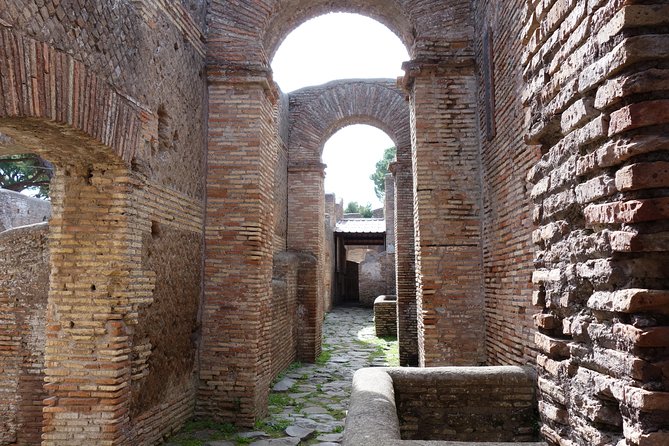
At $59.26 per person, this is priced like a guided half-day with transportation and entry bundled in. That bundle is the value engine.
Here’s where the math starts to make sense for many people:
- Train tickets are included, so you’re not hunting schedules or buying separate transport last minute
- Ostia Antica entry is included, which helps you avoid separate ticket lines and decisions
- English-speaking guide plus a small-group cap means you’re buying time with someone who can connect ruins to everyday life
If you tried to DIY the day, you’d still spend money on transport and entry. The difference is time and clarity. This tour reduces both. You trade a bit of freedom for a smoother flow and a guided explanation that makes the place easier to appreciate.
Also, the semi-private setup matters. Being in a group of up to 12 usually means fewer waits and more chance to ask a question without shouting.
What your guide experience can feel like on real days
Guides vary, but the tour’s format is designed to keep things on track: meet up, board together, walk as a unit, then head back. You’ll notice how different guides handle pacing in heat, and you’ll be glad when the tone is practical.
From past experiences with guides on this kind of route, the best ones tend to do two things well: explain Roman daily life in plain language, and manage shade or standing spots when it’s hot. Some guides are known for being especially warm and patient while still keeping the group moving.
A few guide names that come up with strong praise include Alberto, Laura Luongo, Barbara, Cat, Eduardo, Rob (and Roberto), Liv, Caterina, and Alfredo. If you’re the type who likes a guide with energy and a talent for answering questions, these names are worth keeping in mind when your booking details show who you’ll have.
If you want a slower pace for mobility or comfort reasons, it’s smart to take the site’s walking reality seriously. The tour is moderate fitness, and a fast guide can feel rushed at uneven ruins.
What to bring and how to make the day easier
This is an outdoor ruin walk, often in bright sun. Even without a forecast in front of you, assume you’ll need the basics.
Bring:
- comfortable walking shoes with grip
- a hat and sunscreen
- water (and plan for where you can refill; the guide may point out practical water options)
- a light layer in case the shade feels cool
If you’re traveling with teens, the tour time is often a sweet spot. Many people like pairing it with a relaxed add-on after the tour, since Ostia’s area can include easy coast time later on.
One small admin note: if children under 18 are in your party, they might be asked for an ID card at the entrance. Bring it so you don’t get stuck on the wrong side of a rule.
Can you treat this as a Pompeii alternative?
Yes, and that’s one of the smartest reasons to book. If Pompeii is too far, too crowded, or too time-consuming, Ostia Antica hits a similar emotional note: you walk among substantial ruins and you can imagine the texture of daily life.
But Ostia also has its own identity. It’s the port city story. It’s about movement, commerce, and a working city serving ancient Rome. When you stand in the right street layout and understand the role of buildings like baths, forums, and the amphitheater, the comparison to Pompeii becomes less important.
Instead, you get a clearer sense of Roman urban life beyond famous emperors and gladiator stories.
Should you book this Ostia Antica train day trip?
Book it if:
- you want a half-day with real guidance, not a quick “see it and run” outing
- you prefer a small group and a paced walk through the main highlights
- you like the idea of understanding how Romans lived day to day, not just admiring ruins
Skip or think carefully if:
- you need a very slow, step-by-step pace due to mobility limits
- you want total freedom to wander without a set route (this tour is structured, and the guide keeps you moving)
My bottom line: for the price, the included train and entry make this a tidy, low-stress way to see a major ancient site without burning your whole day. If you’ve been overloaded by Rome crowds already, Ostia’s layout and the guided context can feel like a reset.
FAQ
Where do we meet for the tour in Rome?
You meet near P.za Ostiense, 11, 00154 Roma RM, Italy, and your guide meets the group near the Piramide metro station before heading to the train.
How long is the Ostia Antica portion of the tour?
The guided walk at Ostia Antica is about 2.5 hours, within an overall trip time of about 4 hours.
Is the train ride included?
Yes. Your tour includes round-trip train tickets between Rome and Ostia Antica.
What’s included in the price?
The price includes an English-speaking guide, train tickets to and from Rome, semi-private group entry with a maximum of 12 travelers, and Ostia Antica entry tickets.
Is there a fitness requirement?
Yes. The tour notes a moderate physical fitness level is recommended due to walking around the archaeological site.
What if weather is bad?
The experience requires good weather. If it’s canceled due to poor weather, you’ll be offered a different date or a full refund.