REVIEW · ROME
Vespa Scooter Night Tour in Rome with Professional Photographer
Book on Viator →Operated by RomeIsmylove Vespa tour in Rome with professional photographer 🛵📸🇮🇹 · Bookable on Viator
Rome looks different after sunset. That is the fun here: you cruise key landmarks on a Vespa, then stop for pro photos in dramatic evening light. You also get a fast, low-stress route that avoids the worst daytime crush, while still hitting the hits.
Two things I like a lot: the professional photo setup (you’ll get 25–50 high-quality pictures taken during the tour) and the night riding pace that lets you cover a lot without exhausting your feet. Guides like Karim and Fabio are praised for being funny, friendly, and good at getting people into position for photos.
One consideration: this is built around short picture-and-view stops, so don’t expect a deep, timed walk through every interior monument. If you want inside access, you may need separate tickets for that part.
In This Review
- Key things to know before you go
- Why a Vespa Night Tour Works So Well in Rome
- Meeting at Via del Colosseo: Helmets, Small Groups, and a Photo Plan
- Colosseum at Night: Your First Photos and the Big “Wow” Moment
- Circus Maximus and the Aventine- Palatine Story You Can Actually See
- The Keyhole of Rome at Piazza dei Cavalieri di Malta
- Bocca della Verità: The Marble Mouth With a Big Myth
- Piazza Venezia, Pantheon Nights, and the Walk You Didn’t Have to Plan
- Trastevere at Night: Cobblestones, Church Facades, and a Real Roman Feeling
- Janiculum Hill Finale: Fontanone and the Terrazza del Gianicolo Views
- Price and Value: What $90.11 Gets You (and What It Doesn’t)
- Who This Tour Fits Best (and Who Might Want Another Option)
- Book It or Skip It: My Decision Advice
- FAQ
- FAQ
- How long is the Vespa scooter night tour?
- Where do we meet, and where does the tour end?
- Is the tour offered in English?
- What’s the group size?
- Are photos included, and how many do you take?
- What photo equipment is used?
- Do I need to bring a helmet?
- Are entrance tickets to monuments included?
- Are food and drinks included?
- Can I cancel for a refund?
Key things to know before you go
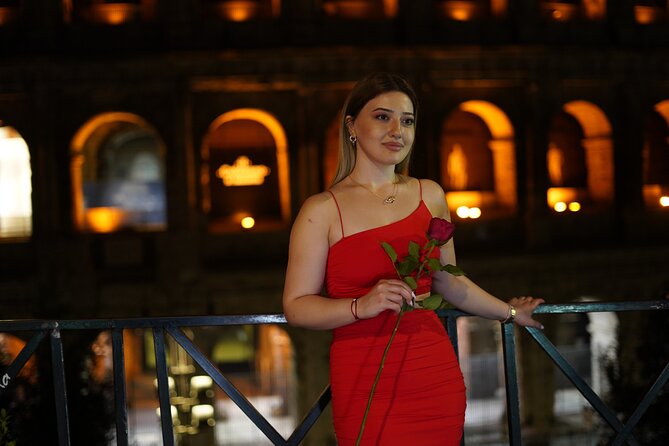
- 25–50 professional photos included using a Sony Alpha 7 IV, plus direction so you get good angles
- Small group size (max 10) for a more controlled, easier-to-manage ride at night
- Helmet + hygienic caps are included, which matters when you’re moving quickly through traffic
- A smart night route: Colosseum, Keyhole view, Bocca della Verità, Pantheon, Piazza Navona, Trastevere, plus hilltop views
- Hilltop finale at Janiculum with Fontana dell’Acqua Paola and major city panoramas
- Free-standing sights more than inside tours, so plan for what you’ll see from outside
Why a Vespa Night Tour Works So Well in Rome
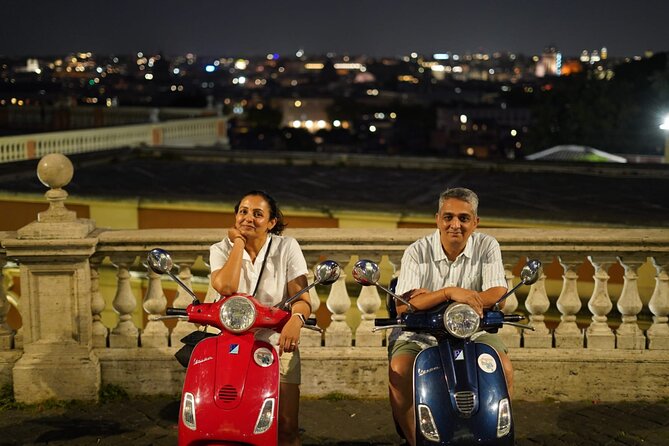
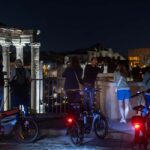
Rome at night has a different mood. Street noise changes, lights hit stone in a more flattering way, and the crowds thin enough that you can actually enjoy a view instead of fighting for one. This tour leans into that. You cover big icons fast, but you still pause long enough for photos and real looking.
The Vespa part isn’t just a novelty. It’s practical. Rome is made for slow wandering, but that gets hard when you try to do everything in one day. A Vespa lets you “move the map” for a shorter time, then spend your energy on the best stops.
I also like the clear focus: this isn’t a long lecture tour. It’s a night ride with stories tied to places you can see right then. One review even notes the guide built in personal touches like singing the state song Oklahoma, which says a lot about how the ride feels—more like hanging out with someone who knows the city, not reciting facts.
You can also read our reviews of more evening experiences in Rome
Meeting at Via del Colosseo: Helmets, Small Groups, and a Photo Plan
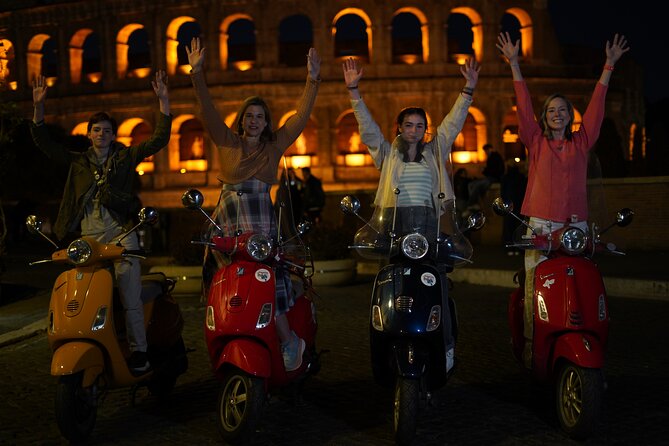
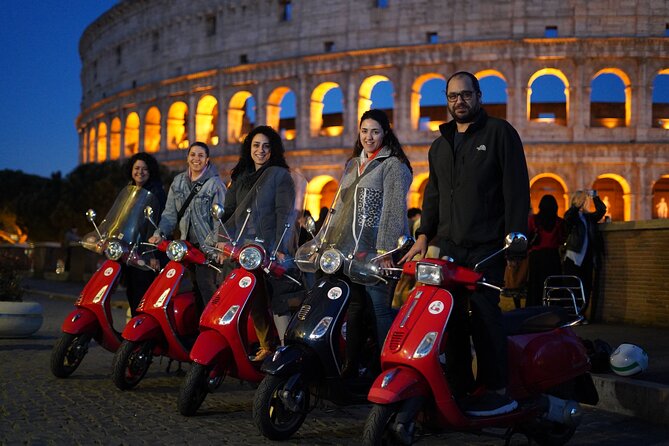
You meet at Via del Colosseo, 31, and the first major moment happens right by the Colosseum. There is a note that the meet point is the Colosseo itself, so you gather in front, do an initial photo session, then head out on the historical route.
The setup is geared for smooth moving. You get helmets, and there are also hygienic caps included. That’s a small detail, but it makes the ride feel more comfortable, especially if you’re with kids or you just don’t love touching shared gear.
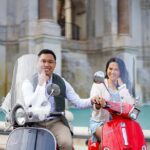
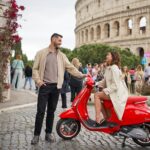
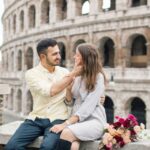
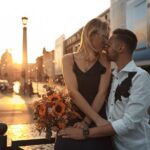
The photo plan is a big part of the value. The included camera is a Sony Alpha 7 IV, and the experience includes 25–50 high-quality photos taken during the tour. In practice, that means you’re not constantly stopping and fiddling with your own phone. The photographer directs where to stand and how to frame your group—something many people praise as making the pictures actually look good.
Your group is also kept small: up to 10 travelers. That matters at night. Less crowding at viewpoints, fewer bottlenecks on sidewalks, and a better chance that your guide can adapt if someone needs an extra minute.
Colosseum at Night: Your First Photos and the Big “Wow” Moment
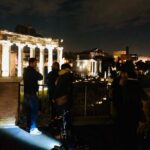
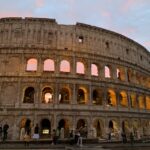
The Colosseum is the headline, and the night version is a different attraction than the daytime circuit. Illuminated stone reads more dramatic after dark. Arches and remaining structures look sharper, and the whole place feels quieter, more personal.
Here’s what to expect on this tour: you start at the Colosseum area and have a photo session immediately, then you continue along the route. The stop is listed at about 15 minutes, and the admission note says the ticket for this stop is free.
That time window is perfect for orientation. You get the “front page” perspective without spending half your evening waiting around. The only caution: this format is more about seeing and photographing from the outside. If your dream is a full internal visit, this isn’t that kind of tour.
Still, even from outside, this is a strong way to begin your Roman night. It sets the tone for the rest of the ride: light, scale, and those classic angles you can’t easily recreate on your own.
Circus Maximus and the Aventine- Palatine Story You Can Actually See
After the Colosseum, you move to Circus Maximus, the ancient chariot racing venue in the valley between the Palatine and Aventine Hills. This is one of those sites where your brain wants to picture crowds and motion, but on your own you might not know where to look.
This tour helps you connect the physical space with what happened there. Circus Maximus wasn’t just entertainment—it hosted major public spectacles and religious ceremonies, and it once held over 150,000 spectators. Now it’s an archaeological site. You don’t need to be a scholar to sense the scale. You just need a guide to point out the right cues.
The stop is short, like most of the stops on this ride, but it’s still worth it. The benefit of a Vespa route is that you see the city’s “main beats” without getting bogged down. Circus Maximus is a beat people often skip, yet it’s right there for you at night.
A practical consideration: this is a moving night tour, so wear comfortable shoes. You’ll likely do some walking on uneven surfaces near historic areas.
The Keyhole of Rome at Piazza dei Cavalieri di Malta
One of the most photo-friendly stops on this tour is Piazza dei Cavalieri di Malta, where you’ll find the famous Keyhole of Rome view—framed through the gate associated with the Order of Malta. The view aims toward St. Peter’s Basilica in the distance.
What makes this stop work at night is simple: the framing feels even more intentional when the background is dark and the city lights give depth. It’s also a cool contrast to the big open monuments. Here, the star is not size—it’s precision.
The stop time is about 15 minutes. That’s just enough to find the spot, take your photos, and move on before it turns into a long wait. The admission note says free, which lines up with what you’ll likely do here: you’re observing and photographing the view, not paying for a guided interior tour.
If you love quirky Rome photography—angles that look like they were planned—that is the kind of stop that makes a night tour feel worth it even if you already saw Rome once.
You can also read our reviews of more photography tours in Rome
Bocca della Verità: The Marble Mouth With a Big Myth
Next is la Bocca della Verità at the portico of Santa Maria in Cosmedin. This enormous marble mask is known for the legend that it bites the hand of those who lie.
This is one of those places where the myth is bigger than the physical object. Night makes it feel even more like a prop in a story. The tour stop is not described with an exact time here, but it’s clearly treated as a quick, fun cultural moment on your ride.
What’s good for you: it’s recognizable, it’s different from the major monuments, and it adds a playful break between heavier sites. What’s not: it’s not a deep museum stop. Think of it as a snapshot of Rome’s folklore and public imagination.
Piazza Venezia, Pantheon Nights, and the Walk You Didn’t Have to Plan
From the historical route, you reach Piazza Venezia, a classic square anchored by big monuments and surrounded by historic buildings. The tour also calls out the connection to shopping street energy, including seeing Via del Corso from across the square.
This is a useful moment because it gives your brain a map. You start to feel how Rome’s grid of major roads and viewpoints connects. Even if you don’t shop that evening, it helps you understand where things sit.
Then comes one of the best night monuments: the Pantheon. At night, the façade and entrance glow in warm light, and the scale feels even more dramatic because you’re not competing with midday glare. There’s also mention that the interior is visible through the open doorway, so you might catch glimpses inside without committing to a long visit.
After that, you’re in Piazza Navona. Night lighting brings out the Baroque details, and the fountains are the focus—especially Bernini’s Fountain of the Four Rivers. The square often has street artists, musicians, and vendors, plus cafes and restaurants around the edges.
The benefit of this tour’s structure: you don’t have to decide in advance how to link these sites. You ride, you stop, you photograph, you move. If you try to do this by yourself at night, it can be harder than it looks to keep the momentum.
A fair drawback: night pictures can be tricky if you’re trying to shoot on your own at the same time. Since the photographer is included, let them do the positioning so you get the shots you’re paying for.
Trastevere at Night: Cobblestones, Church Facades, and a Real Roman Feeling
The tour then moves to Trastevere, known for cobblestone lanes, medieval-style buildings, narrow alleys, and lively neighborhood squares. It’s also known for historic churches, including Basilica of Santa Maria in Trastevere, which dates back to the 4th century.
Trastevere is a smart choice late in the evening because it feels more like an area than a single attraction. You’re not just ticking boxes. You’re seeing how Rome lives after dark: street performances, musicians, and lots of food and drink options nearby.
The stop here is described as part of the evening experience rather than a “do one thing” attraction. That’s good. You get a sense of place. If you want to return later for dinner, you’ll know where you are.
The consideration: Trastevere’s streets are older and uneven. That’s not a deal-breaker, but it’s why the helmet-and-safety gear matters earlier. You’re still on a night route with some walking.
Janiculum Hill Finale: Fontanone and the Terrazza del Gianicolo Views
The last act is the big panoramic payoff on Janiculum Hill (Gianicolo). The tour includes two related stops, both around 20 minutes each.
First is Fontana dell’Acqua Paola, also called Fontanone. It’s a monumental fountain commissioned by Pope Paul V in the early 17th century. The design echoes ancient Roman architecture: a central arch with cascading water and two smaller arches on either side. The real reason you go is the view—this is where Rome opens up.
Then you climb to the Terrazza del Gianicolo for the high point of the night. This hill is described as the highest hill in Rome, and the tour strongly emphasizes the view. Janiculum is also said to have tree-lined pathways, gardens, and monuments such as statues of Garibaldi and Anita, tied to Italian unification.
If you care about photographs, this is the moment that makes the earlier stops pay off. You go from monument-to-monument shots to citywide skyline photos. It’s also a great time to slow down. You can stand, look, and let the lighting do its work.
Practical tip for this section: you’ll likely want to keep your phone battery ready. Night views eat battery fast.
Price and Value: What $90.11 Gets You (and What It Doesn’t)
At $90.11 per person, this tour is priced in the range where you’re paying for more than sightseeing. You’re paying for three main things:
- Transportation and energy
The Vespa ride covers ground quickly, which is valuable if you don’t want to manage routes and logistics on your own.
- Safety and gear
Helmets and hygienic caps are included. That’s part of why the ride feels manageable.
- A real photo package
The biggest value lever is the included photographer and the 25–50 high-quality images shot on a Sony Alpha 7 IV. If you’ve ever done Rome with only your own camera, you know how often photos come out blurry, badly framed, or half-cropped.
What’s not included matters too:
- Entrance tickets for monuments are not included, and the experience is not described as a guided interior tour of monuments.
- Food and drinks aren’t included.
- Tips are optional.
So here’s the honest way to weigh value: if you want night views plus a professional photo set, this price makes sense. If you only want to see exteriors and you’re happy taking your own photos, it might feel pricier than you expect. But the whole point is that you’re buying time, guidance, and better pictures without extra effort.
Also, some stops list free admission tickets, so you likely won’t pay a ticket at those moments. Still, if you want to go inside certain sites, plan for that separately.
Who This Tour Fits Best (and Who Might Want Another Option)
I think this works best for:
- First-time visitors who want a fast, well-paced route without planning every turn
- People who care about photos and want them done right, not just taken
- Families and groups who want a fun night activity that still includes structure
- Anyone who’s been walking all day and wants a change of pace without giving up major landmarks
One of the reviews highlights that the ride felt safe for a young son, and guides were patient with directing portraits. That points to a tour style that feels organized even when it’s playful.
Who might skip it:
- If you want a long, in-depth museum-style visit inside multiple monuments, this isn’t that format.
- If you strongly dislike scooters or you have safety concerns with helmets and night riding, you should pick a walking-based night tour instead.
The tour also runs in English, so it’s straightforward for English-speaking visitors.
Book It or Skip It: My Decision Advice
If your goal is an efficient Rome night with dramatic sights, directed professional photos, and a relaxed ride pace, I’d book this. The mix of Colosseum, Keyhole Rome, classic centers like Pantheon and Piazza Navona, plus the hilltop finale at Janiculum is a strong route for one evening.
I would skip it only if you’re chasing deep interior access and long guided entry times. This experience leans toward seeing, photographing, and moving—more best-of Rome night than slow, inside-the-details sightseeing.
If you’re unsure, look at your priorities like this: do you want the city’s biggest icons at night and photos that actually look like you planned them? Then this is a yes.
FAQ
FAQ
How long is the Vespa scooter night tour?
It runs about 1 hour 30 minutes to 2 hours (approx.).
Where do we meet, and where does the tour end?
You meet at Via del Colosseo, 31, 00184 Roma RM, Italy. The activity ends back at the meeting point.
Is the tour offered in English?
Yes, it’s offered in English.
What’s the group size?
The tour has a maximum of 10 travelers.
Are photos included, and how many do you take?
Yes. The tour includes a professional photo session, with 25–50 high-quality pictures taken during the experience.
What photo equipment is used?
The included equipment is a Sony Alpha 7 IV.
Do I need to bring a helmet?
No. Helmets are provided, and hygienic caps are included as well.
Are entrance tickets to monuments included?
Entrance tickets to monuments are not included. The itinerary notes some stops with free admission tickets, but the tour is not described as providing paid monument entry.
Are food and drinks included?
No. Food and drinks are not included.
Can I cancel for a refund?
Yes. Free cancellation is available up to 24 hours in advance for a full refund.