REVIEW · ROME
Rome: E-Bike Tour of Appia Antica, Aqueducts, and Caffarella
Book on GetYourGuide →Operated by Rome in a Day Tours · Bookable on GetYourGuide
Pedal through Rome’s ancient countryside instead of queues. I love how this ride links Appia Antica relics with aqueduct engineering and then swaps city noise for the calm of Caffarella Valley, all in about four hours. I also like the small group size (up to 8) and the fact that the e-bike does the heavy lifting on uneven, historic ground. One drawback: you need to be comfortable riding a bike, and the tour runs rain or shine.
You start by Circus Maximus (yes, the chariot-race giant), then gradually move from major Roman landmarks into parkland and country-style paths. The whole point is getting you out of the grid and onto the roads and routes Romans actually used—only this time, you’re doing it with a modern electric assist.
In This Review
- Key highlights worth planning around
- Why Appia Antica still feels like time travel
- Getting started at Circus Maximus: the tour’s smart “warm-up”
- Caracalla Baths and Porta San Sebastiano: Rome’s water and walls
- Quo Vadis, catacombs views, and the cemetery-era Appian Way
- Tomb of Cecilia Metella and the villas: roadside Rome in miniature
- Porta San Sebastiano to Parco degli Acquedotti: water system engineering up close
- Caffarella Valley by e-bike: horses, shade, and Egeria’s nymphaeum
- Timing, pace, and what the 4 hours feel like
- E-bikes, safety, and what to wear on historic roads
- Price and value: what $88 buys you here
- Who should book this Appia Antica e-bike experience
- Should you book this Rome e-bike tour of Appia Antica, aqueducts, and Caffarella?
- FAQ
- What is the duration of the tour?
- How much does the tour cost?
- Where does the tour start?
- What’s the group size?
- What language is the guide?
- Does the tour run in rain?
- Do you visit the catacombs or just see them from outside?
- Is a bike ride skill required?
- What should I wear and bring?
- Is it suitable for kids or people with mobility issues?
- FAQ
- Can I cancel for a refund?
- Is there a payment option if I’m not sure yet?
- Are there photo stops and a break?
- What are the key areas the tour covers?
Key highlights worth planning around
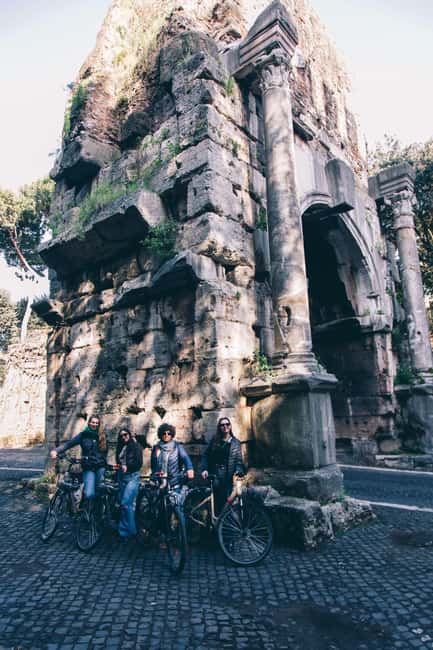
- Appia Antica’s stone-road atmosphere with tombs, villas, and roadside monuments explained as you roll past
- Aqueducts Park without the slog at a pace that lets you stop and look, not just pass through
- Caffarella Valley as a “near Rome” escape with grazing animals close to the city edge
- Safety-focused routing using crossings and quiet stretches, with the guide managing traffic when needed
- E-bike comfort where it counts for hills and bumpy sections that can feel slow on foot
- Stops that match the story—from water systems to walls to cemetery-era Rome
Why Appia Antica still feels like time travel
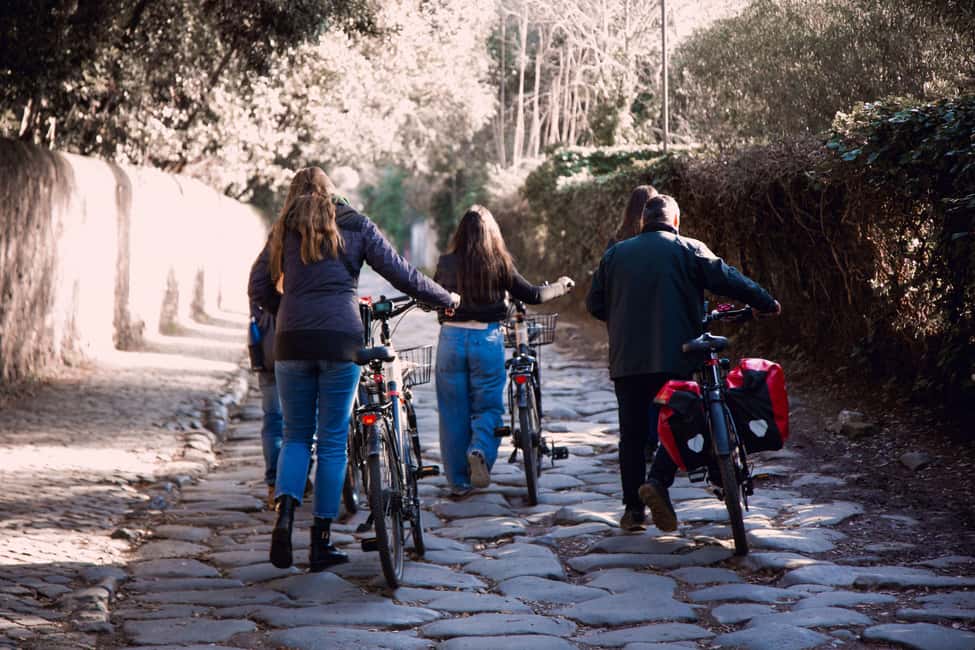
Appia Antica isn’t just another ancient road. It’s Rome’s oldest “major highway” idea made physical—started in 312 BC, linking Rome toward Brindisi—and it still carries that sense of purpose. What I like most is that the tour doesn’t treat it like a static photo spot. It treats the road as a living timeline: engineering, burial culture, and later Roman expansion all sit side-by-side.
There’s also a real modern lesson baked in. The Appia Antica Archaeological Park exists because Antonio Cederna—the archaeologist, urban planner, journalist, and politician—fought hard against postwar housing pressure that threatened to swallow the countryside. That matters to you because it explains why you can still ride here at all, instead of staring at a “maybe we’ll preserve it someday” site.
You can also read our reviews of more cycling tours in Rome
Getting started at Circus Maximus: the tour’s smart “warm-up”
The meeting point is Rome in a Day Tours (Electric Bike and Vespa Excursions), right in the Circus Maximus area. Plan to arrive about 15 minutes early so you can get fitted with the bike and handle the paperwork calmly. This short buffer helps a lot when everyone’s learning the e-bike controls and getting their footing before you head onto historic roads.
First up is a Circus Maximus photo stop. This is useful even if you’ve seen the Colosseum before, because it gives you a sense of Rome’s scale and crowd energy. Then you move into the Baths of Caracalla with another photo stop, setting the tone for Roman life powered by water, stone, and grand public works.
Caracalla Baths and Porta San Sebastiano: Rome’s water and walls
Caracalla’s Baths are a perfect lead-in because they’re part monument, part clue. They show how Roman “infrastructure” could be both practical and theatrical. From there, you shift toward Porta San Sebastiano, where the story tightens: fortification, movement into and out of the city, and the Aurelian Walls concept you’ll recognize throughout Rome’s perimeter.
This section is also where an e-bike makes the experience feel effortless. Even when you’re not going far in distance, you’re covering ground that would be slow on foot and awkward to stitch together with bus rides. You’re not rushing through. You’re building a mental map of how Romans funneled people and resources.
Quo Vadis, catacombs views, and the cemetery-era Appian Way
As the ride starts to settle into the Appian zone, you’ll stop at the Church of Domine Quo Vadis for a proper visit. This is a short window, but it’s an important one because it reminds you that the Appian Way didn’t end with Rome—it kept getting reinterpreted over centuries.
Then you pass by major underground and cemetery-area landmarks. The catacombs of Saint Callistus are one example: you see them from the outside rather than entering, which keeps the pace smooth and keeps the tour within a comfortable four-hour window. You also pass by sights like the Villa of Maxentius and other tombs clustered along the first stretch of Via Appia Antica.
This approach is valuable because it matches how you’ll actually experience the road on two wheels. You can’t park and “read” every monument like you would in a museum. Instead, you’re constantly getting context, so the roadside stone doesn’t feel random.
Tomb of Cecilia Metella and the villas: roadside Rome in miniature
A major reason people love this route is the concentration of recognizable “Roman big names” without the crush of central Rome. You’ll take a photo stop at the Tomb of Cecilia Metella, one of those structures you instantly understand as status. It’s also a great example of how burial culture shaped the visual geography of the Appian Way—ancient Rome literally built memory into the route you traveled.
You’ll also pass by other named sites in this early stretch (including places like the Tumulus of the Curiazi and Villa dei Quintili). The key is how your guide ties them together so they form a story instead of a list. When that connection clicks, the road feels like a corridor where each stop is a chapter.
One small consideration: some parts of the Appian Way are bumpy. That’s not a flaw—it’s part of the physical truth of the road—but it does mean you’ll feel the ride more than on modern paved streets. On an e-bike, it’s still comfortable for most capable riders, and it’s exactly the kind of “you can only get this by bike” moment that makes the experience worth it.
You can also read our reviews of more tours and experiences in Rome




Porta San Sebastiano to Parco degli Acquedotti: water system engineering up close
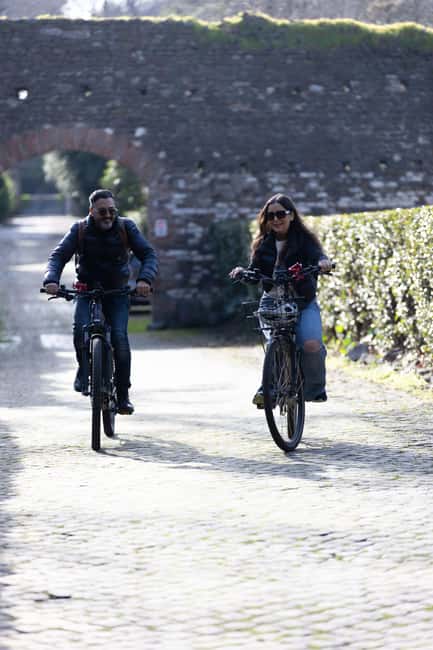
The ride into the aqueduct area is where the tour really earns its name. In the Parco degli Acquedotti, you’ll spend time visiting the ancient aqueduct structures and the surrounding area. This is not just a scenery break—it’s a chance to understand how Rome built and moved water at a city scale without modern pumps.
The water-system topic is set up earlier (you’re primed to notice how Rome’s power was often water power). Then, once you’re in the park, the structures stop looking like abstract ruins and start looking like a working network. That’s the value here: guided interpretation plus a layout that lets you actually see the system from the ground.
I also appreciate the timing. A 30-minute visit in the aqueduct park gives you enough time to take a few good stops and photos, without eating into the rest of the valley experience.
Caffarella Valley by e-bike: horses, shade, and Egeria’s nymphaeum
After the aqueducts, you’ll follow the route down into Caffarella Valley. This is the emotional payoff of the tour. Rome can feel loud and dense. Here, you’re in a calmer pocket where animals are part of the backdrop—horses, sheep, goats, and pigs are often close enough that they feel like part of the ride rather than distant “park decoration.”
You’ll spend about 30 minutes in Caffarella Park, which works well for getting a feel for the terrain and snapping photos in a less frantic environment. The tour also includes the Nymphaeum of Egeria, linked to the idea of a spring and sacred water tradition near a villa area. Even if you only catch the basics, it ties together the tour’s running theme: Romans treated water as sacred, practical, and architectural.
If you’re used to seeing Rome only from streets and viewpoints, you’ll love how this portion changes your pace and senses. It’s Rome, but it’s Rome at ground level.
Timing, pace, and what the 4 hours feel like
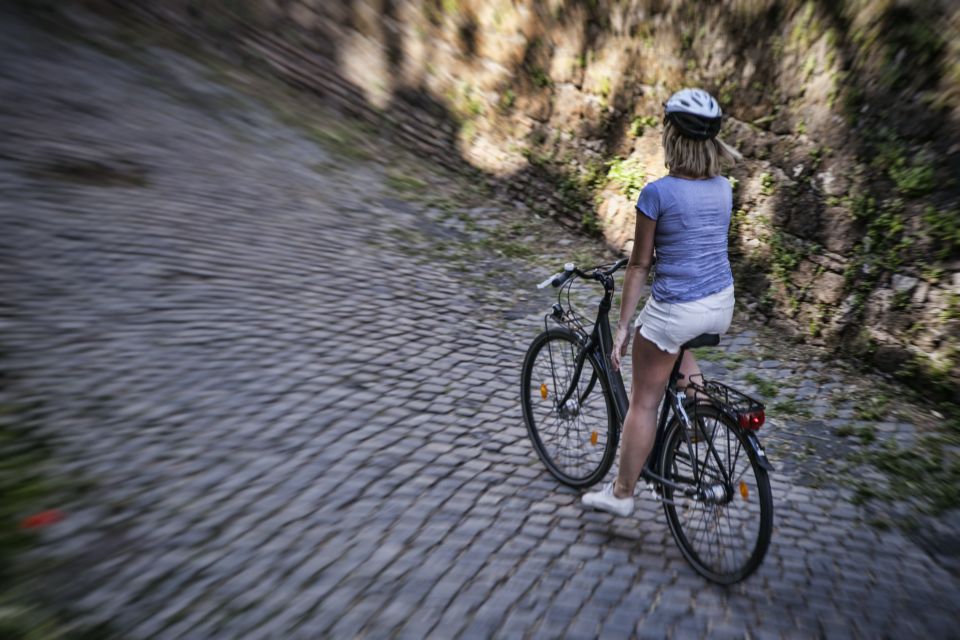
This is a tightly planned half-day: short photo stops and quick visits, with just enough time to move between major zones. You’ll see Circus Maximus (photo stop), Caracalla Baths (photo stop), Porta San Sebastiano (photo stop), Quo Vadis (visit), pass by catacombs and key monuments, take photos at spots like Villa di Massenzio and Cecilia Metella, then break at a local bar for about 20 minutes.
That break is more important than it sounds. It gives you a reset before the aqueduct park and valley, when you’ll likely want your eyes fresh for details and photos. People also appreciate the way the e-bikes make the pacing easier when you’re riding a route that includes bumpy historic surfaces.
And yes, you’ll cover enough ground that the tour feels efficient without feeling like a blur. That balance is where the tour shines.
E-bikes, safety, and what to wear on historic roads
This ride uses a company-owned e-bike fleet in good condition, and that matters. When bikes are well maintained and fully charged, your effort drops from “endurance ride” to “enjoy the views while your legs do less.” In particular, you’re going to be grateful on hills and rough sections where the assist keeps the ride from turning stressful.
Safety is handled in a practical way. The route is designed to keep you mostly away from cars, and when you hit busier crossing points, you use crossings or the guide may manage traffic so you can move through with confidence. That’s also why the guide matters. People mention guides like Monika and Adriana for both knowledge and careful pacing, including time taken to ensure comfort and safety during transitions.
What to bring is simple:
- Comfortable clothes
- Clothes you don’t mind getting a little dirty
- Closed-toe shoes
And remember: the tour runs rain or shine. If you’re the kind of person who gets grumpy when sidewalks are slick, plan for rain-day focus.
Price and value: what $88 buys you here
At $88 per person for about 4 hours, you’re paying for three things you’d otherwise have to cobble together on your own: an expert guide, an e-bike that makes difficult terrain manageable, and a route that connects major Appian and aqueduct areas without exhausting transit logistics.
You’re also buying time. This is one of those Rome experiences where the “best parts” are spread out. Doing it yourself by foot would take a lot longer and would likely force you into buses or taxis that break the continuity of the story. Here, you get the continuity—and you still get stops to look closely instead of just speeding past.
Is it a budget tour? No. But it’s also not pretending to be luxury. For the content you get—ancient road, water engineering, cemetery sites, valley scenery, plus real breaks—this price feels like value.
Who should book this Appia Antica e-bike experience
This fits best if you:
- Can ride a bicycle comfortably
- Want to see more than the usual “center of Rome” sights in one half-day
- Like a mix of monuments plus parks and nature
- Prefer small-group pacing and quiet roads over crowded bus tours
It’s also a great option if you want a break from Rome’s lines and walking-heavy days. One family-style group example included riders ages 14 and 16 who were competent cyclists, and they found the roads manageable with the guide’s careful routing. Just keep in mind the operator’s own rules: it’s not suitable for children under 12, not suitable for pregnant women, not suitable for people with mobility impairments, and not suitable if you can’t ride a bike.
Should you book this Rome e-bike tour of Appia Antica, aqueducts, and Caffarella?
I’d book it if your goal is a high-value Roman day that actually uses Rome’s geography instead of fighting it. The combination of Appia Antica monuments, Parco degli Acquedotti, and the Caffarella Valley feel like three different experiences stitched into one smooth ride. The e-bike makes the historic surfaces and countryside sections doable without draining you.
I would skip it if you don’t ride bikes confidently, hate riding in rain, or need a fully step-free experience. Also, if you want every stop to be a deep museum-style experience with long interior visits, this is more about moving through the landscape with context than lingering for hours.
If you’re in the middle—curious, active, and ready for a guided ride—this is the kind of Rome half-day that you’ll remember long after the photos fade.
FAQ
What is the duration of the tour?
The tour lasts 4 hours.
How much does the tour cost?
It’s listed at $88 per person.
Where does the tour start?
You meet at Rome in a Day Tours – Electric Bike and Vespa Excursions, in front of the Circus Maximus area.
What’s the group size?
The group is limited to 8 participants.
What language is the guide?
The tour offers live guiding in English and Dutch.
Does the tour run in rain?
Yes. It runs rain or shine.
Do you visit the catacombs or just see them from outside?
You pass by the catacombs area; the tour does not indicate an indoor visit.
Is a bike ride skill required?
Yes. You need to know how to drive a bicycle.
What should I wear and bring?
Wear comfortable clothes, clothes that can get dirty, and closed-toe shoes.
Is it suitable for kids or people with mobility issues?
It’s not suitable for children under 12, pregnant women, people with mobility impairments, or anyone who can’t ride a bike.
FAQ
Can I cancel for a refund?
Yes, you can cancel up to 24 hours in advance for a full refund.
Is there a payment option if I’m not sure yet?
Yes. You can reserve now and pay later.
Are there photo stops and a break?
Yes. There are multiple photo stops and a local bar break time of about 20 minutes.
What are the key areas the tour covers?
You’ll cover the Appia Antica area, aqueducts (including Parco degli Acquedotti), and Caffarella Park/Valley, along with major monuments along the way.