REVIEW · ROME
Private Electric Tuk Tuk Tour in Rome
Book on Viator →Operated by Pal.Mar. srl · Bookable on Viator
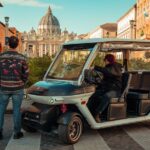
A tuk-tuk tour is the fast lane in Rome. This private electric ride strings together fountains, palaces, and ancient streets, with an audio guide helping you make sense of what you’re seeing as you glide city to city.
I like how it feels tailor-made to your group without the hassle of big crowds, and I also like the built-in narration so you’re not just photographing random landmarks.
In about three hours, you get a “first-day” sweep across Rome’s most famous spots plus a few off-the-main-road moments. Timing is tight on purpose—around 12 minutes per stop—so it’s best if you’re happy to see, snap pics, and move on.
One thing to consider: the Colosseum admission ticket isn’t included, so if you want to go inside, you’ll need to plan for that separately.
In This Review
- Key points to know before you go
- Why a Private Electric Tuk Tuk Works in Rome
- Getting Oriented Fast at Piazza Barberini
- Bernini’s Triton Fountain at Piazza Barberini
- Piazza della Repubblica and the Naiads Fountain
- Quirinale Palace Views Over the Square
- Trevi Fountain, Coins, and La Dolce Vita Atmosphere
- Palazzo Venezia and the Road Into the Ancient City
- Via dei Fori Imperiali: The Scenic Street That Points to the Colosseum
- Colosseum Stop: Seeing the Biggest Stage Up Close
- Circus Maximus and Bocca della Verità: Two Classic Weird-and-Wonderful Stops
- Vatican City and Janiculum Viewpoints in One Smooth Flow
- Piazza del Popolo and Via Veneto for a Final Roman Mood
- Price and Value: Is $54.66 a Smart Deal
- What Makes the Drivers Matter (Carlo, Robin, Davide, Alessandro)
- Practical Tips for a Smoother Ride
- Who Should Book This Tuk Tuk Tour
- Should You Book the Private Electric Tuk Tuk Tour in Rome?
- FAQ
- How long is the Private Electric Tuk Tuk Tour in Rome?
- Is this tour private?
- Is there an audio guide, and what language is it in?
- Do I need to buy tickets for the Colosseum?
- Which stops include admission tickets?
- Does the tour run in bad weather?
- Can I bring a suitcase or bulky luggage?
Key points to know before you go
- Private electric tuk tuk transport with protective covers for rain and wind
- English audio guide + driver assistance, so you’re informed without hunting for a guide
- Quick, photo-friendly stops at major sights across central Rome
- Admissions included at Circus Maximus, Bocca della Verità, and Janiculum’s viewpoint (Terrazza del Gianicolo)
- Colosseum isn’t ticketed in the price, so expect mostly exterior viewing unless you add tickets
- Rain or shine operation with route adjustments if delays happen
Why a Private Electric Tuk Tuk Works in Rome
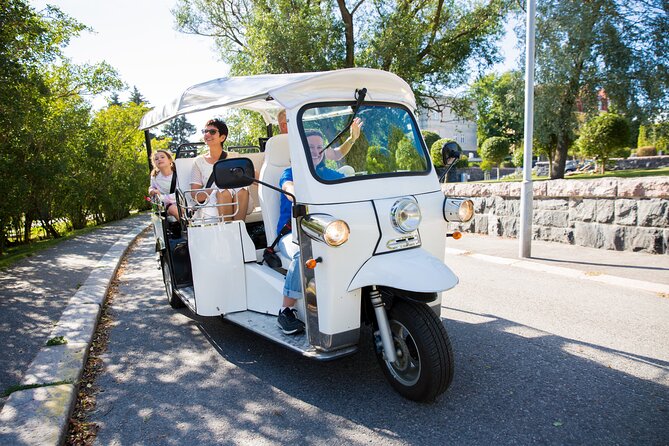
Rome is gorgeous, but it’s also chaotic on foot. Streets are narrow, traffic is intense, and you can easily waste energy walking between “nearby” attractions. A private electric tuk tuk cuts that friction fast, so you can spend your time looking up, not plotting buses.
This tour also makes a smart trade-off: you get a lot of stops in a short window, with enough time to orient yourself and grab photos. It’s a great way to build your personal route for the rest of the trip.
And because it’s private, you’re not stuck with the slowest person in the group—or the group that wants to stop every five minutes. Your pace stays your pace.
You can also read our reviews of more private tours in Rome

Getting Oriented Fast at Piazza Barberini
The tour starts at Piazza Barberini (24/26, 00187 Roma RM), a handy launchpad in central Rome. Since it ends back at the meeting point, you’re not scrambling to figure out public transport later.
This location matters on a first day because you’re close to major grid points and scenic uphill/downhill streets. Once you’re moving, the driver handles the tricky parts—traffic navigation and getting you close enough to enjoy views instead of standing far off.
You’ll feel the rhythm right away: drive, brief stop, short viewing window, photos, then roll again.
Bernini’s Triton Fountain at Piazza Barberini
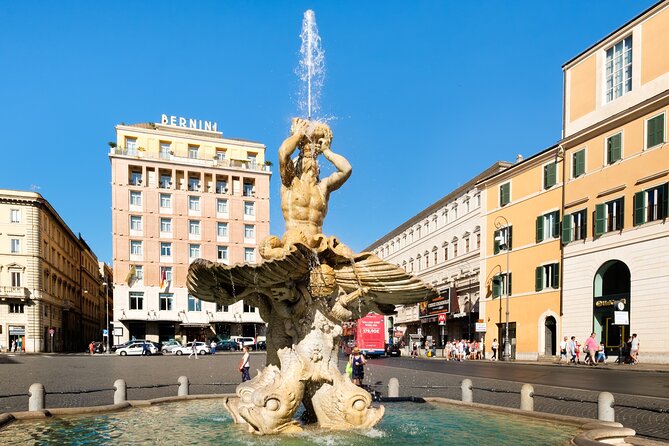
Your first stop is Piazza Barberini for the Triton Fountain by Gian Lorenzo Bernini, commissioned by Pope Urban VIII Barberini. Even in a short visit, the fountain’s scale and details land—because Bernini’s work has that dramatic, theatrical motion that’s hard to ignore.
This is a perfect “warm-up” stop. It sets the tone for what you’ll keep seeing: grand baroque design, mythological themes, and stonework that looks like it’s alive.
If you want a tip for photos, arrive with your camera ready for both wide angles and tighter shots. The fountain rewards both because there are so many visual layers.
Piazza della Repubblica and the Naiads Fountain
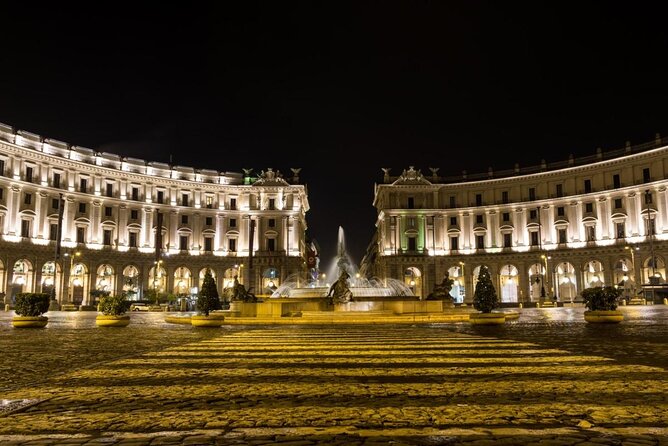
Next up: Piazza della Repubblica for the Fountain of the Naiads by Mario Rutelli and Alessandro Guerrieri. The fact that this is a fountain with named artists is a nice hint that you’re not just ticking off a random “pretty stop.”
Here, you’re looking at a different style of Roman fountain energy—still baroque in spirit, but with a more open, elegant feel in the square. In a 12-minute window, you’re mostly there to appreciate the composition and take a few solid pictures before the route moves on.
This is also a good moment to pause and reset—because after this, the tour starts stacking in major historic landmarks.
Quirinale Palace Views Over the Square
At Piazza del Quirinale, you’ll see the Quirinale Palace, one of Rome’s most important political landmarks. It overlooks the square from the hill of the same name, and it’s been the official residence of the King of Italy since 1870 and later the President of the Italian Republic since 1946.
You’re not visiting the palace as a ticketed interior experience on this ride. Instead, you’re getting the “you are in the center of power” feeling that comes from the location and scale.
What I like about this stop on a tuk tuk tour: it keeps the focus on views and context. You quickly grasp why this hill matters without adding a long walk or line.






Trevi Fountain, Coins, and La Dolce Vita Atmosphere
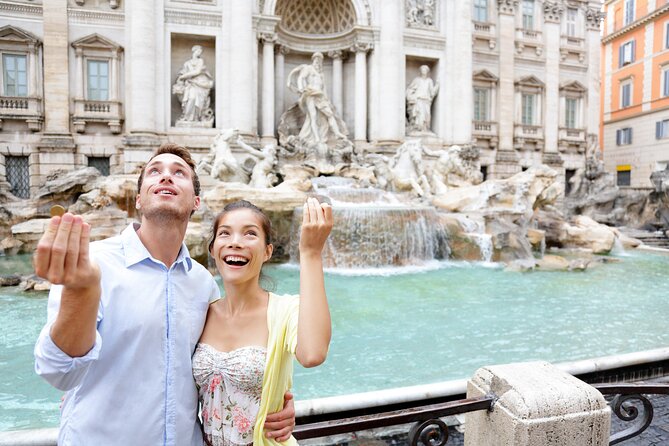
Then comes the big one: Trevi Fountain. It’s described as the largest of Rome’s famous fountains, built by Nicola Salvi and Giuseppe Pannini—and it lives up to that label.
This stop also has a pop-culture layer. The fountain is famous for being used in the world-known film La Dolce Vita. Even if you don’t care about the movie, it adds a different kind of excitement to the scene.
Legend has it that if you throw a coin with your back to the pool and turn around before it disappears, your return to Rome is guaranteed. Whether or not you buy into legends, it’s a fun ritual in a place that’s made for quick, memorable moments.
Palazzo Venezia and the Road Into the Ancient City
From there you move toward Piazza Venezia / Ancient City, with Palazzo Venezia (Palazzo Barbo) as the anchor point. This historic building houses the National Museum of Palazzo Venezia and the headquarters of INASA, which includes an important library for archaeology and art history.
Even if you don’t go inside, it’s a strong “transition” stop. You’re shifting from squares and fountains into an area that feels much more directly connected to Rome’s imperial spine.
What you’ll likely feel here is momentum: the next stretch becomes all about monumental sightlines and the feeling of walking through Rome’s older layers—minus the long haul on foot.
Via dei Fori Imperiali: The Scenic Street That Points to the Colosseum
Via dei Fori Imperiali is one of Rome’s most scenic streets, and it’s also a shortcut to an iconic visual perspective. This road connects Piazza Venezia with the Colosseum and is lined with the characteristic “pines of Rome.”
It also has a time-travel aspect: the road opened in 1932, and it once had a different name—via dell’Impero. Today, its name links you directly to the monumental remains of the forums of Caesar, Augustus, Nerva, Peace, and Trajan.
On a tuk tuk, this section feels like a moving “photo corridor.” It’s not about stopping constantly; it’s about watching the city build toward the visual finish line.
Colosseum Stop: Seeing the Biggest Stage Up Close
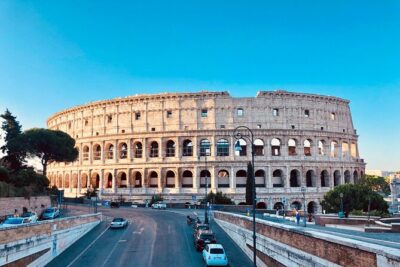
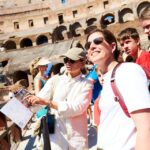
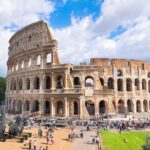
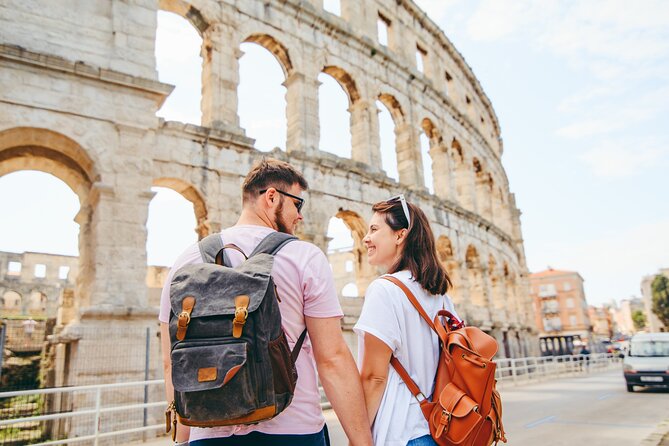
The tour brings you to the Colosseum (originally the Flavian Amphitheater). It’s described as the largest Roman amphitheater in the world, with estimated capacity between 50,000 and 87,000 spectators.
Here’s the important practical point: Colosseum admission isn’t included. That means you should treat this stop as an exterior-focused moment unless you’ve arranged your own ticket and timing.
What you can still do in a short window is impressive: get close enough to understand the scale, spot good viewpoints for pictures, and take a quick “this is real” moment. After that, you can decide whether you want a deeper Colosseum visit on another day.
Circus Maximus and Bocca della Verità: Two Classic Weird-and-Wonderful Stops
Two of the standout “included ticket” moments are Circus Maximus and Bocca della Verità.
Circus Maximus sits in the valley between the Palatine and the Aventine. It’s remembered as a venue for games since the early days of the city, including the famous mythical story connected to Romulus and the god Consus.
Then comes Bocca della Verità (Mouth of Truth), a marble mask in Santa Maria in Cosmedin since 1632. The legend says women accused of adultery would insert a hand into the slit after swearing they’d never cheated—and the Mouth would supposedly cut off the lying hand.
Even if you take the legend as pure theater, the moment is fun and oddly human. It’s the kind of stop where you’ll want a quick photo right after you see what it really looks like in place.
Vatican City and Janiculum Viewpoints in One Smooth Flow
The route also includes a stop around Vatican City, with the Vatican described as the world’s smallest sovereign state by population and size. Even when you don’t go inside, you’re still seeing how Rome’s power map works: the Vatican is not just a building; it’s a whole micro-world.
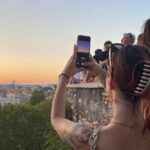
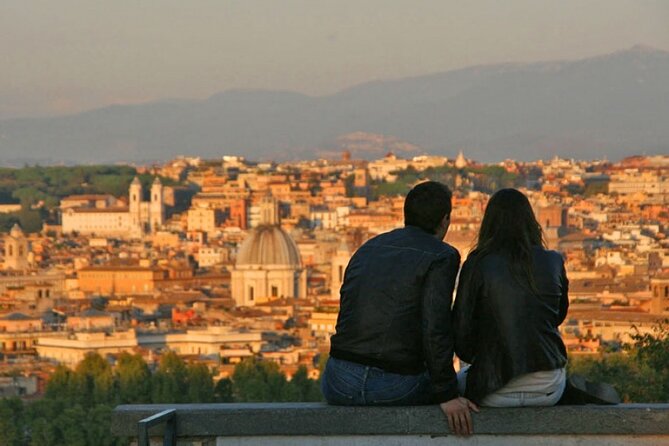
You then reach the Terrazza del Gianicolo on the Janiculum hill for big panoramic payoff. Janiculum’s maximum height is listed at 88 meters, and it’s noted as not one of Rome’s traditional seven hills. The viewpoint angle is the main reason to come, and it’s included here.
This is the moment when the tour shifts from “look at monuments” to “see how Rome is laid out.” It helps you place later visits in your mind.
Piazza del Popolo and Via Veneto for a Final Roman Mood
Your last main stop area is Piazza del Popolo, a key historic intersection and one of the classic Roman “arrive-and-breathe” squares. It connects three major streets—via del Babuino, via di Ripetta, and via del Corso—and sits under the Pincio gardens. The square also preserves charm linked to its past as part of Nero’s family gardens.
Then you head along Via Vittorio Veneto (often called Via Veneto). It rises uphill from Piazza Barberini toward Porta Pinciana in the Ludovisi district, and it’s famous as a street that changes feel as you walk it.
By this stage, the tour is less about rushing from one site to another and more about using your legs where you want them. You’ll get some free time to absorb what you liked most earlier.
Price and Value: Is $54.66 a Smart Deal
At $54.66 per person for about three hours, you’re paying for speed, privacy, and convenience—not for lots of museum time. The value shows up in three places:
First, it’s private transportation, so you’re not sharing the ride with strangers or negotiating group pace. Second, you get protective covers and driver assistance, plus an audio guide in English, which means fewer “what am I looking at?” gaps. Third, several stops have admission tickets included, so you’re not paying separately for every single stop.
The trade-off is obvious: this isn’t a slow, deep sightseeing day. You’ll see a lot of Rome quickly, then you’ll want to return for whatever grabbed you most.
If you’re the kind of traveler who wants to get your bearings fast and then explore further, this price structure fits you well.
What Makes the Drivers Matter (Carlo, Robin, Davide, Alessandro)
A tuk tuk tour lives or dies on how the driver reads traffic and where they position you for views. In past experiences, drivers such as Carlo have been praised for strong know-how and local insight around the ancient parts of the city. Robin has stood out for flexibility and for crafting a route that can feel more personal when you’re already familiar with the biggest hits.
Davide has been noted for taking good care—helpful for groups with different mobility needs—and for making sure you get to the easier entrance points. Alessandro has been praised for adapting when schedules got complicated.
You don’t need a live, spoken guide for this to feel informative, but you do benefit from a driver who can handle the practical side while keeping the story thread moving through the audio.
Practical Tips for a Smoother Ride
A few things will help you get the best outcome from a short tour like this.
Wear comfy shoes even if you’re using the tuk tuk often. The tour stops are brief, and you’ll likely want to step out quickly for photos. Also, keep in mind that there’s no trunk: the tuk tuks don’t have a trunk, so you can’t bring suitcases or bulky packages.
If you’re traveling with kids or have a tight schedule, this style can be a lifesaver. It’s designed to get you close to major highlights with minimal walking and maximal photo windows.
Finally, be ready for street conditions. Rome roads can be rough in places, so hold onto the moment and enjoy the ride. It’s part of the fun.
Who Should Book This Tuk Tuk Tour
This is a strong choice if:
- you want a first-day orientation to Rome’s big sights
- you prefer short viewing windows over long museum time
- you want privacy without the stress of booking a custom guide for every hour
- you’re traveling as a family, a couple, or a mixed-age group and want flexibility
It’s less ideal if:
- you’re planning to do lots of ticketed interiors in one day (especially at the Colosseum, since admission isn’t included)
- you need long dwell time at each stop
- you’re carrying bulky luggage
Should You Book the Private Electric Tuk Tuk Tour in Rome?
Book it if you want a smart, efficient way to see Rome’s “greatest hits” and a few classic stops with included admissions—while keeping things comfortable in traffic. The mix of fountains, palace viewpoints, ancient-road perspective, and panoramic city views is a great primer for the rest of your trip.
Skip or plan differently if you’re specifically focused on deep, ticketed interior time. In that case, use this tour as your orientation day, then come back on another day with tickets for the sites that matter most to you.
If you’re doing Rome for the first time, or you’re short on time, this one is an easy yes.
FAQ
How long is the Private Electric Tuk Tuk Tour in Rome?
It lasts about 3 hours.
Is this tour private?
Yes. It’s private transportation and only your group participates.
Is there an audio guide, and what language is it in?
Yes. An audio guide is included, offered in English.
Do I need to buy tickets for the Colosseum?
Yes. Colosseum admission is not included.
Which stops include admission tickets?
Admission tickets are included for Circus Maximus, Bocca della Verità, and Terrazza del Gianicolo (Janiculum viewpoint).
Does the tour run in bad weather?
It operates rain or shine, and the tuk tuks have protective covers against rain and wind.
Can I bring a suitcase or bulky luggage?
No. The tuk tuks don’t have a trunk, so you can’t bring suitcases or bulky packages.