REVIEW · ROME
Leonardo da Vinci Experience Museum Admission
Book on Viator →Operated by TOURISTATION · Bookable on Viator
Leonardo’s ideas in Rome are easier to see than you’d think. This is a self-guided museum experience with guaranteed access, set in Vatican City just a short walk from St. Peter’s Basilica, so you can fit it into almost any itinerary. You’ll move through five rooms at your pace, using your prepaid voucher to get in.
What I really like is how hands-on the displays feel, even though this is mostly built around reproductions and recreations. I also like the room-by-room structure, where inventions and artwork stay organized instead of turning into one long warehouse scan. One caution: the museum is small, and if you want big museum scale, original works, or a lot of context about Leonardo himself, it may feel like less than you hoped.
In This Review
- Key things to know before you go
- Why this Leonardo exhibit is a smart add-on by St. Peter’s
- Guaranteed access and flexible timing (aka fewer day-killers)
- Room-by-room walkthrough: what you’ll see and why it works
- Room I: flying machines and a famous painting reproduction
- Room II: war machines and artillery ideas
- Room III: music, optics, projectors, and the Room of Mirrors
- Room IV: everyday principles that lead to familiar objects
- Room V: 20 works of art and recreations of famous pieces
- Audio guide: how you’ll listen and what to expect
- Size, atmosphere, and the one thing that can bother you
- Value for $19.22: when the price feels fair
- Best for families, curious adults, and teens who like science
- Practical tips so your visit goes smoothly
- Should you book Leonardo da Vinci Experience Museum Admission?
- FAQ
- Where is the Leonardo da Vinci Experience Museum located?
- What time is the museum open?
- How long does the experience take?
- Is the admission ticket included?
- Is this a guided tour or self-guided?
- What languages are available for the audio guide?
- Can I choose when to enter during opening hours?
- What does the experience include besides admission?
- Is hotel pickup included?
- What is the cancellation policy?
- What’s included in the five rooms?
Key things to know before you go
- Guaranteed admission with a prepaid voucher, so you don’t have to gamble on timing.
- Flexible entry during opening hours, which is gold when your Vatican day runs long.
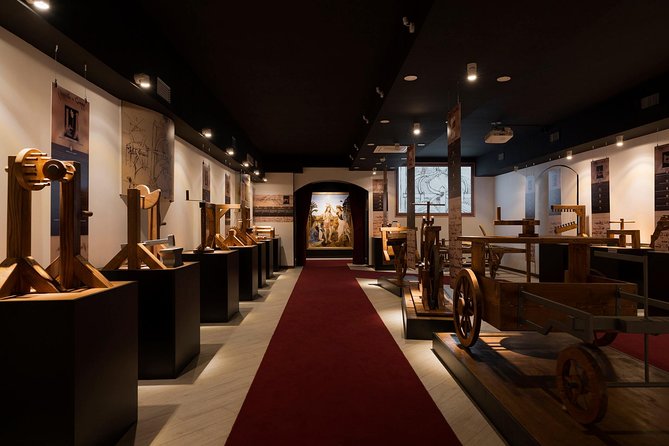
- Five themed rooms that map Leonardo from flight concepts to war ideas to optics.
- English audio guide included, plus many other languages for flexibility.
- Interactive elements, which make it more fun than a typical picture gallery.
Why this Leonardo exhibit is a smart add-on by St. Peter’s
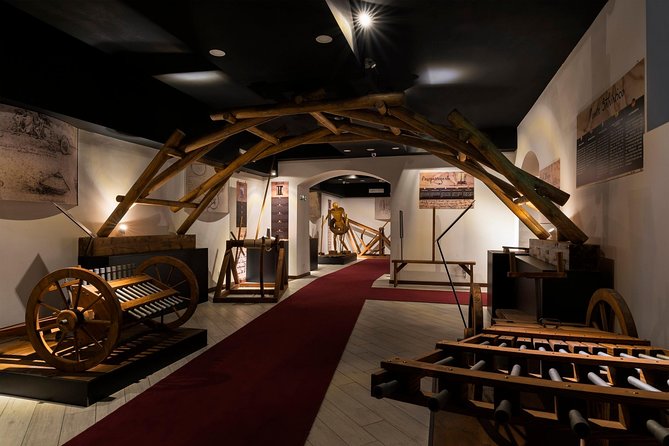
The Leonardo da Vinci Experience Museum Admission is built for exactly the kind of day you usually have in Rome: you start with a major landmark, then you want something that’s still interesting but doesn’t hijack your whole schedule. This museum sits on the Vatican side of town, near St. Peter’s Basilica, with the ticket redemption point at Via della Conciliazione, 19, 00193 Roma RM. That location matters. You can pair this with a Vatican Museums visit or with time around St. Peter’s and still keep the day moving.
The setting also helps you manage your energy. You’re not committing to a big guided tour or long rides between sites. It’s a walk-in-and-go kind of experience, and you can slow down or speed up depending on what you’re in the mood for. In practice, it feels like a focused detour: part inventor workshop, part art appreciation, part science fair.
You can also read our reviews of more museum experiences in Rome



Guaranteed access and flexible timing (aka fewer day-killers)

This ticket is priced like a standalone activity, but it buys you a big practical advantage: guaranteed entry to the Leonardo da Vinci Exhibition in Vatican City. That means your time isn’t at the mercy of sell-outs. It also supports the way most Rome days actually go. You might spend longer than planned outside the basilica, or you might need a bathroom break or a coffee stop before you commit to another indoor stop.
Opening hours are listed as 9:00 AM to 6:00 PM for the period shown (11/04/2025–12/31/2026). Another description of the experience mentions 10:00 AM to 6:00 PM, so the best move is to treat your voucher’s listed time window as the authority. Either way, you’re looking at a late-morning through early-evening slot, which makes it easy to fit after or around your Vatican plans.
Duration is listed as about 1 to 2 hours, and that range is realistic. If you’re an inventor-and-machines person, you’ll probably want the full stretch. If you’re more of a short-attention-span adult or visiting with kids, it can be a satisfying shorter stop.
Room-by-room walkthrough: what you’ll see and why it works
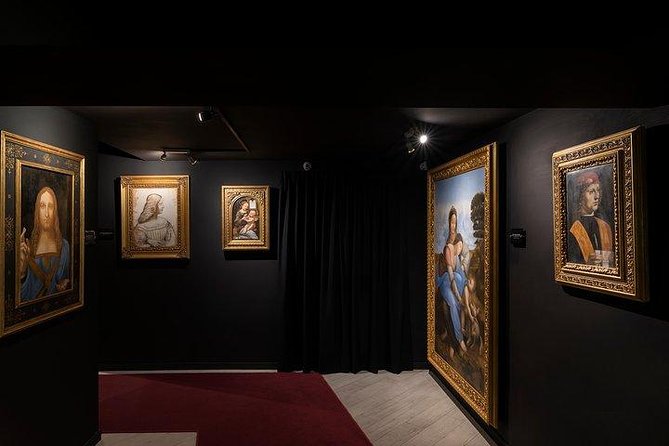
The museum runs through five rooms, each with a clear theme. That design choice is what makes the visit feel organized instead of chaotic. You won’t just see random models; you’ll get a sense of how Leonardo thought across different fields.
Room I: flying machines and a famous painting reproduction
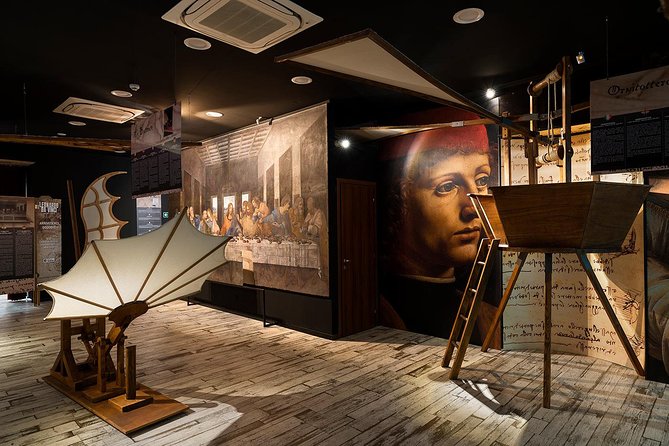
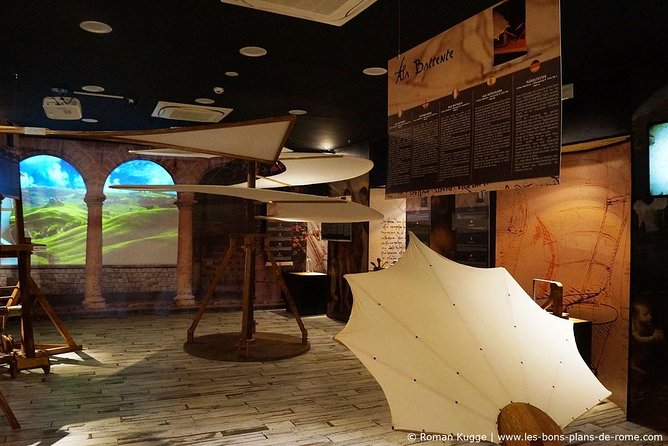
Room I is all about movement and imagination. You’ll see Leonardo’s flying-machine concepts, including a prototype of a hang glider design, plus a life-size reproduction of the Last Supper. Even if you’ve seen similar artwork reproductions before, the museum pairs the painting with the flight ideas in a way that helps you think like Leonardo: art and engineering weren’t separate hobbies for him.
If you like the “how could this have worked?” side of inventions, this room gives you plenty to puzzle over without needing any math background. If you’re an art-only visitor, the Last Supper reproduction is still a strong anchor.
Room II: war machines and artillery ideas
Room II shifts gears into the darker, more aggressive side of Leonardo’s creativity. You’ll find drawings of artillery and war machines, including a multi-directional gun machine with twelve barrels, plus a catapult concept. This room can be a shock if you expected a purely inspirational “inventor genius” show. But that shift is also part of what makes the museum feel honest about the range of Leonardo’s curiosity.
It’s also one of the rooms where you can get stuck in a good way—reading the ideas, comparing how the mechanisms are supposed to function, and thinking about what’s practical versus what’s simply speculative.




Room III: music, optics, projectors, and the Room of Mirrors
Room III is where the experience turns more technical and more clever. The focus is music and optics, and you’ll see devices like the projector and the perspectograph, plus the Room of Mirrors. The mirrors section is especially fun because it brings perspective issues from the drawings into a physical space. You don’t have to “get it” intellectually first—you can play with it and let your brain catch up.
This is also the room that can work best for mixed groups. If you’re visiting with teens, you’ll often see them curious here even if they weren’t as interested in the war-machines room.
Room IV: everyday principles that lead to familiar objects
Room IV is more approachable. The exhibits highlight everyday objects that exist because of Leonardo’s ideas, including a bicycle, spring, and a life preserver. This is the room that helps you connect invention to daily life, even if what you’re seeing is recreated for museum purposes.
If you like “show me why this matters” exhibits, this is your favorite stop. It makes the earlier rooms less abstract by tying the concepts to recognizable shapes and functions.
Room V: 20 works of art and recreations of famous pieces
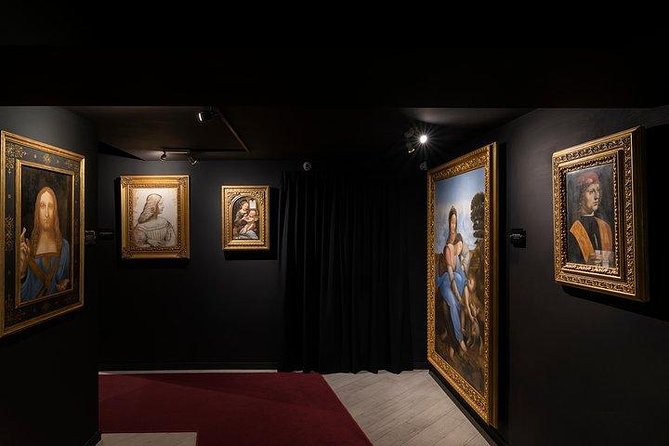
Room V shifts back to artwork. It includes 20 works, with reproductions of some of Leonardo’s most famous paintings. If you’re a serious art fan, you’ll still want to pair this with more original works elsewhere in Rome. But as a final room, it does a good job closing the loop: the museum reminds you that Leonardo was both artist and inventor.
This last room can be ideal if you’re tired. You can skim and linger without needing to interpret machinery details.
Audio guide: how you’ll listen and what to expect
The audio guide is included, and it’s offered in a wide set of languages: English, Italian, French, Spanish, German, Russian, Chinese, and Portuguese. That’s a real value add because it lets you control pace and focus. No waiting for a human guide to catch up with your group’s rhythm.
In many installations like this, you use a device to trigger audio details for each exhibit. That approach is exactly what makes self-guided museums work—each stop gives you context without turning the whole visit into a lecture.
That said, sound quality and presentation can be uneven. Some people find the information delivery more functional than engaging, especially when the notes are presented on laminated sheets and the audio doesn’t feel great. If you’re picky about audio, go into it expecting “useful explanations,” not cinematic storytelling.
Size, atmosphere, and the one thing that can bother you
The museum is described as compact, and a small footprint shows up in two ways. First, it can feel busy when there are lots of families and groups. Second, some visitors note that the indoor space can feel cramped and that there may be an unpleasant smell as part of the environment.
Air-conditioning is mentioned positively in at least one review, so comfort can be decent once you’re inside. But if you’re sensitive to odors or claustrophobic spaces, this is the one practical consideration that can make or break your enjoyment.
Also, keep expectations aligned: this experience includes reproductions. Some models include disclaimers that they may not have been developed or used by Leonardo. So if you’re hoping for authentic historical artifacts, you’ll likely leave thinking about what wasn’t there as much as what was.
Value for $19.22: when the price feels fair
The ticket price—$19.22 per person—isn’t bargain-bin cheap, but it can be fair value because you’re not paying for a guided escort or a long program. You’re paying for: guaranteed admission, multi-room content, and an included audio guide.
The value gets better when:
- you want a short, easy win between bigger Rome sights,
- you like interactive or “try-it” style exhibits,
- you can spend an hour or so walking room to room.
The value feels worse when:
- you’re mainly after original masterpieces,
- you expect a big museum scale,
- you want lots of Leonardo biography background (the museum leans more toward machines and concepts than deep personal history).
My practical advice: if you’re already planning a Vatican-area day, this is often worth doing because it adds variety without requiring more logistics. If you’re building a Rome “must-sees” list from scratch and time is tight, decide based on your interest in inventions and models.
Best for families, curious adults, and teens who like science
This experience can fit a lot of travelers, but it shines with certain types of visits. I’d put it in the “good for all ages, especially mixed groups” category.
- Kids and families tend to enjoy the hands-on style and the ability to move at their own pace.
- Teens who like STEM usually hit pay dirt here because optics, mechanisms, and perspective tricks feel like real science playground topics.
- Adults who like art and ideas together will appreciate the way the museum ties engineering concepts to artwork.
If you’re visiting solo and you’re a serious Leonardo scholar, you might feel it’s too light. If you want a deep biography or original works, use this as a fun add-on, not your main Leonardo stop.
Practical tips so your visit goes smoothly
Here are the details that usually matter once you’re on-site.
Go at a time when you can concentrate. Because it’s indoors and compact, crowded periods can make it harder to slow down and read or test interactive elements.
Plan for 45 minutes to 1.5 hours. The posted range is 1 to 2 hours, but you can finish sooner if you’re moving quickly. Give yourself extra time if you want to really work through the machines and the Room of Mirrors.
Bring your curiosity, not just your patience. Some exhibits are interactive and benefit from a few extra minutes of experimentation.
Pack a “reproductions mindset.” This is an experience built around models, recreations, and reproduced art. Knowing that ahead of time keeps you from feeling disappointed and helps you focus on the ideas and design.
Add it after St. Peter’s or before a Vatican Museum day. The proximity is the whole point. You can use it as a buffer when you want something educational but not exhausting.
Should you book Leonardo da Vinci Experience Museum Admission?
Book it if you want:
- guaranteed entry near St. Peter’s,
- a self-guided format that lets you set your own pace,
- interactive exhibits plus audio in English (and many other languages),
- a one- to two-hour activity that adds a different angle to your Vatican day.
Skip or rethink it if you:
- are hoping for a large-scale museum experience,
- only care about original Leonardo works or extensive biography,
- are especially sensitive to cramped spaces or indoor odors,
- dislike audio-guide setups that rely heavily on devices and exhibit-triggered narration.
If you’re on the fence, I’d use this simple rule: if you like inventions, optics, and the idea of seeing how concepts become objects you recognize, this fits well. If you’re looking for only the masterpieces, save your money for something else in the Vatican orbit.
FAQ
Where is the Leonardo da Vinci Experience Museum located?
The ticket redemption point is at Via della Conciliazione, 19, 00193 Roma RM, Italy. The museum is next to St. Peter’s Basilica and is in the Rome/Vatican area.
What time is the museum open?
Opening hours are listed as 9:00 AM to 6:00 PM (for 11/04/2025–12/31/2026), Monday through Sunday.
How long does the experience take?
The duration is listed as about 1 to 2 hours.
Is the admission ticket included?
Yes. Entrance to the Leonardo da Vinci Experience Museum is included.
Is this a guided tour or self-guided?
This is self-guided. A tour guide is not included.
What languages are available for the audio guide?
The audio guide is available in English, Italian, French, Spanish, German, Russian, Chinese, and Portuguese.
Can I choose when to enter during opening hours?
Yes. Timing is flexible, and you can visit any time during opening hours.
What does the experience include besides admission?
You receive an audio guide in multiple languages.
Is hotel pickup included?
No. Hotel pick-up and drop-off are not included.
What is the cancellation policy?
Free cancellation is available up to 24 hours in advance for a full refund. If you cancel less than 24 hours before the start time, the amount paid is not refunded.
What’s included in the five rooms?
You’ll move through five rooms featuring flying machines and a reproduction of the Last Supper (Room I), war machines (Room II), music and optics devices like the projector and perspectograph plus the Room of Mirrors (Room III), everyday principles like the bicycle, spring, and life preserver (Room IV), and a room focused on 20 works of art including reproductions of famous paintings (Room V).