REVIEW · ROME
Guided Group Tour of Colosseum with Arena Floor
Book on Viator →Operated by Carpe Diem Tours · Bookable on Viator
Step where gladiators once stood. This guided Rome tour pairs real access with a smart plan: you enter the Colosseum through the Porta Libitinaria and—on selected options—walk onto the arena floor with headphones so you can hear every detail. I also like that the admission piece is built into the price, so you’re not playing guess-the-fee mid-journey.
One thing to watch: entry depends on paperwork matching your booking. If the full name on your voucher doesn’t match your passport or ID, you could be turned away.
In This Review
- Key Things I’d Pay Attention To
- Entering The Colosseum Isn’t the Hard Part
- Price and What You Actually Get for Around $95
- Meeting Point Reality: Names, Time, and a Mobile Ticket
- Stop 1: Porta Libitinaria to the Arena Floor
- Stop 2: Palatine Hill’s Imperial Palace Area in 45 Minutes
- Stop 3: The Roman Forum as Rome’s Main Highway
- Headphones and Crowd Control: Why This Tour Moves Better
- Options: When You Might Want the Small-Group Upgrade
- What the 3-Hour Shape Means for Your Day in Rome
- Who This Tour Fits Best (and Who Might Want a Different Plan)
- Should You Book This Colosseum + Palatine Hill + Forum Tour?
- FAQ
- How long is the Colosseum, Palatine Hill, and Roman Forum guided tour?
- Is admission included in the tour price?
- Does this tour include the Arena Floor?
- Where does the tour start and where does it end?
- Do I need to bring a passport or ID?
- What is the cancellation policy?
Key Things I’d Pay Attention To
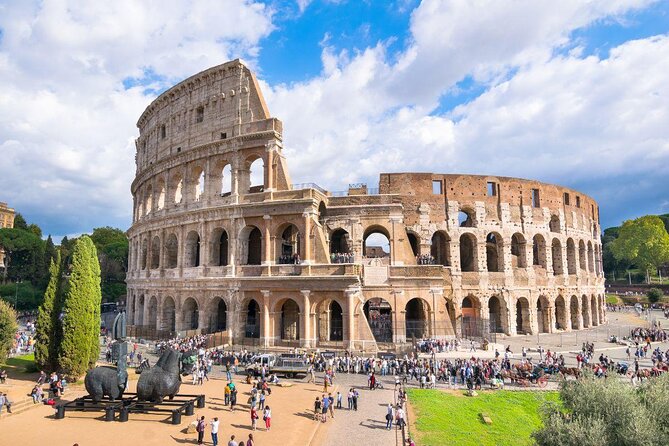
- Arena floor access puts you at the exact center line people picture when they think of gladiators (option-dependent).
- Porta Libitinaria (Gate of Death) sets a dark, historic tone before you even reach the sand.
- Priority access helps you move through the big security and crowd bottleneck more efficiently (option-dependent).
- Headphones keep the guide’s narration clear in a loud, echoing monument.
- Tight pacing: you get the Colosseum plus Palatine Hill and the Roman Forum without feeling like you’re just standing around.
- Small-group upgrade available if you want more personal attention than a standard group.
Entering The Colosseum Isn’t the Hard Part
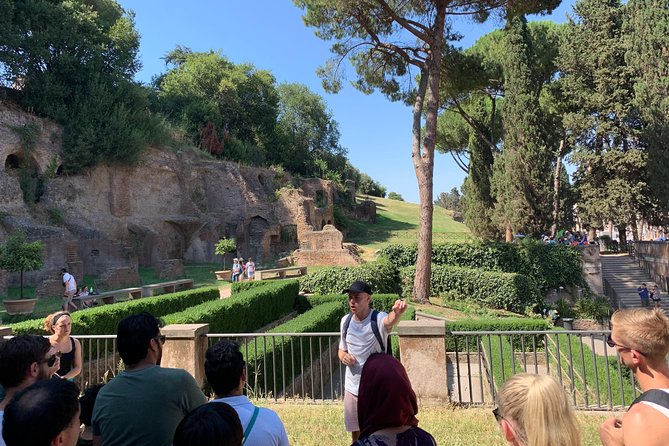
This tour is built for one of Rome’s most common headaches: you can absolutely visit the Colosseum on your own, but you’ll spend a lot of time figuring out what you’re looking at. With a guide leading the way, the amphitheater clicks into place fast—where people sat, what the architecture was doing, and why certain corridors mattered.
What really makes it different is the entry route. You don’t just walk up to the main entrance and wander. You enter through Porta Libitinaria, historically called the Gate of Death, and that changes the vibe right away. It’s a small shift, but it makes the whole structure feel more like a story and less like a photo-op.
You can also read our reviews of more guided tours in Rome



Price and What You Actually Get for Around $95
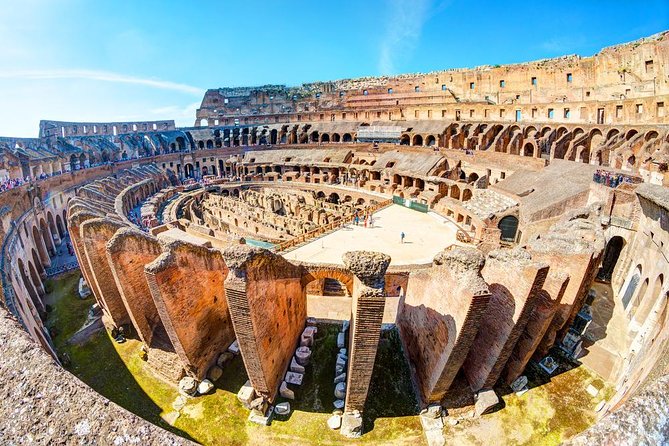
At $94.92 per person for about 3 hours, the price lands in the “serious value” zone for the Colosseum. The big reason is that admission isn’t an extra add-on you’ll pay later. The tour cost includes the entry ticket and a reservation fee (listed as a €20 value), which matters because ticket prices in Rome can be confusing and time-sensitive.
Also look at what’s included beyond the ticket: you get a licensed local expert and headphones. In monuments like the Colosseum and Forum, sound gets eaten by crowds and stone—headphones aren’t a luxury. They’re how you keep the narrative intact while you’re moving.
Meeting Point Reality: Names, Time, and a Mobile Ticket
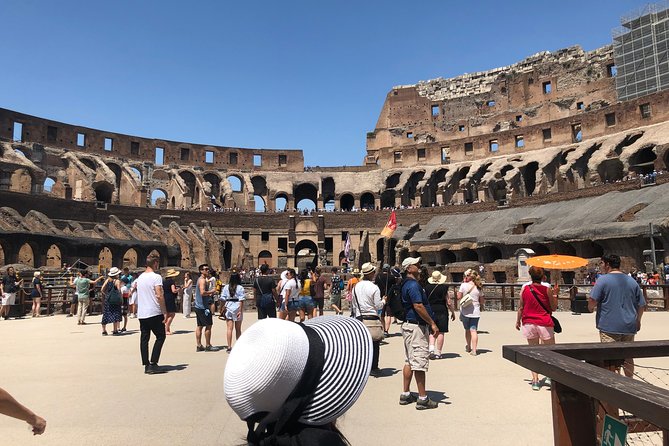
The tour meets at Piazza del Colosseo near the Arch of Constantine (right by the Colosseum area). You’ll end either in the Roman Forum or the Colosseum, depending on which direction your start time sets up the route.
Two practical notes that can save you grief:
- You need to provide the full names for every person booking.
- You must bring a valid passport or ID that matches the names on your ticket/voucher, or entry can be denied.
This is the kind of tour where arriving late can put you behind the entry window and cause you to miss access. I’d treat “close enough” as “not enough” and plan to be at the meeting point a bit early.
Stop 1: Porta Libitinaria to the Arena Floor
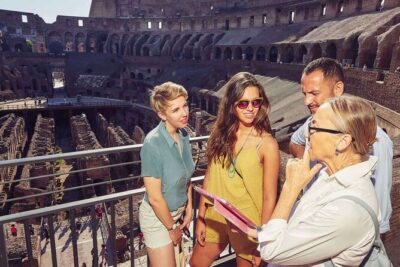
The opening portion is the headline, and it earns it. After you enter through Porta Libitinaria, you step into the Colosseum’s bowl and move toward the arena level. On selected options, you then access the Arena Floor and walk paths in the center area—exactly the sort of moment that turns the Colosseum from an idea into a place.
A few things to keep in mind while you’re there:
- The Colosseum is wide and echo-y, so the guide’s narration is doing real work. That’s why headphones help so much.
- Expect a brisk, guided flow. This isn’t a museum crawl where you can stop and read every plaque.
- Your guide will connect what you see with how the events worked. Think structure first—then stories about what happened inside.
From what I’ve learned about the way guides deliver this route, the best sessions have guides who speak with pace and clarity—people like Tsion, Felicity, Susanna, Valentina, Elina, Giorgio, and Katrina (names that come up for strong explanations). The payoff is that you don’t just see the architecture; you understand why it exists.
One more practical angle from real-world experience: hot days are common. Bring a small umbrella or visor if you have one, and take the guide’s rhythm seriously when shade opportunities appear.
Stop 2: Palatine Hill’s Imperial Palace Area in 45 Minutes
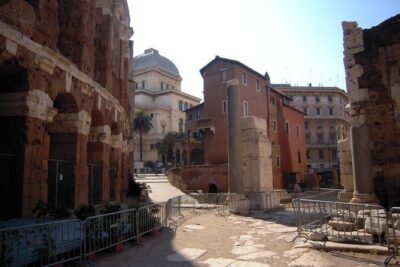
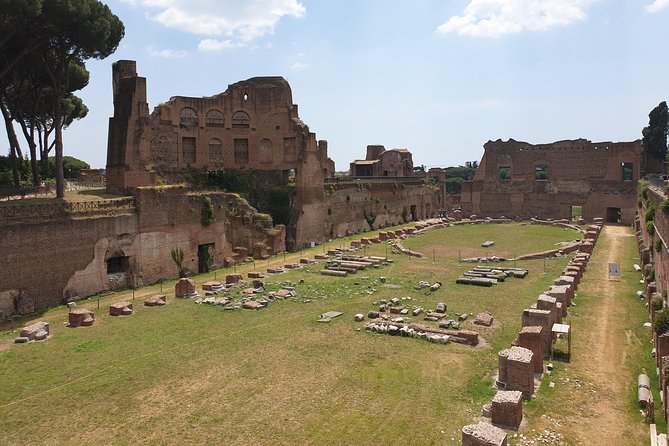
Next you head to Palatine Hill, one of Rome’s seven historic hills and the place tied to the traditional story of Rome’s beginnings. You’re not wandering a single temple. You’re moving through an archaeological zone where the ruins, trees, and sightlines all create context.
In about 45 minutes, you’ll cover:
- The area traditionally linked to Rome’s birthplace
- Ruins connected to the Imperial Palace
- Views that reach over toward the Circus Maximus and the Roman Forum
This stop works best if you let the guide do the connecting. The Palatine can feel like “more ruins” if you’re just looking at stones. But explained well, it becomes a map of power—where rulers lived, how the hill fits into the city’s geometry, and why the setting mattered.
One drawback to be aware of: 45 minutes sounds long until you’re standing in sun, changing levels, and walking with the group. Palatine moves quickly on a guided plan, so if you want slow photo time at every angle, you’ll need to save extra wandering for after the tour.





Stop 3: The Roman Forum as Rome’s Main Highway
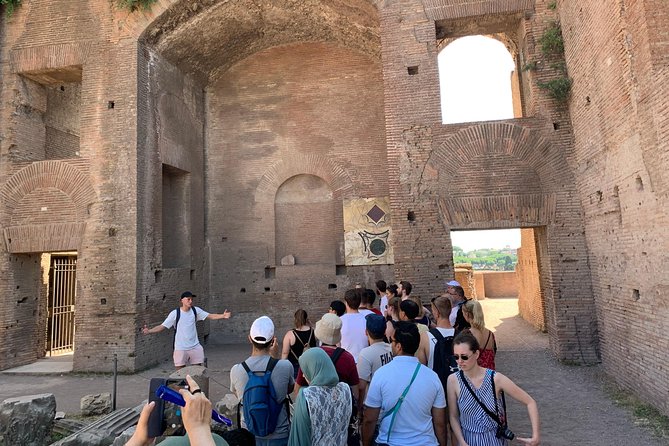
The last stop is the Roman Forum, the political, social, and commercial core of ancient Rome. This portion is where you start to see Rome as a functioning system instead of a collection of monuments.
You’ll walk parts of the route that connect major streets and landmarks, including the Via Sacra and Via Nova. Even though only part of the Forum survives today, the guide helps you build the missing pieces—how the spaces likely worked, what the arches and temples meant, and how people moved through the city’s center.
In about 45 minutes, you’ll do the essentials:
- Walk key historic roadways
- Pass between notable remains (arches and temple areas)
- Get the context to understand why this space mattered day to day
If you’ve ever felt overwhelmed by the Forum’s size, this structure helps. It gives you a line to follow, so you’re not trapped in “stand and guess” mode.
Headphones and Crowd Control: Why This Tour Moves Better
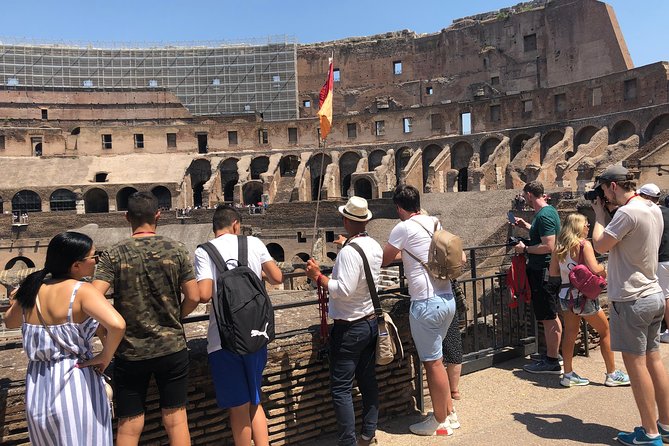
The Colosseum, Palatine Hill, and Forum are all high-demand stops. That means crowds, noise, and time pressure. This tour tries to reduce friction in three ways:
- Priority access to the Colosseum/Palatine Hill/Forum if you choose options that include it
- Headphones so you don’t lose the guide to yelling and echo
- A group size capped at 24 people
That cap is the sweet spot. Large enough to run efficiently, small enough that you’re usually not getting swallowed by the mass. And the better guides keep people moving without turning it into a sprint.
From the way the experience is described by people who’ve done it, pacing is a major praise point. You’re hitting highlights while still getting the details that make the place make sense. On very hot days, the guide also tends to manage comfort—expect reminders to hydrate, and there are chances to fill water bottles and use toilets during the walk.
Options: When You Might Want the Small-Group Upgrade
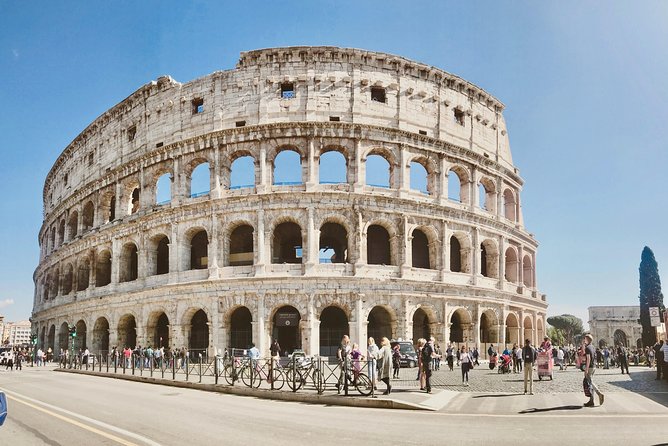
You can choose a standard guided group approach or upgrade to a smaller-group version. The listing notes upgrades such as small-group formats (including options with different group sizes like 12 or 24 people, depending on the variant).
When would that matter to you?
- If you hate feeling rushed and want more time for your personal questions
- If you like hearing explanations at a volume level that feels more conversational
- If you’re traveling with older relatives and want a slightly calmer group dynamic
If you’re comfortable with a standard group and just want the best value, the base version already gives you the key trio: Colosseum + Palatine Hill + Roman Forum.
What the 3-Hour Shape Means for Your Day in Rome
This is about 3 hours total, give or take. That timing is helpful because it keeps you from losing your entire day to one site. It also means you’re more likely to enjoy the rest of Rome without dragging your feet afterward.
The itinerary also ends in either the Roman Forum or the Colosseum, depending on your start. That’s useful. You’re not forced to backtrack across town to catch the next stop.
If you’re planning additional sights nearby, this tour is a strong anchor because it lands you in the thick of the ancient core. Your next walk can be shorter and simpler.
Who This Tour Fits Best (and Who Might Want a Different Plan)
This guided experience makes the most sense if you want structure. If you like knowing what you’re seeing while you’re seeing it, you’ll enjoy this pace.
It’s a good match for:
- First-timers to the Colosseum area who don’t want to waste time guessing
- History fans who want a clear story arc in a short window
- People who appreciate access-level highlights, like the chance to step onto the arena floor (where available)
- Anyone traveling in English who wants a guided narrative with headphones
It may feel less ideal if:
- You want maximum free time for wandering and independent pacing
- You get stressed by crowds and fast movement (high season can slow things down for everyone)
- You’re not comfortable doing on-time entry with matching ID details
Should You Book This Colosseum + Palatine Hill + Forum Tour?
If you want the fastest path to feeling oriented in Rome’s ancient heart, I think you should book it. The combination of priority-style access, headphones, and the option for Arena Floor makes the Colosseum experience feel complete instead of fragmented.
The only real “don’t do this without thinking” factor is the paperwork and timing. Get your names right, bring your ID, and show up on schedule. Do that, and you’ll get a tour that turns three major sites into one connected story.
FAQ
How long is the Colosseum, Palatine Hill, and Roman Forum guided tour?
The tour runs for about 3 hours, with roughly 1 hour at the Colosseum and about 45 minutes each at Palatine Hill and the Roman Forum.
Is admission included in the tour price?
Yes. The Colosseum entry ticket and reservation fee are included, and the tour includes admission for Palatine Hill and the Roman Forum as well.
Does this tour include the Arena Floor?
Arena Floor access is available for selected options. If your chosen option includes it, you’ll enter the Colosseum and step onto the arena area in the center of the amphitheater.
Where does the tour start and where does it end?
The tour starts at the Arch of Constantine area on Piazza del Colosseo. It ends either in the Roman Forum or back in the Colosseum area, depending on which monument you start with.
Do I need to bring a passport or ID?
Yes. Each participant must present a valid passport or ID matching the name provided at booking. If the voucher name and ID do not match, entry may be denied.
What is the cancellation policy?
You can cancel up to 3 days in advance for a full refund. If you cancel less than 3 days before the start time, the amount paid is not refunded.