REVIEW · ROME
Pompeii, Positano & Amalfi Coast from Rome or Naples -Semiprivate
Book on Viator →Operated by Italy on a Budget tours · Bookable on Viator
Pompeii and the Amalfi Coast in one day is rare. This small-group trip solves the hard logistics with fast train plus a private minivan, then adds real time in Pompeii and a guided orientation in Amalfi. I like that you get a local tour leader for Pompeii context (including legends and lesser-known anecdotes), plus clear free time to explore on your own. One thing to consider: it’s a long day with fixed time windows, and lunch isn’t included.
Two parts of this outing really click for me. First, the plan uses rail to shrink the Rome-to-Naples gap, so you’re not wasting your whole morning in traffic. Second, the pacing respects how large Pompeii is: you get entry included and about 1 hour 30 minutes to wander independently after the lead-in. The trade-off is that a fully guided, inside-the-ruins walkthrough isn’t part of the standard deal (it’s listed as available on request).
I also appreciate the human scale. This is limited to max 7 travelers, which usually means fewer time lost wrangling people at each stop. And if you’re lucky, you’ll hear from guides who know how to make the sites make sense—Nino is specifically noted for being informative in Pompeii, and Vincenzo is praised for professional, high-skill driving on the coast road.
In This Review
- Quick hits before you go
- How the route saves you a day (and your sanity)
- The Rome-to-Naples fast train: your early momentum
- Pompeii Archaeological Park: enough time to see the point
- The drive past the coast: Positano and the Amalfi road photo moment
- Amalfi town: orientation walk first, then you roam
- The day’s pace: what fits, what doesn’t, and how not to overdo it
- Semi-private comfort: max 7 travelers, less friction
- Value and pricing: what you’re really paying for
- Who should book this Pompeii–Positano–Amalfi day trip
- Should you book it?
- FAQ
- Where does the tour start and how do you get to Naples?
- How long do you have in Pompeii and is entry included?
- Do you get guided time inside Pompeii?
- What happens on the Amalfi Coast portion of the day?
- Is lunch included?
- What if the weather is bad or the minimum group size isn’t met?
Quick hits before you go
- Fast rail routing: You move from Rome to Naples quickly, then switch to a minivan for the coast stretch.
- Pompeii entry included: You get admission and time to explore without buying tickets on the spot.
- Orientation beats confusion: An Amalfi town walk helps you aim your free time at the right streets and sights.
- Positano photo stop: You’ll get camera time for the postcard views without trying to schedule it yourself.
- Limoncello moment: The drive includes a taste of the famous lemon liqueur.
- Small group size: Max 7 travelers keeps the day tighter and easier to manage than big buses.
How the route saves you a day (and your sanity)
Trying to do Pompeii and the Amalfi Coast in one day by public transportation is basically a math problem you don’t want to solve on vacation. The distances don’t line up cleanly, and even when they do, you’re stuck paying for every delay twice—once in the schedule, and again in your energy.
This trip is built around a simple idea: use the one travel segment Italy does well—high-speed rail between Rome and Naples—then switch to a small vehicle for the coastal leg. That means less waiting at transfer points and fewer missed connections if buses run late.
If you’re departing from Rome, you meet the team at the train station and take the fast train to Naples (about 1 hour). If you’re starting from Naples, the transfer is described as a minivan approach. Either way, you’re targeting the same outcome: Pompeii + coastline + a real stop in Amalfi, all before you return to Rome in the evening (scheduled arrival between 7:30pm and 8:30pm).
You can also read our reviews of more tours and experiences in Rome.



The Rome-to-Naples fast train: your early momentum
The first win is psychological. A fast train knocks down the intimidation factor of the day. You’re not staring at a long grind of intercity trains, and you don’t need to play conductor with your phone battery and a dozen station names.
From Rome, you meet at the train station, then take the high-speed train to Naples. The trip continues from there to Pompeii, with your tour leader sharing context while you travel. Even if you’ve read about Pompeii before, this lead-in helps because it gives you a frame for what you’re about to see—how the site is laid out, what you’re likely to notice first, and what details matter.
Practical tip: keep your daypack light. You’ll be on and off transport quickly, and you’ll want to move fast when it’s time for the next stop.
Pompeii Archaeological Park: enough time to see the point
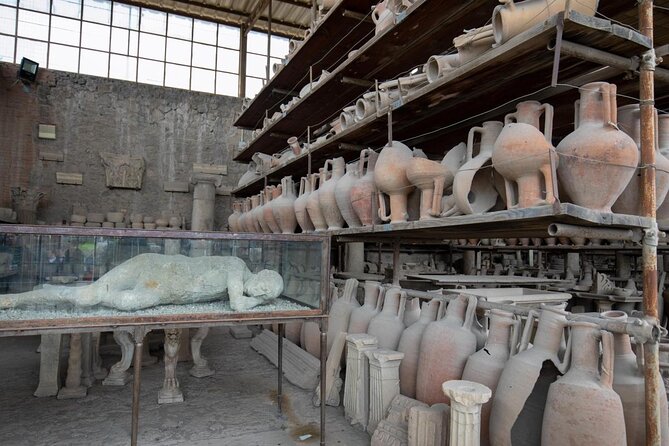
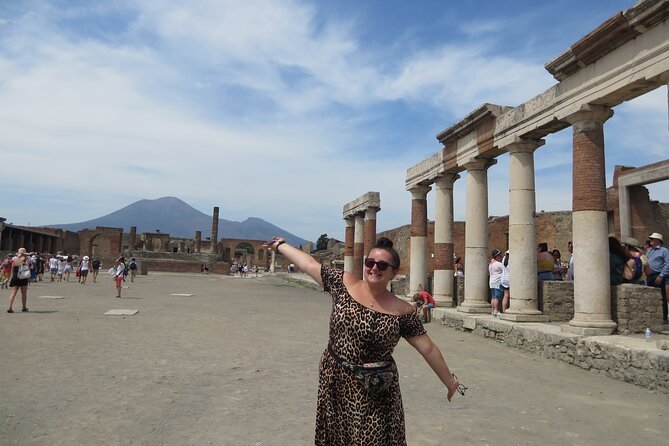
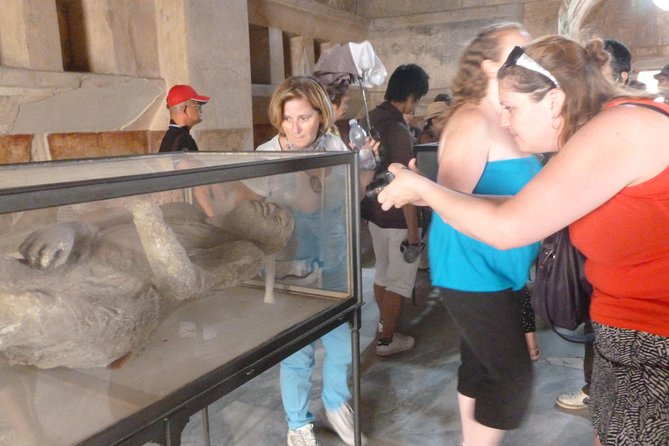
Pompeii is not a place you can “quick glance” without regrets. It’s huge, and it’s dense with details—streets, homes, public spaces, and the tragic evidence of the eruption of Mount Vesuvius in 79 AD. The trick is to balance structured guidance with breathing room.
Here’s the shape of your Pompeii time:
- You arrive via the transport included in the tour.
- You get a tour leader’s explanations with stories and lesser-known anecdotes during the day.
- You then have about 1 hour 30 minutes of free time with your included Pompeii admission.
That free-time window is valuable because Pompeii doesn’t reward rushing in one fixed line. You can choose what you care about most—architecture, street layout, or the feeling of walking through a preserved city. And because the ticket is included, you aren’t losing time at the entrance.
A key consideration: this version is not described as a full guided walkthrough inside Pompeii as standard. A guided tour inside Pompeii is listed as available on request, so if you know you want a narration-heavy experience, ask ahead when booking.
So what should you do with your 90 minutes? I’d aim for this strategy:
- Pick a priority area early, then let yourself meander lightly around it.
- Don’t try to see everything. That only ends with sore feet and blurry photos.
- Use your tour leader’s lead-in to decide what to look for once you’re inside.
Guide note: Nino is specifically mentioned as informative in Pompeii. Even if your guide differs, the format is built to help you decode what you’re seeing so your free time is better spent.
The drive past the coast: Positano and the Amalfi road photo moment
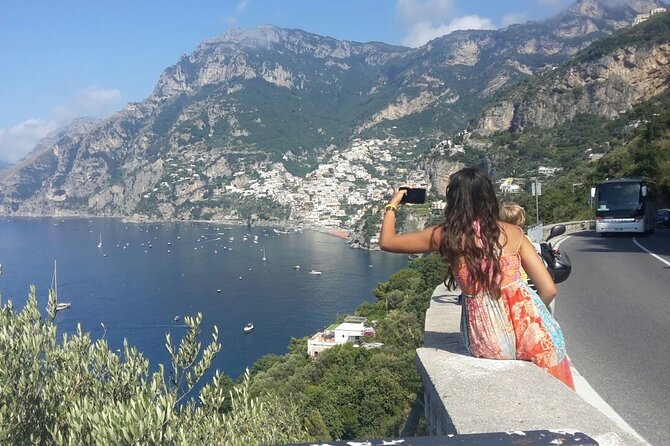
Once you leave Pompeii, the day changes gears. The coast road is where the Amalfi area does its theater—curving viewpoints, sudden drops, and that signature look of towns stacked into the hills.
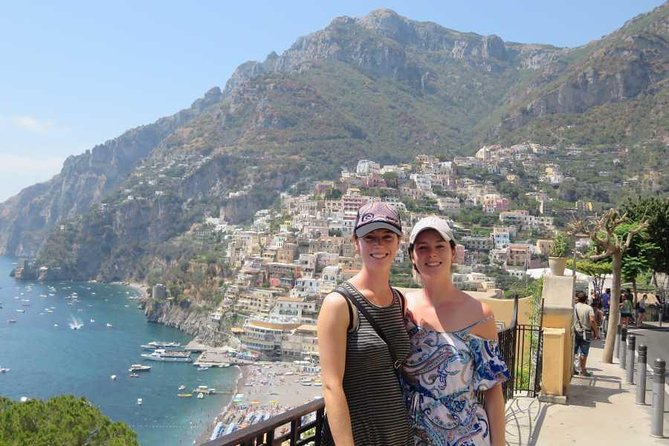
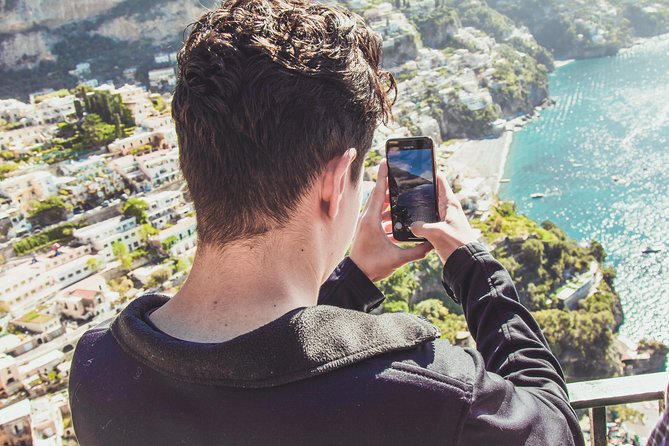
You’ll drive along the spectacular Amalfi road and stop for photos in Positano. That’s the payoff for people who want the famous color-and-cliffs postcard view without spending a day figuring out which bus goes where.
This is also where a small group matters. In a tiny minivan, you tend to get closer to key moments and spend less time waiting for a big vehicle to find everyone. And because the stop is scheduled, you’re not gambling on perfect light or perfect parking.
Then there’s a fun, very practical inclusion: limoncello. The tour description notes a tasting of the yellow lemon liqueur during the day. In practice, this kind of break is useful. It breaks up the long travel arc, keeps the day feeling like a trip instead of a checklist, and it’s a local flavor you can remember later even if you don’t buy a bottle.
If you’re prone to motion sickness, consider bringing what usually helps you. The Amalfi drive is scenic, but it’s also full of bends.
Amalfi town: orientation walk first, then you roam
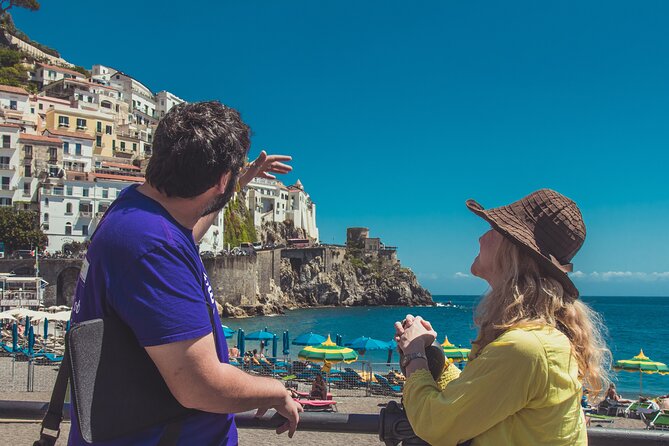
Most Amalfi trips fail at one thing: people arrive with no plan and then spend 45 minutes trying to figure out where the main square is. This one helps by giving you an orientation walk with the tour leader before your free time.
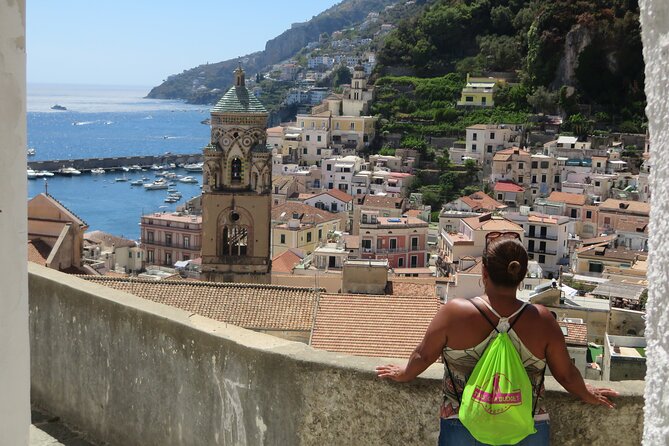
Amalfi is described as charming with historical sights, and one highlight you’ll likely aim for is St. Andrew Cathedral, noted as a 9th-century church in the main square. After that orientation, you get about 1 hour 15 minutes to explore independently.
That mix—short guided orientation plus time to wander—is smart here. Amalfi’s streets can feel like a maze if you don’t know the central points. The orientation gives you bearings fast, and then you get to choose:
- whether you want to linger in the main-square area,
- browse small streets,
- or just enjoy the view and atmosphere.
If you like photo stops, your best photos in Amalfi may come after the orientation, when you know where to stand. If you prefer slower pacing, you’ll also like that the town stop is not a “stay in the van” deal. You’re allowed to use your own legs for a bit.
One more practical note: Amalfi is made for walking, but it’s not flat. Comfortable shoes are worth it, even if you plan to keep your stops short.



The day’s pace: what fits, what doesn’t, and how not to overdo it
This is a 10-hour day (approx.). That means it can be fantastic if you want breadth—Pompeii, Positano, Amalfi—and not if you want deep time in a single place.
Here’s what the schedule supports:
- You’ll see Pompeii and understand what you’re looking at, then still have enough time to wander.
- You’ll get at least one big coastline photo moment (Positano).
- You’ll have a real town stop in Amalfi long enough to enjoy a walk and hit a main sight.
Here’s what the day does not support:
- A slow, unhurried Pompeii experience.
- A long lunch and a sit-down rest hour.
- A full guided deep dive through every corner of Pompeii.
Also, lunch isn’t included. That’s not unusual for day trips, but you should plan for it. Build in a light meal strategy—something quick before Pompeii, and then decide what you want once you’re in Amalfi with your extra free time.
Finally, this experience is weather-dependent. The coast drive needs good conditions, and the provider notes that if poor weather cancels the activity, you’ll be offered a different date or a full refund.
Semi-private comfort: max 7 travelers, less friction
A maximum of 7 travelers is a meaningful detail. It usually means:
- fewer people to coordinate,
- more time for questions without shouting,
- and tighter pacing between stops.
It’s also easier for the guide to manage transitions—train station meeting points, moving to vehicles, and keeping the group together at Pompeii and in town.
In other words: you get the feeling of a group trip, not the feeling of being shipped like luggage. And that affects your overall memory of the day. You’ll feel it in small moments: quicker handoffs, more personal explanations, less waiting in long lines outside the actual sights.
Value and pricing: what you’re really paying for
At $231.55 per person, this isn’t the cheapest day trip in the region. But it’s also not random pricing, because the cost is tied to major pieces you’d otherwise have to piece together yourself.
What’s included:
- Round-trip fast-speed train transportation.
- Pompeii archaeological site entry ticket.
- Scenic driving of the Amalfi Coast plus a Positano photo stop.
- An orientation walk in Amalfi.
- Free time inside Pompeii and free time to explore Amalfi.
When you add up those components, the price starts making more sense. The two biggest costs for DIY travel are time and coordination. You could try to plan rail and bus links, but you’re paying with stress—and stress is the most expensive thing on vacation.
This is also one of those “you pay so you can actually enjoy” situations. If your main goal is to cover the essentials of Pompeii and the coast in a single day without losing half your day to transfers, this structured approach often feels like better value than you’d expect.
Who should book this Pompeii–Positano–Amalfi day trip
This tour is a strong fit if:
- you have limited time in Rome or Naples,
- you want to see more than one major destination in a single day,
- you prefer small-group dynamics instead of a large bus,
- you like a mix of guide context plus independent exploring.
It’s also a good option if you want help choosing where to spend your limited hours in Pompeii and Amalfi. The orientation walk in Amalfi is specifically useful if you’ve never visited before.
If you’re the type who wants a relaxed whole-day Pompeii experience with a lot of guided narration, you might prefer a longer Pompeii-focused tour or request the guided add-on inside Pompeii when available.
Should you book it?
I’d book this if your priority is smart coverage: Pompeii first, then the Amalfi Coast highlights, without the public-transport scramble. The small group size (max 7), the included Pompeii admission, and the Amalfi orientation are the practical reasons this day works. The limoncello inclusion and Positano photo stop are the small reasons it feels fun, not just efficient.
Skip it if you know you need long, slow time in each place, or if a 10-hour day sounds like punishment. And if you’re traveling during a period where weather might be unreliable, keep in mind the provider flags a weather dependency.
If you’re ready for a tightly planned day that still leaves room to wander, this is one of the more sensible ways to connect Pompeii with the coast.
FAQ
Where does the tour start and how do you get to Naples?
You meet the team at the train station in Rome, then take a high-speed train to Naples. The trip is also offered starting from Naples, using a minivan approach for that half of the route.
How long do you have in Pompeii and is entry included?
You have about 1 hour 30 minutes free time in Pompeii Archaeological Park, and entry tickets to Pompeii are included.
Do you get guided time inside Pompeii?
The experience includes time in Pompeii with a local tour leader and free time to explore on your own. A guided tour inside Pompeii is listed as available on request, but it’s not included by default.
What happens on the Amalfi Coast portion of the day?
You drive along the Amalfi road with photo time in Positano, and you’ll also have a tasting of limoncello during the drive. In Amalfi town, you get an orientation walk, then have about 1 hour 15 minutes to explore independently.
Is lunch included?
No. Lunch is not included.
What if the weather is bad or the minimum group size isn’t met?
This experience requires good weather. If it’s canceled due to poor weather, you’ll be offered a different date or a full refund. If it’s canceled because the minimum number of travelers isn’t met, you’ll be offered a different date/experience or a full refund.