REVIEW · ROME
Pantheon: Semi-private Guided Tour with Entry Ticket
Book on Viator →Operated by Kirba Tours · Bookable on Viator
One dome, and suddenly Rome feels logical. This semi-private Pantheon tour adds skip-the-line access so you spend more of your time inside, with a real guide for about 50 minutes instead of racing through as one stop on a bigger route.
I like that the group is capped at 10 people, so questions don’t get lost. I also like that the pacing gives you time to notice the building details (and the story behind them) rather than treating the Pantheon like a quick photo backdrop.
The one drawback to keep in mind: you must provide participant names exactly as on your ID/passport, and you’ll need ID at the entrance. Late arrivals or no-shows won’t be refunded, so show up on time.
In This Review
- Quick hits before you go
- Pantheon with a guide: what changes in 50 minutes
- Where the tour starts (Piazza Capranica) and how it flows
- Skip-the-line and semi-private access: value you can feel
- Inside the Pantheon: dome engineering, light, and details you’ll actually notice
- Headsets, pace, and questions: the small-group mechanics
- Price and logistics: is $47.17 worth it?
- Who this tour suits best (and who might not need it)
- Practical tips to make your visit smoother
- Should you book this Pantheon tour?
- FAQ
- How long is the Pantheon tour?
- What is the price per person?
- Is the tour in English?
- How many people are in the group?
- Is an entry ticket included?
- Are headsets provided?
- Where do we meet, and where does the tour end?
- Do I need to arrange hotel pickup?
- What should I bring for entry?
- What’s the cancellation policy?
Quick hits before you go

- Small group size (max 10): keeps the visit personal and the guide’s attention focused.
- Skip-the-line + ticket included: you’re not just buying entry—you’re buying time.
- About 50 minutes inside: long enough to learn how the Pantheon was built and why it still works.
- Headsets for groups over 6: easier listening inside, where talking over crowds is tough.
- Architecture-first explanations: expect engineering, dome design, and symbolism (not just trivia).
- Guides like Paulo, Nikola, Pietro, Francesco, and Ledio: many tours feature different local guides with a similar style—clear, practical, and question-friendly.
Pantheon with a guide: what changes in 50 minutes
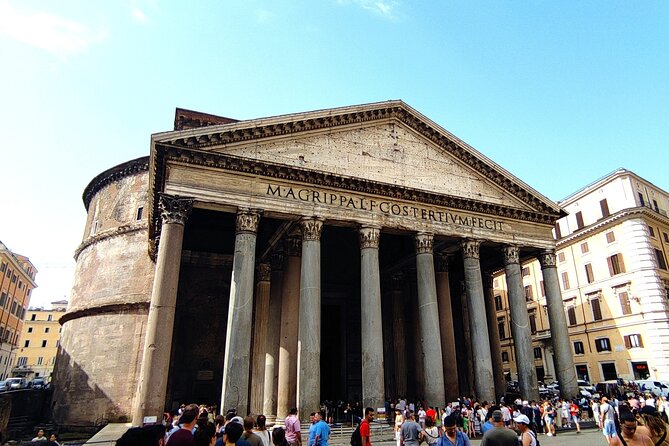
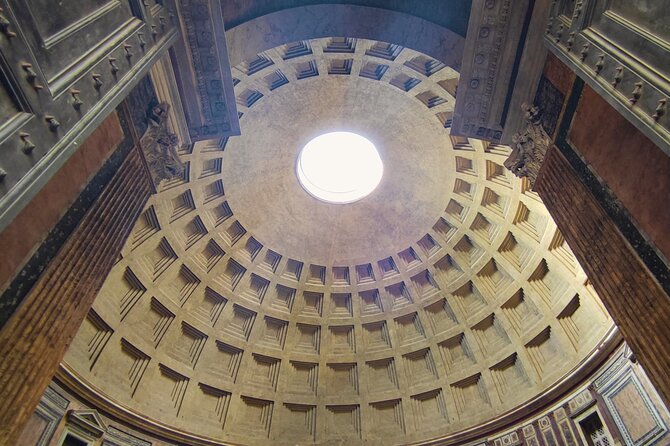
The Pantheon can feel simple at first glance. Then your guide starts pointing out the things you’d probably miss on your own: the Pantheon’s design choices, how daylight behaves through the structure, and the tiny building details that make the place last. It’s one thing to admire the dome from a distance. It’s another to understand the logic behind it.
That’s where this tour wins. It’s focused. You’re not bouncing from one site to the next every few minutes. Instead, you get one “main event” and enough time to connect dots: how the building was engineered, how it has been used over time, and why it still matters today. A short visit with a good guide often beats a longer self-guided walk that’s mostly you trying to figure out what matters.
From the guide styles shared by previous groups, the strongest theme is architecture and engineering—plus a human touch. I’ve seen comments about guides explaining everything with humor and even adding helpful visuals on tablets, which is great when you’re standing in front of a wall and you need a mental picture of what you’re looking at.
You can also read our reviews of more tours and experiences in Rome


Where the tour starts (Piazza Capranica) and how it flows
You’ll meet at Piazza Capranica, in Rome’s historic center (00186). The tour ends at the Pantheon area (Piazza della Rotonda, 00186). That matters because you’re not stuck figuring out how to reconnect with your day right after.
The meeting point is also near public transportation, which is useful if you’re juggling bus/metro timing with other plans. You’ll want to arrive a bit early anyway, because the entrance rules are strict, and groups move together once you’re checked in.
Also, because this is designed as a small group experience, the tour tends to feel like a guided walk into the Pantheon—less like joining a mass line of people and more like stepping into the building with someone who knows where to take your attention first.
Skip-the-line and semi-private access: value you can feel
This tour is priced at $47.17 per person for roughly 50 minutes, and that price makes sense if you care about time and clarity. The main value isn’t only the entry ticket—it’s the combination of skip-the-line access plus an official guide who can keep the visit on track.
Rome’s big-ticket sights are crowded, and the Pantheon is no exception. If you arrive during peak times, you can spend a lot of your day waiting, then feel rushed once you get inside. Here, you reduce the waiting, and you don’t need to choose between “see it quickly” and “understand it.”
It’s also capped at a maximum of 10 people. That cap turns what could be an overwhelming experience into something manageable. In a larger group, you usually end up drifting behind or losing the thread of the explanation. In a small group, you’re more likely to catch key details—like why the dome design is so impressive, or what specific features the guide calls out as you walk around.
Inside the Pantheon: dome engineering, light, and details you’ll actually notice
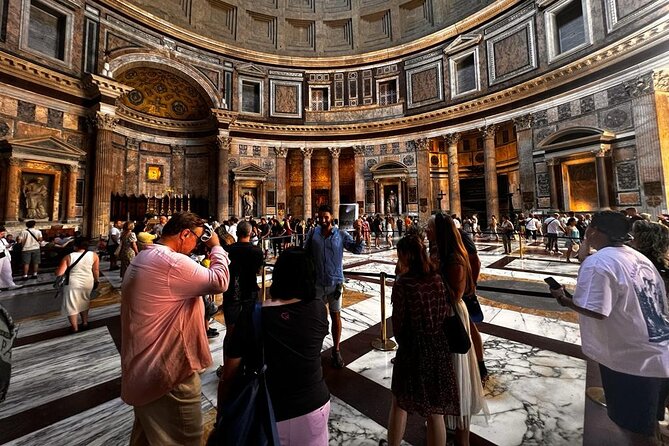
The centerpiece of the tour is the Pantheon itself. You’re inside for about 50 minutes, and that gives the guide enough time to cover more than just the big talking points.
Here’s the type of content you can expect, based on what guides focus on in prior experiences:
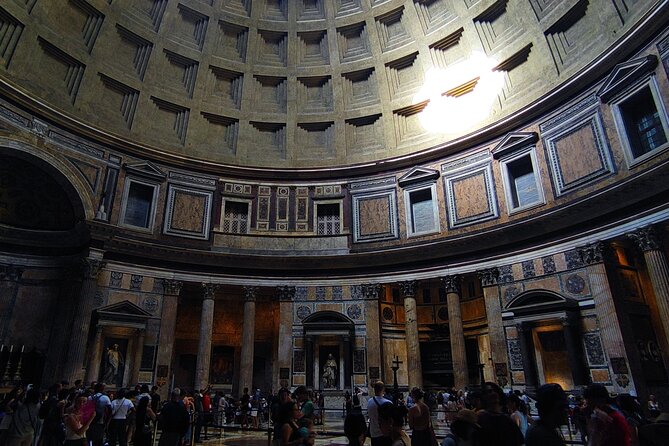
- Dome design and engineering: You’ll hear how the structure works and why the builders’ choices were so clever. People have specifically highlighted explanations of the dome and how it was executed 1900 years ago—so it’s not just a modern “wow” moment.
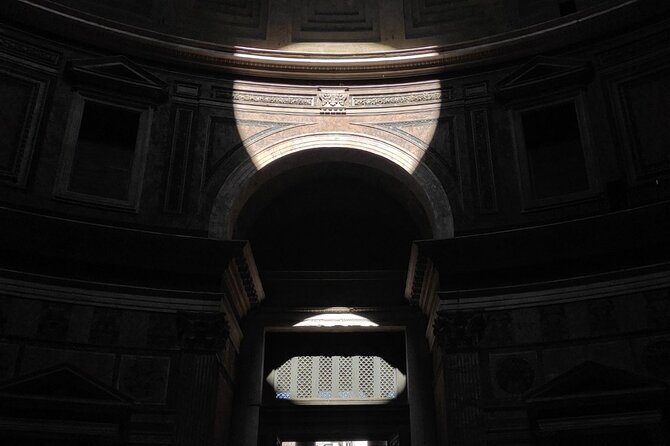
- Light through the dome: Several guides emphasize the way sunlight behaves through the structure throughout the year. That’s the kind of detail that turns the Pantheon from a pretty building into something you can almost “read” while standing there.
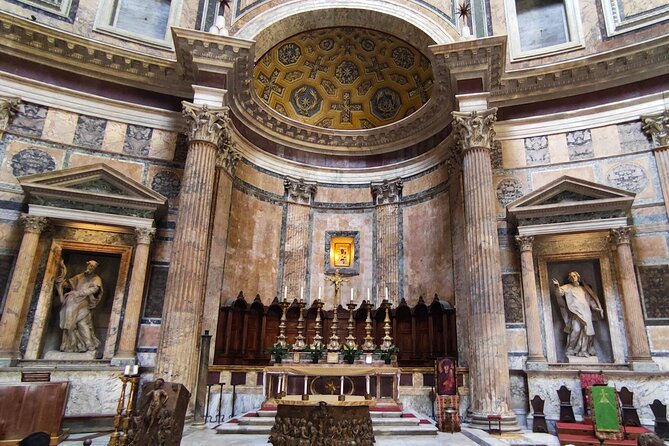
- Tiny features that tell a bigger story: Look for attention drawn to drainage holes, a crack that shows how the building has aged, and empty spaces along the wall. These are the sorts of things you might walk past in silence unless someone points them out.
- Uses over time: You’ll also hear how the Pantheon’s role shifted through the centuries, including its use as a church today. That context helps you understand why the building looks the way it does and why certain elements feel layered rather than frozen in ancient time.
- Symbolism and interpretation: Some guides include symbolism, and a few have used slide show visuals on a tablet to support what you’re seeing in real space.
One smart thing about this style: it encourages you to look longer. You stop treating the Pantheon like a stop you check off and start treating it like a design you can understand.
Headsets, pace, and questions: the small-group mechanics
When the group gets above six people, you’ll be provided headsets so you can hear the guide clearly. That detail matters more than it sounds. Inside the Pantheon, sound can bounce weirdly, and crowds compress your space. Headsets reduce the “guessing game” of what the guide is saying.
Pacing also tends to be a highlight. People describe well-paced tours where the guide keeps things moving but doesn’t bulldoze. You get time to follow along, and you’re not pushed out at the first hint of the crowd shifting.
You’ll also have opportunities to ask questions. Past tours mention guides answering questions freely, sometimes with a back-and-forth that makes the explanation stick. If you like getting clarification—why a design choice matters, how something worked in the past—this format is built for that.
And if you’re traveling as a pair or family, the small-group nature is a plus. One family-sized group even noted how a guide made the information accessible enough for a 9-year-old to stay engaged. That doesn’t mean it turns into a kids’ tour, but it does suggest the explanations aren’t stuck in “technical lecture only” mode.
You can also read our reviews of more guided tours in Rome






Price and logistics: is $47.17 worth it?
Let’s talk value in real terms.
What you pay for:
- Pantheon entry admission ticket
- A guided tour with an official local guide
- A mobile ticket
- Headsets for groups of 6+
- Skip-the-line-style convenience (so you spend less time in lines)
What you don’t pay for:
- Hotel pickup/drop-off
- Tips
For $47.17 and about 50 minutes, you’re paying for two things that are hard to replicate on your own: (1) time saved, and (2) interpretation. If you go in without help, you can still enjoy the Pantheon—no question. But you’ll likely miss the “why” behind the details. And missing the why is exactly where guided visits tend to justify their price.
Another value factor: advance booking. This experience is typically booked about 49 days in advance on average. That’s a hint that the most convenient slots don’t linger forever. If you’re traveling during busy seasons, booking ahead helps you lock in a time window that keeps the day from turning into a waiting-and-rushing cycle.
Who this tour suits best (and who might not need it)
This tour is a strong fit if you:
- Want one focused stop rather than a multi-stop Rome sprint
- Care about architecture, engineering, and how older buildings were actually made to last
- Prefer asking questions in person over relying on an audio app
- Don’t want to spend half your visit in a line
It may be less necessary if you:
- Prefer a completely independent visit with no structure
- Don’t particularly care about the dome’s engineering details or symbolism and just want photos and general views
- Are comfortable with self-guided interpretation using apps or guidebooks
But even then, the extra time inside—paired with skip-the-line convenience—can still make it feel like the easiest way to enjoy the Pantheon without wasting your energy.
Practical tips to make your visit smoother
A few details can make or break the experience with tours that require pre-checks:
- Bring your ID/passport. Entrance depends on it.
- Make sure your booking includes full participant names exactly as shown on your ID, plus age. Incomplete or mismatched info can jeopardize entrance.
- Arrive early enough to handle the check-in rhythm. Late arrivals aren’t refunded, so don’t treat this like a casual meetup.
- Wear comfortable shoes. You’ll be walking and stopping inside, and crowds can force you to adjust.
- If you’re sensitive to noise, headsets help when groups go over six people—worth it for hearing every key point.
One more small note: the Pantheon is popular. Even with skip-the-line convenience, you may still experience crowd density inside. That’s normal. The value of the guide is that you don’t lose the important details just because the space is busy.
Should you book this Pantheon tour?
If you want the Pantheon to make sense—not just impress you—book it. The combination of small group size, skip-the-line convenience, and a guide focused on engineering, light, and specific details turns a one-time sight into something you can understand before you walk back out into Rome.
I’d especially recommend it if:
- You’re going for architecture and want more than surface-level explanations
- You’d rather spend time learning than waiting
- You like guided Q&A and hearing how the design works in real terms
If you’re mainly there for photos and you enjoy wandering without structure, you can still have a great time without a guide. But if you’re paying attention to how the building works—how the dome design, sunlight behavior, and even drainage details connect—this tour is one of the better ways to do it efficiently.
FAQ
How long is the Pantheon tour?
It’s about 50 minutes.
What is the price per person?
The price is $47.17 per person.
Is the tour in English?
Yes, it’s offered in English.
How many people are in the group?
This experience has a maximum of 10 travelers.
Is an entry ticket included?
Yes. The Pantheon entry ticket is included.
Are headsets provided?
Headsets are provided for groups of 6 people or more.
Where do we meet, and where does the tour end?
The start is Piazza Capranica, 00186 Roma RM, Italy, and the end is Pantheon, Piazza della Rotonda, 00186 Roma RM, Italy.
Do I need to arrange hotel pickup?
No. Hotel pickup and drop-off are not included.
What should I bring for entry?
You must bring ID or a passport for adults and children. Full names as shown on your ID card and age are needed at booking.
What’s the cancellation policy?
Free cancellation is available up to 24 hours in advance for a full refund. No-shows or late arrivals are not refunded.