REVIEW · ROME
Golf Cart Small-Group Guided Tour: Rome City Highlights
Book on Viator →Operated by Biga Tours · Bookable on Viator
Rome is big, loud, and easy to overdo. This golf cart highlights tour is a smart way to cover the key monuments fast while keeping your ears on the guide’s story with headsets. In a single 2.5-hour loop, you get the big-picture Rome vibe without spending your whole day in lines.
I like the practical pace here: short stops for iconic places, plus drive-by views that show you how neighborhoods connect. You also get a small group experience (up to 14 people, max 2 carts), which makes it easier to ask questions and stay oriented.
One thing to plan for: stop times are brief, so this is built for seeing, not lingering. If you want long, slow museum-style visits, you’ll likely use this as your starter map, then come back later.
In This Review
- Key things I’d watch for
- Why a golf cart makes sense for Rome highlights
- Price and what you actually get in 2.5 hours
- Meeting point at V. Monterone, ending outside the Colosseum
- Small-group setup: carts travel together, you all hear the guide
- Stop-by-stop: Pantheon quick look, then Trevi for the coin moment
- Piazza Colonna drive-by: a Roman “power strip” in stone
- Pantheon brief stop: exterior focus, interior is extra
- Trevi Fountain: 10 minutes is enough for photos and stories
- Spanish Steps and Piazza di Spagna: the perfect pause for street-level Rome
- Piazza del Popolo and the Via Flaminia idea
- Mausoleum of Augustus drive-past: Rome’s long shadow
- Piazza Navona: a stadium-shaped square with theater in its DNA
- Largo Argentina temples: a rare “archaeology in plain sight” moment
- Campidoglio and Piazza Venezia: Michelangelo planning meets state power
- Monti Neighborhood drive-by: where artisans, shops, and attitude live
- Gelato, water, and the small comforts that keep you happy
- Guides: the real value is how they connect details
- How to get the best from short stops (without feeling rushed)
- Who should book this Rome highlights golf cart tour
- Should you book it?
- FAQ
- How long is the Rome City Highlights golf cart tour?
- What is the price per person?
- What language is the tour delivered in?
- Are headsets included?
- How big is the group?
- Where does the tour start and end?
- Is the Pantheon admission included?
- What food or drinks are included?
- What is the cancellation policy?
Key things I’d watch for
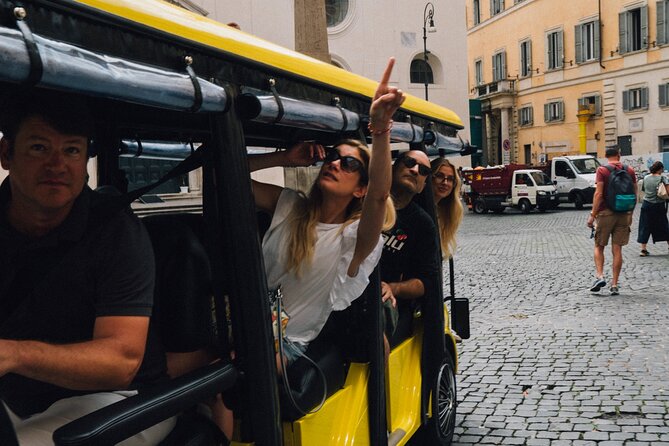
- Headsets for clear narration so you’re not guessing what your guide is saying
- Up to 14 people, two carts max with carts traveling together
- Gelato plus water and snacks included, so you can keep moving
- Brief photo stops at major sights, including the Pantheon (entry not included)
- Easy to end near the Colosseum with less walking than a full walking route
Why a golf cart makes sense for Rome highlights
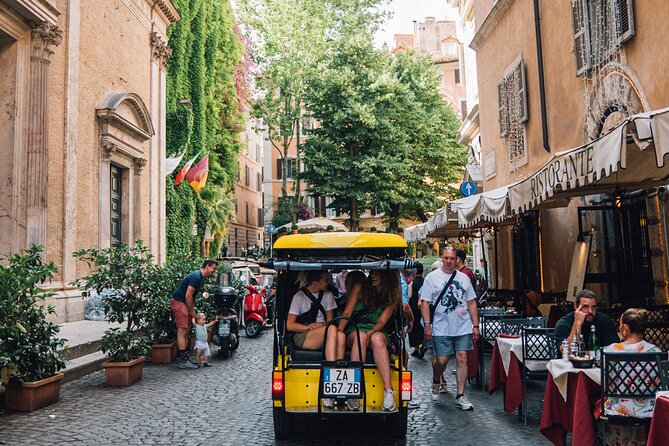
Rome’s center is beautiful, but it can also be a traffic-and-cobblestone puzzle, especially if you’re trying to move quickly from one famous spot to the next. An electric golf cart cuts the friction. You still get street-level views and photo moments, but you’re not worn out by constant walking.
This matters on a first day. You’ll get a “where is what” sense of the city that helps later when you’re choosing what to revisit. And because you’re following a planned route, you don’t waste time threading narrow streets on your own.
You can also read our reviews of more guided tours in Rome



Price and what you actually get in 2.5 hours
This tour costs $104 per person for about 2 hours 30 minutes, and it’s priced like a value “highlights sampler.” The biggest reason it can feel worth it is that entry fees are not the focus. Most stops are exterior or quick views, so you’re paying mainly for guided interpretation plus transport.
Here’s what’s included: an electric golf cart, an English-speaking local guide/driver, headsets, bottled water, and one gelato per person. Add the fact that you’re moving as a group with a guide, and that short time window becomes less stressful.
What’s not included: gratuities and additional food or drinks, and the Pantheon stop is listed with admission not included. So if you want to go inside the Pantheon, you’ll need to plan that as an add-on during separate time.
Meeting point at V. Monterone, ending outside the Colosseum
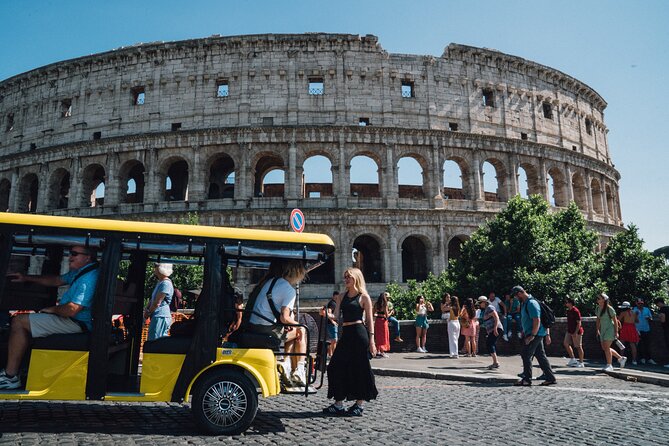
The tour meets at V. Monterone, 19 (00186 Roma RM). It ends at Colosseum, Piazza del Colosseo, 1 (00184 Roma RM), outside the Colosseum.
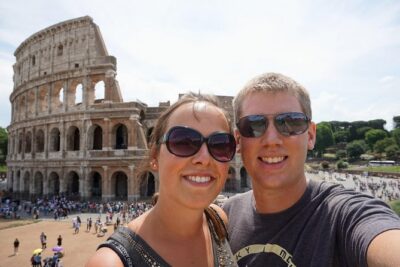
That end point is a big deal. It can save you time because you’re dropped in an area many people already want to visit. If you’re hoping for a smoother flow, I’d build your schedule so you can keep exploring from there.
A practical caution: Rome can be hard to navigate on short taxi timing. The tour can’t pause for late arrivals, so give yourself buffer time and try to be at the office early.
Small-group setup: carts travel together, you all hear the guide
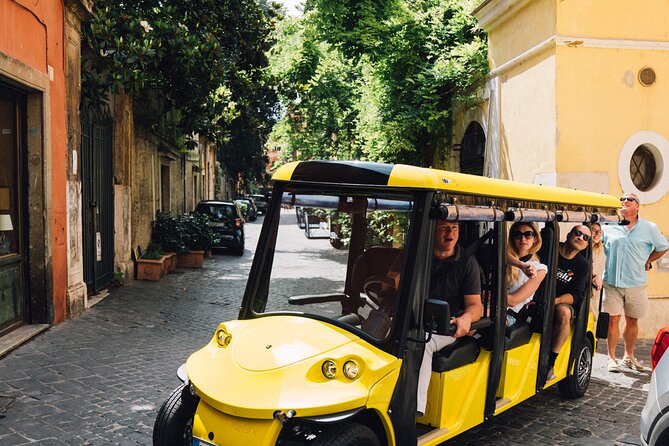
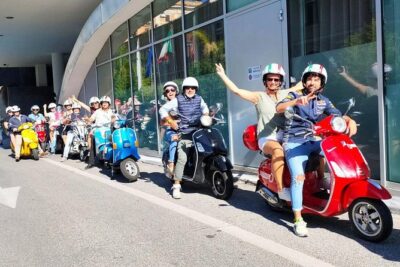
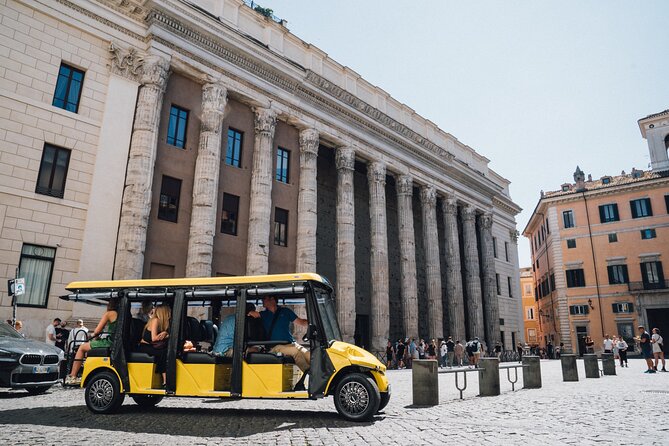
This is capped at 14 participants with up to 2 vehicles. The carts drive together like connected carriages, and everyone listens through the same tour guide using earpieces.
I like this setup for two reasons. First, you don’t feel swallowed by a huge crowd. Second, the guide’s narration is designed to be heard clearly, so you’re not just doing a sightseeing slideshow.
Still, be aware of one risk: if you’re seated farther back or your headset has an issue, you may miss some narration. That’s not common, but one person did mention temporary headset problems from their seat position. If it happens, speak up right away so the team can troubleshoot while you’re still at the stops.
Stop-by-stop: Pantheon quick look, then Trevi for the coin moment
You can also read our reviews of more city tours in Rome



Piazza Colonna drive-by: a Roman “power strip” in stone
Early in the route, you’ll drive past Piazza Colonna and see the Column of Marcus Aurelius, one of the surviving triumphal columns in Rome. Even if you’re not an architecture nerd, this is a strong visual lesson. It shows how Rome’s public monuments were designed to broadcast authority in public space.
Because this is a drive-through moment, you’ll get a view and likely quick context, not a long photo session.
Pantheon brief stop: exterior focus, interior is extra
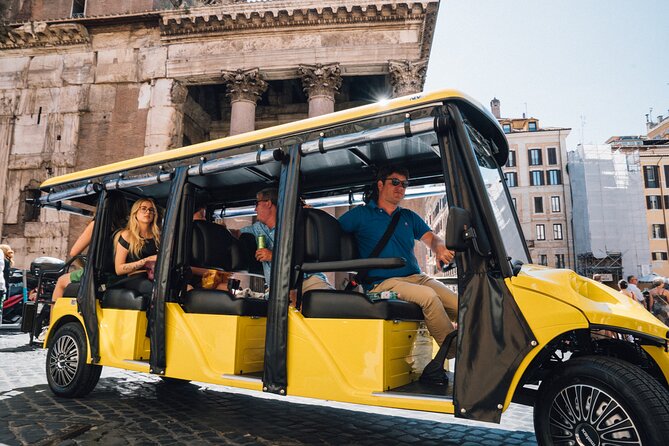
You’ll stop at the Pantheon for about 5 minutes. Admission is not included, which strongly signals you should treat this as a photo-and-orientation break rather than an in-depth interior visit.
If your heart is set on entering, I’d plan separate time. This quick stop is best for soaking in the scale from the outside and understanding what you’ll later want to see up close.
Trevi Fountain: 10 minutes is enough for photos and stories
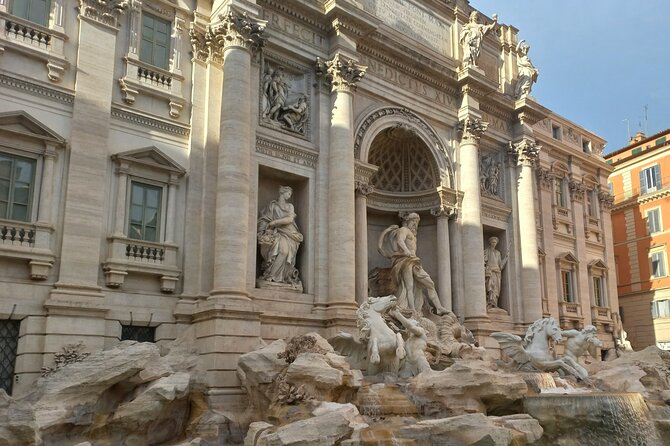
At Trevi Fountain, you get a longer break, about 10 minutes, and admission is listed as free. This is the one stop where you can actually do the “coin toss” without feeling rushed.
A helpful way to use your time here is simple: pick your photo spot, throw your coin, then watch the water and let the guide connect the fountain to Roman history and later culture. The fountain’s Roman-era roots are part of what makes this stop so popular, and the guide narration helps you see past the postcard.
Also, your gelato is coming soon, so don’t overdo snacks right before this stop.
Spanish Steps and Piazza di Spagna: the perfect pause for street-level Rome
Next comes the Spanish Steps and Piazza di Spagna. You’ll have about 10 minutes here, with admission listed as free.
This is a stop that works even if you’re tired, because the setting is naturally photogenic and full of energy. The steps originally connected the Spanish embassy area with the church at the top, and hearing that context makes you look at the geometry in a new way.
If you want better photos, position yourself early. The later it gets, the more crowded it can be right along the main angles.
Piazza del Popolo and the Via Flaminia idea
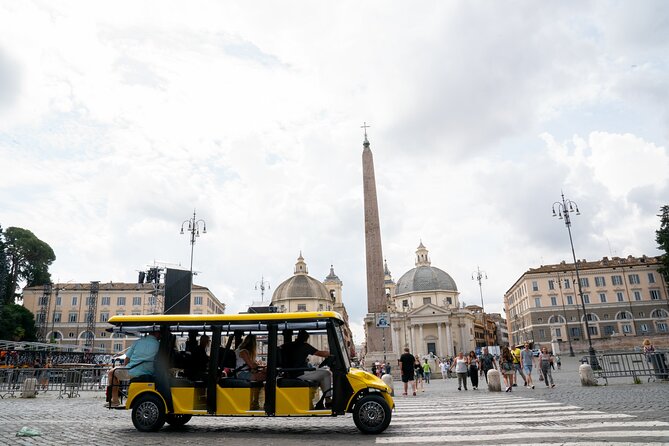
You’ll reach Piazza del Popolo, described as a northern gateway of the city, for a short 5-minute stop. It’s tied to the Via Flaminia, the road leading north.
This is one of those “quietly important” stops. It helps you understand Rome as a network of routes, not just isolated monuments. You’re getting the sense of how the city worked, and that makes your later self-guided wandering smoother.
Mausoleum of Augustus drive-past: Rome’s long shadow
Another drive-through moment includes the Mausoleum of Augustus (built in 28 BC). These pass-by stops are underrated. You don’t linger, but you still see Rome’s timeline layered across the modern streets.
A good mindset here: use the cart ride time to let the guide connect the ancient structures you’re passing to the neighborhoods around them. You’ll be better prepared for what you’ll see later when you’re walking.
Piazza Navona: a stadium-shaped square with theater in its DNA
At Piazza Navona, you get a brief stop of about 5 minutes. The key detail is that the square’s shape echoes the Stadium of Domitian from the 1st century AD.
This is exactly the kind of stop that pays off when a guide is good. You look at a beautiful piazza, then the guide explains how it’s built on an earlier Roman competition ground. After that, you’ll notice the space as a designed arena, not just a place to admire fountains and cafes.
Short stop time is a limitation, but it’s also a feature. It keeps the whole tour moving while still giving you a mental model for the city.
Largo Argentina temples: a rare “archaeology in plain sight” moment
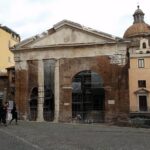
You’ll see Area Sacra di Largo Argentina, which is tied to the Roman temples found at Largo di Torre Argentina. You’ll get about 5 minutes, with admission listed as free.
This is one of the most meaningful stops on the route because the site is an archaeological context point, not just a famous photo location. Hearing the explanation of how that square was uncovered after older neighborhood demolition helps you appreciate why Rome is unusual: you can’t treat history like a museum exhibit. It’s in the ground and around you.
Campidoglio and Piazza Venezia: Michelangelo planning meets state power
Next is Piazza del Campidoglio, described as a square planned following Michelangelo’s criteria with a design unity. You’ll have about 5 minutes for a brief look at the grand staircase.
Then you’ll reach Piazza Venezia, tied to the monument to Victor Emmanuel II, often called the Altar of the Fatherland. This stop is short (about 5 minutes), but it’s important for understanding modern Italy’s national symbolism in the same urban fabric as ancient Rome.
If you’re into photography, these two stops often give you strong lines for framing. Use the cart to position, then do quick snapshots once you’re out.
Monti Neighborhood drive-by: where artisans, shops, and attitude live
The tour also drives through Monti, Rome’s first ward. The description here leans into a mix of cobblestones, vintage shopping, artisan vibe, and good food and bars.
Since it’s a drive-through, you’re not meant to shop during the cart segment. But this is exactly the kind of neighborhood preview that can guide your later plan: if you like the feel of Monti, you’ll know where to aim for a longer wander afterward.
Gelato, water, and the small comforts that keep you happy
You’ll receive bottled water plus a snack: one gelato per person. In the real world, this is practical. You’ll likely walk a bit during stop transitions, and Rome weather can shift fast.
One person specifically raved about gelato flavors like almond, orange jam, and butter crumble. You can’t count on the same flavors every day, but the tip is solid: if those choices show up, take one.
Also, if you finish near a gelato stop with an outdoor market nearby, you might get a quick chance to browse. It’s not a structured market tour, but the timing can line up with a nice break.
Guides: the real value is how they connect details
The cart itself is the transport. The guide is what turns it into a story you can use.
Across the experience, several guide names stood out: Francesco, Andrea, Franco, Marco, Clare, Amber, Val, and Leo. Different personalities show up, but the common thread is clear explanations, humor, and connecting ancient Rome to what you see today.
If you want an easy win for your guide experience, come with a simple question. Example: ask what you should focus on later if you come back to the Pantheon area or Trevi. When the guide is good, you’ll walk away with a plan, not just facts.
How to get the best from short stops (without feeling rushed)
This tour works only if you treat it as a highlights circuit. Most monument stops are 5 to 10 minutes, so your goal is quick learning and solid photos, then follow up later.
Here’s what helps:
- Use the headset time to learn the story, then switch to photo mode when the guide signals.
- If you care about interior entry (like the Pantheon), note that admission isn’t included, then set a separate time after the tour.
- If you’re doing this in cooler weather, bring layers. One person noted they were offered blankets, which is a nice touch.
Finally, don’t plan to bolt immediately at the end. The route ends near the Colosseum, so give yourself a few minutes to reorient and decide what to do next.
Who should book this Rome highlights golf cart tour
This tour is a great fit if you:
- Want orientation in Rome in a short window
- Prefer less walking over a full walking route
- Like guided context, not just photos
- Travel as a small group and want an organized way to move through the city
It may be less ideal if you’re looking for a slow, museum-depth pace. This route is built for seeing the big names and getting the meaning, then using your own time afterward for deeper visits.
Also, if you’re someone who likes flexibility, you can ask about your ending plan. One person advised asking the driver to take you back to the pickup point instead of ending outside the Colosseum, turning the return ride into extra context along the route. That’s worth asking if you want the tour to feel more like a full loop.
Should you book it?
I’d book this if you want a first-day boost that’s easy on your feet and rich in context. The small group, the headsets, and the included gelato and water make the experience feel organized instead of chaotic, and the guides like Francesco, Andrea, Franco, Marco, Clare, Amber, Val, and Leo tend to make the stories stick.
Skip it if you already have your day tightly planned for interior visits and long stops. This tour won’t replace a full Pantheon or museum-level experience. Think of it as your Rome starter pack: you’ll get your bearings fast, then choose what to revisit when you’re not rushing.
FAQ
How long is the Rome City Highlights golf cart tour?
The tour is listed at about 2 hours 30 minutes.
What is the price per person?
It costs $104.00 per person.
What language is the tour delivered in?
The tour is offered in English.
Are headsets included?
Yes. Headsets are included so you can clearly hear the guide.
How big is the group?
The tour has a maximum of 14 travelers and runs with up to 2 vehicles (7 seats per cart). The carts travel together, and you all listen to the same guide using earpieces.
Where does the tour start and end?
It starts at V. Monterone, 19, 00186 Roma RM and ends outside the Colosseum at Colosseum, Piazza del Colosseo, 1, 00184 Roma RM.
Is the Pantheon admission included?
No. The Pantheon stop is listed as admission not included, while other stops are listed as free.
What food or drinks are included?
You get bottled water and one gelato per person, plus snacks.
What is the cancellation policy?
Free cancellation is available up to 24 hours in advance for a full refund. If you cancel less than 24 hours before the start time, the amount you paid will not be refunded.