REVIEW · ROME
German Vom Kapitol bis zum Campo de’ Fiori – Walkingtour
Book on Viator →Operated by Deutsche Römerin · Bookable on Viator
A walk with the right stories makes Rome click fast. This German-guided route runs from the Capitol Hill area down to Campo de’ Fiori, with humor, architecture talk, and city-life anecdotes that connect the big landmarks to what Romans actually did and argued about.
I especially like the Capitol-to-Forum views and the way the guide ties them to Rome’s origins. I also like the ending at Campo de’ Fiori, because you’re dropped into a lively neighborhood where you can keep going without planning your next move. The main thing to consider is that you pay for the guide and walking time, not entry fees or food—so you’ll want to bring water and plan your own snacks.
In This Review
- Key highlights you’ll actually feel during the walk
- From Marc Aurelius to the Forum views: the walk starts strong
- Piazza del Campidoglio: foundation myths, talking statues, and coin details
- The panorama walk toward the Colosseum: your best photo window
- Forum Boarium (the old cattle market): the market inside the market
- Marcellus Theater and the Jewish Quarter: smaller corners, better walking rhythm
- Largo Argentina: the assassination spot that changes the mood
- Campo de’ Fiori: where the tour ends and your evening begins
- German language guide: what you gain (and who should plan for it)
- Group size, pacing, and what to bring for a comfortable 3 hours
- Value and price: why $93.68 can make sense here
- Who should book this German walking tour (and who might skip it)
- Should you book it? My practical decision test
- FAQ
- How long is the German walking tour from the Capitolin area to Campo de’ Fiori?
- How much does the tour cost?
- What language is the guide speaking?
- Where do I meet the guide?
- Where does the tour end?
- Is the ticket delivered on a mobile device?
- Is there a group size limit?
- What is included in the price?
- What is not included?
- Is free cancellation available?
Key highlights you’ll actually feel during the walk
- Small group energy (max 18) that makes it easier to ask questions and keep a steady pace.
- Marc Aurel meeting point right at Piazza del Campidoglio, so you start with a strong visual anchor.
- Panoramic stretch toward the Colosseum and Forum area for classic photos without feeling rushed.
- Forum Boarium and the weekend market clue—a practical window into daily Roman rhythms.
- Jewish Quarter detours plus the Schildkrötenbrunnen for a softer, more intimate side of central Rome.
- Largo Argentina and Julius Caesar’s assassination location for a dramatic story-stop before you reach Campo de’ Fiori.
From Marc Aurelius to the Forum views: the walk starts strong
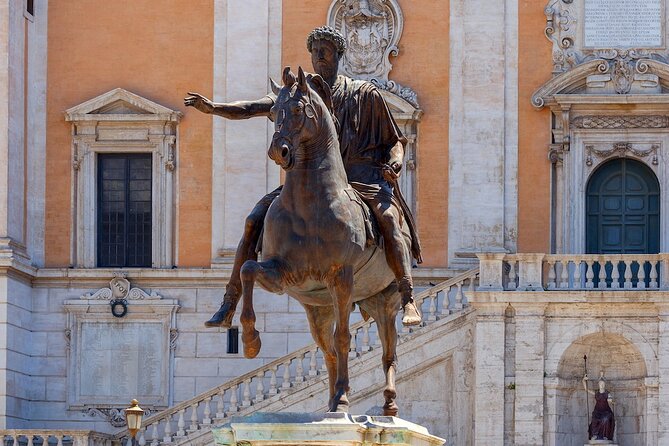
Rome can feel like a list. This tour avoids that trap by starting high, at the equestrian statue of Marcus Aurelius on the Capitol Hill side. From there, you get the kind of overview that helps you orient yourself for everything that comes later. Even if you’ve visited Rome before, a viewpoint like this makes the scale of the Forum area finally make sense.
The guide’s job here is not just to point. You’re led through the meaning behind the scenery: how the city grew, why certain buildings matter, and how public space shaped daily life. And because it’s a walking format, you’re not stuck looking at a sight for ten minutes and moving on with no context.
You can also read our reviews of more tours and experiences in Rome.



Piazza del Campidoglio: foundation myths, talking statues, and coin details
Your first stop is Piazza del Campidoglio, where you meet the guide at the Marc Aurel statue. This is where the tour sets up a theme: Rome isn’t only stone. It’s stories, symbols, and propaganda—stuff you can read if someone points you in the right direction.
Two details are especially useful here:
- Rome’s foundation story in plain terms, so you’re not drowning in names.
- The idea of speaking statues—public sculptures that people used to voice opinions. It’s a great way to understand how Romans handled politics in the street.
The guide also connects monuments to what you may have seen on Italian money coins. That’s not random trivia. It’s a smart trick for remembering symbols you’ll keep seeing as you walk through the city on your own later.
If you’re a photo person, this stop helps you frame the next one. If you’re not, it still helps because you learn what to look for when the Forum area starts to appear in the distance.
The panorama walk toward the Colosseum: your best photo window
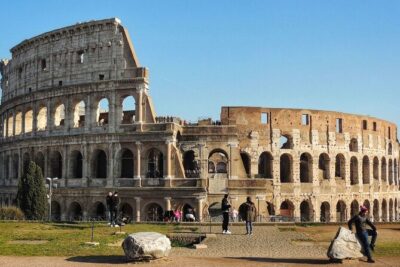
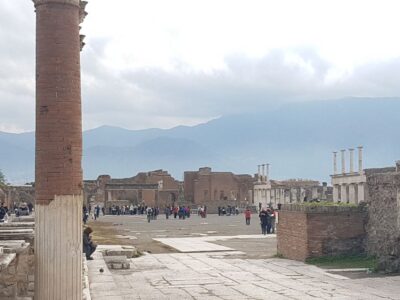
After the Capitol area, the route shifts onto a panorama path. The goal is simple: you walk through the viewpoints, not around them. You see the Forum Romanum stretching toward the Colosseum, and it’s one of those moments where Rome looks built for dramatic staging.
This is also where the tour earns its keep for people who don’t want a “big sights only” day. The guide’s anecdotes keep the walk from turning into background while you scroll photos. Instead of feeling like you’re covering ground, you feel like you’re watching the city unfold.
Practical note: this is still a walking tour, so wear shoes you can trust. Rome sidewalks can be slippery or uneven, and you don’t want a cracked heel to ruin your stories.
Forum Boarium (the old cattle market): the market inside the market
Next you reach the former ancient cattle market of Rome, the Forum Boarium. The name alone gives you a clue: this wasn’t just temples and emperors. It was commerce. It was supply chains. It was the everyday engine of a working city.
The standout part for me is the practical angle. The guide shows you where you’ll find the best farmers market every weekend. That turns an ancient site into something useful for your real schedule.
Here’s why that matters: Rome’s center is full of restaurants and museums, but not everyone plans one local shopping moment. A market stop can make your trip feel less like sightseeing and more like living—especially if you like to eat what locals buy.
Also, Forum Boarium sits in a web of streets that are quieter than the main tourist lanes. So you get a change of pace without losing the “this is important” factor.
Marcellus Theater and the Jewish Quarter: smaller corners, better walking rhythm
As you pass the Marcellus Theater, the tour flows into the Jewish Quarter. This is a smart switch in tone. After the Forum/Capitol sweep, you move toward smaller streets where details matter more than scale.
Two reasons this section works well:
- The guide keeps the stories human-sized, so you’re not just hearing dates and dynasties.
- You’re given time to notice those small, romantic side spots that you usually miss when you’re chasing only the loud attractions.
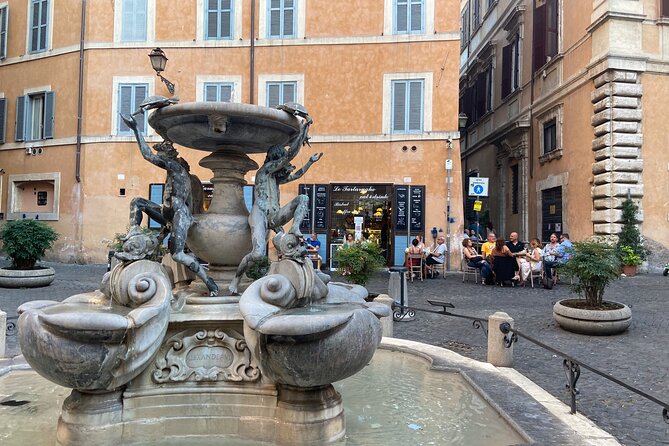
One highlight named in the route is the Schildkrötenbrunnen, described as a romantic tortoise fountain. It’s the kind of thing that’s easy to walk past without noticing. Having a guide point it out gives you a reason to slow down, and slowing down is where Rome turns from scenery into memory.
If you’re traveling with kids, this part tends to play well because it’s visual and story-driven. Even if your group is mostly adults, small surprises like this help break up the “stop–look–move” rhythm.






Largo Argentina: the assassination spot that changes the mood
Then comes Largo Argentina, the area tied to Julius Caesar’s assassination. This stop changes the mood fast. You’ve been moving through daily life and neighborhood texture, and now you hit a site associated with political violence and the turning points of an empire.
What I find valuable here is how the tour uses place to make the story feel real. Instead of treating Caesar as a figure from a book, you see the geometry of the space and learn what kind of public setting could host that kind of event.
You may also get a feel for why this spot is so heavily referenced in Rome. In a city full of grandeur, it’s the moments of drama that often stick hardest.
Tip for your own mental map: after Largo Argentina, you’ll be heading toward Campo de’ Fiori. That means you can keep walking into a lively evening instead of ending the day in a museum-style dead stop.
Campo de’ Fiori: where the tour ends and your evening begins
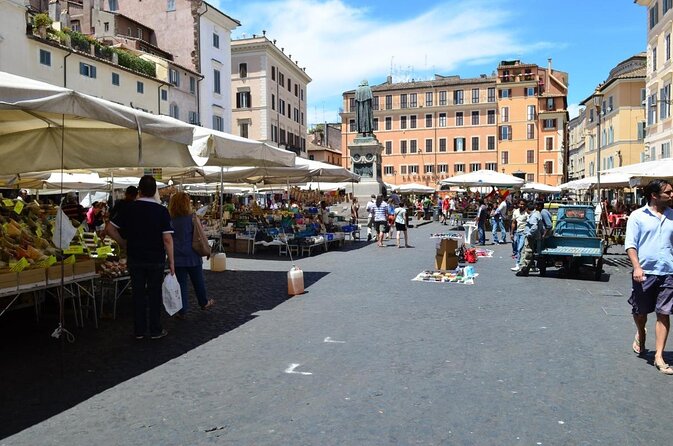
The walk finishes at Campo de’ Fiori, one of Rome’s most famous squares for nightlife and atmosphere. The best part is that you’re not stuck at the end of a route with nowhere to go.
You can use this time immediately:
- find a bite to eat
- grab an aperitivo
- wander side streets without worrying that you’re late for the next scheduled stop
This is why the ending matters. A walking tour is at its best when it points you to how to spend the hours right after it ends.
Also, Campo de’ Fiori is a convenient anchor. If you want to continue exploring on your own, you’re starting from a central meeting point that’s easy to navigate from.
German language guide: what you gain (and who should plan for it)
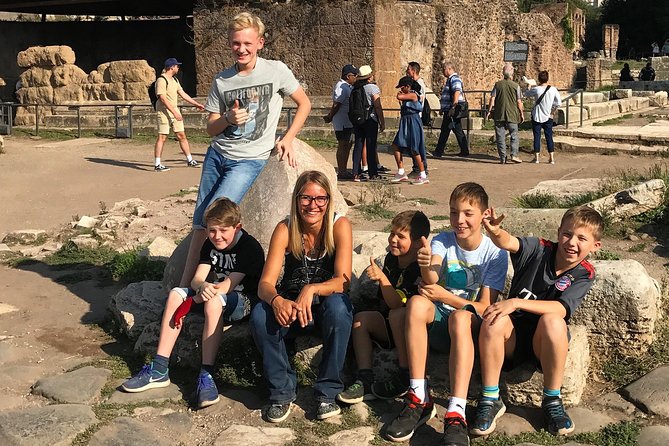
This tour is in German for about 3 hours. That’s part of the value because it shapes how the guide tells the story. Language matters in Rome. Small details—like wordplay around speaking statues or how coin symbolism is explained—land better when it’s delivered in your strongest language.
The operator also keeps things manageable with a maximum of 18 travelers, which helps you hear explanations without feeling packed in.
This is worth thinking about if you’re traveling as a mixed-language group. If you don’t speak German, you might still enjoy the visuals, but the full experience depends on understanding the guide’s talk.
One more helpful point: the tour is said to be suitable for most travelers, and service animals are allowed. It also runs near public transportation, which matters if you want to hop in and out around other plans.
Group size, pacing, and what to bring for a comfortable 3 hours
Three hours sounds short, but Rome walking adds up. Since there’s no transportation included, you’ll be walking the route between stops as part of the experience.
Here’s what I suggest you bring:
- comfortable shoes (the sidewalks and curb cuts can be uneven)
- water, because the tour doesn’t include snacks
- a light layer, especially if you’re visiting in shoulder seasons or if weather changes quickly
Weather can also affect the tone. In the past, guides like Mira have been praised for staying flexible even with rain. That’s a good sign for planning: you should expect the guide to adapt rather than cancel the whole feel of the day.
Value and price: why $93.68 can make sense here
The price is $93.68 per person, and what you’re paying for is a 3-hour German language guide. You’re not paying for museum admissions (one listed detail is free admission at Piazza del Campidoglio), and you’re not paying for snacks or transportation.
So the value depends on what you want most:
- If you want a guided story walk that connects viewpoints, neighborhoods, and key historical moments, the price can feel fair.
- If you’re mainly looking for entry tickets and you don’t care about explanations, you might compare costs with other self-guided options.
Where this tour wins for value is in the storytelling style—humor, wit, and city-life anecdotes are repeatedly highlighted in guide feedback. Names that have shown up as guides for this experience include Donato, Giancarlo, Niels, Susi/Susanne, Julia, Anna, and Annett. That matters because it suggests you’re not just getting someone reading facts. You’re getting people who know how to communicate.
It’s also a max-18 format, which usually makes the guide’s attention feel less diluted than the huge, loud group tours.
Who should book this German walking tour (and who might skip it)
This tour is a strong fit if you want:
- a compact highlights route with context
- humor and stories, not just sightseeing
- a smooth transition from historic sites to an evening square
It’s especially appealing for families, too. In past feedback, the guidance is described as working for children and adults, including explanations that stay understandable even when the topic is heavy.
Skip it if:
- you don’t read or speak German and don’t want to rely on guessing from visuals
- you prefer a route with lots of museums and indoor time (this is street walking)
- you’re expecting snacks or included transit between areas
Should you book it? My practical decision test
Book it if your goal is to leave with a sharper mental map of Rome—Capitol views, Forum area connections, the Jewish Quarter’s texture, and the political weight at Largo Argentina—then end where you can actually enjoy the evening.
Don’t book it if your main priority is saving money on guided time or you need food and transport included.
If you can do a steady 3-hour walk and you want German narration with a lively tone, this one has a good chance of paying off quickly.
FAQ
How long is the German walking tour from the Capitolin area to Campo de’ Fiori?
It runs for about 3 hours.
How much does the tour cost?
The price is $93.68 per person.
What language is the guide speaking?
The tour is offered in German.
Where do I meet the guide?
You meet at Piazza del Campidoglio, at the Marc Aurel statue.
Where does the tour end?
The tour ends at Campo de’ Fiori.
Is the ticket delivered on a mobile device?
Yes, it uses a mobile ticket.
Is there a group size limit?
The tour has a maximum of 18 travelers.
What is included in the price?
A 3-hour tour in German is included.
What is not included?
Transportation to and from the attractions, tips, and snacks are not included.
Is free cancellation available?
Yes. You can cancel up to 24 hours in advance for a full refund.